

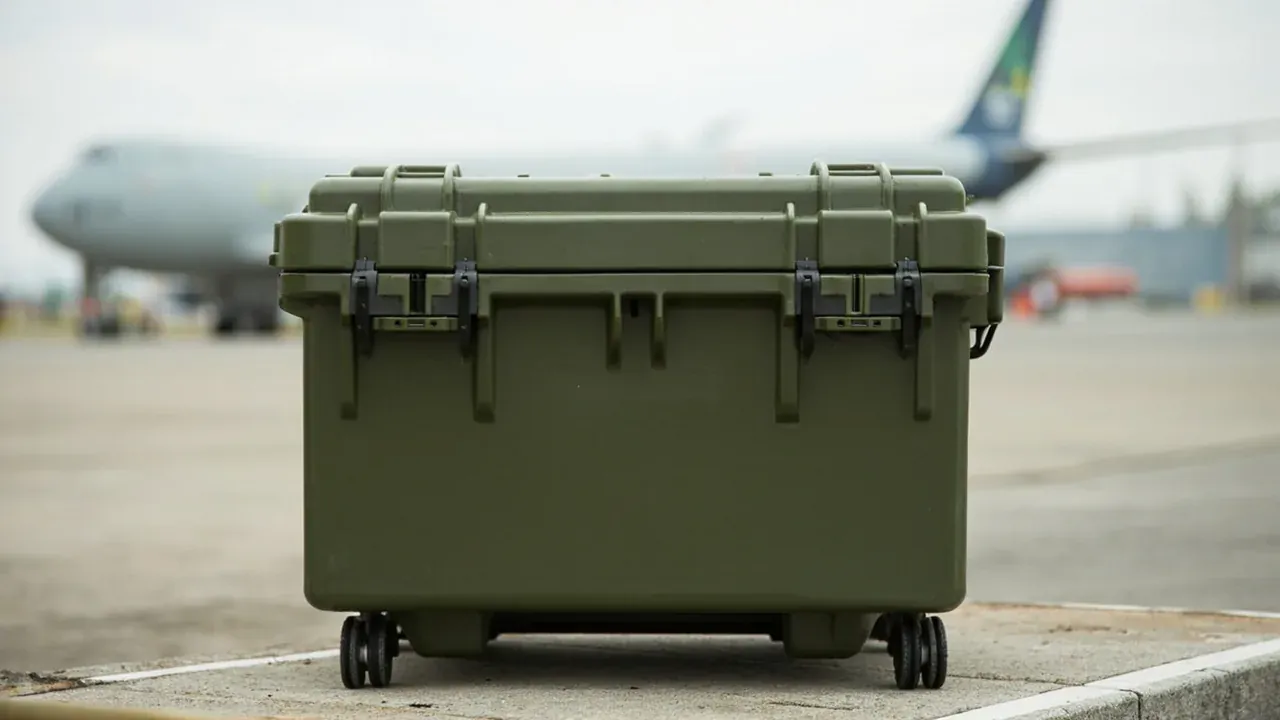
Quick answer: A military air transport case must hold its seal through repeated pressure and temperature swings, and stay put under restraint loads. It is built as a pressure-tolerant cavity: a continuous gasket, a valve that equalizes without admitting water, and a shell stiff enough to keep its shape. Compliance is not a grade claim but a drawing, a test report and a set of shipping documents that agree with one another.
Table of contents
- Military air transport case: air versus ground conditions
- Cabin pressure change and the equalization structure
- Temperature cycling and seal behaviour
- Restraint: straps, latches and floor interfaces
- Shipping documents and marking
- FAQ
1. Military air transport case: air versus ground conditions
Air transport differs from road transport less in distance than in what coincides: falling pressure, fast temperature change, repeated handling and restraint. On the road the load is vibration and braking. In the air a steady differential presses on the whole cavity.
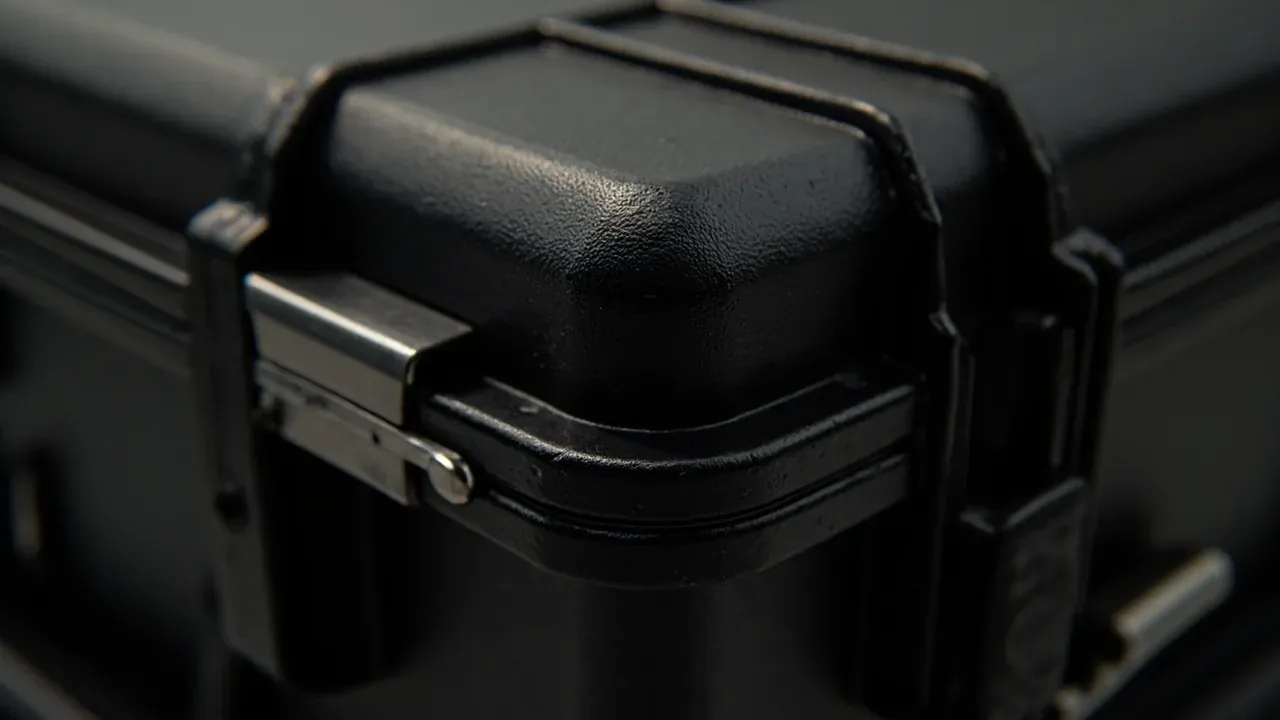
The corner above shows where those loads meet: a moulded handle spans it, its end seated in a stainless draw latch. Force travels through the latch seat into the shell, not into a thin wall. That path is what a military air transport case is built around.
| Aspect | Ground transport | Air segment |
|---|---|---|
| Load | Vibration, braking | Vibration plus differential |
| Pressure | Ambient both sides | Tens of kPa in cruise |
| Failure | Corner damage, loose latch | Flattened seal, bulged lid |
2. Cabin pressure change and the equalization structure
Equalization is not ventilation. It keeps the differential inside what the gasket tolerates while admitting neither water nor dust: a valve, an unbroken perimeter gasket, a cavity stiff enough not to bow. A one-metre lid at fifty kilopascals carries fifty kilonewtons, about five tonnes, so a military air transport case equalizes first and leaves the latches to compress the gasket.
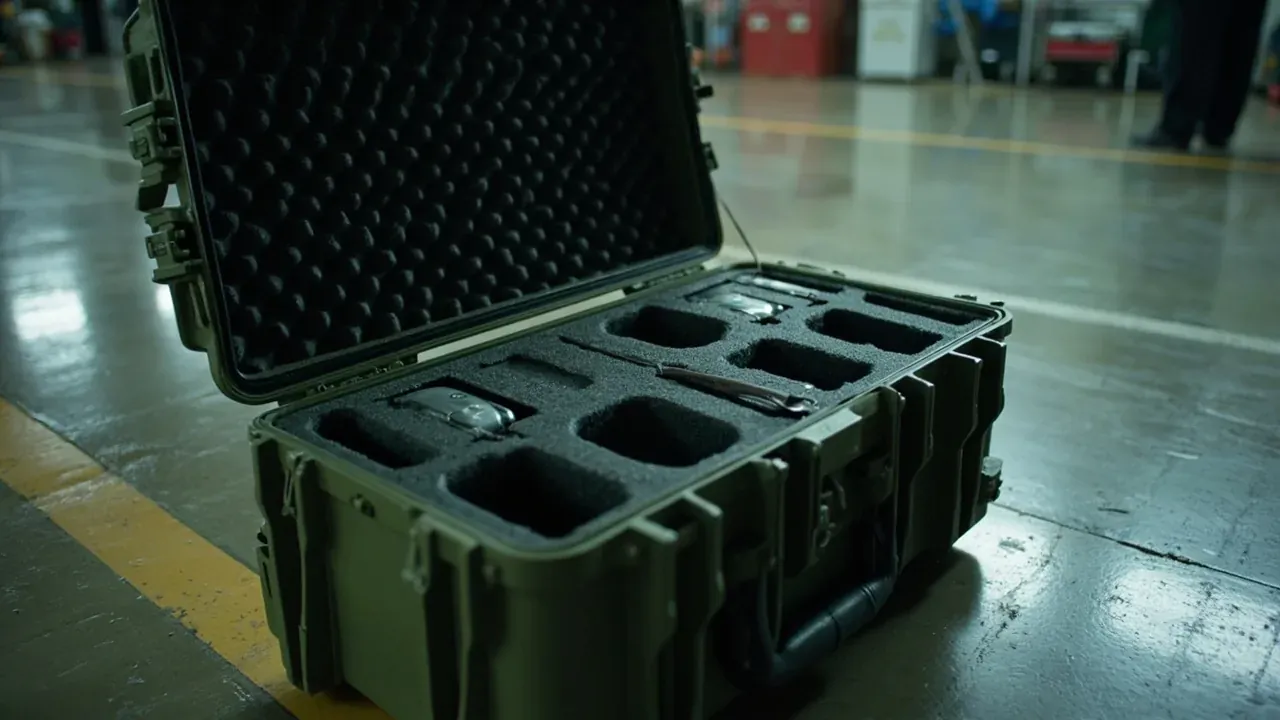
With the lid open the cavity is visible: egg-crate foam in the lid, block foam routed into square pockets, narrow channels between blocks. Those channels decide whether air reaches the valve from the far end. In a military air transport case, liner layout and valve position are settled together.
3. Temperature cycling and seal behaviour
Seals rarely fail in flight; they fail while a case waits on the ground. A gasket with correct compression at room temperature stiffens at minus twenty and does not seat on the first stroke. Silicone spans the widest range, EPDM holds to minus forty.
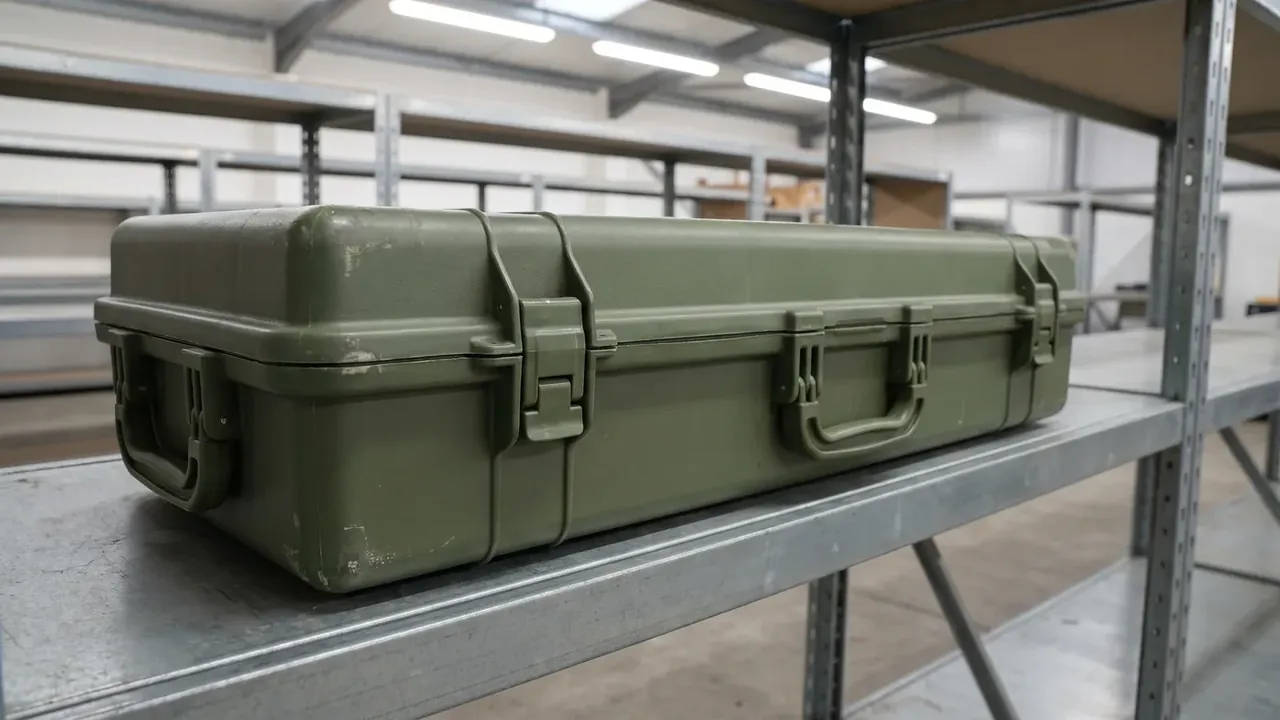
The long case above lies on a galvanised rack, latches and folding handle scuffed white. Such racks sit in half-open stores where the daily swing beats the hold. There a military air transport case loses gasket compression a fraction at a time.
4. Restraint: straps, latches and floor interfaces
Restraint must stop motion on three axes: fore and aft, sideways, vertically. Load factors come from the carrier's document, commonly nine g forward, 1.5 g lateral and 3 g vertical. An eighty-kilogram military air transport case needs a forward interface rated above seven hundred kilograms.
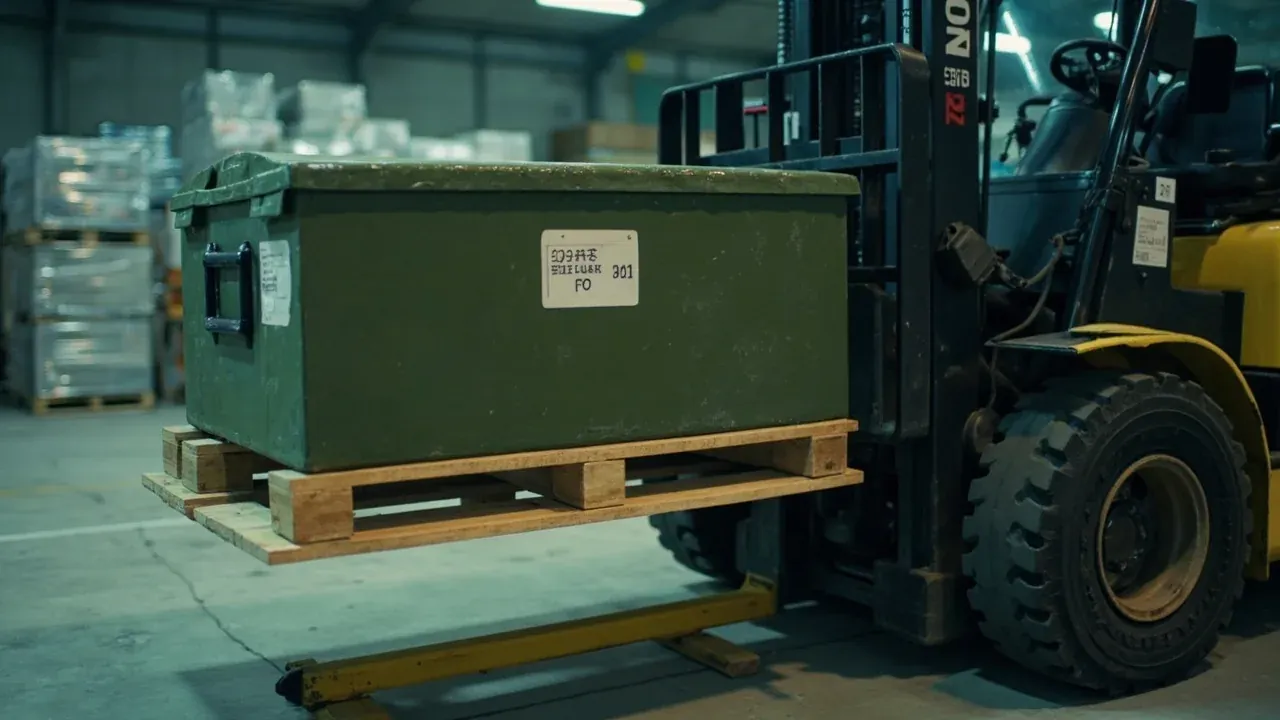
Forks slide under a timber pallet and lift the closed case clear of the floor. Without a recess seating against the pallet upstand, a military air transport case slides at every start and stop. Restraint works in three layers: anchors, pallet, and track with clamps and net.
5. Shipping documents and marking
Compliance has to be traceable on paper. Documents travelling with a military air transport case cover the box alone: certificate, third-party report, drawing, spares list, and the record of seal changes.
Five checks decide whether the file is complete:
- Thickness, ribs and hardware match the drawing
- Report states cavity condition and liner at test
- Tie-down drawing matches shell marks
- Tare and stack shown on a visible face
- Seal changes carry date and batch
Marking carries box data only: model, batch, serial, tare, permitted stack, and tie-down positions. Names and quantities inside stay off the shell, because they change with each task. Symbols follow convention, with this-way-up, keep-dry and stack limit doing most of the work.
Conclusion
Check in a fixed order: whether the cavity equalizes, whether the valve matches its volume, whether the gasket covers the coldest and hottest stops, whether anchors and base match the load factors. Where a step needs adjectives, the requirement for a military air transport case is not written yet.
This article covers container-side specifications and design implications only.
Related Reading
- Military air transport case versus standard aviation case
- Structural requirements and cushioning for airdrop cases
- ordnance-packing-box-standards
- Military Rotomolded Case: Adapting Rotationally Molded Cas…
Related Products
- 8 Series — Gun Cases; Military Equipment Cases; Camera Equipment Cases; Drone Cases; Watch Cases; Knife Cases; First Aid Cases; Electronics Equipment Cases
- WL8-2812 PP Gun Case — model WL8-2812
- All protective cases and toolboxes: 7 series, 158 models