

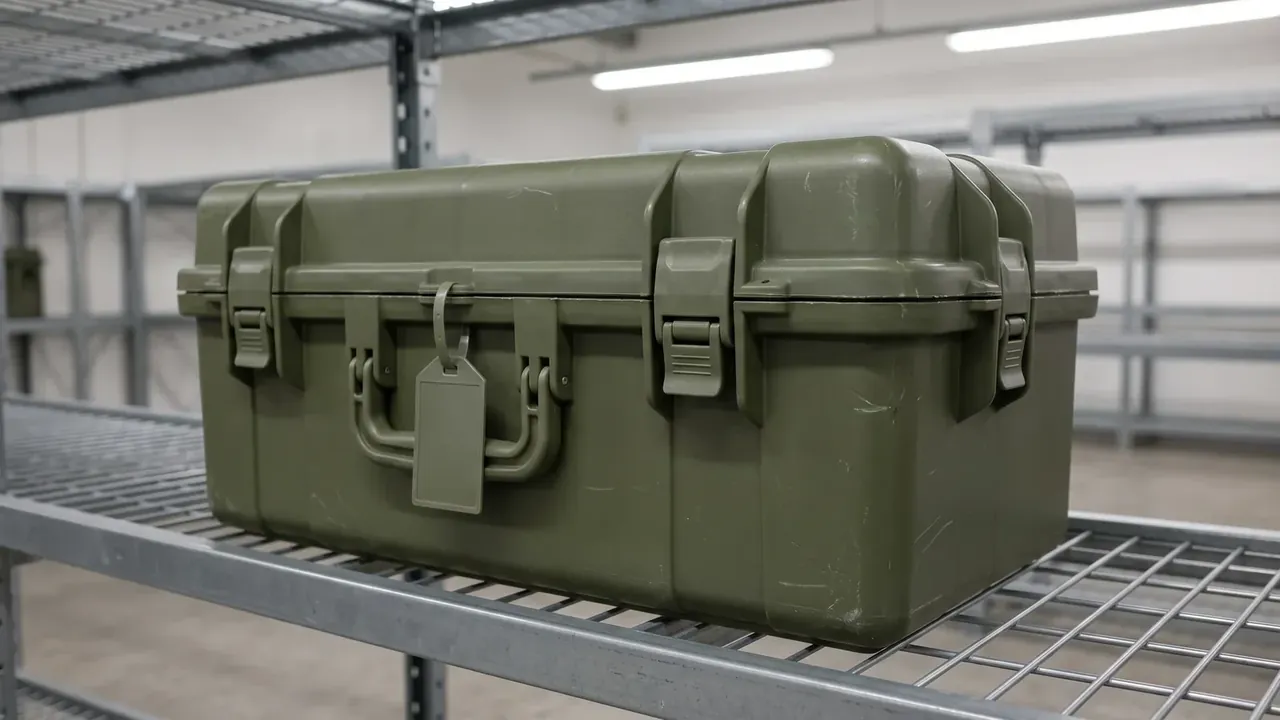
Quick answer: An ordnance packing box must identify itself, show it was closed, and stay put in a vehicle. Marking answers what the box is, which lot it belongs to and whether it may be stacked; the closure shows whether it has been opened; the restraint keeps it from shifting. All three follow one rule: never put critical data where a strap, seal or stacked face will cover it.
Table of contents
- Ordnance packing box marks: what they do and how they are built
- Box-face marking: number, lot, stack limit and orientation
- Closures and tamper evidence: seal seats and tape seals
- Transport restraint: pallets, strapping and stack limits
- Durability and replaceable marking design
- FAQ
1. Ordnance packing box marks: what they do and how they are built
A mark on an ordnance packing box is not decoration but the information layer that lets the box be identified, traced and handled without an explanation. It has four parts.
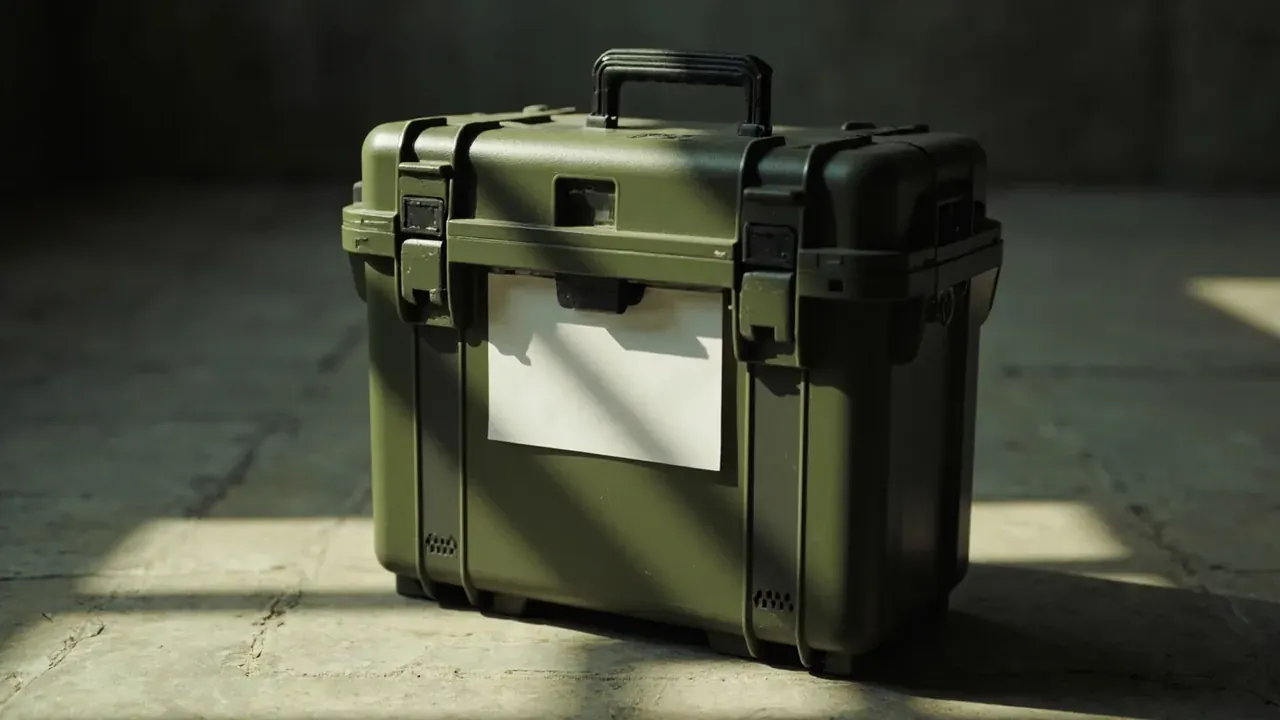
- Fixed data: number, lot, gross weight and dimensions, printed on the shell;
- Variable data: consignee, destination and dispatch date, held in a label pocket;
- Handling symbols: this way up, keep dry, stack limit, centre of gravity;
- Closure reference: seal number, paired with the box number.
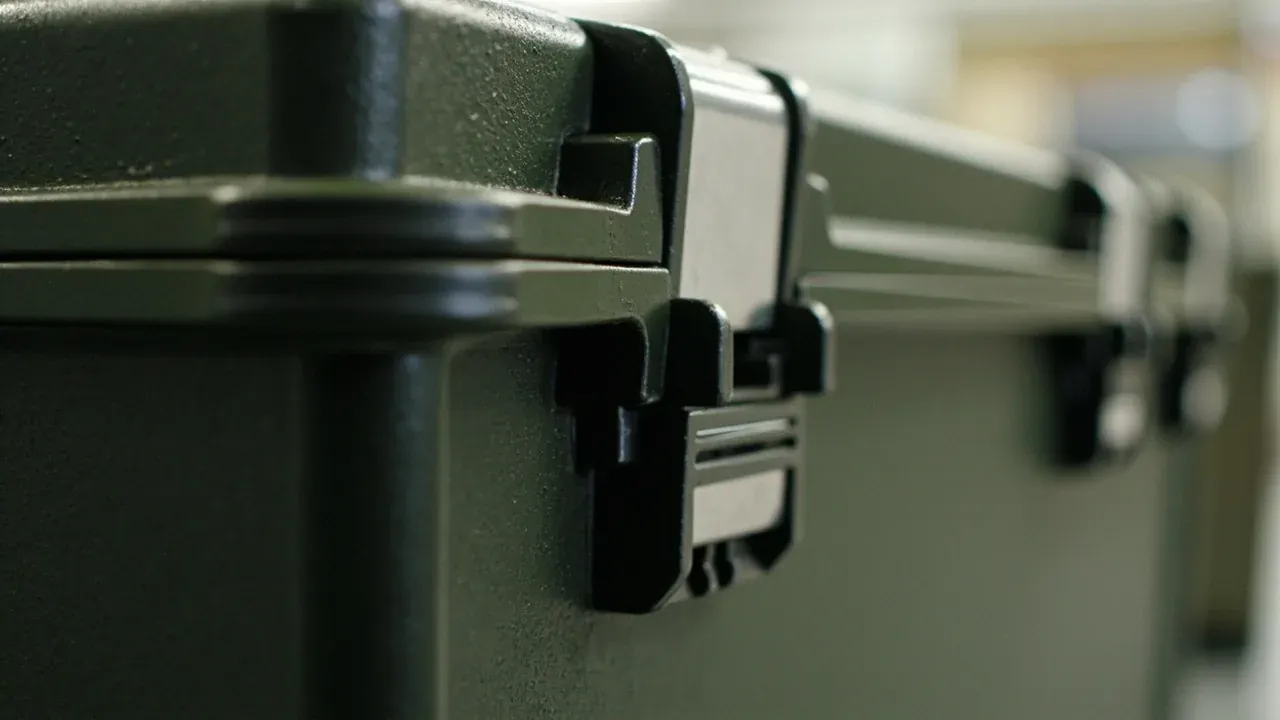
The box is a lid, a body, a stepped lip and latches; the lip locates, the latches clamp, and both rub on every open and close, so marks stay clear of them. The foam inside answers a different question: which cavity holds what.
2. Box-face marking: number, lot, stack limit and orientation
An ordnance packing box carries unique data on the face least likely to be covered, and changeable data where it can be swapped fastest.
| Item | Content | Position |
|---|---|---|
| Number | Unique code with serial | End face centre |
| Lot | Lot code and build month | Under the number |
| Stack | A set layer count | Top corner, aisle side |
| Orientation | Up arrows and centre line | Both opposite faces |
The number on an ordnance packing box also has to match the internal layout. Tray cavities are physical positions, and whole-box marking loses that reference once the box is repacked.
Stack and orientation are usually written as adjectives. A layer count needs a figure, and arrows belong on two opposite faces, because a box can be turned inside a vehicle.
3. Closures and tamper evidence: seal seats and tape seals
Closure on an ordnance packing box answers a separate question: was it fully closed, and has it been opened since. There are three layers, and none substitutes for another.
- Structural closure: lid on the stepped lip, latches clamping. Latches give force, not tamper resistance.
- Tape seal: across the lid seam, one end on the lid and one on the body, breaking when pulled.
- Numbered seal: through a latch or seal hole, logged against the box number at handover.
Seal seats must stay exposed after stacking. Neighbouring faces press together, and a seal on one of them rubs through, leaving an ordnance packing box that looks opened. A seal hole also needs a raised boss, or a thin wall tears.
4. Transport restraint: pallets, strapping and stack limits
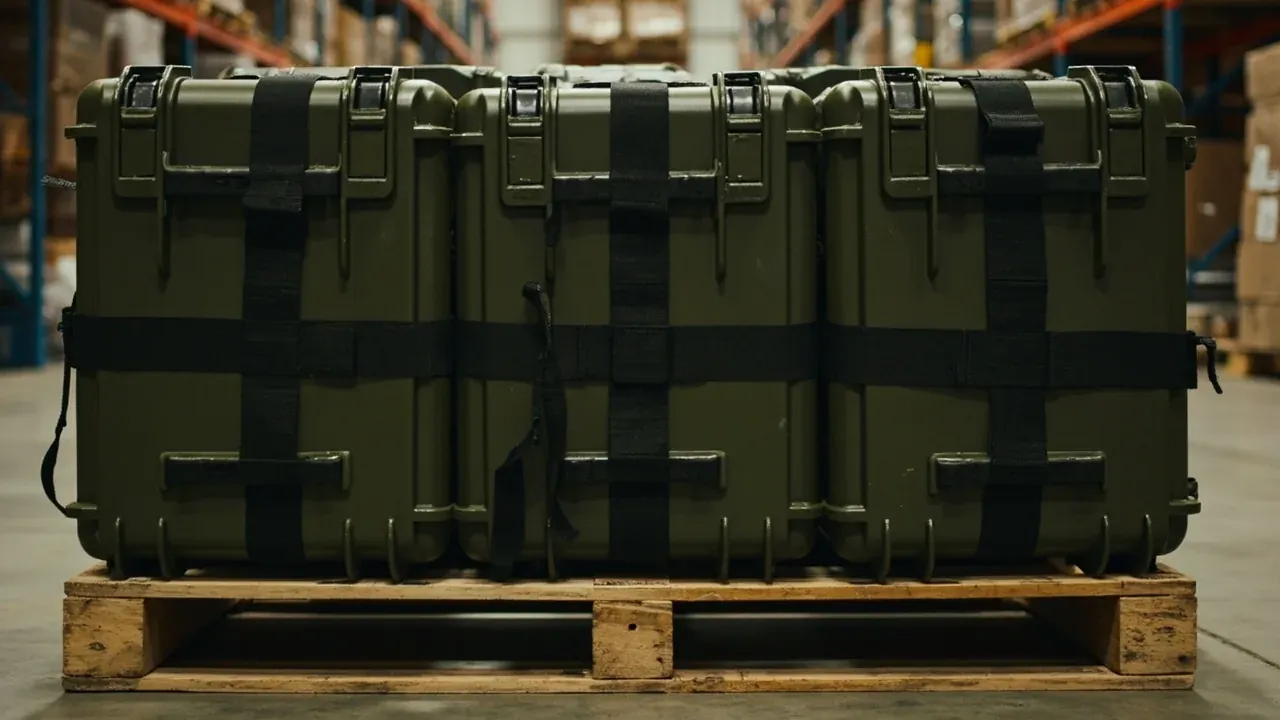
Restraint on an ordnance packing box limits sliding, tipping and bouncing. Pallets, straps and blocking interact, so the order of decisions matters.
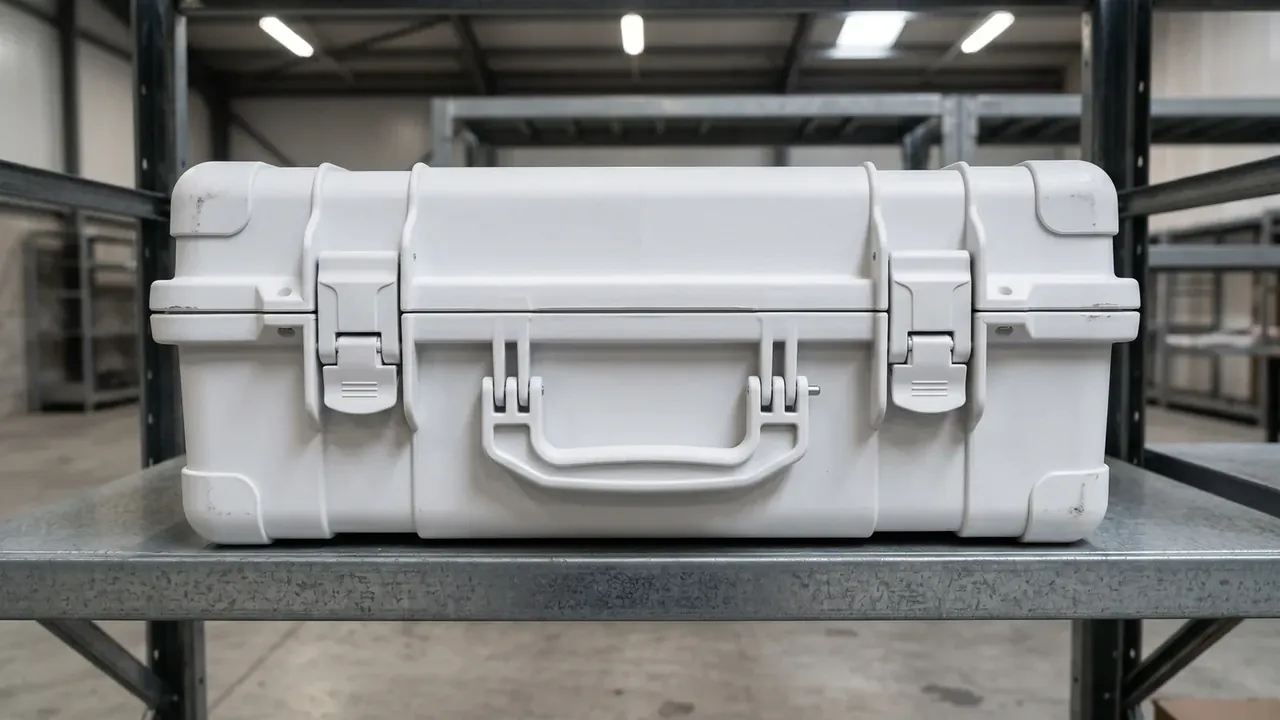
- Pallet fit: footprint on the pallet module, slight mid-span overhang, no corner overhang;
- Strapping: over flat panels, protectors at the lid seam, clear of handles;
- Stack limit: layer count from the static rating, checked against exposed seal faces;
- Blocking: chocks or void fillers so the box cannot run forward under braking.
Seal seats and tie-down points compete for the same panel. Decide the seal first and route straps around it. Fold handles flat, since a raised handle concentrates load and forms a point contact above.
5. Durability and replaceable marking design
Durability of the marking depends on printing method, surface finish and the face used.
| Method | Durability | Replaceable | Suitable data |
|---|---|---|---|
| Screen printing | High | No | Number, symbols |
| Adhesive label | Moderate | Yes | Lot, consignee |
| Card pocket | Low | Anytime | One-off data |
One test: will the data change with the shipment. Changeable data goes in a pocket; fixed data is printed into the shell. Printing changeable data permanently causes most rework.
- Fixed and variable data occupy separate areas
- Box number shares one code with cavity numbers
- Stack marking gives a figure, not an adjective
- Seals sit on faces still exposed after stacking
Conclusion
Work an ordnance packing box in this order: split the marking area by whether the data changes, place closure hardware by the way the lid opens, route straps and stacks around both, then check durability and layer count. Reverse it and the result is a seal on a mating face and a strap over a handle.
This article covers container-side specifications and design implications only.
Related Reading
- Structure and specification points of an ordnance packing box
- How to run box marking and asset tracking in practice
- Test items and pass criteria for transport packaging
- Military Box vs Military Case: Selection Boundaries for Mi…
Related Products
- 8 Series — Gun Cases; Military Equipment Cases; Camera Equipment Cases; Drone Cases; Watch Cases; Knife Cases; First Aid Cases; Electronics Equipment Cases
- WL8-2812 PP Gun Case — model WL8-2812
- All protective cases and toolboxes: 7 series, 158 models