

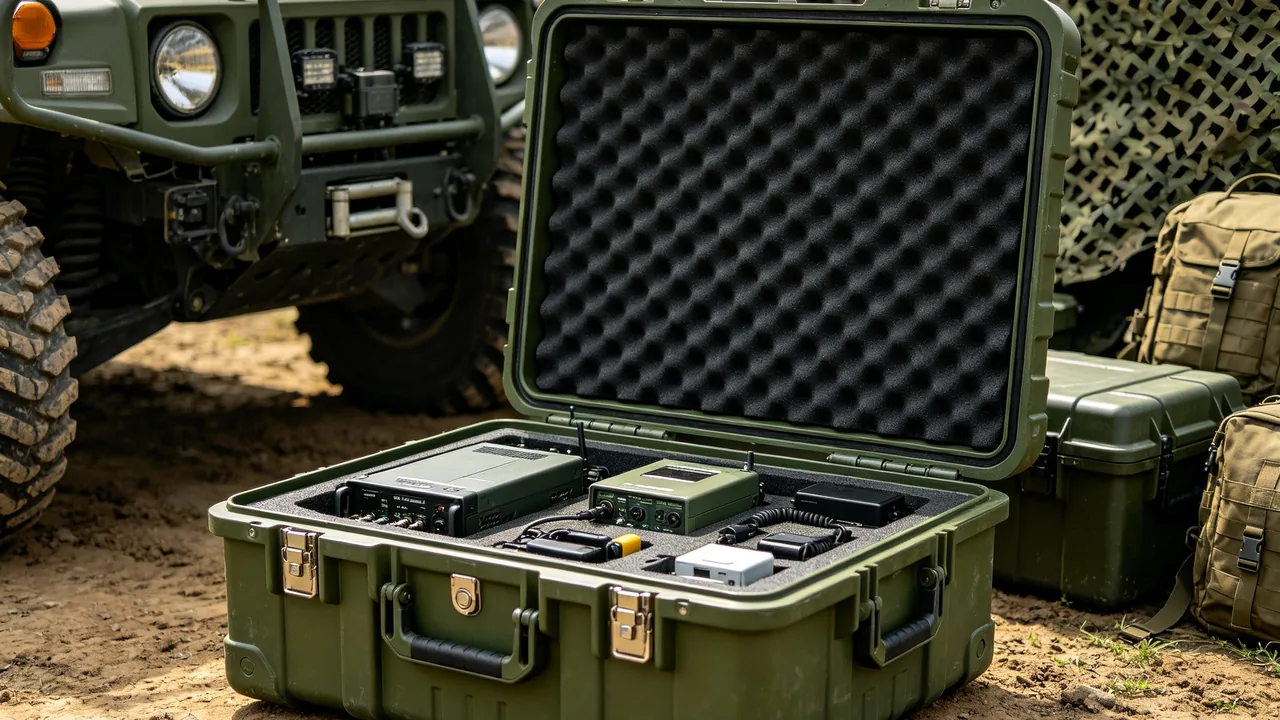
In military procurement and unit-level logistics, a Military Box and a Military Case are often written into the same inquiry as though they were one product, yet the quotations that come back can differ by a factor of two. The reason is rarely the material; it is that the two containers are designed for two different jobs from the very first sketch. Industry practice treats the hinged-lid, stack-and-turn general-purpose container as a Military Box, and the hard shell built around one precision item with a custom liner as a Military Case. JUNZHJIA, as a protective case manufacturer running both product lines in parallel for years, has learned one lesson above all: the selection boundary comes before the specification sheet. Define the mission, and the container defines itself. This article takes the manufacturer's view and walks the boundary line across materials, sealing, military standard testing, liner engineering, load structure, locks and seals, and export packaging documents, so that procurement officers, logistics planners, and defense trade buyers can place every inquiry on the correct side of it. One more framing note before the details: nothing in this article touches the characteristics of any managed munitions or energetic goods; the subject throughout is the packaging container itself, its structure, materials, testing, and documentation.
The One-Line Boundary: What a Box Does Versus What a Case Does
A Military Box is a hinged-lid, top-opening container with a regular internal cavity and deliberately general-purpose fittings. It carries apparel, rations, common spares, and tools: cargo that tolerates jolting but must not be lost or soaked. The controlling metrics are stacking layers, drop cycles, the condition of contents after long-term sealed storage, and hardware life across hundreds of turns. A Military Box behaves like the standard pallet of military logistics: its footprint follows container and racking modules, anyone can use it, it stows anywhere, and a damaged unit is swapped out as a whole.
A Military Case is engineered in the opposite direction: it is designed backwards from one item or one set of equipment. The liner is machined or thermoformed to match the item's three-dimensional data, limit blocks constrain all six degrees of freedom, and cutouts line up with operating faces and heat-dissipation surfaces. It serves electro-optical turrets, inertial assemblies, radio sets, and test instruments, where a single knock means an expensive repair. The controlling metrics are shock transmission, vibration attenuation, and liner conformity, and acceptance often involves joint testing with the actual equipment inside.
The one-line test is simple: ask whether the contents can survive a fall. If they can, if they come in batches, and if they must stack high, choose a Military Box. If they are fragile, singular, or carry a precise optical axis, choose a Military Case. The two are a division of labor, not a ranking. Using a case for bulk cargo wastes liner budget; using a box for precision equipment can write off an entire assembly at the first forklift operation.
What the Terms Mean in Procurement Documents
Where the two words appear in tender documents and packing lists is itself a clue. In Chinese-language tenders, items labeled as a general box cluster in warehousing, rations, apparel, and common tooling chapters, with acceptance clauses written around stacking load, drop height, and storage duration. Items labeled as a packaging case cluster in optics, communications, and metrology chapters, with acceptance clauses written around liner conformity, random vibration spectra, and shock response. English RFQs behave the same way: Military Box tends to be followed by palletized, stackable, and storage, while Military Case tends to be followed by custom foam, transit, and protective.
The cost of inconsistent terminology is real. One procurement office wrote only the generic Chinese term in its specification; the supplier quoted a hinged storage box, and only at acceptance did it emerge that the contents were test instruments with a precise optical axis. The whole scheme had to be rebuilt and the delivery date slipped. JUNZHJIA advises buyers to name the container type explicitly in the specification and to attach the contents' weight, center of gravity, fragility rating, and packing interface drawing, so that no interpretation gap survives into the quotation stage.
In military trade projects, mismatched translation between Chinese and English terms is a common source of claims and disputes. The contract should carry a terminology clause binding the box-versus-case criteria to the test standards and the acceptance outline, giving every later document a single reading. That clause costs almost nothing and removes most correspondence friction and on-site argument.
One more asymmetry belongs in the contract from the start: spare-parts logic. A Military Box is serviced with a hardware kit, latches, hinges, and gaskets bought by the batch and swapped in the field in minutes. A Military Case is serviced through its liner: when the equipment is upgraded, the cavity must be re-cut, so the spares annex should carry a liner modification rate and a response period. Negotiating the spare-parts list while the order is still on the table gives the buyer the better position and gives the manufacturer the schedule certainty to staff the tooling shop accordingly.
Typical Military Box Forms: Hinged Lids, Storage, and Batch Stacking
The product language of a Military Box is built around the batch. A wide hinged lid allows bare-hand access; stacking registers on the top and receiving grooves on the bottom carry vertical loads down the walls rather than through the lid; forklift slots and lifting points sit in the side walls; palletizing and container loading follow a fixed module; and an identification zone on the outer surface holds stenciled or molded-in storage codes and asset numbers so the warehouse can scan units in and out.
Rotomolded HDPE dominates the material mix: one-piece molding leaves no weld seams, resists impact, UV, and salt fog, and floats when empty, which suits amphibious and beach operations. Steel boxes serve heavy equipment and locked warehouse positions where theft resistance matters. Internal division relies on removable dividers or compartment trays rather than item-specific cavities, which is the most visible external difference from a Military Case.
Ammunition-class bulk storage is the most demanding branch of this family; the ventilation, segregation, stacking, and marking logic at the container level is discussed in our comparison of ammunition boxes versus ordinary boxes, listed in the related reading at the end. Field experience is blunt: roughly eight out of ten Military Boxes retire because hinges, latches, and gaskets fail first, not because the shell breaks. When evaluating a box, hardware cycle life deserves more attention than shell wall thickness, a point developed further in the locks section below.
Identification and asset management is the most underrated function of the box family. In a warehouse, one number maps to one batch, so the identification zone must accommodate stenciling, laser engraving, and labels; barcode or RFID placement must avoid wear zones and handle zones so codes remain scannable after a year of turns. JUNZHJIA molds the number zone into the side wall with lettering depth around a third of a millimeter, deep enough to resist abrasion yet shallow enough not to collect dirt. Individually these details look trivial; across a warehouse of thousands of boxes they are the direct difference in throughput.
Typical Military Case Forms: Custom Liners and Precision Protection
The product language of a Military Case is built around a single high-value item. Top-and-bottom clamshells or a front-opening door, compartmented liners CNC-machined or thermoformed from the item's three-dimensional data, limit blocks and straps at the critical load points suspending the item inside the cushioning layer, and a lid interior that integrates a drawing pocket, humidity indicator card, and an accessory pouch for spares. A side pocket can host a temperature logger or an inspection window, so the storage state is readable without opening.
For items with an optical axis, the liner enforces attitude: the lens direction stays fixed for the entire journey. For electronics, shielding liners and grounding terminals are added as needed. For contamination-sensitive items, liner materials must be low-dust and non-shedding. Each of these details should carry an item number on the procurement drawing and be checked line by line at acceptance, because any one of them can become a field failure.
Counterintuitively, the shell of a Military Case is often thinner than that of a Military Box, because the liner absorbs the impact energy and the shell's job is to be a rigid skeleton and a sealing interface. The cost structure mirrors this: the shell mold can reuse a standard platform, but the liner tooling is nearly one set per item, which is why quotations for Military Cases diverge mostly on liner complexity rather than shell material. Writing liner tooling ownership and custody terms into the contract prevents a second tooling charge on repeat orders, advice that matters most for small-lot customization.
There is also a documentation rhythm unique to the case family. Because the cavity is drawn from the item's three-dimensional data, the drawing revision of the equipment becomes part of the packaging record; ship a liner cut to revision B hardware against revision C equipment and the mismatch will surface at fitting, not at the factory. JUNZHJIA stamps the equipment drawing revision into the liner tooling file and prints it on a small label inside the lid, so any future reorder opens with the right question. Buyers should mirror this by keeping packaging drawings under the same change control as the equipment itself, a small administrative habit that prevents the most expensive class of repeat-order error.
Material Boundaries: Rotomolded HDPE, Aluminum, Steel, and Composites
Rotomolded HDPE is a one-piece shell without weld seams, with the best impact and weathering performance at mid-range cost. It is the default shell material for most Military Boxes and Military Cases, and it excels in salt fog, humidity, and low temperature. Its weaknesses are self-weight and limited tolerance of sustained heat: above roughly eighty degrees Celsius for long durations, change material or add insulation.
Aluminum is light, stiff, and thermally conductive, accepts EMC treatment and anodizing readily, and is the first choice for air-frequent Military Cases. The trade-offs are demanding workmanship at welds and gasket interfaces, a higher cost tier, and dents that do not recover. Steel offers the strongest load capacity and theft resistance for heavy equipment and fixed warehouse positions, paid for in weight and a coating maintenance schedule. Fiber composites serve extreme lightweight and special-task applications at high prices and small volumes, usually as dedicated projects.
Cross four variables, air-freight share, stacking layers, electromagnetic requirements, and budget, and most projects converge on the combination JUNZHJIA ships most: a rotomolded shell, aluminum hardware, and a custom liner. The rotomolding process is developed in detail in the linked rotomolded case article at the end; reach for aluminum or composites only when the lightweight or thermal requirement is real.
Once material is chosen, an incoming-inspection gate follows. Resin batches must be verified as virgin material, with recycled blend ratios disclosed, because recycled content erodes low-temperature brittleness and UV life; JUNZHJIA samples melt index and impact coupons per batch. Aluminum must show alloy and temper certificates, and post-weld aging affects stiffness. Gasket and hardware material certificates must match the materials named in the test reports, so the report never describes one material while the shipment carries another. Writing these checks into an incoming inspection standard, held by both supplier and buyer, is what keeps later batches stable as a matter of system rather than luck.
Sealing: IP67, Pressure-Equalization Valves, and Gasket Aging
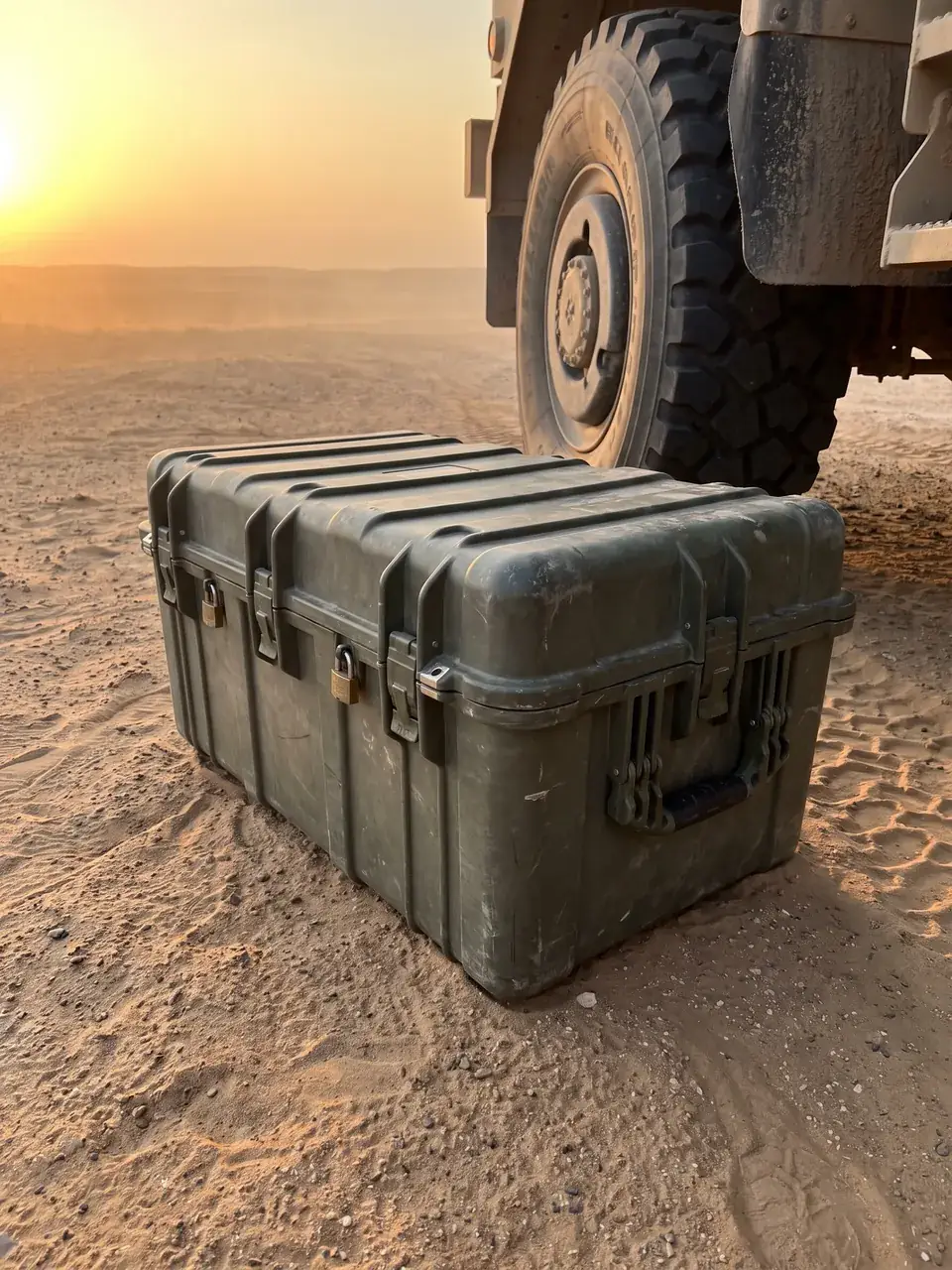
IP67 is a floor for military containers, not a finish line: one meter of water for thirty minutes proves rain, wading, and wash-down survivability, not prolonged immersion or high-pressure jetting. The more decisive metrics live in the sealing system's durability: the compression set of the EPDM or silicone gasket decides whether it still seals after five years, and the distribution of latch pressure points around the lid decides whether the gasket is loaded evenly. Sparse pressure points are the usual root of localized leaks within a few years.
The pressure-equalization valve is the most commonly omitted necessity. Moving from plateau to plain, or from a cold store into a warm room, creates a differential across the shell; the better the seal, the stronger the vacuum. At best the lid becomes hard to open; at worst the gasket is sucked out of shape and the IP67 rating is gone for good. The valve membrane equalizes pressure while still blocking liquid water and dust, so the two functions do not conflict. JUNZHJIA runs a whole-case air pressure-decay test on every unit before shipment and verifies gasket contact footprints point by point with blue tape at the sample stage; a continuous, even footprint is the pass criterion.
The most practical advice for buyers: at acceptance, do not stop at the IP67 report. Ask for the gasket material grade, the designed compression percentage, and the replacement interval. Gaskets are consumables; scheduling replacement into the maintenance plan costs far less than chasing an indestructible shell, and moisture damage from a failed seal almost always exceeds the price of the gasket itself.
A word on the decay test itself: seal the case, pressurize to the set value, and log the pressure curve over time. A sound case decays smoothly within limits; a stepped drop points to a gasket seating defect or a leaking valve seat. JUNZHJIA runs this station after final assembly and before packing, records the test number on each certificate, and invites on-site acceptance to randomly retest three units, which says more than a hundred pages of paper.
Sealing and hardware also interact in ways worth naming at specification time. A lid with sparse latch points concentrates gasket compression near each latch and lets the spans between them relax, so the effective seal is a dashed line rather than a ring; the fix is latch pitch, not a thicker gasket. Hinge stiffness matters too: a lid that drops shut slams the gasket at the latch side first and waves the far edge, which is why damped or hold-open hinges appear on most Military Cases. These are small mechanical decisions, but they are where the five-year sealing record of a container is actually written.
Military Standard Testing: MIL-STD-810H and GJB Test Focus
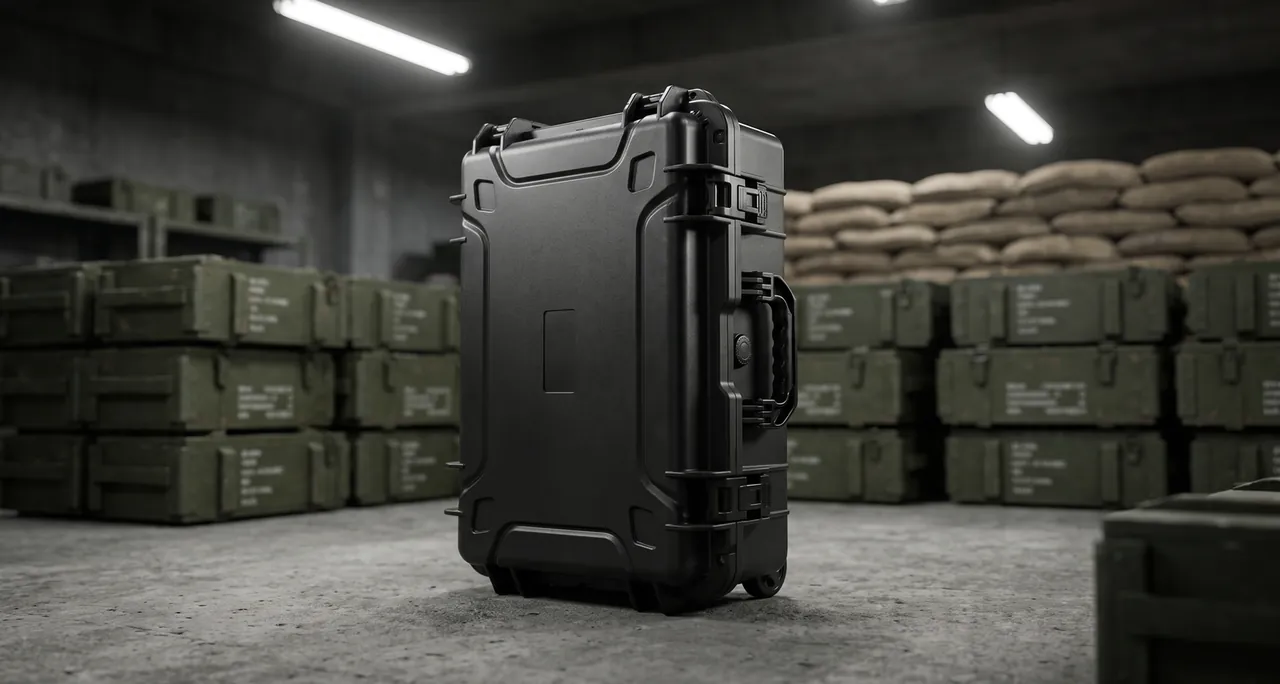
MIL-STD-810H is a library of environmental test methods, not a pass-fail standard; the buyer selects method numbers from the equipment's life profile. Vibration, mechanical shock, temperature-humidity cycling, salt fog, solar radiation, rain, and sand and dust are the usual picks. The GJB system parallels the domestic military standards with the same logic and different parameter conventions, and programs serving both domestic fielding and export often have to run both, so the test matrix should be planned early to avoid paying twice.
The two container families stress differently under the same framework. A Military Box is judged on stacking strength, drops, and functional retention after long sealed storage, with corner drops and stacking creep doing the most damage. A Military Case is judged on resonance transmission under random vibration and shock response with the liner loaded, with liner-to-equipment interface wear doing the most damage. One standard, two very different points of impact, and the test articles should be built to match.
When the report arrives, verify three things: the method numbers and revision letters match the contract; the test article state is stated, empty shell, loaded dummy, or real equipment, and transit tests must be loaded or the transmission results are meaningless; and the acceptance criterion is defined as no structural damage or as functional after test. Reports are issued method by method; a supplier who writes only "certified to 810H" has usually not run the set.
Matrix planning also has judgment in it: more methods are not automatically better. For materiel that sits in a depot and occasionally rides a truck, temperature-humidity, stacking, and road vibration done thoroughly are enough; airdrop and field deployment add shock, rain, and dust. Over-selecting doubles cost with little information gain; under-selecting surfaces the gap at the first field task. JUNZHJIA asks for the transport route and storage environment before proposing a method list, so the decision is made at quotation and the test budget lands where it matters. Method-by-method reading is linked in the MIL-STD-810H and GJB articles at the end.
A final note on reports: keep the raw curves, not just the summary sheet. Resonance peaks visible in a vibration trace tell the liner engineer where to add damping, and a drop test photo sequence documents which corner took the hit, which matters when the same corner fails in the field two years later. Reports archived as data rather than paper let the next procurement round start from evidence instead of memory, and they give both sides a common baseline when a design change is proposed. The cost difference between archiving curves and archiving summaries is zero; the difference in engineering value is not.
Liner Engineering: EVA/EPE Cushioning Versus VCI Corrosion Protection
The liner is the technical core of a Military Case, and two material families divide the work. High-density EVA machines and thermoforms cleanly, so it forms the cavity: pockets cut to the item's outline hold it at the center of the cushioning layer, with limit blocks constraining six degrees of freedom. Low-density EPE rebounds well and forms the background: it fills the remaining volume, adding bulk cushioning and a degree of thermal buffering. Fragility-critical items then add isolation pads that attenuate high-frequency vibration below the item's sensitive band, and this layer is usually what decides whether the test passes first time.
Corrosion protection is the other line of defense. For long sealed storage of metal parts, VCI (vapor corrosion inhibitor) packaging releases protective molecules inside the sealed volume that adsorb on metal surfaces as a molecular-scale layer, protecting even bare metal. Desiccant drives the internal relative humidity below the corrosion threshold, and a humidity indicator card makes the state visible from outside. VCI and desiccant do not conflict; they are a combined anti-rust plus humidity-control kit. Dosage must be calculated from the case volume, storage duration, and cargo mix: too much desiccant raises dust, and dust on an optic is its own failure.
JUNZHJIA configures this kit in tiers by storage duration and glues a preservation card inside the lid stating the opening date, the desiccant replacement cycle, and the resealing procedure, so any warehouse clerk can operate by card rather than memory. The full custom liner process and tooling ownership are covered in the linked custom foam article; for ammunition-class preservation, the liner plan must also be confirmed against the container standard.
A finished liner still has to be verified. Three checks apply: conformity, visual gap uniformity around the item with feeler checks at critical limit points; imprint inspection, reopening the liner after simulated transit to look for shiny pressure marks on the equipment surface, which indicate local overpressure and call for re-cutting; and post-vibration recheck of strap tension and limit block displacement. Writing these three into the acceptance outline visibly raises the liner quality bar, because wherever a check item exists, the process gets taken seriously.
Liner documentation should live with the box, not in a drawer. JUNZHJIA ships each Military Case with a liner drawing reference, the equipment drawing revision it was cut to, and the material lot used, all printed on the preservation card or a small laminated tag. When a liner wears after years of turns, the reorder starts from a record instead of a reverse-engineering exercise, and the replacement cavity matches the first one. Buyers who impose the same rule on any supplier, existing or new, gain something subtler than convenience: liner quality becomes comparable across vendors, because everyone is quoting against the same recorded geometry rather than their own recollection of it.
Load Structure: Stacking, Lifting, and Forklift Interfaces
The shell of a Military Box is a structural member. Stacking loads are designed for four or even six fully loaded layers, with ribs or dedicated stacking posts at corners and walls so that upper weight bypasses the lid and lands on the load-bearing face of the box below. Forklift slot height matches the warehouse's standard forks with wear edging at the mouths, and lifting points are sized for gross weight times a dynamic factor, with pull-out tests at welds and inserts.
The shell of a Military Case is a skeleton plus sealing interface. Stacking is typically rated at only two or three layers, and the structural budget saved is redirected into limit blocks and vibration isolation. The four lifting D-rings have their load directions annotated on the drawing to prevent bending moments under slanted lifts, and the base interface to vehicle decks or pallets needs anti-slip features or isolation pads to keep road shock out of the equipment.
Both families share the same dynamic watch items: transport vibration loosens fasteners and creeps liners, so periodic maintenance re-torques bolts and inspects liner imprints. The classic trap is quoting static stacking test data for dynamic transport stacking; under vibration the permissible layer count is roughly half the static value, and field stacking must follow the dynamic figure. Deeper discussion is linked in the stackable container and stacking structure articles at the end.
Palletizing is the final link. The box footprint should align to standard pallets as an integer fraction so nothing overhangs; bases need flatness or locating grooves with anti-slip pads, and strap points get corner protection. For airlift the constraints tighten: pallet height limits, gross weight, and center-of-gravity marks all belong on the load plan, and a case a few centimeters over height will be rejected at aircraft loading. JUNZHJIA attaches a stowage diagram with large deliveries showing layer patterns and strap points, and customers who follow it see transport damage rates fall measurably.
One more interface deserves an early decision: ground handling in austere locations. A case sized for a standard pallet may still be unmovable at a forward site with no forklift, so skid bases, side tote handles, or compatibility with a common hand truck should be specified for any container that leaves paved ground. JUNZHJIA has shipped bases with forklift channels plus four-way hand-truck access at negligible weight cost, and units with that dual interface simply move more often without damage. Ask where the case will actually be handled, not only how it will be shipped; the two answers frequently point to different details on the same drawing.
Locks and Seals: Mechanical Locks, Padlocks, and Tamper Evidence
Hardware decides the real service life of military containers. Latches should be die-cast or forged stainless steel with an over-travel design: once the gasket reaches its designed compression, additional latch force stops increasing, which prevents long-term clamping from permanently deforming the gasket. Lift-off hinges let the lid come away whole for equipment extraction and hardware replacement, and handles must work with gloved hands, which matters outdoors in winter.
Locking works in three layers. A mechanical lock or padlock handles daily closure. Tamper-evident seals, lead seals, plastic pull-tight seals, or wire seals, answer the question of whether the case was opened en route, and their single-use numbering is the whole point: seal numbers must be entered on the transport documents and verified at both ends. For fleets of Military Boxes, RFID or QR asset tags turn the container itself into a tracked asset, logging movements, repairs, and reuse counts. High-value Military Cases can add electronic seals recording opening time and location for later audit.
JUNZHJIA's experience is that holes in seal management procedure outnumber holes in the seals themselves; unverified numbers and un-rechecked seals amount to decoration. Write hardware life into the contract as hard numbers, latch cycle count, hinge fatigue cycles, and salt fog hours, and acceptance finally has teeth. Suppliers generally welcome quantified clauses too, because they end the era of verbal promises.
Salt fog deserves specific attention for coastal and island units: five hundred hours is a sensible floor for hardware, rising to one thousand in high-salt environments, with plating and surface treatment named in the report. Rubber gaskets additionally need UV and ozone aging data, since cracking from weathering retires them early. Requesting these figures costs nothing at selection time and filters out short-lived proposals before they are quoted.
UN Export Packaging and Military Trade Documentation
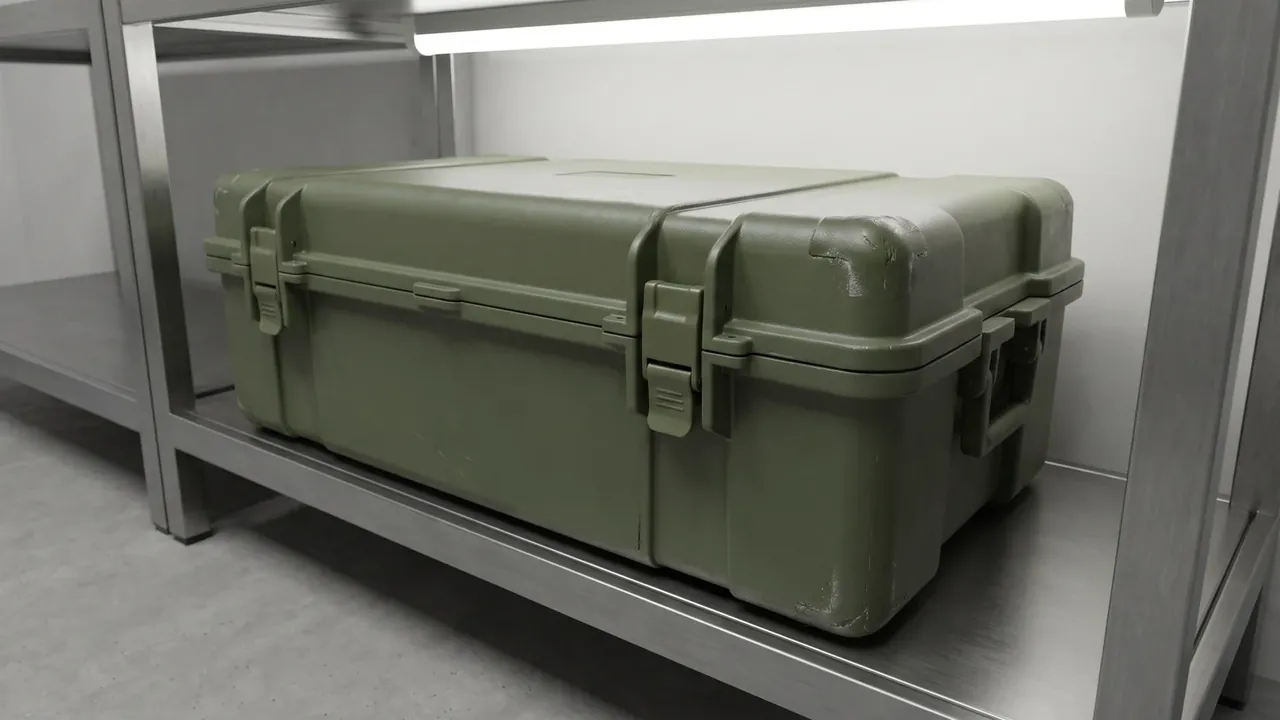
In military trade and cross-border delivery, the container must clear a documentation gate before anything else. UN packaging certification applies to dangerous-goods packaging and is issued by category and packing group. General equipment moving by sea requires IPPC fumigation marks on wood packaging or a switch to exempt materials. Air freight must satisfy the relevant IATA packing provisions, with weight and dimensions matched to aircraft door and pallet limits.
The usual document pack for a Military Case includes a UN certificate or declaration of conformity, stacking and drop test reports, material conformity files such as RoHS and REACH where the customer requires them, and packing lists with marking specifications. Practical advice: write the document list into a contract annex with version numbers, validity periods, and the testing laboratory's credentials, and keep UN certificate specifications in one-to-one correspondence with the actual shipping case. Changing the case without reissuing the certificate is a classic cause of customs detention, and rework at the port is the most expensive kind.
One boundary statement: for military trade and export scenarios, local regulations and export control requirements prevail; this article discusses packaging containers only. Ammunition-class exports are governed by dedicated packaging standards, and the container-level requirements are outlined in the linked ammunition packing box standard article at the end; no parameters of the goods themselves are discussed here, and competent authorities and carriers remain the final word.
Life-Cycle Cost and a Selection Checklist
The lowest unit price is almost never the lowest total cost. A Military Box amortizes across turn cycles: a rotomolded box costs more than double a wooden crate up front, yet after thirty or more reuses its per-use cost is the lowest of all, with near-zero maintenance. Steel lasts longer still, but its weight eats freight on every long road leg, and the difference shows within a year.
A Military Case amortizes against protection failure: one repair plus downtime on a precision assembly routinely costs tens of times the case-price delta, so liner investment returns are extreme. Putting two damage records on one page of a budget memo moves the approval faster than any abstract talk of protection ratings, and it reads better in procurement files too.
JUNZHJIA's decision checklist runs eight questions: How fragile are the contents? Single item or batch? Warehouse or open storage yard? Road, sea, or air dominant? Cross-border, and are UN documents needed? How many reuse cycles are planned? What traceability and seal level is required? Is the budget one-off or annualized? Once the eight answers are down, whether box or case, rotomolded or aluminum, and what liner tier, usually has a single remaining solution. Sending the answered checklist to suppliers also filters out any bidder who cannot state a fragility value or a stacking count.
Frequently Asked Questions
Q: Can a Military Box and a Military Case substitute for each other? A: In a short-term emergency, yes; as a long-term habit, the substitution costs you twice. Storing bulk cargo in a Military Case wastes the liner cavity, leaving an effective volume of roughly half a hinged box of the same footprint, with lower stacking ratings and a direct hit to warehouse capacity. The reverse is worse: storing precision equipment in a plain Military Box removes limit blocks and tuned cushioning, and one rail journey's vibration can shift an optical axis, with repair costs far exceeding the case-price difference. The workable compromise is to buy standard hinged boxes for general materiel, customize cases only for high-value single items, and keep both families on one shared footprint module so stacking and palletizing are unaffected. JUNZHJIA's own production lines are split exactly this way: one shell platform, a box version fitted with dividers and a case version fitted with machined liners, so customers order by cargo attribute rather than choosing a winner, and mixed fleets still stack cleanly. The discipline that keeps the compromise honest is a packing plan per mission: decide which container carries which class of contents before loading, not after the first incident.
Q: Which material holds up best for long-term outdoor or open-yard storage? A: The first choice outdoors is a rotomolded HDPE shell with EPDM gaskets. One-piece rotomolding leaves no weld seams, the resin tolerates UV and salt fog, and the material does not go brittle in cold. Aluminum shells are strong enough but vulnerable to dents and galvanic corrosion; steel boxes outdoors demand a full coating maintenance program, or rust arrives before structural life does. Beyond the shell, outdoor storage is decided by details: the roof of the case needs drainage slope and drip channels so water never pools; the equalization valve should sit out of direct rain wash; and markings should be molded in or laser engraved rather than sprayed, because sprayed codes fade within two or three summers. Choose light colors to cut solar heat gain and the peak internal temperature drops noticeably. Whatever the material, open every outdoor box twice a year to check gasket footprints and desiccant condition; that habit determines what you find after five years more than the material choice does. Snow load is the last silent variable in open yards: a case that stacks four high in summer can be crushed under a winter of drifting snow, so yard stacks should be reduced one layer where snowfall is routine.
Q: Why must an IP67 Military Case also carry a pressure-equalization valve? A: IP67 measures sealing, and the valve manages the side effect of good sealing. Move a sealed case from plateau to plain, or from a cold store into a warm room, and the internal pressure diverges from ambient; the tighter the gasket, the stronger the vacuum. At best the lid resists opening, and at worst the gasket is drawn out of its groove and never seats properly again, at which point the IP67 rating is lost regardless of what the certificate says. The valve is a one-way breathing membrane or port that equalizes pressure while still blocking liquid water and dust, so sealing and breathing do not contradict each other. Size the valve's airflow for the operating altitude and temperature range, and mount it away from direct rain and forklift contact zones. JUNZHJIA runs an air pressure-decay test on every case before shipment and retests after the valve is installed, so the valve and the gasket are accepted as one system. Users should treat the valve as a precision part: inspect the membrane for aging periodically, and when lid resistance grows abnormally, check the valve before blaming the gasket.
Q: Can a MIL-STD-810H report be trusted as-is, and what should be checked? A: Trust it after verification, not on sight. First, check method numbers and revisions: 810H is a method library, so a valid report names each method number and test level actually run, and a document that says only "certified to 810H" carries essentially no evidential weight. Second, check the test article state: empty shell, loaded dummy, or real equipment, because transit testing must be loaded or the vibration and shock transmission results are distorted. Third, check the criterion: whether the pass condition was no structural damage or functional operation after test, which differ by a full tier in what they demand of liners and hardware. Fourth, check laboratory accreditation and report traceability. Domestic fielding programs additionally map to the GJB system, whose parameter conventions differ, so one report cannot substitute for the other. As a rule of thumb, a report worth trusting cites its laboratory, its sample history, and its equipment calibration all in the first two pages. JUNZHJIA's practice is to build a test matrix from the customer's life profile, list each method with its level and criterion in a contract annex, and let both acceptance parties tick the matrix line by line, which is how most disputes simply never arise.
Q: Can VCI corrosion protection and desiccant be used together? A: They can, and together they are the complete scheme, because the mechanisms differ and each covers a segment. VCI releases protective molecules that adsorb on metal surfaces as a molecular-scale layer inside the sealed volume, protecting even bare, uncoated parts. Desiccant drives the internal relative humidity below the corrosion threshold, slowing the reaction at its source. Three precautions govern the combination: dose everything from the case volume, storage duration, and cargo mix, since excess desiccant adds dust rather than protection; keep VCI materials within effective range of the metal and leave airflow paths open, because overpacking chokes vapor diffusion; and always add a humidity indicator card visible from outside, read before opening. JUNZHJIA tiers the kit by storage duration and glues a preservation card inside the lid stating the opening date and resealing procedure. One warning deserves emphasis: every reopening depletes both the VCI and the desiccant, so replace consumables per the card before resealing, otherwise the anti-rust system exists in name only. Units that cycle in and out of storage frequently should carry double the desiccant budget of continuously sealed ones, and their indicator cards should be logged at every inspection.
Q: What documents must packaging containers carry for military trade export? A: One boundary first: in military trade and export scenarios, local regulations and export control requirements prevail, and this answer discusses packaging containers only. At the container level, the usual document pack includes a UN packaging certificate or declaration of conformity, mandatory when goods fall under a dangerous-goods classification; stacking and drop test reports; material conformity files such as RoHS or REACH where the customer requires them; IPPC fumigation marks for wood packaging or a declaration of exempt material; and packing lists with marking specifications. The most common failures are consistency failures: the case specification on the UN certificate, the test article state in the reports, and the physical shipping case must correspond one to one, because changing the case without reissuing the certificate is a classic customs-detention trigger, and expired report versions or unaccredited laboratories draw challenges at destination ports. JUNZHJIA recommends embedding the document list in a contract annex with versions, validity, and issuing bodies, then reconciling each new case against its certificate before shipment. Starting the paperwork two weeks early typically halves clearance time. Carriers and freight forwarders should receive the same annex, since most detention incidents begin with a document the shipper never saw.
Q: How can mold costs be controlled for small-lot Military Case customization? A: The controlling idea is to share the shell platform and spend tooling money only on the liner. The shell mold is the largest single cost in customization, so small-lot projects should fit an existing platform from the manufacturer's catalog and customize through color, hardware configuration, and identification zones, rather than cutting a shell mold for a few dozen units. Liner costs scale gently: CNC-machined liners need no mold and are cut directly from three-dimensional data, with unit cost falling linearly with quantity, which suits small lots; thermoformed liner tooling only pays back beyond roughly a thousand units. A second lever is staged investment: validate the first article with a machined liner, pass the tests and acceptance, then decide whether later batches justify tooling. JUNZHJIA's routine for small-lot customers is to quote the platform first and itemize liner and marking separately, so the buyer sees exactly where every unit of budget goes and later batches can reuse the pricing for comparison.
Related Reading:
Closing: Define the Mission First, Then the Container
A Military Box serves batch turnover; a Military Case serves single-item precision. Write the mission profile down, and the box-versus-case boundary draws itself. JUNZHJIA builds both lines to the same sealing, test, and traceability discipline.