

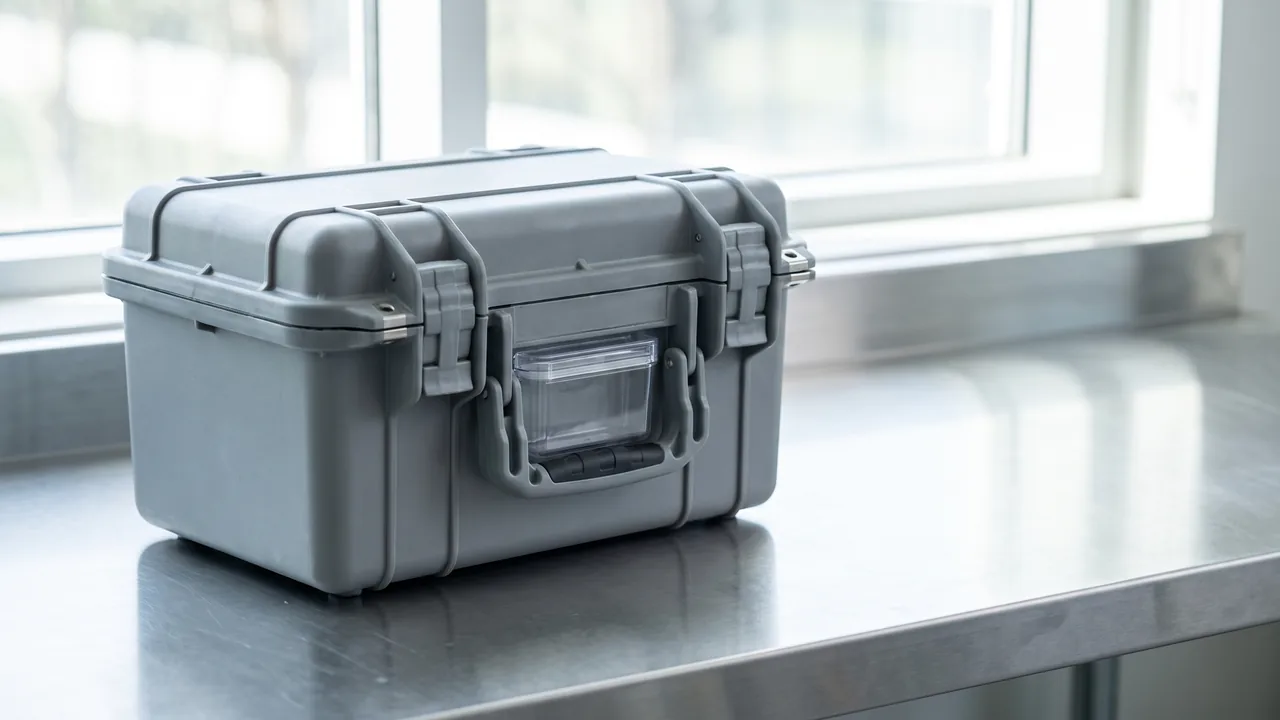
In manufacturing plants, third-party logistics hubs and spare-part warehouses, a protective case rarely completes its working life in a single shipment. Once equipment arrives and parts are booked in, the case enters a weekly loop: lifted by forklift, racked, loaded four to six tiers high, destacked, refilled and dispatched again. What actually degrades a case is seldom the one drop it took on the road, but the static load that accumulates over months on a warehouse floor, combined with repeated misalignment during handling. Stacking failures almost never start at the bottom tier. They appear as a collapsed top face on tier four, a domed lid, a leaning column, or a case that no longer closes cleanly after a destack.
Stacking performance is not the automatic result of thicker walls; it is the outcome of routing load along a defined path from the top face through the shell into the pallet, with structure and material sharing that load together. JUNZHIJIA designs stackable protective cases as load-bearing components: define the load path first, then set wall thickness, rib geometry, interlock form and material, and finally verify with static and cyclic testing rather than discovering a collapsing top face when a customer reaches the fifth tier.
Table of Contents
- Four Starting Points of Stacking Failure in Warehouse Turnaround
- Structural Baseline of JUNZHIJIA Stackable Cases
- Stacking Load: Load Path from Top Face to Bottom Reinforcement
- Interlock and Anti-Slip: Locating Grooves, Rubber Pads and Misalignment Control
- Stacking Height and Safety Factor: From Single-Case Load to Multi-Tier Stacks
- Dimensional Modularity: Matching 600 x 400 to 1200 x 1000 Pallets
- How Molding Process and Material Choice Affect Stacking Stiffness
- Coupling of Sealing and Stacking: Gasket Compression and Opening Force
- Interface Design for Forklifts, AGVs and Manual Handling
- Temperature, Humidity and Condensation in Stacked Storage
- Turnaround Cycle Life: Drop, Vibration and Fatigue
- Identification and Traceability: Barcodes, RFID and Post-Stack Visibility
- Selection Checklist: Matching Configuration to Turnaround Scenario
- Frequently Asked Questions FAQ
- Conclusion and Related Reading
Four Starting Points of Stacking Failure in Warehouse Turnaround
Warehouse stacking and transport stacking are very different duty conditions. In transit, a case absorbs short, high-energy impact; in a warehouse, it absorbs a low-level static load plus a daily temperature cycle, which may act continuously for months. Creep behaves completely differently under the two regimes, which is why a case that passes a transport test may still deform under prolonged warehouse stacking.
Field failures cluster around four starting points. The first is insufficient top-face bearing area, so the lid center slowly dishes and load ends up carried by the lid instead of the side walls. The second is poorly arranged bottom reinforcement, where ribs run only along the long axis and leave an unsupported span across the short axis, producing visible sag once tiers build up. The third is inadequate interlock depth, leaving only flat surface contact between tiers, so a forklift turn or rack vibration slides the whole column sideways. Once displacement exceeds the footprint of the stack center of gravity, the risk of toppling rises quickly. The fourth is a missing transition between corner load columns and the lid, concentrating stress at the corners until stress marks appear and propagate into cracks after repeated handling.
| Failure Mode | Typical Symptom | Mechanism | Structural Countermeasure |
|---|---|---|---|
| --- | --- | --- | --- |
| Top-face collapse | Lid center dishes above tier three | Small bearing area, local pressure exceeds limit | Top bearing platform, ribbed lid |
| Bottom sagging | Mid-span deflection on long cases | Long unsupported span on short axis | Closed bottom reinforcement frame |
| Stack misalignment | Column leaning before destack | Shallow interlock, low friction | Locating grooves, anti-slip pads |
| Corner cracking | Stress marks then cracks at corners | Stress concentration, tight radii | Corner load columns, larger fillets |
Selection begins by identifying which risk dominates: a high-turnaround spare-part warehouse concentrates risk at corners and interlocks, while a store that only receives and holds concentrates risk at the top face and in bottom creep. For general trade-offs, see stackable toolbox design benefits.
Structural Baseline of JUNZHIJIA Stackable Cases
The structural baseline of a JUNZHIJIA stackable case has five parts: the top bearing platform, the bottom load frame, four corner load columns, the interlock interface, and the seal interface between lid and body. These are five nodes on one continuous load path. Design starts by fixing the pallet interface and target tier count, then working backward to the minimum top bearing area required.
Three processes cover different stacking strength classes. Injection-molded polypropylene copolymer suits small and medium sizes where dimensional precision matters; consistency is high and ribs can be narrow. Rotational molding in low-density polyethylene suits large sizes with high impact exposure, where thick walls and generous radii are wanted; wall thickness typically runs 4 to 8 mm and drop resistance is strong, but flexural modulus is lower than polypropylene at equal thickness, so stiffness must be recovered through a larger section modulus. Modified ABS suits mid-size products where appearance and surface hardness matter.
| Item | Injection PP Copolymer | Rotomolded LLDPE | Modified ABS |
|---|---|---|---|
| --- | --- | --- | --- |
| Typical wall thickness | 2.5 to 4 mm | 4 to 8 mm | 3 to 4.5 mm |
| Flexural modulus class | High | Medium-low | Medium-high |
| Low-temperature impact | Medium | High | Medium |
| Dimensional precision | High | Medium | High |
| Suitable stacking tiers | 3 to 5 | 2 to 4 (large units) | 3 to 5 |
| Tooling cost for large sizes | High | Medium | High |
For sealing, JUNZHIJIA places a replaceable silicone or EPDM gasket in a lid channel with compression controlled at 20 to 30 percent of section height. That band keeps the protection rating stable without compressing the gasket so far that it takes a permanent set and makes the lid hard to open after long stacking. Where a case must hold a protection level close to IP67, the effect of stacking load on lid deflection must also be assessed, because every 0.5 mm of lid deflection removes the same amount from gasket compression. Rotational molding details are covered in rotomolded protective case construction.
Stacking Load: Load Path from Top Face to Bottom Reinforcement
Stacking load reduces to one question: how much force does the lowest case carry? It equals tiers minus one, multiplied by gross case weight and a dynamic amplification factor. With a gross weight of 28 kg and six tiers, the bottom case carries 140 kg statically, and roughly 196 kg once a 1.4 amplification factor is applied. That figure sets the lower bounds for top bearing area, bottom reinforcement section and side wall thickness.
Load travels as follows: the bottom frame of the upper case presses on the top bearing platform below, the walls carry it into the corner load columns, and the bottom frame spreads it across the pallet face. Any break in that chain diverts load into the lid or mid-wall, the weakest locations in bending, which is why bearing platforms sit near the four edges rather than the lid center.
| Stacking Tiers | Bottom Static Load (28 kg each) | Design Load with Amplification | Recommended Top Bearing Area | Recommended Rib Height |
|---|---|---|---|---|
| --- | --- | --- | --- | --- |
| 3 tiers | 56 kg | 78 kg | 240 cm2 or more | 8 mm or more |
| 4 tiers | 84 kg | 118 kg | 300 cm2 or more | 10 mm or more |
| 5 tiers | 112 kg | 157 kg | 360 cm2 or more | 12 mm or more |
| 6 tiers | 140 kg | 196 kg | 430 cm2 or more | 14 mm or more |
Creep deserves special attention. Polypropylene and polyethylene both deform slowly under sustained load at ambient temperature, and the creep rate roughly doubles for every 10 degrees Celsius of temperature rise. An unventilated finished-goods store can reach 45 degrees Celsius in summer, so a case designed for ambient conditions at a safety factor of 1.5 may keep very little margin. The engineering response is to raise the safety factor for long-term stacking to 2.0, or to add metal inserts beneath the top bearing platform so load is delivered directly into the walls. The short axis must also form a continuous closed frame, otherwise a long case will visibly sag at mid-span.
Interlock and Anti-Slip: Locating Grooves, Rubber Pads and Misalignment Control
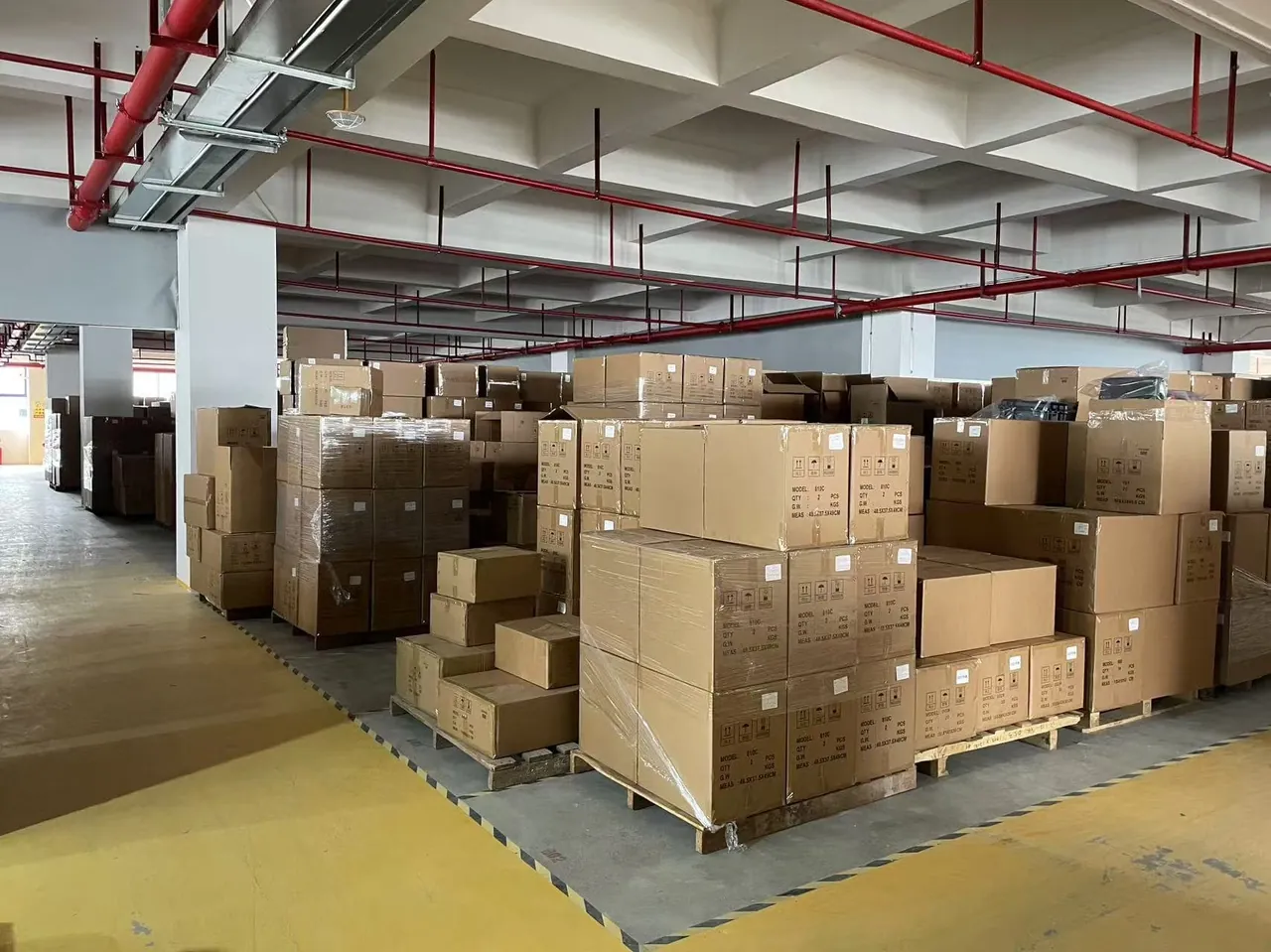
In a stack, the interlock interface prevents horizontal displacement rather than carrying load. It must satisfy three conditions: tiers must align quickly, resist sliding once aligned, and still nest without jamming when empty. The JUNZHIJIA approach places shallow recesses at the four lid corners and matching bosses on the base, giving an interlock depth of 3 to 6 mm. Too shallow and the feature does nothing; too deep and it interferes with nesting empty cases for return transport.
Friction coefficient is the other overlooked variable. Static friction between polypropylene surfaces sits around 0.25 to 0.35 and drops further with dust or an oil film. To bring the anti-slip performance of a full column under control, nitrile rubber pads can be bonded at the four base corners, raising the coefficient above 0.6 while also preventing direct abrasion between case base and rack surface. Pad thickness is usually 2 to 3 mm.
| Interlock Scheme | Locating Accuracy | Anti-Slip | Empty Nesting | Suitable Scenario |
|---|---|---|---|---|
| --- | --- | --- | --- | --- |
| Lid recess plus base boss | High | Medium | Good | Automated warehouses, frequent destacking |
| Base rubber pads | Medium | High | Fair | Flat storage, rack stacking |
| Combined recess and pad | High | High | Needs nesting clearance | High-value spares, long-turnaround loops |
| Flat contact, no interlock | Low | Low | Best | Single or double tier only |
In automated storage and retrieval systems, misalignment directly causes pick failures. Such projects should adopt the combined recess-and-pad scheme and verify it with a column push test: apply horizontal force to a four-tier stack until it displaces 10 mm, record the force required, and compare it with the disturbance force of the stacker fork. If the measured resistance is lower than the fork disturbance, interlock depth or friction area must be increased. Height and tier limits are treated separately in stackable toolbox height limit.
Stacking Height and Safety Factor: From Single-Case Load to Multi-Tier Stacks
Treating stacking height as a rule of thumb is the fastest way to lose control of a turnaround loop. The sound approach lists available clear height, rack beam spacing, case height, pallet height and pick clearance in sequence, then checks against load capacity. Assume 4.2 m clear height, a 0.15 m pallet, a 0.32 m case and 0.1 m pick clearance: seven tiers theoretically. But at 28 kg per case the bottom case would carry 168 kg static, roughly 235 kg after amplification, which already exceeds the long-term capacity of a conventional injection-molded case.
Safety factor values should reflect how severe the duty is rather than defaulting to one number. Our working values are 1.5 for short turnaround, dry indoor conditions and manual destacking; 2.0 for ambient long-term static storage with mechanical destacking; and 2.5 or more for high-temperature warehouses, open-air stacking and long sea-freight loops. A safety factor only carries meaning once material, temperature, humidity and load duration are all defined.
| Duty Combination | Recommended Safety Factor | Main Consideration | Note |
|---|---|---|---|
| --- | --- | --- | --- |
| Short indoor turnaround | 1.5 | Short load duration | Manual destacking |
| Ambient long-term storage | 2.0 | Accumulated creep | Mechanical destacking |
| High-temperature warehouse | 2.5 | Creep rate rises with temperature | Ventilation or shading |
| Open-air stacking | 2.5 or more | Thermal cycling plus UV aging | Requires UV-stabilized compound |
| Sea-freight turnaround | 2.5 or more | Humidity plus vessel vibration | Used with desiccant |
Stiffness and strength must also be kept apart. Most stacking failures are stiffness problems, not strength problems: the case does not fracture, it simply deforms past the point of usability or pallet alignment. Verification should therefore control permissible deflection, for example holding top-face center deflection within 1/200 of span, and then sizing wall thickness and rib height to meet that limit.
Dimensional Modularity: Matching 600 x 400 to 1200 x 1000 Pallets
Case dimensions should not be decided in isolation but together with the pallet and rack module system. The international 600 x 400 mm module lets a 1200 x 1000 mm pallet take exactly six cases, or a 1200 x 800 mm pallet take four, with no leftover gap, so the stack edge stays flush with the pallet edge and stability is best. A non-modular size may offer better single-case performance but leaves 30 to 80 mm of clearance at the pallet edge, shifting the stack center of gravity and encouraging lean over long storage.
| Case External Size | Layout on 1200 x 1000 Pallet | Layout on 1200 x 800 Pallet | Cases per Layer | Area Utilization |
|---|---|---|---|---|
| --- | --- | --- | --- | --- |
| 600 x 400 | 3 x 2 | 2 x 2 | 6 / 4 | 100 percent |
| 500 x 400 | 2 x 2 with 200 mm spare | 2 x 2 | 4 | 83 percent |
| 600 x 500 | 2 x 2 with 200 mm spare | 2 x 1 with spare | 4 | 100 / 83 percent |
| 400 x 300 | 3 x 3 with spare | 3 x 2 | 9 / 6 | 75 percent |
Height must be modular too. A 40-foot container offers about 2.39 m internal height, leaving 2.24 m above a 0.15 m pallet. At 0.32 m per case, seven tiers fill that height exactly; at 0.35 m only six fit, wasting 0.14 m and raising the freight cost allocated to every case. Dimensional design should therefore cross-check tier count, pallet size and container clear height before tooling is cut.
How Molding Process and Material Choice Affect Stacking Stiffness
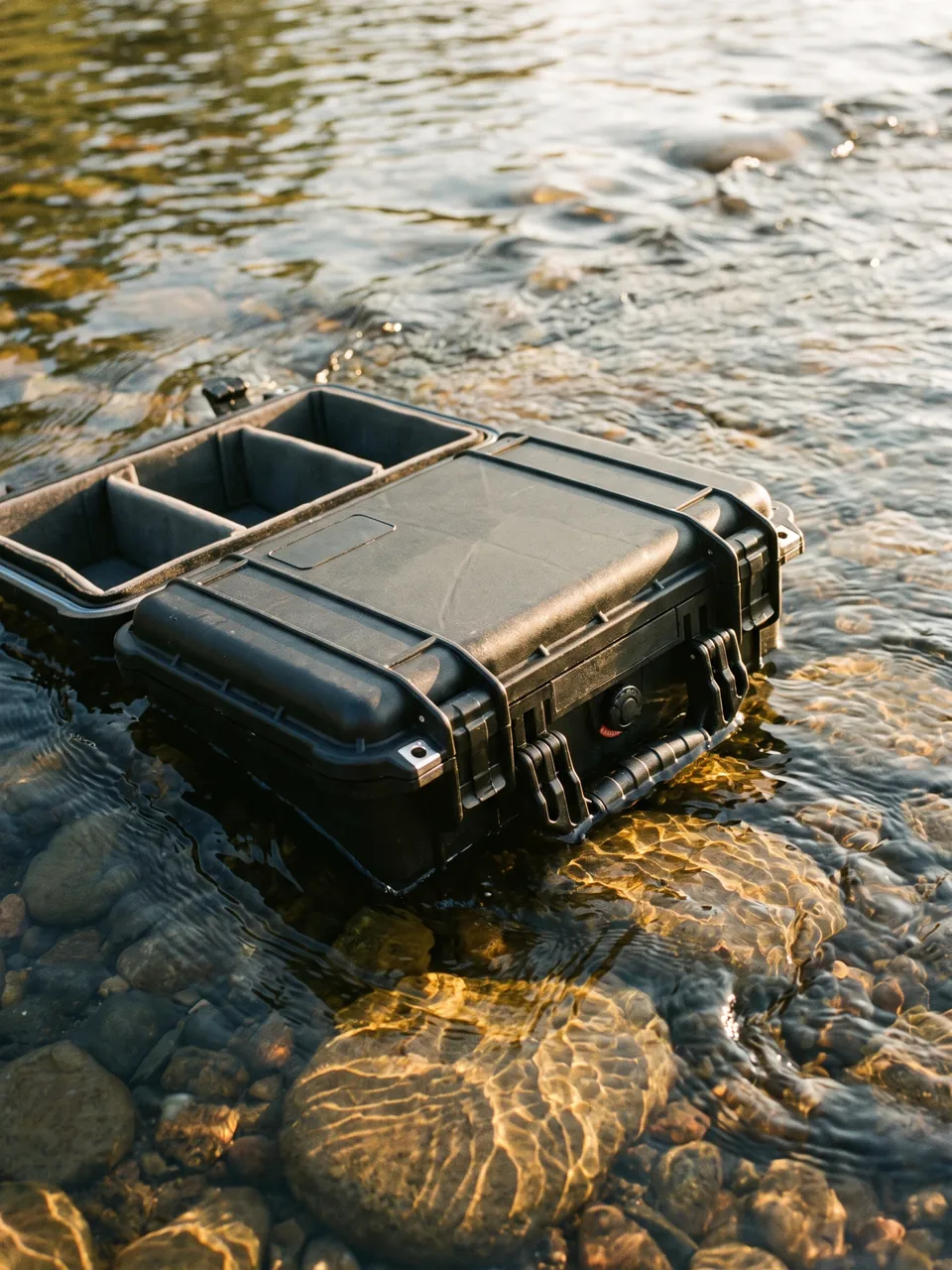
Stacking stiffness depends on two quantities: the flexural modulus of the material and the moment of inertia of the section. Increasing the moment of inertia is far more efficient, since it scales with the cube of section depth, whereas flexural modulus can at best be doubled by switching materials. Rib design, not material choice, therefore usually decides how many tiers a case can carry.
Hollow ribbed section stiffness can be estimated from rib height and spacing. On an injection-molded case with 3 mm walls, 12 mm ribs and 60 mm rib spacing, the top face reaches roughly six to nine times the bending stiffness of an unreinforced flat panel. Rotational molding cannot produce narrow deep ribs, so stiffness must come from overall wall thickness and generous radii; large rotomolded cases therefore win through structural depth rather than rib geometry.
| Stiffness Measure | Typical Gain | Cost Impact | Applicable Process |
|---|---|---|---|
| --- | --- | --- | --- |
| Add 1 mm wall thickness | About 30 to 50 percent | Higher material cost | All |
| Add 4 mm rib height | About 80 to 150 percent | Local tooling change | Injection, rotational |
| Add more ribs | Better load distribution | Higher tooling complexity | Injection |
| Switch to higher modulus material | About 30 to 80 percent | Notable material cost | Injection, modified ABS |
| Add metal insert columns | Large local capacity gain | Higher cost and weight | All |
Rib thickness should stay between 50 and 70 percent of nominal wall. When a rib approaches wall thickness, uneven cooling at the root produces sink marks and internal voids that become crack initiation sites. For long-term stacking we set the rib root fillet at 25 to 50 percent of rib thickness and run a mold flow analysis during tooling design.
Coupling of Sealing and Stacking: Gasket Compression and Opening Force
Sealing and stacking are not separate topics. Stacking load deflects the lid, and lid deflection directly changes gasket compression. Less compression degrades the protection rating; more compression raises opening force and eventually causes permanent set. Design must therefore place lid stiffness, gasket section and stacking load in a single model.
The usual JUNZHIJIA approach raises the stiffness of the lid center so that deflection under stacking load stays below 0.3 mm, while shaping the gasket section with a hollow core. A hollow core delivers roughly 40 percent less reaction force at 25 percent compression than a solid section, which keeps opening force low while holding contact pressure. Where a case experiences repeated temperature swings, a waterproof breathable pressure equalization valve should also be fitted, so internal and external pressure differences do not pull the gasket against one side of its channel and create a temporary leak.
| Seal Condition | Typical Compression | Opening Force | Rating Retention | Note |
|---|---|---|---|---|
| --- | --- | --- | --- | --- |
| Under-compressed | Below 15 percent | Very low | Clearly reduced | Can work loose under vibration |
| Recommended band | 20 to 30 percent | Moderate | Stable | Remains openable after stacking |
| Over-compressed | Above 40 percent | Very high | Short-term stable, long-term loss | Permanent set in gasket |
| Hollow core with valve | 22 to 28 percent | Lower | Stable | Suits thermal cycling and air freight |
The equalization valve matters most on large, high-rating cases. Without one, a case moving from an ambient warehouse to a high-altitude site or into air freight can see a differential of more than ten kilopascals, equivalent to hundreds of kilograms of force on the lid, pressing the gasket to one side. Valve selection and failure diagnosis are discussed in case pressure equalization valve.
Interface Design for Forklifts, AGVs and Manual Handling
How a case is moved determines which interfaces it needs. Manual handling relies on handles, forklifts rely on base fork openings or pallet feet, and AGVs and stacker cranes depend on locating features and base flatness. The three sets of requirements differ, so the dominant handling method on site must be established before selection.
| Handling Method | Interface Feature | Critical Dimension | Common Problem |
|---|---|---|---|
| --- | --- | --- | --- |
| Manual | Side handles, recessed grips | Handle height 700 to 900 mm above floor | Handle root cracking |
| Forklift | Base fork openings or feet | Opening height 90 to 110 mm, depth 900 mm or more | Deformed openings, worn base frame |
| Palletized forklift | Locating recesses for pallet feet | Matches pallet top anti-slip pads | Cases sliding on pallet |
| AGV and stacker crane | Base flatness, locating marks | Base flatness within 2 mm | Pick failure from positioning error |
Where manual handling dominates, handles should not simply be molded flush with the wall; local thickening and a generous root fillet are required. Handle root cracking accounts for a large share of failures in warehouses with frequent manual destacking, usually because the wall around the opening matches the main wall thickness and the stress concentration factor reaches 2.5 or more. Thickening the root by 40 percent and raising the transition radius from 1 mm to 3 mm substantially reduces cracking.
Temperature, Humidity and Condensation in Stacked Storage
The internal environment of a stacked case differs from that of a single stored case. Cases in a column shade one another, ventilation is poorer, and the breathing effect of the daily temperature cycle is more pronounced. By day, internal air warms and expands, letting moisture-laden air move in and out. By night, as temperatures fall, that moisture condenses on the coolest wall surface and over time produces rust spots on metal parts.
Open-air stacking raises three issues at once: UV aging, rain pooling and condensation. For UV resistance, the compound must carry sufficient hindered amine light stabilizer and carbon black, assessed under accelerated aging to the GB/T 16422.3 method. To prevent pooling, the stack top should not form a dished water trap, and bearing platforms should be separated by drainage channels. For condensation, desiccant can be placed inside and a humidity indicator card fitted on the outer wall so an inspector can judge condition without opening the case.
| Environment | Main Risk | Countermeasure | Inspection Interval |
|---|---|---|---|
| --- | --- | --- | --- |
| Open-air sun exposure | Embrittlement, color shift | UV-stabilized compound, shade cover | Quarterly |
| Rain pooling | Top-face ingress, gasket aging | Drainage channels, scheduled gasket replacement | Monthly |
| Large day-night swing | Internal condensation, metal corrosion | Desiccant, humidity indicator card | Weekly |
| Humid coastal sites | Salt-spray corrosion, coating failure | 316 stainless steel hardware | Quarterly |
Open-air stacking also requires the safety factor to be rechecked. Case surfaces in direct summer sun can exceed 60 degrees Celsius, material modulus falls and creep rate rises sharply, so long-term deformation at the same tier count may be two to three times that of an ambient store. Material selection for hot environments is covered in outdoor case engineering plastic.
Turnaround Cycle Life: Drop, Vibration and Fatigue
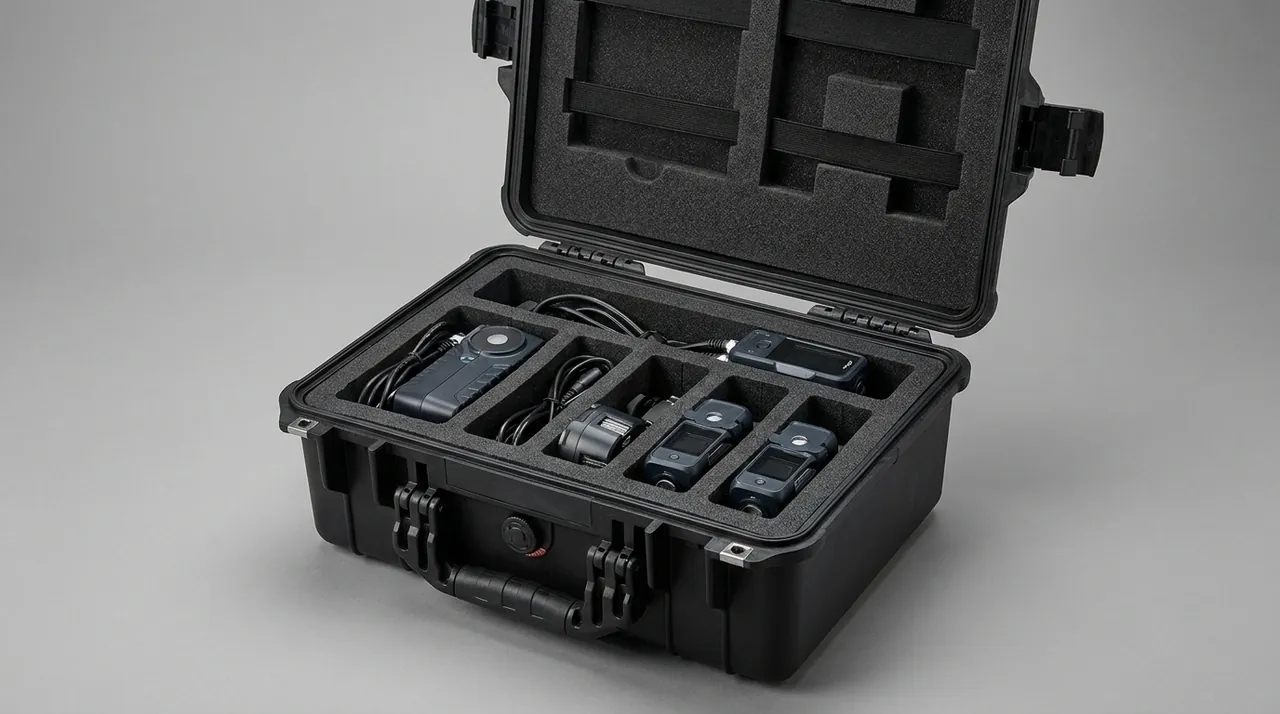
Cases in a turnaround system are reused repeatedly, so their life is better described by cycle count than years. Three factors dominate: fatigue of hinges and latches, elastic decay of the gasket, and accumulated micro-deformation from repeated stacking.
Hinge life is normally quoted in open-close cycles. A conventional one-piece molded hinge handles 5,000 to 20,000 cycles, while a metal pin design with glass-filled bushings can exceed 50,000. A spare-part warehouse opening a case twice a day reaches about 500 cycles a year, so a one-piece hinge is sufficient. Above ten openings a day, a replaceable pin design is preferable because it reduces repair cost from replacing the whole case to replacing the hinge.
| Test Item | Reference Standard | Purpose | Typical Criterion |
|---|---|---|---|
| --- | --- | --- | --- |
| Free drop | GB/T 4857.5 | Handling and loading impact | No rupture, contents intact |
| Random vibration | GB/T 4857.23 | Long-haul fatigue | No structural loosening |
| Static stacking | GB/T 4857.3 | Storage and stacking capacity | Deflection within allowance |
| High-temperature creep | Company specification | Long-term stacking deformation | 72 h deflection within 2 mm |
| Seal protection | IEC 60529 / GB/T 4208 | Water and dust resistance | Judged at declared rating |
Transport validation usually follows the ISTA and GB/T 4857 families, combining drop, vibration, stacking and impact items to match the actual logistics chain. The stacking item deserves care: an ISTA stacking test runs from hours to a day, while real warehouse stacking lasts months, so the two are not directly equivalent. For long-term stacking we recommend an additional creep test at 40 degrees Celsius under design load for 72 hours, measuring top-face deflection and extrapolating to long-term deformation.
Identification and Traceability: Barcodes, RFID and Post-Stack Visibility
Once a returnable case enters a closed-loop system, identification becomes the efficiency bottleneck. Only the sides and front of a stacked case remain visible, since top and base are obscured, so label positions must be fixed at the design stage.
The standard JUNZHIJIA scheme has three layers. The first is a large barcode area on the case front, produced by laser engraving or a weather-resistant label, for manual scanning. The second is a color-coded block on the side wall, letting warehouse staff sort by material class from five meters away. The third is an RFID inlay embedded in the side wall, typically operating at 860 to 960 MHz with a read range of 3 to 6 m, suitable for bulk inventory of a full column.
| Identification Method | Read Range | Dirt Resistance | Stage of Use | Note |
|---|---|---|---|---|
| --- | --- | --- | --- | --- |
| Barcode label | 0.1 to 1 m | Medium | Single-case scanning | Lowest cost |
| Laser-engraved code | 0.1 to 1 m | High | Permanent marking | Cannot be reassigned |
| Color-coded block | Over 5 m | High | Rapid sorting | Limited number of classes |
| RFID inlay | 3 to 6 m | High for non-metallic contents | Bulk column inventory | Assess metal interference |
| QR code with serial | 0.1 to 1 m | Medium | Full life-cycle traceability | Requires system support |
RFID inlays lose significant read performance when metal parts are inside the case, because metal reflects and absorbs radio frequency energy and can cut read range by more than half. Keeping at least 10 mm between inlay and metal, or adding a radio-absorbing layer behind the inlay, restores most of the range. For customer-specific branding, see protective case color customization.
Selection Checklist: Matching Configuration to Turnaround Scenario
The conclusions above translate into selection. The configurations below are starting points; actual projects still need cross-checking against single-case weight, tier count and site temperature.
| Turnaround Scenario | Recommended Process | Tiers | Interlock | Identification | Safety Factor |
|---|---|---|---|---|---|
| --- | --- | --- | --- | --- | --- |
| Electronic spares, indoor | Injection PP | 4 to 5 | Recess plus pads | Barcode and RFID | 2.0 |
| Large tooling, indoor | Rotomolded LLDPE | 2 to 3 | Flat plus pallet feet | Color block and barcode | 2.0 |
| High-temperature workshop | Injection PP, heat-stabilized | 3 to 4 | Recess plus pads | Laser engraving | 2.5 |
| Open-air stacking | Rotomolded LLDPE, UV-stable | 2 to 3 | Recess plus drainage | Color block | 2.5 or more |
| Long sea-freight loop | Injection PP or modified ABS | 3 to 4 | Recess plus pads | RFID and serial number | 2.5 or more |
| Automated warehouse | Injection PP | 4 to 5 | Deep combined interlock | RFID | 2.0 |
Three further inputs are often missed: contents center of gravity, since a high center of gravity reduces stability even when capacity is sufficient; destacking method, since mechanical destacking demands higher interlock accuracy; and the weight ceiling, since turnaround systems bill by gross weight.
Frequently Asked Questions FAQ
Q: A stackable case is rated for six tiers. How many tiers can actually be used?
A: The rated tier count is an upper bound under ideal conditions, and the practical figure depends on gross case weight, load duration, ambient temperature and destacking method. In our experience a six-tier rated case in ambient long-term storage with mechanical destacking should be limited to four or five tiers with a safety factor of 2.0; where a warehouse sees summer heat or open-air stacking the safety factor should rise to 2.5 or above and the practical tier count drops further. The capacity check is straightforward. Bottom static load equals tiers minus one, multiplied by gross case weight, multiplied by a dynamic amplification factor of 1.4. If that value approaches or exceeds the long-term capacity of the case, either reduce the tier count or move to a structure with a larger top bearing area and taller bottom reinforcement. Rack clear height, pallet height and pick clearance impose independent limits, so the final count is the smaller of the capacity check and the space check.
Q: The lid has dipped slightly after stacking. Can the case still be used?
A: First separate recoverable from permanent deformation. After destacking, let the case rest for twenty-four hours. If the lid returns to its original flatness and the seal re-tests within specification, the case can stay in service. If residual dishing exceeds one millimeter, or a seal re-test shows leakage, the case should no longer be used where IP65 or better is required and may be downgraded to dry general storage. The root cause of dishing is usually insufficient top bearing area or a long-term load above the creep limit of the material, so continued use simply accelerates deformation. Practical remedies include reducing the tier count, adding load-bearing structure beneath the top platform, or moving to a material with a higher flexural modulus. Where dishing appears across a whole batch rather than a few units, supply the manufacturer with tier count, gross weight and warehouse temperature range so the design load can be recalculated and the rib and wall layout revised. Photograph the before and after lid profile as part of the batch record.
Q: Do interlock recesses reduce the efficiency of returning empty cases?
A: They do have an effect, but it is controllable through design parameters. Interlock depth is normally three to six millimeters, and one to two millimeters of clearance should be left between boss and recess so empty cases nest by sliding along the gap rather than jamming. Where return efficiency matters more, the base bosses can be shaped as tapers that self-align during nesting, or the interlock can be a removable pad taken off for full nesting. Nested return transport consumes internal volume, but it lifts the case count per unit volume and cuts return freight substantially. The trade-off is that a tapered boss sacrifices some anti-slip performance in the stacked state, so high-value spares usually keep the deeper recess and accept slower nesting. Choose according to round-trip frequency and distance: frequent, long round trips favor the removable interlock, while short local loops favor the fixed deep recess. Record nest depth and clearance on the case drawing so a later tooling revision cannot silently remove the clearance that makes nesting work.
Q: Can stackable protective cases sit directly on standard racking without a pallet?
A: Yes, provided the beam span does not exceed the length of the case base. When a case rests directly on rack beams, load travels through the two edges of the bottom load frame, so if the span exceeds the case length an unsupported zone forms under the base center and sags gradually under sustained load. Keep the beam span within the short-side dimension or add a mid-span support beam. Rack beam surfaces are also fairly smooth, and friction between base and beam typically falls below 0.3, so a case can slide under rack vibration or forklift disturbance; anti-slip pads or locating stops are advisable. For long-term storage above three tiers we still recommend pallets, because they spread load across a larger area, keep the column square and simplify moving a full stack. Where racks are used without pallets, mark the maximum tier count on the beam so staff do not overstack to save aisle space. A simple visual aid is a painted band at the maximum tier height on the rack upright.
Q: When choosing between injection polypropylene and rotomolded polyethylene, which indicators matter?
A: Four indicators dominate: case size, stacking tier count, impact requirement and dimensional precision. Below about 800 millimeters, above four tiers, with tight dimensional tolerance, injection polypropylene is the better fit because its high flexural modulus allows thin walls and narrow ribs, delivering greater bending stiffness at the same weight. Above 800 millimeters, with heavy contents, high drop risk and a preference for soft radii, rotomolded polyethylene wins on thick walls and low-temperature impact resistance, at the cost of lower modulus at equal thickness, so stiffness must be recovered through structural depth rather than rib geometry. Where both high stiffness and high impact resistance are required, an injection-molded shell with metal insert columns is viable, though cost and weight rise noticeably. Also weigh the operating temperature range: a hot warehouse favors heat-stabilized polypropylene, while a cold store favors polyethylene. Wall thickness and rib layout should be frozen only after both materials have been quoted against the same duty cycle and tier count.
Q: How often should the gasket be replaced on a case used for long-term stacking?
A: Replacement intervals depend on gasket material, compression level, thermal cycle count and media exposure, so elapsed time alone is a poor guide. A silicone gasket running at ambient temperature and 25 percent compression typically serves three to five years; EPDM offers better weather resistance for outdoor duty with similar or slightly longer life. Under frequent thermal cycling, elastic decay accelerates, so inspect compression set annually: remove the gasket, let it rest for thirty hours, measure section height, and replace it if recovery falls below 85 percent of the original. In coastal or chemical environments where salt spray or solvents may contact the gasket, shorten inspection to every six months and check the channel for debris that could hold the seal off its seat. Replace the gasket as a continuous loop rather than splicing lengths together, because a splice is a common leak path that may only appear under immersion testing. Keep a spare gasket set on site, since a torn seal found during a destack otherwise removes the whole case from service.
Q: A stacked column is leaning slightly. How do I decide whether to restack it?
A: The criterion is whether the stack center of gravity still projects inside the pallet footprint. Drop a plumb line from the center of the top face; if the projected point deviates from the pallet center by more than ten percent of the pallet short side, restack the column. Lean usually has one of three causes: cases were placed without tight contact, leaving uneven gaps; interlocks were not fully seated, so cases rest on a boss edge instead of on the flat platform; or some cases have already crept and vary in height, accumulating lean up the column. Check the bottom tier for flatness first, then confirm interlock seating, then look for individual deformed cases. If a deformed case is the cause, remove it from the turnaround loop so it stops affecting column stability. Restacking is worthwhile once, but repeated lean points to a design issue such as insufficient interlock depth. Measure lean at the top tier rather than the middle, because the top tier amplifies every deviation below it.
Q: What stacking-related documentation is needed for an export turnaround project?
A: Three document families are normally required. The first covers structural capacity: design load calculations, top bearing area data and the basis for the chosen safety factor, used to justify the selected tier count to the customer or the receiving site. The second covers testing: static stacking, free drop and vibration reports, executed to the GB/T 4857 or ISTA families, or to ASTM D4169 where the customer specifies it, with the test tier count matching the declared one. The third covers material and process: material certificates, UV-stabilized compound documentation and gasket material data, needed for destination-country compliance filing. If the case contains dangerous goods or powered equipment, packaging performance evidence meeting destination requirements is also required. All documents should be reviewed before volume delivery, and the tier count printed on the label must match the tier count actually tested. Keep a controlled copy of the tested configuration, since changing gasket material or tier rating invalidates the report. Retain the tier-loading photographs and material certificates with that controlled copy.
Conclusion and Related Reading
JUNZHIJIA stackable cases turn one-way shipping packaging into a reusable warehousing asset, with load path, interlock, module and seal creep-verified as one.
Related Reading