

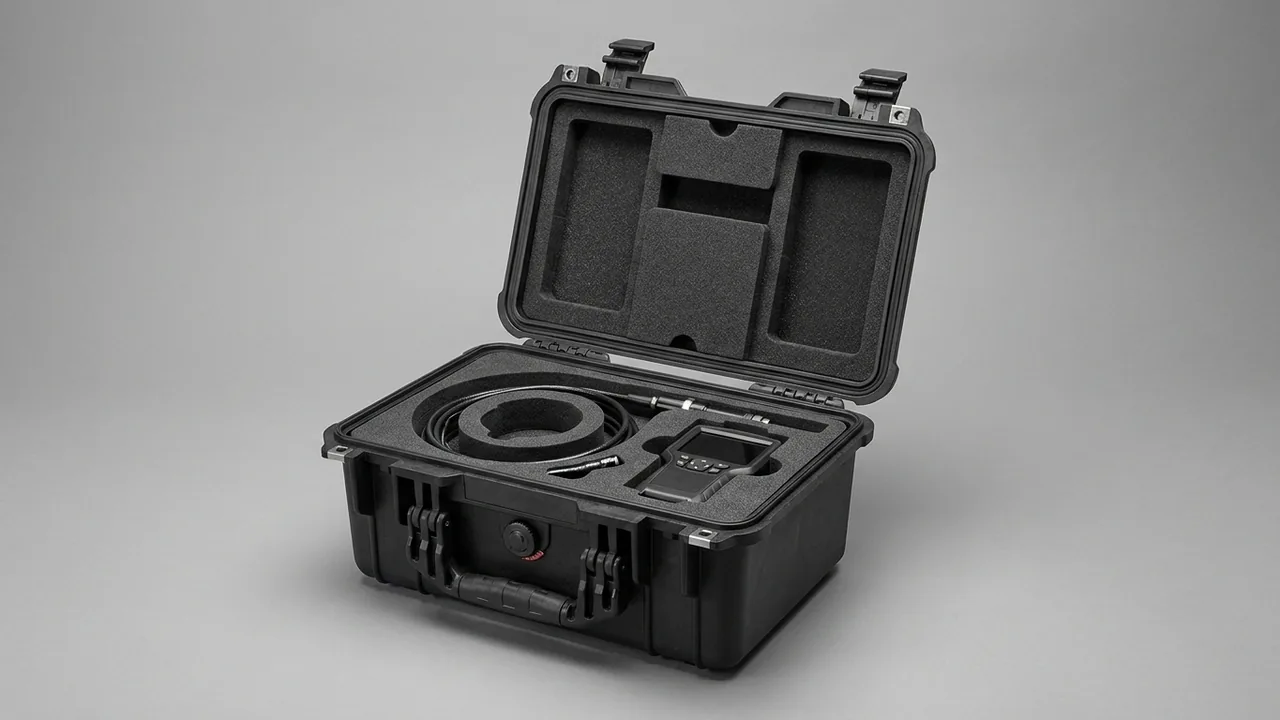
Rotomoulded cases are the most common class of rigid protective container in outdoor and industrial service. Their visual signature is consistent: generously rounded corner transitions, walls with no visible seam or weld line, and a solidity of feel that usually exceeds that of an injection-moulded case of the same footprint. None of this is a stylistic decision. It follows directly from the rotational moulding process, in which polymer powder melts and builds up layer by layer under gravity inside a rotating mould. Every region of the shell can therefore be given an independent thickness, sharp internal angles are eliminated by necessity, and the seams of the fabricated metal mould leave almost no trace on the finished part.
The principle JUNZHIJIA applies to rotomoulded case design is this: single-shot moulding is not a way to eliminate assembly labour, it is a process capability that forms the seal groove, hinge lugs, stacking faces and reinforcing ribs as one continuous structure. The fewer features depend on secondary assembly, the fewer points exist at which the case can fail under drop impact or sustained stacking load.
Table of Contents
- How Rotational Moulding Works and Why It Suits Protective Cases
- Wall-Thickness Distribution and Ribbing: Structural Freedom Unique to Rotomoulding
- Material Selection: PE, LLDPE and Cross-Linked Polyethylene
- Functions Achieved in a Single Moulding: Seal Groove, Hinge Lugs and Stacking Faces
- Rotomoulding Versus Injection Moulding: Tooling Cost and Volume Break-Even
- Double-Wall Construction: Insulation, Buoyancy and Impact Behaviour
- Seal Design: Reaching IP65 and IP67 in a Rotomoulded Shell
- UV and Weathering Design for Long-Term Outdoor Service
- Liners and Accessory Integration: Brackets, Dividers and Castors
- Quality Control: Wall Thickness Points, Leak Testing and Dimensional Verification
- Failure Modes and Design Countermeasures
- Applications and a Selection Checklist
- Frequently Asked Questions FAQ
- Conclusion and Related Reading
How Rotational Moulding Works and Why It Suits Protective Cases
The process begins with a measured charge of polymer powder or liquid placed into a hollow mould. The mould rotates on two axes as it enters an oven, and the charge tumbles, adheres to the inner wall, melts and builds up in successive layers. It then moves to a cooling station and continues rotating while it sets, before the part is demoulded. There is no injection pressure and no high clamping force, so the mould only has to withstand rotation and its own weight, which allows it to be fabricated from relatively thin aluminium or sheet steel.
Three characteristics make this process a natural fit for protective cases. First, the part is a seamless, single-piece hollow body. There are no weld lines or gate residues as in injection moulding, and therefore no weld line along which a crack can initiate and propagate. Second, tooling can be made large at comparatively modest cost. A mould for a case measuring 1200 by 800 by 600 mm requires far less investment than an injection mould of the same size, which is why nearly all large cases are rotomoulded. Third, wall thickness derives from charge weight and oven time rather than from cavity gap, so a single mould can produce a family of thickness grades by adjusting the charge, offering a graduated range of load ratings from one tool.
The constraints are equally definite. Cycle times are long, occupying a mould and oven for tens of minutes per part, so the process suits medium and low volume production of large, geometrically complex items rather than millions of small components per year. Internal corners must also be generously radiused; a tight concave feature prevents powder from reaching it, producing a thin or starved wall. This is why the interior of a rotomoulded case always shows smooth transitions and never a sharp internal corner.
Wall-Thickness Distribution and Ribbing: Structural Freedom Unique to Rotomoulding
The most important structural advantage of rotomoulding is the ability to thicken locally. In injection moulding, adding material to one region creates sink marks and internal stress, so stiffness is usually obtained indirectly through ribs. In rotomoulding, thickening simply means depositing more material in that region, with no sink marks and no process penalty. The designer can therefore place material exactly where the load travels.
A typical mid-size rotomoulded case distributes thickness as follows: the centre of the base is built up to 6 to 8 mm to resist contents impact; the four corners and their transitions are taken to 7 to 9 mm to resist drop loading; the mid-height sidewalls remain at 4 to 5 mm to control weight; and the lid crown is increased to 5 to 7 mm to carry stacking load. This differential distribution can multiply drop resistance while adding only modest mass.
Ribs on a rotomoulded case are usually external, wide and shallow, forming a continuous stiffening network with the wall. It is worth separating two strategies that are often confused. External ribs raise bending stiffness but increase the outer envelope and can interfere with close stacking. Internal thickening raises impact performance but adds weight. The combination found in good designs is shallow external ribs to carry bending, plus internal thickening at corners and base to absorb impact.
| Region | Suggested thickness | Primary function | Process note |
|---|---|---|---|
| --- | --- | --- | --- |
| Base centre | 6–8 mm | Resist contents impact and puncture | Increase radius, avoid starvation |
| Corners and transitions | 7–9 mm | Absorb drop impact | Extend oven time to ensure build-up |
| Mid-height sidewall | 4–5 mm | Control overall weight | Do not thin excessively; stacking suffers |
| Lid crown | 5–7 mm | Carry stacking and foot traffic | Use together with ribs |
| Seal groove perimeter | 5–6 mm | Maintain stable compression | Groove profile must match gasket section |
Material Selection: PE, LLDPE and Cross-Linked Polyethylene
Rotomoulded cases are built on the polyethylene family, and the specific grade determines low-temperature brittleness, UV resistance and chemical compatibility.
Linear low-density polyethylene is the general-purpose choice: its melt flow is well matched to the process, it fills complex internal geometry reliably, and it balances toughness at room and low temperature. Medium-density grades offer better stiffness and surface hardness but lose low-temperature impact performance, which matters below roughly minus 20 degrees Celsius. High-density polyethylene gives the best stiffness and chemical resistance, but its poorer melt flow makes deposition uneven in complex shapes, so it suits simpler case geometries.
Cross-linked polyethylene represents a different route. By compounding a cross-linking agent into the charge, the finished polymer forms a three-dimensional molecular network. The result is markedly better resistance to environmental stress cracking, chemical attack and low-temperature impact, at the cost of losing melt-reprocessability, a narrower process window and higher material cost. For cases in long-term contact with oils and solvents, or intended for buried service, cross-linking is worth considering.
| Material | Density g/cm³ | Low-temperature brittleness | Stress crack resistance | Recyclability | Typical service |
|---|---|---|---|---|---|
| --- | --- | --- | --- | --- | --- |
| LLDPE | 0.92–0.93 | Moderate | Moderate | Good | General cases, complex internals |
| MDPE | 0.93–0.94 | Moderate to high | Moderate | Good | Cases needing higher stiffness |
| HDPE | 0.94–0.96 | High | Moderate to low | Good | Simple geometry, chemical duty |
| XLPE | 0.92–0.94 | Low | Excellent | Poor | Long outdoor, buried, chemical sites |
On additive packages, UV stabiliser and carbon black are the most common. Carbon black does more than colour the part; it screens ultraviolet radiation, and a loading around 2 percent is typical. Below roughly 1.5 percent, outdoor degradation accelerates noticeably. For broader context on how engineering plastics behave in outdoor enclosures, see the comparison of engineering plastics used in outdoor cases.
Functions Achieved in a Single Moulding: Seal Groove, Hinge Lugs and Stacking Faces
The most underestimated capability of rotomoulding is the ability to form several functional features in the same shot. An injection-moulded case often requires a moulded body, separately produced latch mounts and assembled hinge bushes. A rotomoulded case can carry those features directly on the shell, reducing part count and cutting the tolerance chain.
The seal groove is the clearest example. The mould can produce a recess in the case lip whose width and depth match the gasket section, with compression designed at 25 to 35 percent. Mould finish at the groove determines sealing reliability, so that region is usually polished and abrupt changes in draft angle are avoided.
Hinge lugs are moulded as integral ears on the shell, with a stainless steel pin passing through. Load transfers directly into the wall with no risk of a screw pull-out. The trade-off is that once the pin bore wears, it cannot be replaced as a bolt-on hinge could be; the bore must be reamed and bushed, or the case replaced. Hinge regions must therefore be thickened and fitted with a metal bush to extend service life.
The stacking face also benefits. The base can be moulded with locating bosses that mate with recesses in the lid to give self-locating stacks. Boss height is typically 6 to 10 mm, enough to restrain lateral movement without making separation difficult. Stacking capacity should be matched to the rated stacking height so that a design does not end up with a lid strong enough to carry the load but locating bosses that shear off under it.

Rotomoulding Versus Injection Moulding: Tooling Cost and Volume Break-Even
The choice between the two processes is essentially arithmetic about tooling investment against unit cost. Injection moulds become expensive rapidly as part size grows, but their cycle time is measured in seconds and the resulting unit cost is very low. Rotational moulds scale more gently with size, but cycle time is long and labour and energy form a larger share of unit cost.
A simple model helps. If an injection mould costs four to eight times as much as a rotational mould for the same case, and the rotomoulded unit cost is 30 to 60 percent higher, the break-even generally falls somewhere between a few thousand and a few tens of thousands of units per year. Below that band, rotomoulding has the lower total cost; above it, injection moulding wins. Revision cost also matters: a rotomoulding revision often requires modifying one area of the tool, whereas an injection revision may require reworking cavity and runner design.
| Comparison | Rotational moulding | Injection moulding |
|---|---|---|
| --- | --- | --- |
| Tooling investment | Low, scales gently with size | High, rises steeply with size |
| Cycle time | Long, measured in minutes | Short, measured in seconds |
| Economic volume | Low to medium, up to several thousand | High, tens of thousands and above |
| Wall thickness freedom | High, local thickening possible | Low, limited by sink marks |
| Practical size ceiling | Very large, over 2 m possible | Limited by clamp force |
| Weld lines | None | May be present |
| Internal complexity | Restricted, needs generous radii | Fine detail possible |
| Revision cost | Low | Medium to high |
The two processes are not mutually exclusive. A common approach is a rotomoulded body combined with injection-moulded latches, handles and internal load-bearing parts, capturing the strengths of each. For a closer look at how the processes differ in protective case applications, see the comparison of rotomoulding versus injection moulding for cases.
Double-Wall Construction: Insulation, Buoyancy and Impact Behaviour
A double-wall rotomoulded case has a closed cavity between an outer and an inner wall. That cavity delivers three additional capabilities: thermal insulation, buoyancy and secondary cushioning. Insulation comes from the low thermal conductivity of still air and is genuinely useful for samples or equipment that must hold a temperature band in transit. Buoyancy keeps the case from sinking immediately if it enters water. Secondary cushioning means the inner wall can deform independently after the outer wall has taken an impact.
The cost is weight and moulding difficulty. The cavity adds material, and the inner wall must be supported by local connecting ribs or pillars, otherwise it collapses under load. Rib spacing directly determines the inner wall's load capacity; 100 to 150 mm centres in primary load-bearing regions is typical. If the cavity is to be filled with foam for higher insulation performance, the mould must include a pour port and the foaming pressure must be controlled to avoid bulging the outer wall.
It is important to be clear that double-wall construction does not by itself raise the ingress protection rating. Sealing depends only on the outer wall interfaces; the inner wall and the cavity play no part. If the inner wall cracks, water will not immediately enter the case, but the cavity becomes a reservoir that releases moisture slowly over subsequent use, creating a persistent internal humidity source. Inner wall defects therefore deserve the same attention as outer wall ones.
Seal Design: Reaching IP65 and IP67 in a Rotomoulded Shell
Sealing works on the same principle as in an injection-moulded case, but groove tolerances differ. Rotomoulded grooves generally hold looser dimensional tolerance than moulded-in features on an injection part, so the design must allow a larger compression envelope and should specify a gasket section that tolerates variation well.
For an IP65 target, a single primary interface with a drainage lip is normally sufficient. The lip carries water away from the outside of the groove when the lid is closed, reducing the time that water sits above the gasket. For IP67, three further interfaces must be addressed: the hinge pin bores, the latch mounting positions and the pressure equalisation valve. If hinge bores are not bushed, the bore enlarges with use and becomes a leak path, so IP67 rotomoulded cases should use bushes or sealed pins at these locations.
Gasket material must be matched to the temperature range. Silicone retains elasticity from roughly minus 50 to 200 degrees Celsius and suits wide temperature excursions. EPDM offers good weathering and ozone resistance at low cost and suits ambient outdoor service. Nitrile rubber excels against oils and suits cases exposed to lubricants. Whatever is chosen, the initial compression should be set slightly above the minimum requirement so that ageing losses are absorbed. For ageing mechanisms and replacement criteria, see the guide to outdoor case seal ring ageing and replacement.
Where sealing must be combined with internal cleanliness, outgassing and particle accumulation inside the shell become relevant as well; the underlying approach is set out in system-level IP67 design principles.
UV and Weathering Design for Long-Term Outdoor Service
Ultraviolet radiation is the primary ageing driver for a case stored outdoors. Polyethylene undergoes chain scission and oxidation under UV, showing as surface chalking, colour fade and reduced impact strength. Because rotomoulded walls are thick, degradation is usually confined to a fraction of a millimetre at the surface, but it still affects the dimensional stability of critical features such as seal grooves and hinge bores.
Three countermeasures apply. The first is compounding, adding carbon black for screening together with hindered amine light stabilisers that trap free radicals; the combination outperforms either additive alone. The second is surface design, using mould texture to reduce gloss and direct reflection area, and avoiding sharp edges near grooves so that stress concentration does not coincide with the onset of photo-oxidation. The third is service practice: storing cases under shade or under a cover markedly extends life in long-term deployment.
Weathering performance is normally assessed with xenon-arc or fluorescent UV exposure, translated into equivalent outdoor years using accumulated irradiance. A more practical acceptance criterion than exposure duration is the property retention after ageing, for example maintaining at least 70 percent of impact strength and staying within an agreed colour difference limit.
Liners and Accessory Integration: Brackets, Dividers and Castors
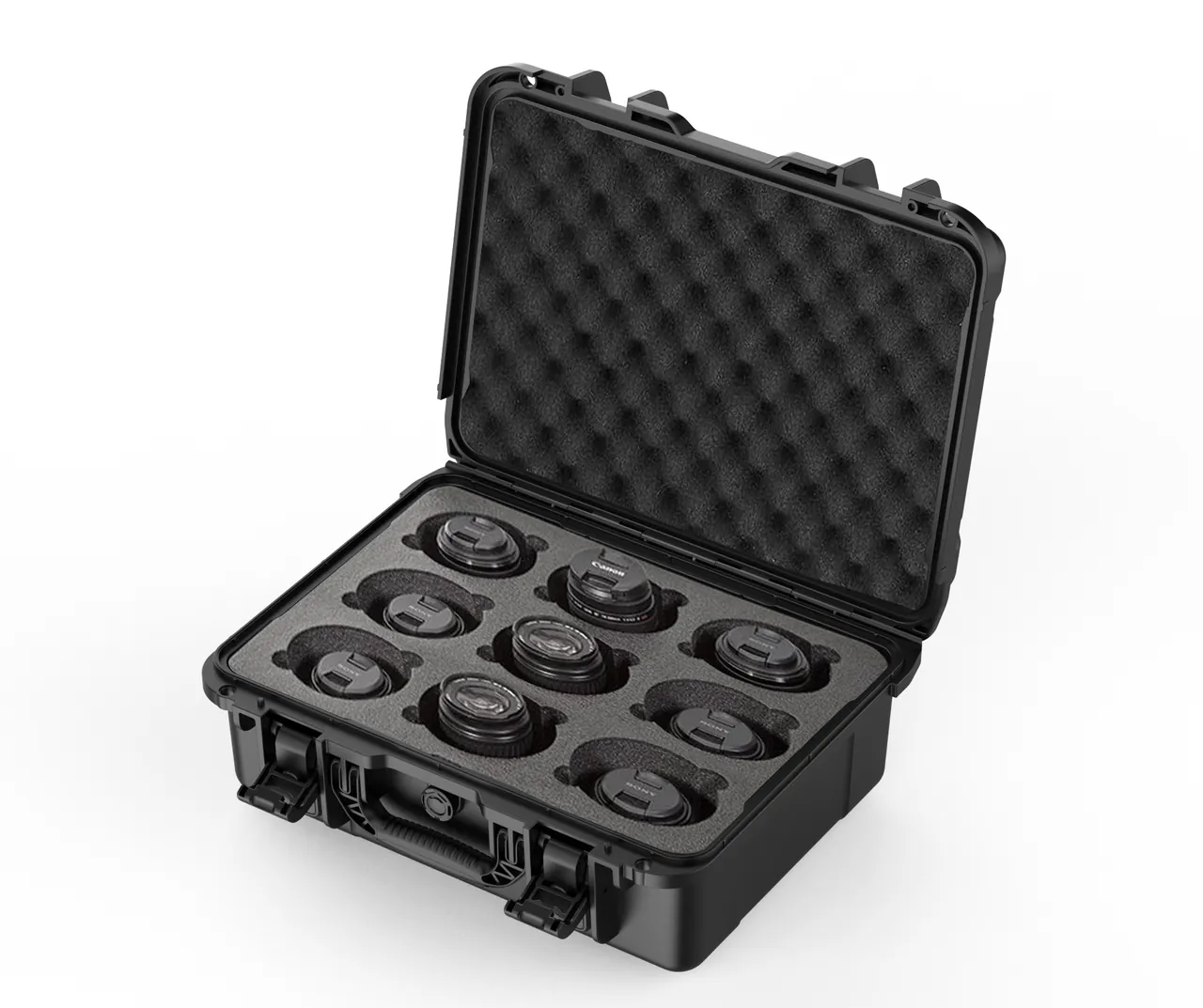
Liners and accessories must be designed in conjunction with the internal geometry. Because a rotomoulded cavity necessarily has generous radii, a liner cannot simply be cut to the theoretical internal dimensions, or conspicuous voids will remain in the corners. The correct approach is to design against the actual cavity model, accounting for the radii and, where necessary, filling those regions with compliant material.
Castor selection should distinguish between pushing and towing. Fitting castors raises the centre of gravity and increases the overturning moment during turning, so the mounting region must be locally thickened and externally ribbed. Where a case regularly crosses steps or thresholds, larger castors with corner bumpers are preferable; where movement is short-distance on flat floors, smaller castors giving a lower centre of gravity are more stable.
Handles and attachment points deserve the same care. Rotomoulded handles are formed integrally with the shell, and the root must have a generous transition radius to avoid cracking when the case is lifted fully loaded. Where tool pouches or restraint straps must be attached, dedicated moulded attachment points should be designed in rather than drilled afterwards, since a drilled hole interrupts the continuous structure and can become a leak path.
| Accessory | Suited application | Key design point | Common problem |
|---|---|---|---|
| --- | --- | --- | --- |
| Castors | Short moves on flat floors | Local thickening, ribs, centre of gravity | Tipping in turns, cracking at mount |
| Integral handle | One-person short carries | Generous root radius, grip width | Root cracking when lifted full |
| Internal dividers | Multi-item partitioning | Compliant layer below, edge trim | Divider stiffness creates point load |
| Attachment points | Straps and accessories | Moulded-in, avoid drilling | Drilled holes admit water |
| Pressure vent | Temperature and altitude swings | Hydrophobic membrane, matched airflow | Blocked membrane makes opening hard |
Quality Control: Wall Thickness Points, Leak Testing and Dimensional Verification
Quality control for rotomoulded parts has its own logic. Because wall thickness results from powder deposition, thickness naturally varies across a part, so acceptance cannot be a single nominal figure. The specification must define thickness ranges by zone together with measurement locations.
Thickness is normally checked ultrasonically, with points covering the base centre, the four corners, the mid-height sidewall, the lid crown and the seal groove perimeter, three readings per zone with the minimum recorded. An example specification might be a minimum of 5.5 mm at the base centre, 6.5 mm at corners and 3.5 mm at sidewalls. A reading below 80 percent of the lower limit should be treated as a reject, because a thin zone is where a drop will first rupture the shell.
Leak testing verifies sealing directly. The pressure decay method charges the closed case to a specified gauge pressure and measures the drop over a fixed interval; the bubble method immerses the case or applies soap solution to suspect locations and looks for bubbles. For an IP67 target, an actual immersion test to IEC 60529 is preferable to relying on pressure decay alone.
Dimensional verification should concentrate on interface dimensions rather than the full envelope. The priorities are the gap between lid and base, groove width and depth, locating boss height and clearance, and hinge bore diameter. These determine sealing, stacking and opening feel, and they are the dimensions most likely to drift with process variation.
Failure Modes and Design Countermeasures
A failure mode table with a countermeasure against each entry is the most effective tool in a rotomoulded case design review. The six modes below cover the majority of field incidents.
| Failure mode | Trigger | Mechanism | Countermeasure |
|---|---|---|---|
| --- | --- | --- | --- |
| Corner cracking | Loaded drop, low temperature | Stress concentration plus low-temperature embrittlement | Thicken corners, increase outer radius |
| Seal leakage | Compression decays with service | Permanent set in the gasket | Raise initial compression, choose low-set material |
| Hinge bore wear and leakage | Frequent opening, abrasive dust | Three-body abrasive wear at pin and bore | Fit metal bushes, use sealed pins |
| Wall bulging | High-temperature stacking in a vehicle | Material stiffness falls with temperature | Reduce stacking height, add external ribs |
| Surface chalking | Long-term UV exposure | Photo-oxidation of the surface layer | Carbon black plus HALS, shaded storage |
| Liner loosening | Repeated clamping | Compression set in the foam | Specify EVA, replace liners on schedule |
Design reviews should work backwards from the three most likely failures rather than distributing effort evenly. Field data consistently shows that corner strength, seal compression retention and hinge bore wear account for the majority of incidents; getting those three right typically doubles the practical service life of the case.
Applications and a Selection Checklist
Applications range widely, from outdoor communications equipment to industrial tool storage, emergency response kits and cold-chain circulation. Requirements differ enough that selection should rank five dimensions: ingress rating, load capacity, weight, stacking and identification.
| Application | Protection priority | Recommended structure | Avoid |
|---|---|---|---|
| --- | --- | --- | --- |
| Outdoor telecom equipment | Sealing and corrosion | IP67, double wall, pressure vent | Unbushed hinges, shallow seal grooves |
| Industrial tool storage | Load capacity and wear | Thickened base, integral dividers | Thin base, soft liner |
| Emergency response kit | Fast access and identification | Full-opening lid, colour coding | Multi-stage latches, dark shells |
| Cold chain and samples | Insulation and washdown | Double wall, washable interior | Water-absorbing foam |
| Vehicle-mounted storage | Stacking and restraint | Self-locating stack, strap points | Flat lid without locating bosses |
One further dimension is frequently overlooked: serviceability. A case whose gasket can be bought separately, whose hinge bushes can be replaced and whose liner can be re-milled will cost substantially less over its life. Procurement should request a spare parts list and replacement instructions, and confirm how long spares will remain available. For multi-item partitioning, reconfigurability should be evaluated alongside load capacity; the relevant considerations are described in the design notes on removable divider systems.
Frequently Asked Questions FAQ
Q: Is a thicker wall always better on a rotomoulded case?
A: No. The relationship between thickness, weight, stiffness and impact performance is non-linear. Increasing thickness raises puncture resistance and resistance to local deformation, but it also adds mass, which increases handling fatigue, and it can raise the centre of gravity enough to reduce stacking stability. More importantly, excessively thick local build-up in rotomoulding lengthens oven and cooling time and tends to create internal stress at the transition between thick and thin zones; uneven shrinkage during cooling then becomes the initiation point for a crack. The sound approach is to place material where the load actually travels: build corners and base to 6 to 9 mm for impact resistance, hold sidewalls at 4 to 5 mm to control weight, and keep the seal groove perimeter at 5 to 6 mm so that compression remains stable. Acceptance should be based on zonal thickness ranges with minimum values at critical regions rather than one nominal figure. If a loaded drop test produces local deflection without cracking, that zone has enough material and further thickening offers little return.
Q: How do I choose between a rotomoulded and an injection-moulded case?
A: Volume and size drive the decision. Injection tooling cost rises steeply with part size, but cycle time is measured in seconds, so it suits high-volume production of small and medium cases. Rotational tooling scales more gently with size, and although cycle times run to tens of minutes, the process suits medium to high volume production of large cases. Without detailed cost data, a rough break-even guide is useful: if annual demand is below several thousand units and the outer dimension exceeds 500 mm, rotomoulding usually wins on total cost, whereas annual demand in the tens of thousands with a small case favours injection moulding. Structural freedom matters too. Rotomoulding allows arbitrary local thickening, produces no weld lines and can create large double-wall geometry, which suits load-bearing and sealing-critical applications. Injection moulding produces fine internal detail and tight tolerances, suiting compact products with precise fits. The best answer is often hybrid: a rotomoulded body with injection-moulded latches, handles and internal load-bearing components. Whichever route is taken, validate the choice against a drop test of the finished assembly, since tooling economics alone will not reveal whether the sealing interface survives the real duty cycle.
Q: Why are the corners of a rotomoulded case always rounded?
A: This follows necessarily from the process. During rotational moulding the charge tumbles and adheres to the rotating mould wall under gravity, then melts and builds up. If the mould contained a sharp internal corner, powder could not reach it properly, producing a thin or starved wall. Moulds for rotational moulding must therefore use generous corner radii, and the finished case naturally shows smooth transitions. From a structural standpoint, this process constraint turns into an advantage: the radius substantially reduces stress concentration, so corners resist cracking during drops, which is one reason a rotomoulded case usually survives impacts better than an injection-moulded case of the same footprint. Designers should treat the radius as an available resource rather than something to work around. For example, combining the rounded corner with local internal thickening creates an energy-absorbing zone that is both smooth and tough. The radius does reduce usable internal volume, so liner design must use the actual cavity model rather than a theoretical rectangular box, or noticeable voids will remain in the corners and protection will suffer.
Q: How often should the gasket on a rotomoulded case be replaced?
A: The interval depends on gasket material, opening frequency and the amplitude of temperature cycling, so a fixed calendar period is unsuitable. Silicone gaskets in ambient indoor service with moderate opening frequency can last several years. EPDM costs less but has a narrower temperature range and ages faster where temperatures swing frequently. Nitrile resists oils well but has a shorter life under ozone and UV exposure. A condition-based rule works better than a fixed interval: inspect quarterly or every 20 clamping cycles, looking for visible cracking, hardening, discolouration or permanent flattening, and measure the recovered section thickness in the free state. Replace the gasket as a complete loop when recovered thickness falls below 90 percent of the original. Splicing is not acceptable, because compression cannot be transmitted evenly across a joint. Clean the groove before fitting and confirm that no grit or oil remains, since a significant share of field leakage cases turn out to be caused not by gasket ageing but by particles in the groove forming a capillary path. Repeat an immersion or jet test after replacement.
Q: Can a rotomoulded case be left outdoors in direct sun for years?
A: Yes, provided the compound includes UV stabilisation, and provided that gradual property loss over time is accepted. Polyethylene undergoes photo-oxidation under ultraviolet light, appearing as surface chalking, colour fade and reduced impact strength in the surface layer. Adding carbon black at around 2 percent together with hindered amine light stabilisers markedly slows this process; below roughly 1.5 percent carbon black, outdoor degradation accelerates noticeably. Because rotomoulded walls are thick, degradation is largely confined to a fraction of a millimetre at the surface and has limited effect on overall structural strength, but it does affect dimensional stability at critical interfaces such as seal grooves and hinge bores. Three practical measures help: store the case under shade or a cover where possible, avoid standing water inside the case to reduce hydrolysis and mould growth, and inspect the groove and hinge areas annually for chalking. When assessing weathering performance, ask the supplier for property retention after accelerated ageing rather than exposure duration alone, and specify the retention figures in the purchase agreement so that replacement claims rest on measurable evidence.
Q: Can I replace the pressure equalisation valve with a simple breather plug?
A: No. A plain breather plug allows air to pass freely but cannot keep water or dust out, so fitting one creates a permanent leak path and immediately voids the ingress protection rating. A rotomoulded case faces significant differential pressure from temperature and altitude changes. Taking a 60-litre case as an example, moving it from a temperature-controlled store into a vehicle interior on a summer day raises internal pressure; if that pressure cannot be released, the gasket is compressed continuously and takes a permanent set. On the return journey into a cold environment, internal pressure falls below ambient, opening the case requires excessive force, and a springing lid can cause injury. The correct component is a vent fitted with a hydrophobic microporous membrane, which passes gas at a rate on the order of hundreds of millilitres per minute while blocking liquid water and dust. Airflow must be matched to case volume: too little results in slow equalisation, while too much increases the breathing exchange and admits more moisture, worsening condensation. Mount the valve away from areas that collect water or take impact, and include it in the periodic inspection.
Q: Does a double-wall rotomoulded case justify its higher cost?
A: It depends on whether insulation, buoyancy or higher impact performance is genuinely required. A single-wall case is simpler and lighter and suits most routine storage and transport. A double-wall case has a closed cavity between inner and outer walls; the low thermal conductivity of still air provides insulation, the cavity provides buoyancy so that the case does not sink immediately if it enters water, and the inner wall can deform independently after the outer wall takes an impact, giving secondary cushioning. These capabilities have real value in cold-chain sample circulation, over-water operations and precision instrument transport. The costs are added weight, higher moulding difficulty, and the need to support the inner wall with connecting ribs or pillars whose spacing determines load capacity, typically at 100 to 150 mm centres in primary load-bearing regions. It is important to understand that a double wall does not raise the ingress rating; sealing is determined solely by the outer wall interfaces. If the inner wall cracks, water does not enter immediately, but the cavity becomes a long-term moisture source, so inner wall defects still need prompt attention.
Q: What service life can be expected, and when should a case be scrapped?
A: With normal use and periodic maintenance, a rotomoulded case is typically designed for five to ten years, depending on load intensity, handling frequency and environmental severity. Three factors dominate: corner impact resistance, retention of compression at the sealing interface, and wear resistance at the hinge bores. Scrapping is justified when any of the following appears: a through-crack in a corner or wall; cracking at the hinge region, or bore wear so severe that a bush cannot restore it; seal groove deformation from repeated gasket replacement such that a new gasket no longer restores the rated protection; or widespread thin-wall deformation at the base that undermines stacking stability. Where the shell is sound but gaskets and liners have aged, replacement of those consumables normally restores full service at far lower cost than a new case. Numbering each case and logging clamping cycles and maintenance history allows retirement decisions to be made from data rather than impression, and it also identifies recurring design weaknesses for correction at the next tooling revision.
Conclusion and Related Reading
The value of a rotomoulded case does not lie in the generic label of a plastic box; it lies in the way.
Related Reading