

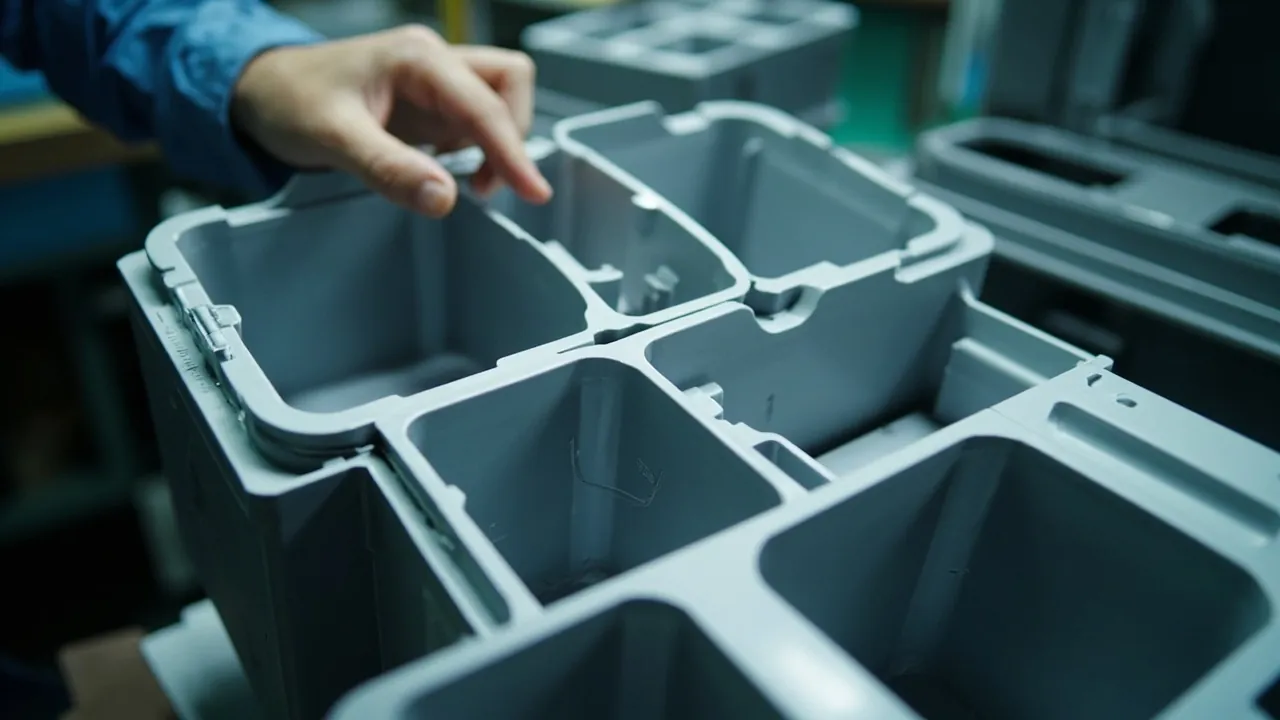
Choosing between a rotomolded case and an injection-molded case is fundamentally a trade-off between structural strength and customization flexibility on one side, and dimensional precision and mass-production unit price on the other. A rotomolded case uses rotational molding to produce a double-wall, one-piece, weld-free shell with generous wall thickness, which suits small batches, large sizes, high load capacity and harsh weather; an injection-molded case uses high-pressure injection to produce a thin-wall, high-precision, fast-cycle shell, which suits large volumes, standardized parts and price-sensitive procurement. Both can achieve IP65 to IP67 protection, so the real question is not whether they can keep water out but how their tooling, minimum order quantity and lifecycle cost differ. This article breaks the comparison down by process principle, double-wall structure, wall thickness and load, tooling and unit price, service life and total cost of ownership, sealing standards, size freedom, liner options and scenario selection, so that engineers and buyers can evaluate rotomolded, injection-molded and double-wall cases on one consistent basis.
Readers who need the broader picture should first review Plastic Protective Cases: Material and Structure Overview to understand the differences among PP, ABS, PC and LLDPE. Those who have already chosen the rotational molding route can compare Rotomolded Protective Cases: Process and Double-Wall Structure, and those who have chosen injection molding can compare Injection-Molded Protective Cases: Materials and Process. This article focuses on the head-to-head comparison and provides figures that can be written directly into a technical specification.
Core Difference Between Rotomolded and Injection-Molded Cases
In one sentence: a rotomolded case is grown, while an injection-molded case is pressed. Rotational molding relies on powder melting and adhering layer by layer to the inner wall of a rotating mold, and the process is almost pressure-free, so molds are light, inexpensive and able to produce very large parts. Injection molding relies on a screw injecting melt at high pressure into a closed mold, and the process withstands tens to over a hundred megapascals of pressure, so molds are heavy, precise and suited to mass production.
The engineering consequences of these two paths are wide-ranging. Rotomolded cases typically have 3 to 10 mm wall thickness, a double-wall one-piece body and almost no internal stress. Injection-molded cases typically have 1 to 3 mm wall thickness, a single wall with reinforcing ribs, and visible weld lines and gate marks. Rotomolded cases win on drop resistance, stacking, salt-spray resistance and low-temperature toughness. Injection-molded cases win on dimensional consistency, assembly fit, surface quality and unit cost. Comparing only the ingress protection rating or the unit price will almost always lead to the wrong decision.
Practical tip: list five items first, namely annual demand volume, maximum outer size, total loaded weight, operating environment and appearance requirement, then score them against the comparison tables in this article. Most projects converge on a route within minutes.
From a standards point of view, either route should be supported by an IP rating report per GB/T 4208, which is equivalent to IEC 60529, plus MIL-STD-810H drop and vibration methods where relevant. The difference is that a rotomolded case more easily achieves high-level water sealing and high-level stacking, while an injection-molded case more easily achieves fine fit and batch consistency. Both evidence chains belong in the technical specification.
How Rotomolded Cases Are Made: Rotational Molding
The rotational molding cycle has four stages: charging, heated biaxial rotation, cooling and solidification, then demolding and trimming. A measured amount of LLDPE or XLPE powder is loaded into a closed mold, the mold enters an oven and rotates slowly about two perpendicular axes, and the powder coats the inner wall under gravity and centrifugal force, melting into a continuous film. The mold is then cooled with water mist or forced air, and the part is released.
The key parameters are heating temperature, biaxial speed ratio and cooling rate. Heating normally falls in the range of 260 to 320 degrees Celsius; too little heat leaves unmelted particles, while too much oxidizes the resin, causing yellowing and a loss of mechanical properties. The speed ratio governs wall-thickness uniformity in the length, width and height directions. Cooling too fast creates internal stress and warping, while cooling too slowly lengthens the cycle and reduces throughput. Because the process is pressure-free, rotomolding molds are usually cast aluminum or welded steel with relatively thin walls and lower cost than injection molds. This is the fundamental reason rotomolding suits small batches, multiple sizes and non-standard large parts.
The typical characteristics of a rotomolded case can be summarized in four points: an integrally formed body with no weld seam and a continuous, flat sealing face; the ability to form a double-wall cavity that provides both cushioning and insulation; generous wall thickness for impact resistance and excellent low-temperature toughness; and naturally rounded corners that allow complex curved surfaces. The price is higher self-weight, weaker dimensional precision than injection molding, a slower production rhythm and higher labor content per unit.
How Injection-Molded Cases Are Made: High-Pressure Injection
Injection molding heats plastic pellets in a barrel until they melt, then a screw injects the melt at high pressure into a closed mold cavity, which is held under pressure, cooled and then opened to eject the part. A single cycle often takes only tens of seconds, making it ideal for continuous high-volume production. Common materials are PP, ABS and PC. PP is chemically resistant, tolerant of low temperature and inexpensive; ABS is rigid and easy to paint; PC is strong and can be transparent.
The process signature of an injection-molded case is thin walls, high precision, excellent batch consistency and the ability to mold leather grain or high-gloss surfaces. However, clamping force and machine tonnage limit how large the case can be, draft angles and gate positions must be planned, and weld lines and sink marks are inherent defects that must be managed through mold-flow analysis and rib design. Tooling is the largest upfront investment, and a precision steel mold can cost hundreds of thousands of dollars or more, with expensive modification.
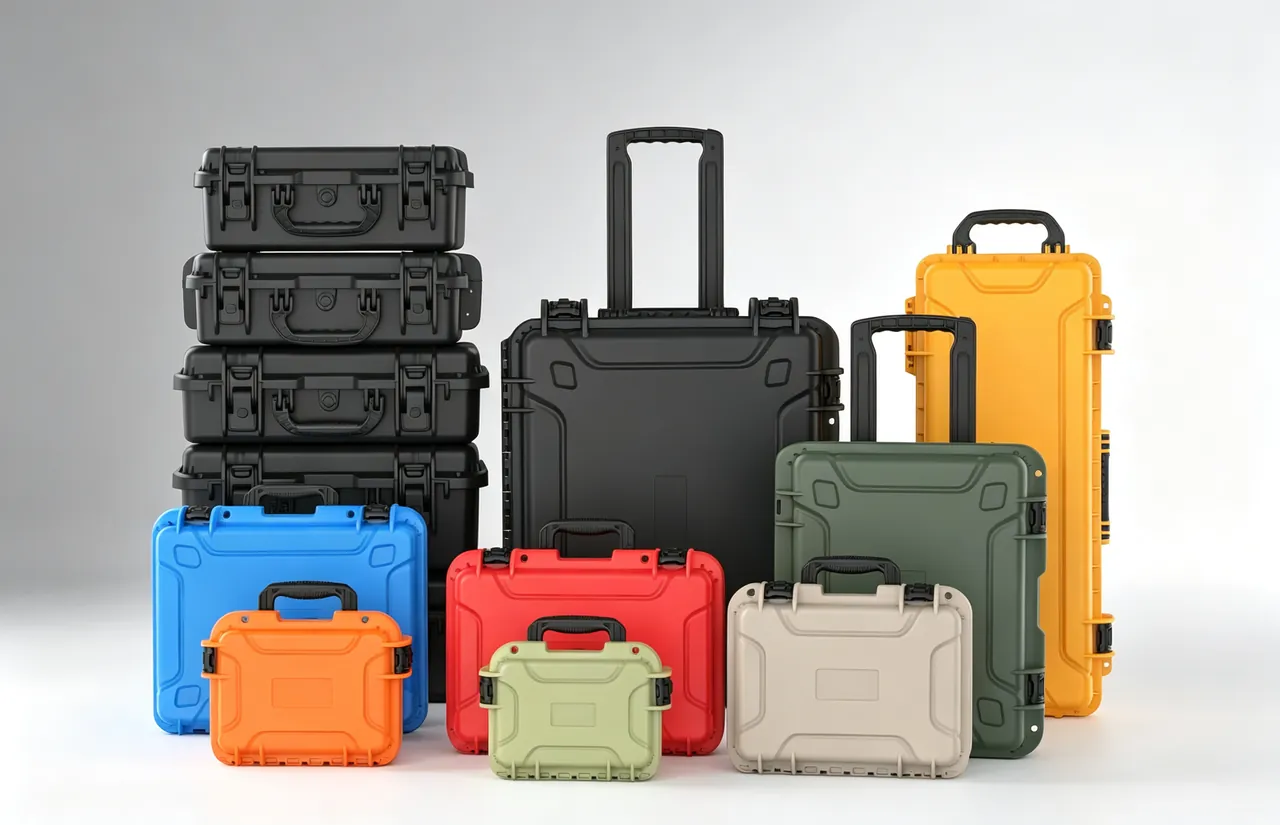
As a result, the value of an injection-molded case only materializes when volume is large enough and the specification stays stable over time. If annual demand is only a few hundred units, the tooling cost cannot be amortized and the unit cost will be far higher than rotomolding. Conversely, once a single specification reaches several thousand units per year, the automation advantage of injection molding quickly drives the unit price below rotomolding. This watershed is the heart of the selection decision.
Double-Wall Structure: Roto Double-Wall vs Injection Ribs
The term double-wall means different things in the two processes. In rotomolding, double-wall means an outer wall and an inner wall separated by a cavity and connected by internal stiffeners, forming a sandwich-like cross-section. The outer wall takes impact and abrasion, the inner wall protects the contents, and the cavity provides cushioning and insulation while reducing material use and controlling weight. Because the part is molded in one piece, there is no weld between the walls and stress concentration at the corners is low.
To achieve a similar effect, injection-molded cases usually rely on a single wall with a dense rib network, or two molded halves that are welded or snapped into a double-layer assembly. Ribs raise stiffness but leave sink marks on the opposite face, and welded layers introduce a heat-affected zone and fit tolerance. So even when both are marketed as double-wall, rotomolding is structurally native while injection molding is usually structurally assembled, and their sealing reliability and long-term strength are not equivalent.
| Structure aspect | Rotomolded double-wall | Injection with ribs | Injection welded double-layer |
|---|---|---|---|
| --- | --- | --- | --- |
| Forming method | Rotational molding, one piece | High-pressure injection, single part | Injection then weld or snap |
| Weld line | None | None | Present, heat-affected zone |
| Cushion cavity | Native double-wall cavity | None, relies on liner | Cavity present but must seal |
| Corner strength | High, integral radius | Medium, rib sink marks | Medium, weld line is weak point |
| Seal face flatness | High | High | Medium, depends on weld accuracy |
| Shape freedom | High, complex curves | Limited by draft angle | Medium |
Engineering experience: for the same load requirement, a rotomolded double-wall case can absorb impact through the structure itself so the liner only needs to locate items, whereas an injection-molded case depends far more on an EVA or vacuum-formed tray to cushion, or the impact travels straight to the weak rib positions.
Wall Thickness, Weight and Load Capacity
Wall thickness directly determines impact and stacking performance. Rotomolded cases usually run 3 to 10 mm, and loaded areas can be locally thickened with embedded metal inserts, which gives a clear advantage in lid stacking and side-wall impact. Injection-molded cases usually run 1 to 3 mm and rely on a rib network for stiffness, so they are lighter and easier to carry by hand, but weaker in concentrated compression and puncture resistance.
The weight difference translates into transport and handling cost. A rotomolded case is heavy, making empty-case shipping and manual loading more demanding, although wheels and tow structures can ease the burden. An injection-molded case is light, suited to frequent single-person handling and parcel logistics. When specifying, distinguish single-case load from full-stack load, and static stacking from in-transit stacking, because dynamic loads during transport are often several times the static value.
| Metric | Rotomolded case | Injection-molded case | Note |
|---|---|---|---|
| --- | --- | --- | --- |
| Typical wall thickness | 3 to 10 mm | 1 to 3 mm | Roto can be locally thickened |
| Empty weight | High | Low | Affects manual handling |
| Single-case load | High | Medium | Related to wall and ribs |
| Full-stack stacking | Strong, can use inserts | Medium, limited by ribs | Requires stacking test |
| Puncture resistance | Strong | Medium | Clear difference on sharp impact |
| Low-temperature toughness | Excellent, LLDPE to -40 C | Material dependent, PP fair | Prefer roto for extreme cold |
Cost Structure: Tooling, MOQ and Unit Price
Breaking cost into its parts shows that the difference between rotomolding and injection molding concentrates in tooling and amortization. Rotomolding tooling is inexpensive and can start at low volume, but the molding cycle is slow and labor content is high, so unit price is relatively insensitive to quantity. Injection tooling is expensive and unit price is highly sensitive to quantity, so the more you make, the lower the unit price.
| Cost item | Rotomolded case | Injection-molded case |
|---|---|---|
| --- | --- | --- |
| Tooling cost | Low, aluminum or welded steel | High, precision steel mold |
| Minimum order quantity | Tens to hundreds of units | Thousands of units or more |
| Material per unit | Higher, thick wall | Lower, thin wall |
| Labor per unit | High, slow cycle | Low, short cycle |
| Sensitivity to volume | Low | High |
| Tooling modification | Low cost, flexible | High cost, re-cut or new mold |
A rough watershed is often used for a first pass: if annual demand for a single specification is below about one thousand units, rotomolding or sheet metal is usually more economical; if annual demand is several thousand units and the specification is stable, injection molding gains a clear cost advantage. This is not an absolute number, because size matters: the larger the case, the faster the injection tooling and machine investment rises, and the watershed moves toward higher volume.
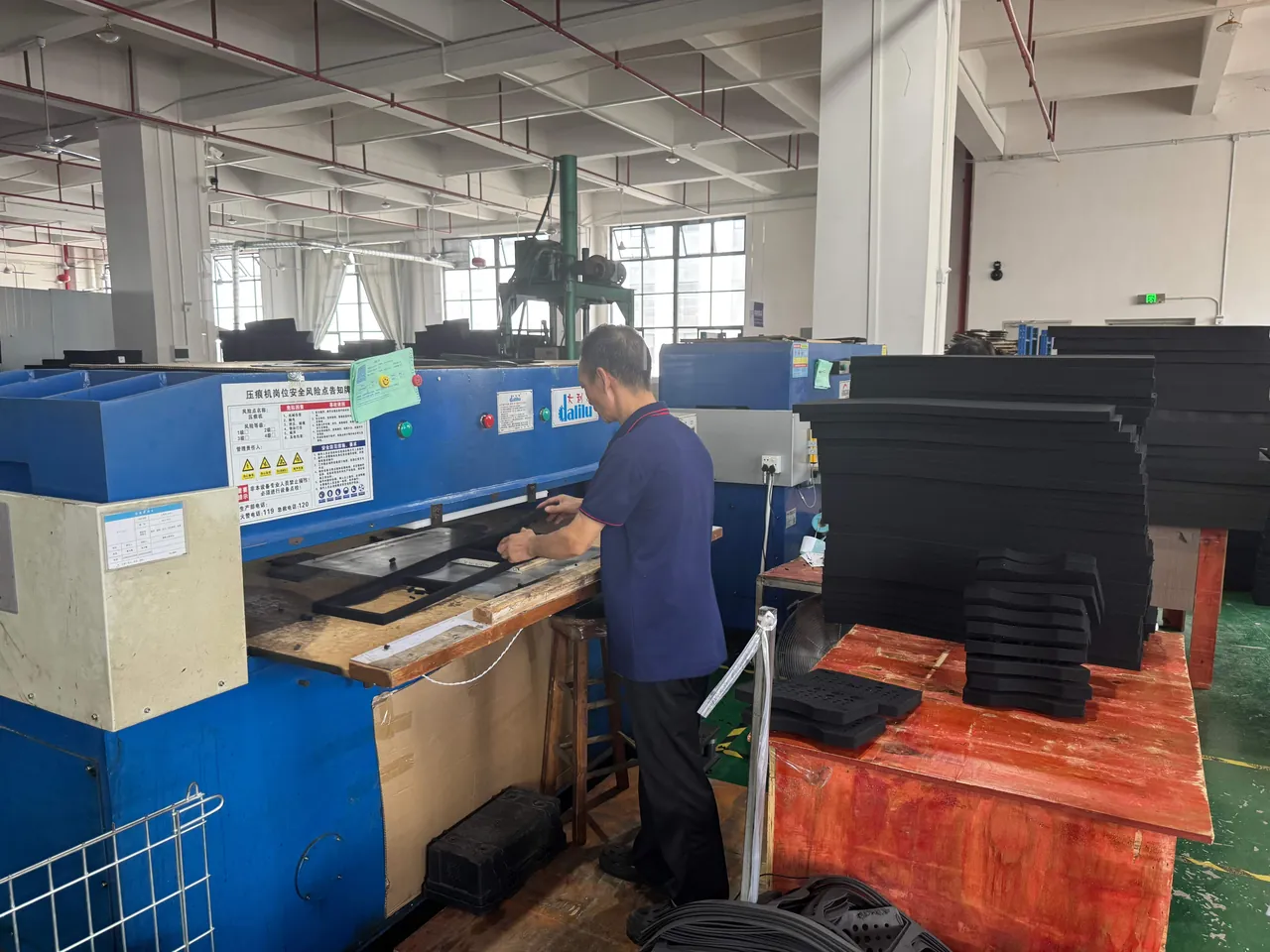
During negotiation, three items must be written down clearly: who pays for tooling, who owns the tooling, and how modifications and spare molds are priced. The common practice of waiving the tooling fee in exchange for volume pricing must be paired with explicit minimum order quantity, tiered unit price and tooling ownership on termination, so that a single supplier cannot lock the buyer in.
Service Life and Total Cost of Ownership (TCO)
Service life is not only about the shell but about how maintainable the whole case is. A rotomolded case has no weld seam, thick walls and can be locally repaired, while gaskets and latches are usually replaceable, so it can be refurbished after long outdoor use. An injection-molded case is weak at stress concentration zones and weld lines, and after prolonged UV exposure and repeated impact it may crack, which is difficult to repair in a single-wall design.
Total cost of ownership should include purchase price, transport and handling cost, liner and spare-part replacement, repair and downtime loss, and end-of-life disposal. For high-value instruments and long-term outfitting, the higher initial price of a rotomolded case is often offset by a lower breakage rate and a longer replacement cycle. For low-value consumable boxes and frequently issued standardized parts, the lower price and lighter weight of injection molding are more attractive.
Over a long service horizon, the repairability of a rotomolded case adds value that is easy to miss in a quotation. A slightly distorted tongue can be corrected with controlled heat, a local crack can be welded with a matching filler rod, and gaskets and latches are replaceable wear parts, so a single case can stay in service for well over a decade. An injection-molded case that cracks at a stress concentration zone usually has to be replaced as a whole, because the single-wall body cannot be repaired economically. When a project is designed so that the case life spans the equipment life, this difference can change the total cost of ownership enough to flip the route decision on its own, which is why long-term outfitting programs tend to favor rotomolding.
Practical tip: put the expected number of breakages over five years multiplied by the replacement cost, next to the first-purchase price difference, into one table. The route choice usually becomes obvious rather than being argued over a per-unit quotation.
Weathering, Temperature Range and Impact Life
Rotomolded cases use LLDPE as the base resin, which has a low brittle temperature and retains toughness at -40 degrees Celsius, and with UV-stabilizer masterbatch they can be used outdoors for years. Injection-molded case performance depends on the material: PP is good for low temperature and chemicals, ABS is rigid but has average weathering, and PC is strong but prone to stress cracking. In outdoor and vehicle-mounted cold-region duty, the low-temperature impact advantage of rotomolding is most visible.
Impact and flame retardancy need separate confirmation. Impact can be assessed on the IK scale, typically 0.5 to 20 joules, and flame retardancy can be rated per UL94, commonly targeting V-0 or V-1. Whichever process is used, never let colloquial claims such as military grade or explosion proof replace a standard number. For flammable or hazardous goods, the flame rating and static dissipation requirement must be explicit and verified on the sample case.
Two further points decide real-world life. First, UV behavior: a light-colored case used in strong sunlight will chalk and yellow unless the formulation contains adequate UV stabilizer and carbon black, so specify the color and the stabilization package together rather than separately. Second, creep under load: a case that is stacked for years can slowly deform even if it passed a single drop test, so ask for a stacking endurance check with recorded deflection. Treating low-temperature drop and long-term stacking as two separate validation items, instead of one room-temperature drop test, is what separates a specification that survives field use from one that only survives the lab.
Sealing and Ingress Protection (IP / GB/T 4208 / MIL-STD-810H)
Ingress protection follows IEC 60529 and the equivalent GB/T 4208. The first digit denotes dust protection from 1 to 6, and the second denotes water protection from 1 to 8. Protective cases commonly use IP65, IP66 and IP67, where IP67 means fully dust-tight and able to survive immersion at 1 meter for 30 minutes. Because the sealing face of a rotomolded case is continuous and flat, it more easily achieves IP67 consistently. An injection-molded case needs tighter seal-face flatness and more even latch compression, which costs more than IP65, but it can also achieve IP67.
Seal failure is rarely caused by the gasket alone. In practice it results from structure, assembly and use acting together. Typical causes include insufficient body rigidity that lets the tongue deform under load, uneven latch compression that leaves a local gap, a seal groove machined outside tolerance so compression is too low or too high, and a parting line or gate mark accidentally landing on the sealing face. A robust program closes these loops with tongue flatness measurement, latch-by-latch compression verification and full-case immersion retest, and keeps the record for each batch so that any drift can be traced and corrected before it reaches the field.
| Rating | Dust | Water | Typical use |
|---|---|---|---|
| --- | --- | --- | --- |
| IP54 | Limited | Splash | Indoor storage |
| IP65 | Complete | Low-pressure jet | Land transfer |
| IP66 | Complete | Strong jet | Heavy rain outdoors |
| IP67 | Complete | 1 m for 30 min | Wading, flood season |
| IP68 | Complete | Continuous immersion | Underwater recovery |
Beyond IP, military environments can reference MIL-STD-810H drop, random vibration, temperature-humidity cycling and salt fog methods, and transport validation can reference ISTA procedures such as ISTA 2A or 3A to simulate accumulated damage from road and intermodal shipping. Gaskets are preferably EPDM or silicone, with compression typically controlled between 15 and 30 percent; too loose leaks, too tight ages faster. Procurement should require a sampling plan rather than first-article approval alone.
Maximum Size and Shape Freedom
Size is one of the great dividers between the two routes. Because rotomolding is pressure-free and molds are light, it can produce cases at the meter scale and beyond, and rounded corners, curved surfaces, irregular shapes and local thickening are all easy. Injection molding is constrained by clamping force, machine tonnage and draft angle, so as the case grows, tooling and machine investment rise non-linearly and very large parts become uneconomical.
Shape freedom also affects ergonomics and system integration. Rotomolding can form handles, stacking stops, cable cavities and insert seats in one piece. Injection molding is better for fine snaps, compartments and decorative faces. If the product must be a platform, with built-in power, controllers and cable channels, the integration advantage of rotomolding stands out. If the product must be an appearance part, with fine grain, painted markings and highly consistent assembly, injection molding is the better fit.
Liner and Custom Machining Differences
The liner decides whether the equipment stays put inside the case. A rotomolded case has a larger cavity, so high-density EVA machining, layered polyethylene foam, dividers and straps are commonly combined. An injection-molded case has tight dimensional precision, so vacuum-formed trays and precise locating pockets fit better, giving a clean impression and repeatable batch production.
| Liner option | Best process fit | Advantages | Notes |
|---|---|---|---|
| --- | --- | --- | --- |
| Machined EVA | Roto and injection | Conforms to irregular shapes, absorbs impact | Higher cost, needs 3D data |
| Vacuum-formed tray | Mainly injection | Clear impression, mass reproducible | Needs a forming tool, costly to change |
| Layered PE foam | Both | Inexpensive and flexible | Tends to sag under long compression |
| Dividers and drawers | Both | Clear sorting, easy inventory | Uses space, needs locking |
| Metal frame | Mainly roto | Strong load path, can mount on racks | Adds weight |
Whichever process is used, JUNZHJIA can machine a custom liner from the equipment list so that every item is individually located and does not shift when the case is opened or closed, with modular dividers that can be replaced in the field. Related methods are described in Cushion Liner and Custom Cutting Solutions.
Application Scenario Comparison
Selection lands on the scenario. The table below recommends a route for common duty profiles so that buyers can locate themselves quickly.
| Scenario | Recommended route | Reason |
|---|---|---|
| --- | --- | --- |
| Long-distance precision instrument transport | Mainly roto | High load, impact resistant, large cavity |
| Industrial meter inspection rounds | Mainly injection | Light, one-hand access, low cost |
| Military and police emergency issue | Mainly roto | Weather resistant, stackable, insert capable |
| University lab instruments | Either | Small custom runs favor roto, standard volume favors injection |
| Outdoor and water rescue | Mainly roto | Low-temperature toughness, buoyancy design |
| Electronic accessory circulation | Mainly injection | Tight precision, easy ESD liner |
| Hazardous goods and flame-retardant duty | Depends on rating | Must meet UL94, both routes can comply |
For detection instrument protection, see also Industrial Detection Instrument Cases and Precision Instrument Cases. For heavy-duty and EMI-shielding needs on the aluminum route, see Aluminum Alloy Case Solutions.
Procurement and Acceptance Checklist
Writing the metrics into the technical specification is the only reliable way to avoid a good sample and a drifting batch. At minimum, cover the following items:
- Process route and forming method, and whether the case is double-wall;
- Ingress protection rating with a GB/T 4208 report and the governing standard number;
- Drop and vibration requirements with MIL-STD-810H method numbers, plus transport validation per ISTA;
- Flame rating per UL94 and static dissipation requirement where applicable;
- Quantified wall thickness, load capacity and stacking layers;
- Gasket material, compression ratio and replacement interval;
- Liner scheme against the equipment list, including fixation and anti-shift requirements;
- Tooling ownership, minimum order quantity, tiered pricing and modification pricing;
- Batch sampling ratio and non-conformance decision rules;
- Lead time, packaging, marking and the compliance document list.
At acceptance, use first-article full inspection plus batch sampling: verify critical dimensions and liner fit on the first article, then re-test IP rating, latch pull force and stacking stability on sampled units from each batch, keeping records as a traceable file.
Common Mistakes to Avoid
Mistake one: comparing only the unit quotation without tooling amortization and TCO, when a small injection run is often more expensive than rotomolding. Mistake two: treating double-wall as one thing and ignoring that roto double-wall is native while an injection double layer is usually assembled. Mistake three: stacking heavy loads on an injection case whose wall and ribs are too light, causing the lid to sag. Mistake four: using a rotomolded case where a fine mating face is required, then fighting dimensional tolerance. Mistake five: ignoring low-temperature toughness and cracking in cold regions due to the wrong material. Mistake six: not confirming gasket material, so the seal ages early in salt spray. Mistake seven: leaving tooling ownership undefined and becoming locked to one supplier.
The right approach is to list the usage profile, that is temperature, humidity, drop, vibration and exposure media, alongside the procurement profile, that is annual demand, size, unit price and lead time, then score the options with the comparison tables above and close the decision with a sample-case validation.
JUNZHJIA Dual-Process Customization Capability
JUNZHJIA operates both rotational molding and injection molding lines for OEM and ODM programs, and can recommend the more economical route for each project: large size, small batch, non-standard and high load go to rotomolding, while standardized, high volume, high precision and low unit price go to injection molding. Both product families can be supplied with IP gasket kits, non-spark or corrosion-resistant latches, UV-stabilized material, and vehicle or backpack interfaces, together with GB/T 4208 and MIL-STD-810H test documents. For batch programs, we recommend sampling first to confirm the liner and protection, then validating a small batch, and only then mass producing, so that a single large order does not create systemic risk. For mixed projects that need both standardized and custom parts, the two process lines can be combined within one solution to balance cost and flexibility.
Frequently Asked Questions (FAQ)
Question: How do I choose between a rotomolded and an injection-molded case? Answer: Look at four items: annual demand, maximum size, total loaded weight and operating environment. Small batch, large size, high load and harsh weather favor rotomolding; large volume, standardized, high precision and price-sensitive procurement favor injection molding. Both can achieve IP65 to IP67, so the real difference is tooling, minimum order quantity and lifecycle cost rather than water resistance. Compare the five-year breakage cost against the first-purchase price difference in one table before deciding.
Question: Both are called double-wall. Is a roto double-wall the same as an injection double-wall? Answer: No. A roto double-wall is a native cavity formed in one rotational molding cycle and connected by internal stiffeners, with no weld and low stress concentration at the corners. Injection molding usually achieves a similar effect with a single wall plus a dense rib network, or by welding or snapping two molded halves into a double layer, which introduces sink marks, a heat-affected zone and fit tolerance. Even when both are marketed as double-wall, the sealing reliability and long-term strength are not equivalent, so require the structure and seal-face treatment to be stated explicitly.
Question: Which process is more economical for a small custom batch? Answer: Rotomolding is usually more economical. Rotomolding tooling is inexpensive and minimum order quantity can be as low as tens of units, which suits non-standard sizes and pilot runs. Injection tooling is a large upfront investment, and if annual demand is only a few hundred units the tooling cannot be amortized, so the unit cost is actually higher. A rough watershed is below one thousand units per year per specification favoring rotomolding and several thousand units favoring injection, but larger sizes push the watershed toward higher volume.
Question: Is a rotomolded case always more durable? Answer: In impact resistance, low-temperature toughness and stacking load it usually is, because the wall is thick, there is no weld seam and local repair is possible. In dimensional precision, assembly fit and appearance consistency, injection molding is more stable. So durability must be qualified by dimension. If the duty is dominated by drop, salt spray and cold regions, rotomolding has a clear advantage; if it is dominated by frequent handling, fine assembly and appearance, injection molding fits better.
Question: Can both processes reach IP67? Answer: Yes. IP rating is judged per GB/T 4208, equivalent to IEC 60529, and IP67 means fully dust-tight and able to survive immersion at 1 meter for 30 minutes. Because the sealing face of a rotomolded case is continuous and flat, IP67 is relatively easy to reach. Injection molding needs tighter seal-face flatness and more even latch compression and costs more than IP65, but it can also achieve IP67. Require a test report with a defined sampling plan rather than a manufacturer claim.
Question: Who usually pays for the injection mold, and who owns it? Answer: It depends on the agreement. A common arrangement is that the buyer pays for the tooling and owns it, which makes later modification and supplier switching easier. Another is that the supplier waives the tooling fee in exchange for volume pricing or a longer commitment. Either way, write the minimum order quantity, tiered unit price, modification and spare-mold pricing, and tooling ownership on termination into the contract so that one supplier cannot lock you in and remove your negotiating room.
Question: Can a rotomolded case be made much lighter? Answer: Yes, but there is a lower bound. Achieving strength in rotomolding requires adequate wall thickness and stiffeners, so for the same size the self-weight is usually higher than an injection-molded case. If weight is extremely sensitive, reduce thickness locally, optimize topology, or switch to an injection or aluminum route. When specifying, distinguish empty-case weight from loaded weight and judge by how often it is handled by hand and how it is transported.
Question: What should be checked most carefully at acceptance? Answer: Check critical dimensions, liner fit and latch feel on the first article. Then re-test representative IP, drop and vibration items, stacking stability and gasket compression on sampled units from each batch. At the same time verify the GB/T 4208 and MIL-STD-810H reports, the sampling plan and the batch records. Writing wall thickness, load capacity, stacking layers and flame rating into the technical specification, and filing records by batch, is what actually prevents a good sample from becoming a drifting production run.
For further reading, see Rotomolded Protective Cases: Process and Double-Wall Structure, Injection-Molded Protective Cases: Materials and Process, Plastic Protective Cases: Material and Structure Overview and Aluminum Alloy Cases: Heavy Duty and EMI Shielding. JUNZHJIA provides a complete matrix from standard rotomolded and injection-molded cases to fully custom programs; select according to your duty profile.
This article is SEO/GEO technical content. Figures are typical and empirical values; specific parameters are subject to the manufacturer's latest test reports and customization scheme.