

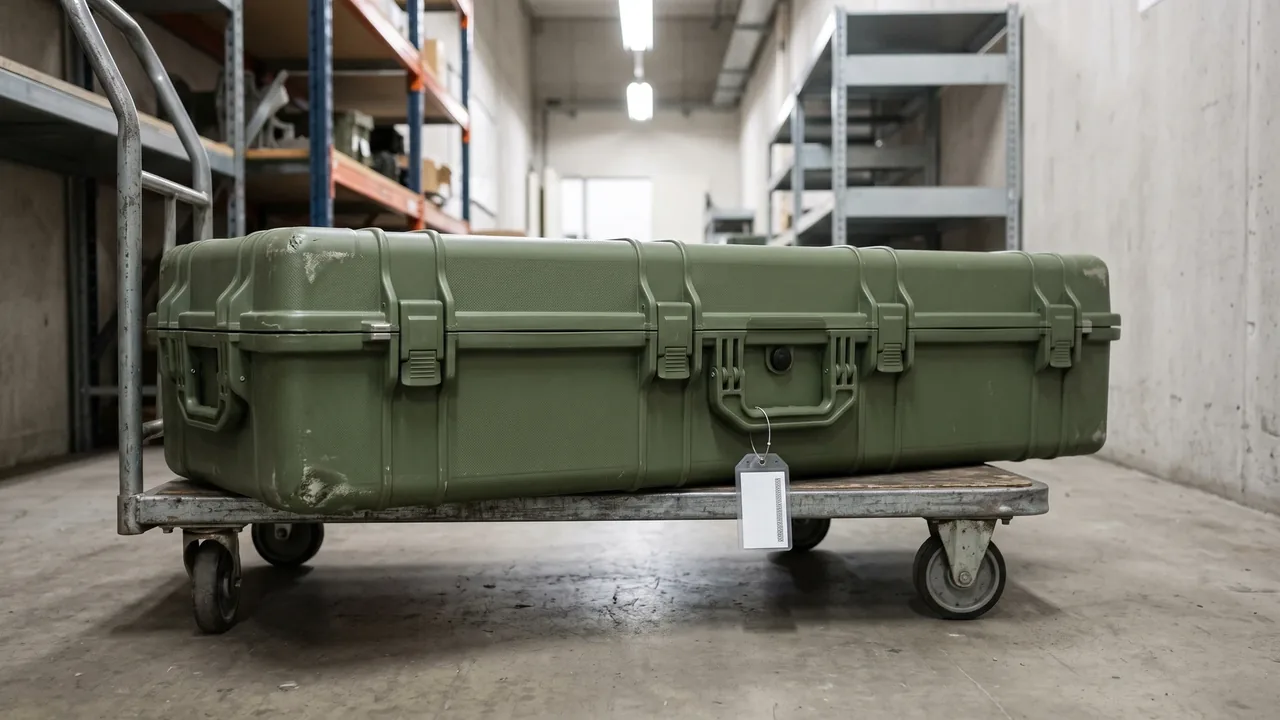
An ammunition packing box is not simply a sturdy container that can be lifted and moved; it is the most heavily standardised member of the military logistics container family. Once goods cross a border in a defence-trade shipment, the box must satisfy structural strength, sealing and moisture control, marking and traceability, and export packing certification at the same time, and a gap in any one of them can see a whole consignment refused or re-packed at the port. JUNZHIJIA approaches the ammunition packing box as an engineered container: something verifiable, traceable and reusable rather than a disposable crate.
One boundary should be stated first. This article deals only with the engineering of the container itself and with conformity to packaging standards. Where goods classification, control lists, licences or customs procedures are involved, local regulations and export control requirements take precedence, and this article discusses the packaging container only. That is not a courtesy note; it marks what packaging engineering can and cannot do, because getting the container right is the manufacturer's responsibility while complying with the law is the exporter's.
Why an Ammunition Packing Box Is a System, Not a Crate
Reading an ammunition packing box as "a strong box" is the most common misunderstanding in the category. What actually decides whether a consignment clears export and remains usable after years of storage is the standard system behind the box: material and wall-thickness rules, quantified liner and cushioning design, sealing class and moisture-control configuration, test items and acceptance criteria, marking content and traceability method, and the inspection records that travel with the goods. These elements interlock, and omitting one always shows up somewhere.
The distinguishing feature of a military logistics container is that its service life is usually far longer than the journey it was first built for. A single box may be packed at the factory, moved inland, shipped by sea or flown, received into a customer warehouse, held in reserve, and then opened, counted, re-packed and re-dispatched several times. A design that only considers one journey will show hinge slack, seal ageing, worn marking and collapsed liner by its second or third cycle. Standardisation therefore matters not because it makes a box harder but because it makes the condition after every cycle predictable, inspectable and recoverable.
From a procurement standpoint, standardisation also makes a box tenderable, comparable and acceptable. Once material, structure, sealing class, test items and marking content are written into a technical specification, quotations from different suppliers sit on the same basis. When supporting defence-trade customers, JUNZHIJIA normally supplies a complete specification sheet and test data so that the buyer can turn "it feels solid" into something measurable, checkable and traceable.
How the Standards for Ammunition Packing Boxes Fit Together
The standard system usually has three layers, and understanding how they relate matters more than memorising any single standard number. The first is the national military standard and military specification, which sets a mandatory framework for classification, marking, material performance and test methods. The second is general transport packaging standards such as the GB/T 4857 series for transport packages, the ISTA series procedures, and the ATA 300 specification for air transport, which define how vibration, drop, stacking and pressure tests are performed. The third is the technical condition and drawing annex agreed in the contract, which brings the first two layers down to a specific size, a specific set of contents and a specific batch. For how that framework is applied in practice, see the compliance path for military-standard protective cases.
Environmental testing is the most underrated part of the system. In transit and storage a box meets temperature cycling, humidity, salt fog, rain and mechanical vibration, and the combined damage from overlapping stresses is usually worse than from any single stress. MIL-STD-810H provides a complete methodology for environmental testing; it does not dictate the shape of a packing box but defines how to verify that a container keeps its protective capability in its intended environment. Mapping MIL-STD-810H items to protective cases is the key junction between container engineering and the standard system.
The third layer is where mistakes concentrate, because it is bespoke. The same box model should have different drop heights, cushioning thickness and restraint methods for different content weights and centres of gravity. JUNZHIJIA's practice is to turn all three layers into a single cross-reference table annotated line by line with "source standard, applicable clause, verification method, acceptance criterion", exposing disagreements before sampling rather than after bulk delivery.
Shell Materials and Structure: Steel, Aluminium, Engineering Plastic and Wooden Overpack
Shell material is never an isolated technical choice; it is a balance among strength, weight, weather resistance and export compliance. Cold-rolled steel shells are stiff and resist compression, suiting heavy contents and long sea voyages. Aluminium alloy shells are lighter, which helps air freight and manual handling, but cost more at equal stiffness. Modified engineering plastics such as PP, ABS and PC alloy resist corrosion and mould freely, which suits returnable packaging that is opened and closed often. Wooden overpack is used mainly for one-trip export packing or as the outermost crate on a palletised load, where its advantages are low cost and easy local sourcing. For corrosion thinking on metal shells in salt-laden conditions, see metal ammunition container specifications.
Several judgement calls recur in structural design. First, ribs beat uniform thickening: simply increasing plate thickness across a wide wall adds weight quickly for limited stiffness gain, whereas formed ribs or folded edges raise bending resistance for very little weight. Second, lid stiffness should match shell stiffness: many failures do not start at the base but with a lid that bulges under stacking load and throws the sealing line out of register. Third, the load path should be continuous, with base, side walls and corners overlapping to form a closed loop rather than being separate stiffeners stuck onto individual faces.
Wooden overpack carries a hard compliance precondition: wood packaging material used for export must be heat-treated or fumigated as required and carry the corresponding treatment mark, or it may be refused or forcibly treated in the destination country. That is a packaging-material compliance matter, unrelated to internal structure yet equally critical. Exporters should confirm treatment method and mark content with the packaging supplier at order stage rather than improvising before loading.
Liner and Cushioning Design: EVA, EPE and Load-Bearing Cradles
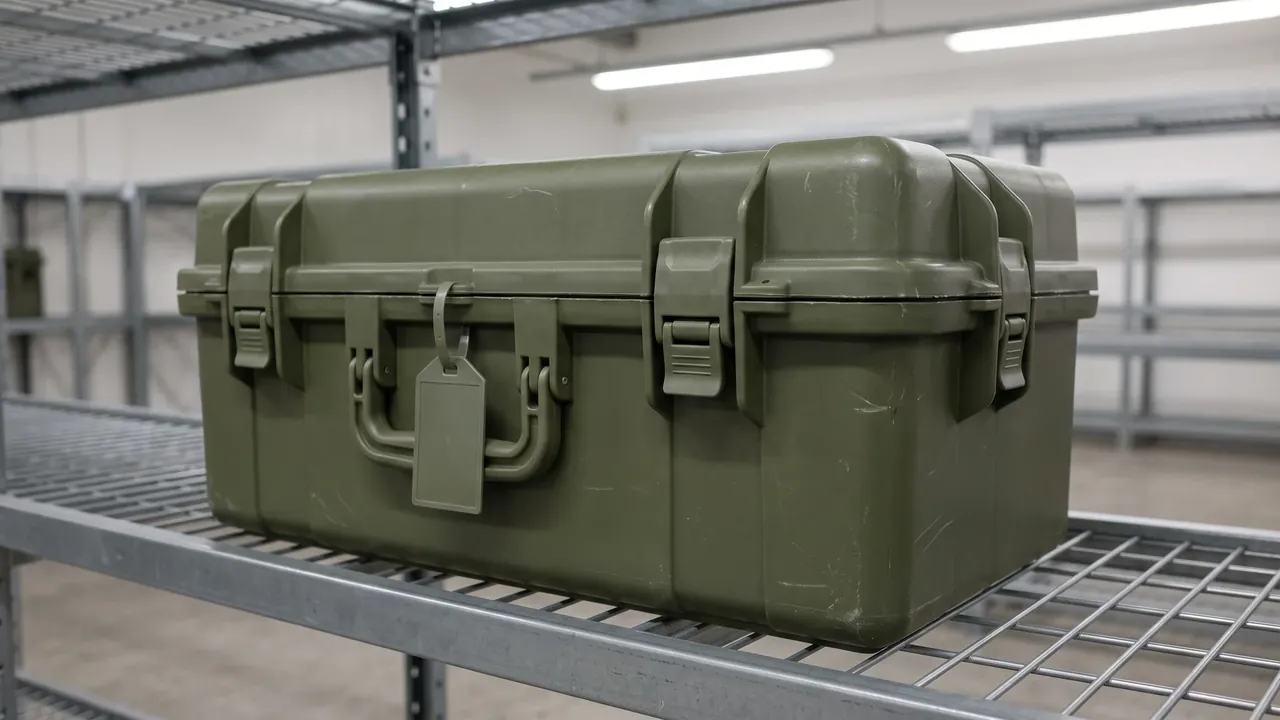
The liner is the part that works closest to the contents. Its job is to reduce the freedom of the packed item to almost zero while absorbing transport impact energy before it reaches the item. Common liner materials include EVA, EPE, PU foam and high-density sponge, chosen by balancing density, resilience, compression set and machinability. Closed-cell EVA is dense, resilient and easy to CNC-mill into a close-fitting cavity, making it a common choice for precision and heavy items. EPE is lighter and cushions well but collapses under sustained load, suiting lighter contents. PU foam can be poured on site to fill irregular space, but it demands controlled working conditions.
Cavity logic matters more than material. Reliable cushioning is not about burying an item in foam; it starts by identifying which force the item fears most and then using structure to cut that load path. Items vulnerable to impact are wrapped in closed-cell material with controlled deflection space. Items vulnerable to crushing sit on load-bearing cradles so their weight lands on rigid supports rather than on the cushioning material. Items vulnerable to abrasion get a soft facing so they never rub against a hard liner. Items vulnerable to shifting get removable dividers and limit blocks that allow only minimal travel. JUNZHIJIA follows a rule of one cavity per item and separating precision from heavy parts, precisely to avoid meeting contradictory protection goals with one generic block of foam.
Liner maintainability also drives long-term cost. When contents change, a spare part number is substituted or an accessory is added, a modular liner allows only the affected blocks to be replaced instead of remaking the whole case. Removable dividers let users adjust cavity positions without destroying the cushioning structure. If a liner is fully potted or moulded as one piece, every change means scrapping the case, which becomes a hidden cost in defence-trade orders that must stay in service for years.
Sealing, Moisture Control and VCI Rust Prevention
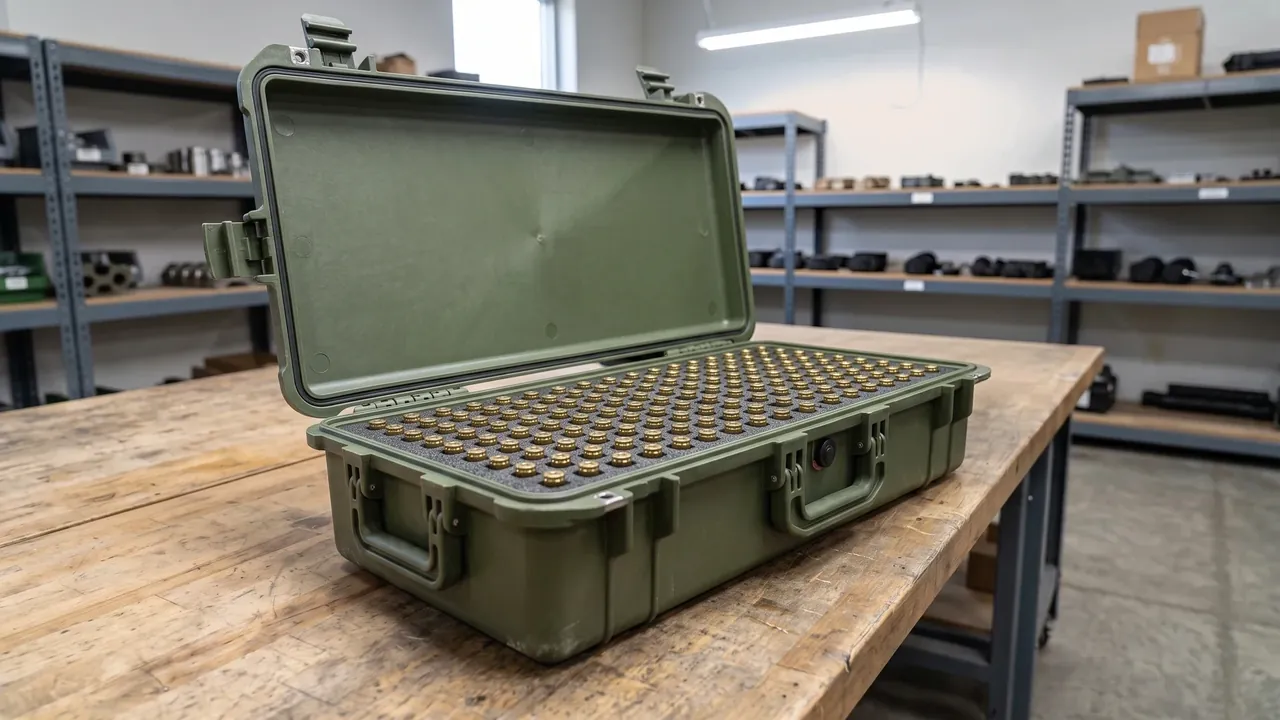
Sealing and rust prevention solve entirely different problems but are constantly confused. Sealing addresses whether water and dust outside can get in; rust prevention addresses whether the moisture and oxygen already inside will oxidise a metal surface. Only when both are handled does packed metal stay serviceable after long storage. For how sealing components are selected and replaced, see the importance of sealing in ammunition storage boxes.
The core of sealing is a continuous sealing line at the joint face. The common approach is to cut a channel into the shell or lid, seat a silicone or EPDM gasket, and close it under latch clamping force that compresses the gasket to its design value, forming an unbroken seal. Seal failures are rarely about bad material; they come from insufficient compression, foreign matter trapped in the gasket, a distorted joint face or weakened latch clamping force. Acceptance should therefore look not only at initial sealing performance but at how well compression is retained after latch cycles.
Moisture and rust control rely on managing the micro-environment inside the case. Desiccant holds humidity low, a humidity indicator card gives a visible criterion, and VCI material releases inhibitor molecules that form a protective film on metal surfaces. VCI's value is that it does not depend on perfect sealing: even if the case is briefly opened or the seal is challenged, inhibitor molecules still provide protection for a period. But it has preconditions. Metal parts must be clean and dry when loaded, because cutting fluid, fingerprints or existing rust prevent the film from bonding evenly. In high-humidity regions or high-salinity sea freight, moisture control and rust prevention are usually stacked rather than chosen between. Warehouse conditions also affect internal state; storage, stacking and moisture control in humid warehouses gives the warehouse-side practices that support the box.
IP Ratings and the Pressure-Equalisation Valve
An IP rating is the common language for dust and water resistance, with IP65, IP66 and IP67 covering different spraying and short-immersion conditions. The first selection rule is to match the real transport and storage environment rather than choosing the highest number. If goods stay inside a container and are never rained on or immersed, IP65 already covers dust and water spray. If there is open-air transfer, deck stowage or possible short-term standing water, IP66 or IP67 comes into play. Higher ratings demand tighter joint-face machining, higher latch clamping force and more consistent gaskets, so cost and maintenance rise with them.
Breathing matters as much as waterproofing. A gasketed case in an aircraft cargo hold, at altitude or in storage with wide seasonal temperature swings develops a pressure difference that stresses the seal: a small difference makes the case hard to open, while a large, repeated difference can deform the gasket and damage the seal it was meant to protect. A pressure-equalisation valve permits slow gas exchange while maintaining water and dust exclusion, keeping the pressure difference within what the sealing system tolerates. It is especially relevant to military logistics containers that fly or circulate across climate zones.
The maintenance rhythm for the sealing system should be written into the delivery instructions. Cases opened frequently need shorter gasket inspection intervals; seasonal storage cases can be checked on entering and leaving the season; a gasket showing permanent set, cracking or obvious hardening should be replaced as a whole. Shipping maintenance requirements with the case is what turns factory sealing performance into whole-life sealing performance.
MIL-STD-810H and GJB Tests Mapped to Packaging
The point of environmental and mechanical testing is to turn "can it take it" into a repeatable, judgeable conclusion. Packaging tests generally fall into three groups: mechanical stress, covering vibration, drop, shock and stacking compression; climatic, covering temperature cycling, humidity, salt fog and rain; and combined, which applies mechanical and climatic stresses together against a realistic transport profile. Before a design is frozen, the test spectrum should be built from the actual transport mode, road, rail, sea or air, and the number of handling stages, rather than from a generic template.
The drop test exposes structural weakness most directly. It simulates an accidental drop during handling and tests whether corner strength, liner cushioning and content restraint work together. Drop height and attitude should follow the box's actual weight and centre of gravity, and an empty-box drop pass proves almost nothing, because the real risk comes from the inertia of the mass inside at the moment of impact. The vibration test simulates sustained excitation over a long journey, looking at whether the liner fatigues and collapses, whether fasteners loosen, and whether contents gradually shift.
The stacking test addresses storage. Long-term static stacking and dynamic stacking during transport are not the same: the former is a sustained load, the latter adds road excitation. Rib layout, lid stiffness and stacking features together decide whether a box keeps its shape under stacking. Salt fog and damp heat tests serve sea freight and tropical storage, verifying corrosion behaviour of metal parts, hinges and latches. JUNZHIJIA normally supplies key test records for the relevant batch, so packaging quality can be traced rather than judged by appearance alone.
UN Packaging and Export Packing Certification
For dangerous goods, the packaging container itself must pass type testing and obtain the corresponding certification, with a conforming UN packaging mark applied to the box. What is discussed here is still the container: certification concerns the performance of the package, whether it meets requirements in drop, stacking and sealing tests, not the properties of the goods. Common packaging types include fibreboard boxes, plywood boxes, steel drums and plastic drums, each mapped to a packaging code and a test combination. Whether a package is managed under dangerous-goods rules, and under which class and packing group, is subject to local regulations and export control requirements; this article discusses the packaging container only.
Type testing typically includes some combination of drop, stacking, leakproofness and hydrostatic tests, with the combination set by the packaging type and the classification of the goods. Certification hinges on consistency: a design that has been certified must be produced in batch with the same material, structure and process as the submitted sample, and any substantive change may require retesting. Manufacturers therefore need a complete record chain from raw-material batch and moulding parameters to finished-unit serial numbers, so that every box leaving the factory maps to a certified design.
Export packaging compliance also involves destination-country import requirements. Some markets impose additional rules on wood packaging, recycled content, marking language and accompanying documents, and exporters should confirm packaging admission conditions for the target market at quotation stage. Certification and admission for US-bound protective cases surveys the compliance points commonly raised on the import side, while general requirements for export packaging compliance gives a fuller framework covering materials and documents. Bringing both sets of requirements forward into the design stage avoids reworking a product after it has already been tooled.
Marking, Barcodes and RFID Traceability
Marking is the interface between the packing box and the information system. A poorly marked box can be mishandled at every stage of storage, picking, loading and counting. Standard marking usually covers contents name and quantity, gross and net weight, centre-of-gravity guidance, orientation such as an upward arrow, batch or serial number, production date and manufacturer information. UN packaging marks are applied under their own rules and sit alongside these markings rather than replacing them. Marking durability matters too: ink should resist abrasion, moisture and ultraviolet light, and pressure-sensitive labels should use an adhesive system suited to long storage so they do not fall off in damp conditions.
Barcodes and QR codes extend marking from something read by people to something read by machines. A linear barcode suits fast entry into a warehouse system, while a QR code can carry more fields such as part number, batch, packing date and inspection status. For boxes in service for years, label replaceability should be designed in: reserve a renewable label area on the shell, or fit a tag holder on textured surfaces, rather than pressing labels onto reinforcement ribs where they will not bond reliably.
RFID suits fast, bulk, non-line-of-sight counting. It identifies batches and reconciles inventory without opening the case, which is valuable to customers that conduct regular stocktakes or verify case-to-manifest consistency. Tag selection must match shell material: metal shells shield or reflect radio energy, so on-metal tags and a carefully chosen read-write position are required, while engineering-plastic shells are far more forgiving. The value of traceability is not the technology itself but the ability to pull up, at any time, what is inside a box, which batch it belongs to and what its inspection status is. Related certification and traceability requirements are covered in certification and traceability for ammunition transport boxes.
Palletisation, Stacking and Container Loading
Palletisation is the first step in organising individual boxes into a transport unit. Pallet dimensions should match the target market standard, commonly a 1200 by 1000 mm or 1200 by 800 mm footprint, so that the stacking features on the box base align with the pallet and the unit is stable without wasting load space. Stacking follows heavy low, light high, with similar case heights on one pallet so that no upper case bridges two cases of different height and creates an eccentric load.
The stacking load path needs to be designed explicitly. Ideally, the weight of upper cases travels down the walls and corner posts to the base and pallet without passing through the contents. That requires interlocking stacking features on base and lid, sufficient bearing area at the corners, and ribs that run continuously from bottom to top. If stacking features only stiffen a local part of the lid, load concentrates at a few points and the lid distorts first under long-term stacking. Stack height is also limited by racking and container internal height, so before loading, confirm that unit height multiplied by the number of tiers fits the internal clear height of the vehicle.
Container loading concerns weight distribution and restraint. The centre of gravity of the whole consignment should sit near the longitudinal centre and on the floor, avoiding an overloaded end that unbalances axle load or lifting. Boxes should be restrained against movement relative to each other and to the container walls, and cargo at the door end should be secured reliably, because movement at the moment of opening is the most likely to cause a fall. Rail and sea loading rules differ, so operations should follow the carrier's loading specification; loading and transport precautions for protective cases lists more detailed checkpoints.
Lifting, Forklift Handling and Manual Movement
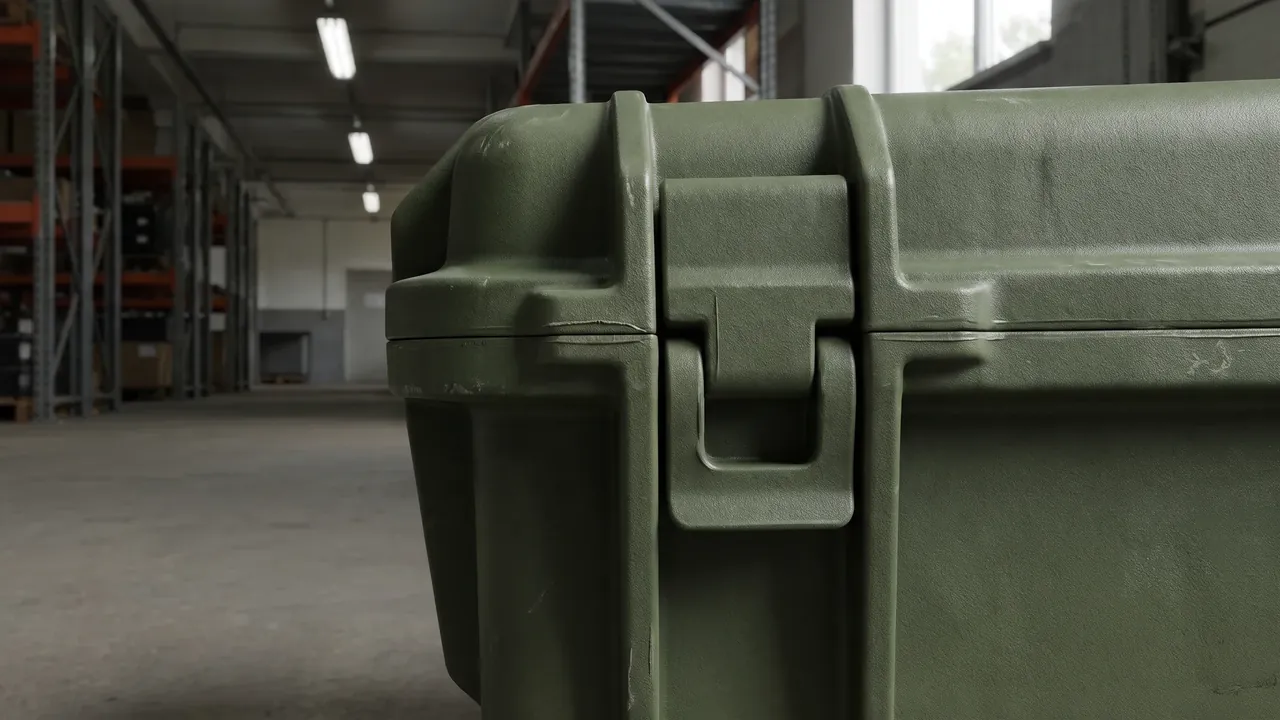
Handling is where both boxes and people are most often injured, so the box design must account for how it will be moved. Forklift handling is the most common mechanical method and requires clear fork-entry pockets whose centre spacing aligns with the box centre of gravity so the load stays level and does not tip. Fork pockets need enough structural strength to take the local pressure of the forks without collapsing. Boxes without pockets should have lifting points or dedicated lifting gear, with the lifting positions and permitted method stated in the marking.
The key to lifting is a clear load path. The wider the sling angle, the greater the horizontal component acting on the lifting points, which can crush the side walls or fail a point locally. The number, position and capacity of lifting points should match the weight and be checked at design stage. For boxes with a high centre of gravity, swinging during the lift is a risk, and a counterweight note or repositioned lifting points may be needed, with a spreader beam where appropriate.
Manual movement suits only boxes within safe weight and size limits. Boxes beyond a single person's capacity should be marked clearly for mechanical or two-person handling, avoiding damage to the box and strain injuries caused by forcing a lift. In practice, grip handles or hand slots on both sides markedly reduce the chance of dropping a case. All handling cues, fork pockets, lifting points, upward direction, centre of gravity and weight, should be grouped on the same face or side so an operator can read them at a glance and mis-handling becomes less likely.
Third-Party Inspection and AQL Acceptance Sampling
At volume, inspecting every unit is neither economic nor practical, so sampling inspection becomes the norm. AQL sampling plans use GB/T 2828.1 and ISO 2859-1 as the general basis, determining sample size and acceptance number from lot size, inspection level and AQL value. The key is defect classification. Critical defects affecting sealing, strength and safety, such as a broken sealing line, a failed latch or a structural crack, should be judged strictly; minor defects affecting appearance and convenience, such as colour variation or slight print offset, can be relaxed appropriately. Unclear classification is a common reason sampling plans fail. For the full method, see AQL acceptance practice for custom protective cases.
The value of a third-party body lies in independence and traceability. For defence-trade orders, buyers often require witnessed or pre-shipment inspection at the factory, with a qualified body checking material certificates, dimensions, sealing performance and marking content and issuing a report. The manufacturer should prepare in advance: verifiable drawings and technical conditions, raw-material batch certificates, test records and traceable finished-unit serial numbers. Getting documentation ready before inspection, rather than filling gaps during it, is the precondition for passing first time.
Beyond third-party inspection, a self-check and sample-retention system should be established. Retaining a sample case or measured data for key components from each batch means that if a field problem appears, it can be traced back to a specific batch and process parameter. Retention is not only for resolving disputes; it is also the source of real data for later design improvement.
Delivery Documents, Sample Approval and the Compliance Statement
When a packing box is delivered as an engineered product, the accompanying documents matter as much as the hardware. Typical documents include a technical specification or product drawing with material, dimensions, sealing class and load requirements; a packing list with contents and quantities; key test reports; raw-material or treatment certificates such as the treatment mark for wood packaging; marking artwork; and usage and maintenance instructions. The completeness of these documents decides whether the customer can bring the packaging into its own quality system and warehouse management.
Sample approval is the last gate before bulk production. The first-article sample should pass a full check of appearance, dimensions, sealing, load capacity and fit, and be confirmed in writing by the customer. Confirmation is not simply whether it looks right; it covers the fit between liner and contents, latch opening force and closing feel, gasket compression state, and whether marking content matches the order. After first-article approval, batch units should match the sample in process and material, and any change should be re-confirmed.
One principle runs through the whole flow. Packaging container engineering answers how to pack, move and store goods safely and compliantly, while whether goods may be exported, how they are declared and which licences are needed belongs to export compliance. In any controlled scenario, local regulations and export control requirements take precedence, and this article discusses the packaging container only. JUNZHIJIA, manufactured by Kexin New Materials (Guangdong) Co., Ltd., has long supplied custom container solutions to defence-trade and industrial customers, and can deliver structural design, liner development, sealing configuration and test support against a customer's technical conditions, helping reduce the uncertainty of the packaging stage to a manageable level.
FAQ: Ammunition Packing Box Questions
Q: Why must an ammunition packing box distinguish transport packing from storage packing?
A: The two fail in completely different ways, and mixing them weakens protection on both sides. A transport pack faces short, high-intensity stress such as a handling drop, vehicle vibration and stacking compression, so design focuses on structural stiffness, liner cushioning and restraint, aiming to survive one journey. A storage pack faces long-cycle small temperature differences, humidity cycling and static stacking load, so design focuses on sealing, desiccant, rust prevention and shape stability under sustained compression, aiming to stay undistorted and rust-free for years. If a one-trip transport box is made to carry years of storage, the gasket loses resilience under permanent compression and the liner gradually collapses under static load. If a long-term storage box is used for frequent handling, its hinges and latches may wear out early from excessive cycles. JUNZHIJIA normally confirms the intended use at enquiry stage, whether transport-led, storage-led or both. For orders that must do both, it adds margin in gasket life, hinge strength and liner compression set, and states inspection intervals in the instructions. Defining transport and storage separately is the cheapest first step in avoiding a selection error.
Q: Why must export wood packaging be ISPM 15 treated?
A: Because untreated wood can carry pests harmful to forests, and destination countries impose mandatory requirements on wood packaging material to prevent the spread of pests with packaging. The usual compliant method is to heat-treat or fumigate the timber and then apply a conforming mark showing the treatment method and the facility number. This step is unrelated to the internal structure of the box, yet it directly decides whether goods can enter the country: untreated wood packaging may be refused at the port, ordered returned, or forcibly treated in the destination country with costs borne by the consignor. Several points are easily missed in practice. The treatment mark should be clear, durable and correctly placed. The treatment certificate should travel with the goods for verification. If a shipment mixes pallets, dunnage and bracing timber, all of that wood must meet the same requirement, not just the outer crate. When taking orders that need wooden overpack, JUNZHIJIA confirms the target market's specific requirements with the customer and states the treatment method and mark content in the packaging plan, so nothing has to be improvised before shipment.
Q: What do the codes in a UN packaging mark mean, and what should buyers check?
A: A UN packaging mark is a set of rules-ordered information showing the packaging type, material category, performance level and manufacturing details. Buyers do not need to memorise every code, but they should verify the key fields. The letter and digit combination for packaging type indicates the basic structure class. The following letter and digit combination indicates material type, such as steel, aluminium, plywood, fibreboard or plastic. What follows relates to test performance, and the mark ends with the year of manufacture and the maker's code. Concentrate on three things: whether the mark matches the type agreed in the order; whether the performance level suits the target market and transport mode; and whether the mark is clear and durable enough to remain legible after repeated circulation and outdoor exposure. Note that a mark only shows the container passed the tests for that type; it does not mean the container may be used for any goods. Whether a package is managed under dangerous-goods rules, and under which class, is subject to local regulations and export control requirements; this article discusses the packaging container only. Buyers should include mark verification in the incoming inspection checklist.
Q: How do you choose between IP65 and IP67 sealing on a packing box?
A: Judge by the form of water and dust the box actually meets in transport and storage, not by which number is larger. IP65 covers dust protection and water spray, suiting a journey that stays inside a container and is never rained on or immersed. IP66 withstands stronger spraying. IP67 permits short immersion under specified conditions, suiting open-air transfer, deck stowage or possible short-term standing water. Higher grades demand tighter joint-face machining, higher latch clamping force, more consistent gaskets and stricter assembly, so cost and maintenance frequency rise with them, which makes adequate more economical than maximal. Selection should also consider how the box is used. A box opened frequently can hardly keep a high-grade seal over the long run, because every opening brings the gasket into contact with foreign matter. A box used mainly for storage is better suited to a higher grade combined with desiccant and a humidity indicator card. JUNZHIJIA usually asks customers to describe the real transport and storage stages, whether it flies, whether it is open to weather, whether water can collect, and sets the sealing grade from that rather than picking a grade and reasoning backwards.
Q: Can a VCI liner replace sealing?
A: No. They solve different problems, and the correct relationship is complementary rather than interchangeable. Sealing controls whether water and dust outside can enter, isolating the internal environment from the outside. VCI controls the tendency of metal surfaces inside to oxidise, releasing inhibitor molecules that form a protective film. If a box is poorly sealed and outside moisture keeps entering, the inhibitor molecules are continually diluted and carried away, and protection time falls sharply. Conversely, with sealing but no rust-prevention configuration, residual moisture and oxygen trapped at closure can still oxidise metal surfaces during long storage, especially where temperature cycling repeatedly causes condensation. For long sea voyages or humid storage, the usual configuration is therefore a combination of sealing, desiccant, humidity indicator card and VCI. Using VCI has one precondition: metal parts must be loaded immediately after cleaning and drying, because cutting fluid, fingerprints or existing rust prevent the film bonding evenly. JUNZHIJIA states the effective life and replacement rhythm of VCI in its delivery instructions, so that fitting it once is not mistaken for maintenance-free operation.
Q: What does MIL-STD-810H testing mean for a packing box?
A: It means a test methodology that turns "can it take it" into a repeatable judgement, rather than a drawing that dictates the shape of the box. For packing boxes, the most relevant items are vibration, shock, temperature cycling, humidity, salt fog and rain. Vibration examines whether the shell and liner fatigue, whether fasteners loosen and whether contents gradually shift under sustained excitation. Drop and shock examine whether corner strength, cushioning and restraint work together. Temperature cycling and damp heat examine material stability under repeated expansion and contraction and under condensation. Salt fog examines corrosion behaviour of hinges, latches and metal parts. Before a design is frozen, the test spectrum should be built from the real transport profile, road, rail, sea or air and the number of handling stages, rather than a generic template. One warning deserves emphasis: an empty-box test has limited value, because the destructive load comes from the inertia of the contents at the moment of impact. JUNZHIJIA designs test conditions around the actual loaded weight and centre of gravity and supplies the corresponding records with delivery.
Q: Why do palletisation and container loading affect packaging safety?
A: Because transport damage is often not a single-box problem but the result of a whole unit becoming unstable. Palletisation determines how boxes form a unit: only when the pallet footprint and the box stacking features match is the unit stable, and only with heavy low, light high and similar heights on one pallet does an upper box avoid bridging cases of different height and creating an eccentric load. The stacking load path must be designed explicitly. Ideally, upper weight travels down the walls and corner posts to the base and pallet without passing through contents, which requires interlocking stacking features, sufficient corner bearing area and ribs that run continuously from bottom to top. Container loading then governs weight distribution and restraint: the centre of gravity should sit near the longitudinal centre and on the floor, boxes should be restrained against each other and the walls, and cargo at the door end should be secured, because movement at the moment of opening is the most likely to cause a fall. Rail and sea loading rules differ, so operations follow the carrier's specification, and before loading the unit height and tier count should be checked against internal clear height. These belong to the loading stage yet directly decide whether the packaging design can perform as intended.
Q: How does AQL acceptance sampling work when buying packing boxes?
A: The key is to classify defects first, then select a sampling plan, then execute. Defects are usually graded critical, major and minor. Problems affecting sealing, structural strength and safety, such as a broken sealing line, a failed latch, a shell crack or a lifting-point defect, are critical and judged strictly. Problems affecting function but repairable, such as an over-tight hinge, can be major. Appearance-only issues, such as colour variation or slight print offset, can be minor. Once graded, lot size, inspection level and the AQL value for each class determine sample size and acceptance number under GB/T 2828.1 or ISO 2859-1. At execution, sampling must be random, judgement criteria written down, inspection records traceable, and a clear handling route defined for nonconforming lots. For defence-trade orders, buyers often require third-party witnessed inspection, so the manufacturer should prepare drawings, material certificates, test records and finished-unit serial numbers before inspection. Before bulk delivery JUNZHIJIA completes latch-cycle and sealing sampling and retains batch records, so acceptance is evidence-based.
Related Reading
- Certification and traceability for ammunition transport boxes
- The compliance path for military-standard protective cases
- Mapping MIL-STD-810H items to protective cases
- Cross-border logistics planning for protective cases
- AQL acceptance practice for custom protective cases
- Loading and transport precautions for protective cases
- Certification and admission for US-bound protective cases
- Writing technical conditions for protective case tenders