

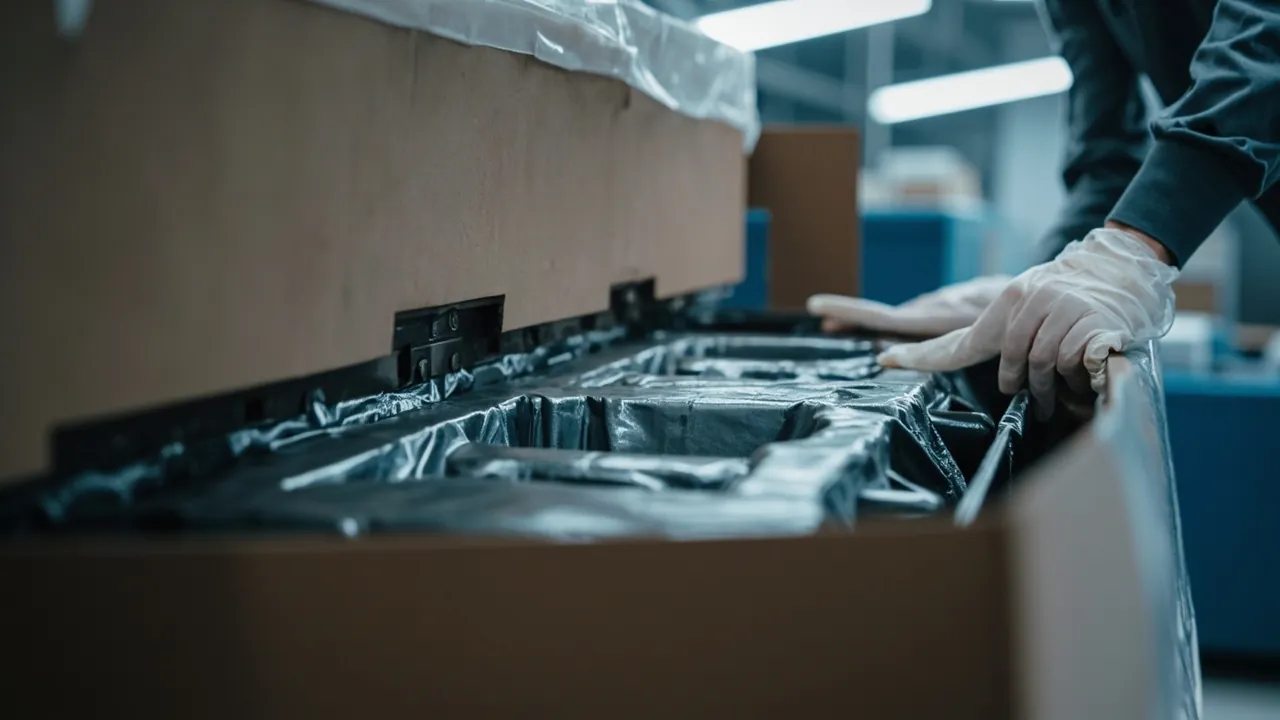
Short answer: what goes wrong when protective cases are exported is rarely the product itself. It is three things - packaging that is not strong enough so the goods arrive damaged, wood packaging that does not comply with ISPM 15 and is returned or destroyed, and documents or tariff classification that do not line up and hold up customs clearance. There is an irony here: a protective case exists to protect someone else's product, yet in export transit it often travels with no protection of its own - no corner boards when stacked, no cushioning between cases, no stretch film around the pallet, no stacking markings on the carton. The result is scuffing, crushed corners, deformed latches and even a chipped sealing face on arrival. On top of that, export adds two thresholds that have nothing to do with product performance but decide whether the goods can enter the country at all: phytosanitary treatment of wood packaging and the consistency and completeness of documents.
This article is written for B2B export sales, procurement and logistics engineers. It breaks cross-border logistics for protective cases into four executable blocks: first, what loads and environments the transport chain actually applies; second, how to design the packaging and which transport packaging test standards to cite; third, how to handle wood packaging and phytosanitary requirements; and finally, a line-by-line check of customs documents, trade terms and product compliance. All dimensions, ratios and cost structures quoted here are typical or empirical values used to build a judgement framework. Formal operations should follow carrier requirements, the current regulations of the destination country or region, and the written opinion of a professional customs broker or freight forwarder. If you are about to ship a batch of protective cases, toolboxes, military specification storage boxes or waterproof junction boxes overseas, this checklist can be used directly as a pre-shipment inspection sheet.
Contents
- Short answer: three gates - packaging strength, quarantine compliance, document consistency
- What a protective case goes through in transit: six load types and environments
- Export packaging design: inner packing, cartons, pallets and moisture control
- Transport packaging test standards: how to cite ISO 2233, ISO 2234 and GB/T 4857
- Wood packaging and ISPM 15: fumigation, heat treatment and the IPPC mark
- Loading and container selection: volumetric weight, load factor and box type
- The customs document checklist: a complete export document set
- Incoterms 2020: risk and cost allocation across common rules
- Classification and duty: how the HS code is determined
- Product compliance: CE, RoHS, REACH and destination requirements
- Cargo insurance, claims and arrival inspection
- Common cross-border logistics incidents and how to prevent them
- Frequently Asked Questions
- Conclusion and Related Reading
Short answer: three gates - packaging strength, quarantine compliance, document consistency
Gate one is packaging strength. A protective case endures harsher loads in cross-border transit than in domestic shipping: longer transit times, more handling points, more extreme temperature and humidity swings, and the high salt and moisture environment of sea freight. The packaging plan must be designed against the actual risk of the transport route, not inherited from domestic practice. The test is simple: if your packaging plan cannot name a transport packaging test it has passed, whether it is sufficient comes down to luck.
Gate two is wood packaging quarantine. Where solid wood pallets, crates, dunnage or bearers are used as packaging or stowage material, most countries require the wood to be heat treated or fumigated and marked with the IPPC symbol. Wood packaging that has not been treated, or that carries a non-conforming mark, may be ordered for return, destruction or treatment, with costs borne by the shipper. This is purely a compliance issue, unrelated to product quality, and it is regularly overlooked.
Gate three is document consistency. The description, quantity, weight, value and shipping marks on the invoice, packing list, bill of lading, certificate of origin and insurance certificate must agree with each other and with the actual cargo. Any mismatch can trigger inspection, supplementary filings or port delay. The cost of a clearance delay is usually far higher than the cost of preparing the documents properly.
One line to memorise: for exported protective cases, getting the product right is only half the job. Packaging, quarantine and documents complete it.
What a protective case goes through in transit: six load types and environments
Understand the risk before designing the packaging. Cross-border transport applies roughly six load types to a package.
| Load type | Typical source | Possible damage | Countermeasure |
|---|---|---|---|
| --- | --- | --- | --- |
| Static stacking load | Multi-tier stacking in a container, warehouse stacking | Case creep and deformation, crushed sealing face, carton collapse | Limit stacking tiers, use corner boards, raise carton compression strength |
| Drop and impact | Loading, transfer, sorting, manual handling | Corner cracking, latch fracture, hinge deformation | Corner cushioning, insert location, drop test verification |
| Vibration | Road, rail and ship's main engine vibration | Contents shifting, fasteners loosening, label lifting | Insert restraint, anti-loosening design, fastener locking |
| Compression and squeeze | Lashing, clamps, adjacent cargo in groupage | Sidewall denting, local deformation | Lateral reinforcement, avoid point-contact lashing |
| Temperature and humidity | Day-night swing, climate zones, high container temperature | Accelerated seal ageing, packaging absorbing moisture, condensation | Desiccant, moisture barrier liner, avoid direct sun |
| Salt spray and corrosion | Sea freight environment, open port storage | Hardware rust, metal nameplate corrosion | Anti-corrosion coating, rust-preventive packaging, VCI material |
Sea freight has a frequently overlooked phenomenon called container rain. By day the internal temperature of a container can exceed 60 °C; as it cools at night, water vapour condenses on the container walls and on cargo surfaces and drips down. This is fatal for cartons - corrugated board that absorbs moisture can lose 40 percent or more of its compression strength. The countermeasures are to control the moisture source and add margin: goods and packaging should be dry before stuffing, sufficient desiccant should be placed inside, and loading should be avoided in rain.
Vibration is the most underestimated load. Cumulative vibration over one trans-Pacific sea voyage can reach hundreds of hours - more than enough to loosen fasteners that were only slightly slack, shift inserts and lift labels. If there is free play inside a protective case, vibration amplifies it into wear. This is why an insert must positively locate the contents rather than simply fill space.
Export packaging design: inner packing, cartons, pallets and moisture control

Export packaging for protective cases usually has four layers, each with a defined job.
| Layer | Composition | Primary function | Common failure |
|---|---|---|---|
| --- | --- | --- | --- |
| One: product protection | Bubble film, EPE sleeve, corner protectors | Prevent surface scuffing and corner impact | Wrapping the faces but not the corners, where damage concentrates |
| Two: inner packing | Individual inner box or divider | Prevent direct rubbing between cases | Several bare cases stacked directly |
| Three: master carton | Corrugated carton, honeycomb board carton, timber crate | Provide overall compression and stacking strength | Carton too loose, cases shifting inside |
| Four: unit load | Pallet, stretch film, strapping, edge boards | Stable mechanical handling | No pallet, or insufficient film, so the load collapses |
Beyond these four layers are two systems: moisture control and marking.
Moisture control covers desiccants (commonly silica gel or montmorillonite), rust-preventive materials (VCI film or paper for cases containing metal parts) and moisture barrier liners (aluminium foil composite film). Desiccant quantity should be calculated from package volume, transit duration, destination climate and the moisture transmission of the packaging, not guessed. As a rule of thumb: long sea voyages, humid destinations and products containing metal parts all call for materially more desiccant than domestic short-haul shipments.
Marking covers shipping marks (consignee, destination, order number, carton number, piece count), stacking tier markings, and barcode or QR labels. The GS1 Serial Shipping Container Code can be used for pallet-level traceability. Markings must agree with the documents and use weather-resistant ink and face material, or they will blur quickly in the high humidity of a sea voyage. For the selection logic of marking carriers and durability, see asset numbering and QR traceability for protective cases; the same selection principles apply to export shipping marks.
One practical rule: write the packaging plan into a formal specification confirmed alongside the product drawing as part of the technical agreement. The plan should cover inner packing materials and dimensions, carton material and size, units per carton, gross and net weight and volume per carton, pallet size and tiers per pallet, film and strapping method, desiccant quantity, and the content and position of shipping marks. Deciding packaging at the last minute before shipment is one of the leading causes of arrival damage.
Transport packaging test standards: how to cite ISO 2233, ISO 2234 and GB/T 4857
A packaging plan is only defensible if it cites a test standard. Three families of transport packaging testing are commonly used.
The first is the ISO series for complete, filled transport packages. ISO 2233 specifies conditioning before testing and is a precondition for the other tests. ISO 2234 specifies the static load stacking test. ISO 2248 specifies the vertical impact drop test. ISO 4180 sets out general rules for testing complete, filled transport packages. The defining feature of this family is conditioning before testing, because the mechanical properties of cartons and plastics depend heavily on temperature and humidity, and results from unconditioned samples are not comparable.
The second is the GB/T 4857 series, the Chinese national standard family of basic tests for transport packages, corresponding to the ISO family and covering stacking, drop, vibration, impact and water spray. Where the customer is in China or a domestic test laboratory report is preferred, the GB/T 4857 series is more convenient.
The third is the ISTA series, which packages tests into programmes by transport mode and scenario - programmes for small parcels, for palletised shipments, and enhanced programmes for multi-modal transport. The strength of ISTA is that it mirrors real logistics scenarios closely, and it is widely used in e-commerce and fast-moving consumer goods.
| Test item | Reference standard (example) | Failure mode verified | When it is essential |
|---|---|---|---|
| --- | --- | --- | --- |
| Conditioning | ISO 2233 | Consistency of test conditions | Before every mechanical test |
| Static stacking | ISO 2234 / GB/T 4857.3 | Long-term stack collapse, creep | Multi-tier container stacking, long storage |
| Vertical drop | ISO 2248 / GB/T 4857.5 | Corner cracking, latch fracture | Wherever transfer and manual handling occur |
| Vibration | GB/T 4857.7 / GB/T 4857.10 | Loosening, wear, shifting | Sea freight, long road transport |
| Water spray and moisture | Relevant part of GB/T 4857 | Moisture uptake, water ingress, rust | Open-air storage, wet season shipment |
| Unit load stability | Relevant ISTA programme | Load collapse, overturning | Palletised unit load transport |
Three practical points when citing standards:
- The test object should match the actual package, including carton, insert, pallet and strapping method. Change the carton or remove one corner board and the test conclusion no longer applies.
- Test conditions should reflect the real route. Drop height, for instance, should follow the handling method and weight rather than a single arbitrary figure.
- The test report should be traceable, recording sample description, conditioning conditions, test parameters and the verdict. Where the report supports project acceptance, the standard and pass criteria should be written into the technical agreement.
For the relationship between packaging strength and case structure, see how the stacking structure of a protective case is designed. The protective effect of packaging depends on the combination of case stiffness and package cushioning, and if either side is too weak, the other fails.
Wood packaging and ISPM 15: fumigation, heat treatment and the IPPC mark
Wood packaging quarantine is the classic area where lack of knowledge causes avoidable loss.
The rule centres on International Standard for Phytosanitary Measures No. 15 (ISPM 15), whose purpose is to prevent pests carried by wood packaging from spreading through international trade. Under the standard, wood packaging material used in international trade - including pallets, crates, dunnage, bearers, wedges and reinforcing timber - must receive an approved treatment and carry a compliant mark bearing the IPPC symbol.
| Treatment | Mark code | Description | Note |
|---|---|---|---|
| --- | --- | --- | --- |
| Heat treatment | HT | Wood core temperature raised to a specified level and held | The most common method, reusable after treatment |
| Methyl bromide fumigation | MB | Treated by fumigation | Restricted or prohibited by some destinations |
| Dielectric heating | DH | Treated by dielectric heating | Relatively narrow application range |
A compliant mark normally contains four elements: the IPPC graphic symbol, the country code (CN for China), the wood packaging producer code assigned by the national plant protection organisation, and the treatment code (HT, MB or DH). The mark must be clear, permanent and visible, normally applied to two opposite faces of the wood packaging.
Three practical points that avoid most trouble:
First, distinguish solid wood from processed wood. Plywood, particleboard, fibreboard and oriented strand board, produced under high temperature and pressure, are generally regarded as processed wood and, in most countries implementing ISPM 15, are not subject to the standard's wood packaging requirements. Where the destination is strict on quarantine, using plywood pallets or plywood crates can materially reduce both compliance risk and treatment cost. Whether an exemption applies in a given destination should still be confirmed against current local rules and with the forwarder.
Second, the treatment mark must come from a compliant source. Printing or imitating the mark yourself is a violation, and the consequences when detected are far more serious than the treatment cost. Buy wood packaging from qualified suppliers who can provide treatment certificates.
Third, treatment does not last forever. If wood packaging becomes damp, mouldy or is re-infested during unprotected long-term storage, its compliant status may be questioned. Wood packaging should be stored dry, under cover and away from pest risk.
One hard rule of thumb: where an export project involves wood packaging, check every piece for the IPPC mark before loading, and retain photographs and treatment certificates. That one minute costs far less than a return shipment or destruction.
Loading and container selection: volumetric weight, load factor and box type
Loading efficiency directly determines freight cost per case, and protective cases are classic low-density cargo - large volume, low weight.
Step one is to understand how chargeable weight is taken. Express and air freight charge on the greater of actual weight and volumetric weight, the latter usually calculated as length x width x height in centimetres divided by 5,000, with some channels using 6,000. Sea LCL charges on the greater of weight tonnage and measurement tonnage, where one cubic metre counts as one measurement tonne. Protective cases are almost always charged by volume, so improving load factor saves more than squeezing material cost.
Step two is choosing the container type. Common types and loading characteristics (typical dimensions; actual values should follow the carrier's specification):
| Container | Approximate internal dimensions | Approximate capacity | Loading characteristics |
|---|---|---|---|
| --- | --- | --- | --- |
| 20 ft standard | 5.9 x 2.35 x 2.39 m | About 33 m3 | Payload limited; low-density cargo runs out of volume first |
| 40 ft standard | 12.0 x 2.35 x 2.39 m | About 67 m3 | The workhorse for low-density cargo; most economical when well filled |
| 40 ft high cube | 12.0 x 2.35 x 2.69 m | About 76 m3 | About 12 percent more height; clearly beneficial for high stacking |
| 20/40 ft open top | Top loading by crane | Depends on type | Over-height packages or crane-loaded items |
| Flat rack | No side walls | - | Oversized or irregular packages |
Step three is understanding the three layers of void. The volume of the case itself, the gaps between cartons, and the gaps between pallets and container walls stack up. Empirically, total void from net case volume to occupied container space can reach 25 to 45 percent. The right order of loading optimisation is therefore:
- Optimise carton dimensions first, so the carton hugs the case profile and internal void is small.
- Then optimise stacking tiers, adding layers within the compression limit of the carton and the internal height of the container.
- Then optimise the pallet pattern, raising units per pallet and reducing the gap around the pallet.
- Only then consider special container types or irregular stowage.
Step four is to watch the surcharges. Ocean freight is not just the base rate. It includes bunker adjustment, peak season surcharge, port congestion surcharge, destination terminal handling, and demurrage and detention. Demurrage and detention are the most common unexpected cost in export projects, usually caused by document problems or a consignee slow to collect, charged by the day and accumulating quickly. The prevention is to confirm in advance that the consignee can clear and collect, and to state in the contract who bears demurrage caused by the consignee.
For a combined calculation of freight and product cost per unit, see how is a protective case costed: the price structure of materials and process; the volumetric weight and load factor analysis there follows the same logic.
The customs document checklist: a complete export document set
Documents are the passport through customs. A complete export document set normally contains the following, and it is worth turning this into a standard checklist to be worked through before every shipment.
| Document | Issued by | Core content | Common problem |
|---|---|---|---|
| --- | --- | --- | --- |
| Commercial invoice | Exporter | Description, specification, quantity, unit price, total, currency, trade term | Description inconsistent with HS classification, value not matching the bill of lading |
| Packing list | Exporter | Pieces, contents per carton, gross weight, net weight, volume, shipping marks | Gross and net weights wrong, volume error too large |
| Bill of lading or air waybill | Carrier | Shipper, consignee, notify party, cargo description, pieces, weight, volume | Wrong consignee details, description inconsistent with invoice |
| Certificate of origin | Chamber of commerce or trade promotion body | Country of origin and declarations | Not applying for the correct format under a trade agreement, missing duty preference |
| Insurance policy or certificate | Insurer | Cover, insured amount, scope | Cover mismatched to the Incoterms responsibility in the contract |
| Customs declaration and attachments | Exporter or broker | Classification, quantity, value, trade mode | Wrong classification, inaccurate value declaration |
| Inspection or test certificate | Third party or manufacturer | Ingress protection, performance items, verdict | Report sample not matched to the shipped model |
| Treatment certificate (wood packaging) | Treatment company | Treatment method and batch | No certificate, or mark inconsistent with the actual timber |
| Dangerous goods documents | Depending on cargo | Transport condition assessment, test summary | Lithium batteries carried with the case not declared as dangerous goods |
Five elements must agree: description, quantity and pieces, gross and net weight, volume, and value. These five must correspond across the invoice, packing list, bill of lading and customs declaration. Any mismatch can trigger manual inspection. In practice the inspection itself is not the problem; the port delay and breached delivery date that follow are.
On certificates of origin and duty preference. Where a free trade agreement or preferential arrangement exists between the destination and the exporting country, and the product meets the applicable rules of origin, the applicable preferential rate can be claimed with a designated certificate of origin. Whether it applies, which format is required and which rules of origin must be met should be confirmed against the agreement text and the latest requirements of the issuing body, not applied from memory. The benefit can be substantial and is worth planning for, but a false declaration to obtain it is never acceptable.
On performance documents such as the ingress protection report. Customers frequently ask protective case suppliers for an IP rating test report. Note that the sample description in the report must match the shipped model, otherwise the customer or destination regulator may not accept it. For how to verify that a document corresponds to the product, see how to verify the authenticity of IP67 certification documents; the same verification logic applies in cross-border delivery.
Incoterms 2020: risk and cost allocation across common rules
Trade terms determine who pays which cost, who carries which risk, and where risk transfers. Without normalising the term, prices are simply not comparable.
| Rule | Delivery point | Main carriage | Insurance | Export clearance | Import clearance | Risk transfer point |
|---|---|---|---|---|---|---|
| --- | --- | --- | --- | --- | --- | --- |
| EXW | Seller's premises | Buyer | Buyer | Buyer | Buyer | When goods are placed at the buyer's disposal at the seller's premises |
| FCA | Named place, to the carrier | Buyer | Buyer | Seller | Buyer | When goods are handed to the carrier |
| FOB | On board at port of shipment | Buyer | Buyer | Seller | Buyer | When goods are on board |
| CIF | On board at port of shipment | Seller | Seller, minimum cover | Seller | Buyer | When goods are on board; risk still transfers at shipment |
| CIP | Named destination, to the carrier | Seller | Seller, higher cover | Seller | Buyer | When goods are handed to the carrier |
| DAP | Named place at destination | Seller | Arranged by seller | Seller | Buyer | When goods arrive at destination ready for unloading |
| DDP | Named place at destination | Seller | Arranged by seller | Seller | Seller | When goods arrive at destination ready for unloading |
Four common misconceptions:
Misconception one: CIF and CIP require the same insurance. Under Incoterms 2020 the required cover differs; CIP requires a higher level of protection than CIF. For high-value cargo, specify the cover and insured amount explicitly rather than relying on the default requirement of the rule.
Misconception two: risk under CIF transfers at destination. CIF and CIP are shipment contracts. Risk transfers at the place of shipment; the seller's obligation is to pay freight and insurance, not to bear the risk of loss or damage to the goods. This is the most common misunderstanding when damage occurs.
Misconception three: ignoring import clearance responsibility under DAP and DDP. Under DAP the buyer handles import clearance; under DDP the seller does. A seller who signs DDP without clearance capability at destination often ends up stuck at the port of discharge.
Misconception four: treating the rule as a catch-all agreement. Terms do not cover every cost. Terminal handling, destination port charges and demurrage allocation still need to be specified separately in the contract.
A practical recommendation: the quotation must state the trade term, the named place and the version of the rules, such as Incoterms 2020. All three are required. Writing only "FOB" without the port of shipment, or only "CIF" without the destination port, invites disputes at execution.
Classification and duty: how the HS code is determined
Customs classification is a core technical issue and a source of tax risk.
The basic principle is to apply the General Rules for the Interpretation of the Harmonized System, determining the heading by material, function, use and degree of processing. Protective case products usually fall between several candidate headings. The heading actually applicable depends on the real material, structure, principal use and packaging form of the product, and must be determined by the company in consultation with a professional customs broker and declared to customs.
| Candidate heading direction | Product form roughly covered | Facts that must be clarified |
|---|---|---|
| --- | --- | --- |
| Plastic boxes, cases and similar articles | Cases and boxes mainly of plastics, used for packing or storage | Principal material, whether the use is as a packing container |
| Trunk, suitcase and similar headings | Cases primarily designed for carrying | Whether it has carrying features and resembles luggage |
| Other articles of plastics | Plastic articles not meeting the above characteristics | Material and principal function |
| Special-purpose container headings | Containers designed for a specific purpose | Exclusivity of use and design features |
Four practical notes on classification:
- Products in the same series can fall under different codes by size and configuration. A wheeled, telescopic-handle tool case and a fixed industrial protective case may be classified differently and should be confirmed separately.
- Once determined, classification should be applied consistently. Declaring different codes for the same product across shipments is a classic audit risk.
- Describe use and material accurately. An over-broad description such as "plastic article" invites queries, and an over-specific but inaccurate one is worse.
- Tariff lines can differ by destination. The first six digits of the HS are internationally consistent; subsequent digits are sub-divided nationally, so the destination's full tariff line should be used at clearance.
Duty should be built into the landed cost calculation. Duty, value added tax, destination port charges and inland transport together form landed cost. Under DDP or DAP, all of these must be estimated in advance. For specific rates, follow the destination's current tariff and customs rulings; no specific rate figures are provided here.
Product compliance: CE, RoHS, REACH and destination requirements
As a structural product, a protective case usually does not involve complex electrical compliance, but it can touch several regulatory areas. The following is a survey of common directions. Whether a given requirement applies should be confirmed against the product's use, the place of sale and the latest regulations.
| Compliance area | Broad scope | Common impact on protective cases |
|---|---|---|
| --- | --- | --- |
| Restricted substances regulations | Plastics, rubber, coatings, inks | Material declarations and supply chain statements |
| Product safety and general safety | Consumer goods, toolboxes, luggage-type products | Possible labelling, instruction and safety requirements |
| Packaging and packaging waste rules | Outer packaging materials | Possible heavy metal limits, recyclability claims and producer responsibility |
| Wood packaging quarantine | Wood packaging and dunnage | ISPM 15 treatment and marking |
| Ingress protection claims | Products claiming water and dust resistance | Claims need verifiable evidence; avoid unsubstantiated claims |
| Battery requirements | Products carrying or containing batteries | Possible dangerous goods transport and battery transport rules |
| Electrical and electronic requirements | Cases with powered functions such as lighting | Possible electrical safety, EMC and hazardous substance restrictions |
Three practical points:
First, separate product compliance from transport compliance. Product compliance answers "may this be sold at destination"; transport compliance answers "may this be shipped there". They are different regimes with different authorities and cannot substitute for each other.
Second, claims need evidence. If a product is marked IP67, evidence corresponding to the shipped model should be available. For the acceptance conditions and verification methods of IP ratings, see how to read an IP rating: acceptance conditions from IP67 to IP68 and how to verify IP67 certification. For the compliance implications of material selection, see how to choose waterproof box material.
Third, supply chain declarations must be traced upward. Material compliance declarations are normally issued by the material supplier and passed up by the finished goods manufacturer. Buyers should confirm at the enquiry stage whether the supplier can provide material compliance declarations, otherwise a gap discovered during a customer audit will seriously affect delivery.
On dangerous goods: a protective case itself is usually not dangerous goods, but a case carrying or containing lithium batteries changes the picture. Lithium batteries are normally handled under dangerous goods rules and may require a test summary, a transport condition assessment and specific packaging and marking. For any project involving batteries, confirm declaration requirements with the carrier before booking, and never book as general cargo.
Cargo insurance, claims and arrival inspection
Insurance is the last buffer against export risk, but it only works if the cover matches the trade term and the allocation of responsibility.
First, establish who insures and under what cover. Under CIF and CIP the seller insures, but the required level of protection differs between them. Under FOB and FCA the buyer normally insures. Specify the cover, for example one of the Institute Cargo Clauses A, B or C, and the insured amount, rather than relying on the minimum default of the rule.
Second, watch the start and end of cover. Standard policies usually use warehouse-to-warehouse terms, but exclusions and time limits remain - for example liability may terminate after a defined period in storage at destination. If goods must sit at the port of discharge or in a transit warehouse for a long period, confirm whether the policy still covers them.
Third, the key to a claim is the evidence chain. After a loss, four things should happen quickly: notify the insurer or its agent within the period stated in the policy; mitigate by taking reasonable steps to prevent further loss; document with site photographs, video, retained packaging remnants, transport documents and inspection reports; and where necessary request a joint survey with a third-party report. Disposing of damaged cargo before filing a claim is the most common reason claims fail.
Fourth, arrival inspection should be tied to liability. State the appearance acceptance criteria in the contract, covering scuff length and area limits, deformation and missing parts, and whether the sealing face is damaged, together with the treatment of non-conforming batches. For the practical method of appearance criteria and sampling judgement, see how to sample protective cases at incoming inspection. The same method applies in cross-border delivery, with the additional need to distinguish manufacturing defects from transit damage.
Common cross-border logistics incidents and how to prevent them
The earlier points compressed into a sheet that can be ticked off before shipment.
| Incident | Typical appearance | Root cause | Prevention |
|---|---|---|---|
| --- | --- | --- | --- |
| Arrival appearance damage | Scuffs, crushed corners, deformed latches | Missing packaging layers, stacking without corner boards | Complete the four packaging layers, improve stacking, run drop and stacking tests |
| Seal performance failure | Chipped sealing face, crushed gasket | Transit compression, stacking beyond capacity | Limit stacking tiers, reserve protection space for the sealing face |
| Hardware corrosion | Rust on latches, hinges, nameplates | Salt spray environment, no rust prevention | VCI packaging, desiccant, upgraded surface treatment |
| Carton collapse from moisture | Soft cartons, leaning pallets | Container rain, insufficient desiccant | Control moisture before stuffing, use adequate desiccant, avoid loading in rain |
| Wood packaging rejected | Destination orders treatment or destruction | No IPPC mark or non-conforming mark | Buy compliant wood packaging, retain treatment certificates |
| Customs delay | Inspection, supplementary filings, port delay | Inconsistent documents, classification mismatch | Check the five agreeing elements, confirm classification in advance |
| Demurrage and detention | Daily charges accumulating at destination | Consignee slow to clear or collect | Confirm consignee capability, state cost allocation in the contract |
| Dangerous goods declaration issue | Cargo refused or held | Batteries with the case not declared | Confirm declaration requirements and documents before booking |
The most useful column in this table is prevention. Of the eight incident types, six can be stopped before shipment by doing two things: putting the packaging plan in writing and turning the document check into a formal list. Cost control in export logistics is not about saving freight; it is about not having incidents.
Frequently Asked Questions
Q: Must exported protective cases be packed in timber crates?
A: No. It depends on the weight, volume and value of the package and on the transport mode. Timber crates offer high compression strength, can carry heavy cargo, can be stacked and suit forklift handling, making them suitable for large, heavy or high-value full container loads. Their drawbacks are greater tare weight, a quarantine treatment requirement and higher cost. For small and medium protective cases, a high-strength corrugated carton with honeycomb board corner posts often already satisfies the stacking and drop demands of an ocean voyage, at lower cost and weight. The real criterion is the transport packaging test result, not habit. The recommended approach: establish the cargo weight and stacking tier requirement, run a stacking and drop test on the corrugated or honeycomb option, and escalate to timber only if it fails. That avoids both over-packaging and arrival damage. If wood packaging is used, confirm it has been treated per ISPM 15 and carries the IPPC mark.
Q: Do plywood pallets need fumigation?
A: Plywood, particleboard, fibreboard and oriented strand board, produced under high temperature and pressure, are generally regarded as processed wood in most countries implementing ISPM 15 and are therefore not subject to the standard's treatment and marking requirements. That makes plywood pallets an effective way to reduce quarantine risk and cost in export projects. Two caveats apply. First, "generally" is not "always": individual destinations may enforce more strictly or have separate rules for particular boards, so confirm against current destination rules and with the forwarder in writing. Second, if the pallet also uses solid wood blocks, bearers or reinforcing pieces, those solid wood elements still require ISPM 15 treatment and marking. The safest practice is to obtain a material statement and treatment evidence from the pallet supplier and to retain photographs before loading.
Q: Will an IP rating report for a protective case be accepted in the destination country?
A: It depends on the issuing body, the test basis and the acceptance criteria of the customer or regulator. For a report to be effective in cross-border delivery, three conditions should be met. First, the sample description in the report must correspond one-to-one with the shipped model, not "a product in the same series". Second, the test basis must be explicit, for example IEC 60529 or GB/T 4208, stating the submersion depth and duration of the water test. Third, the issuing body must be traceable, so a customer or destination authority can verify it. In practice, customers often require the report simply as quality evidence, in which case completeness and consistency matter more than international accreditation of the laboratory. If the destination has a mandatory certification requirement, a locally recognised conformity assessment is needed in addition. Write "a test report corresponding to the shipped model is provided with the goods" into the contract or technical agreement to avoid acceptance problems after arrival.
Q: Should an export quotation be FOB or CIF?
A: It depends on the capabilities and relative position of the parties; there is no absolute right answer. Under FOB the seller only has to load the goods on board and complete export clearance, leaving main freight and insurance to the buyer; the seller's responsibility is clear and the risk lower, which suits a first cooperation or a seller unfamiliar with destination logistics. Under CIF the seller bears freight and insurance; the quotation looks higher but the customer's experience is simpler, which suits a buyer without logistics capability or seeking one-stop sourcing. Two judgement points: first, whether the seller has stable ocean freight channels and pricing power - if the seller's rate is clearly above the buyer's forwarder, quoting FOB benefits both sides; second, whether the boundaries of responsibility are clear, noting in particular that CIF is a shipment contract where risk transfers at the place of shipment and the seller's obligation is to pay costs rather than to bear the risk of loss. Whichever is chosen, the quotation must state the version of the rules, the port of shipment or destination, and the validity period.
Q: If protective cases rust or labels blur during sea freight, whose responsibility is it?
A: Establish the failure mechanism before allocating responsibility. Corrosion of metal parts usually stems from high salt and high humidity in sea freight combined with insufficient rust prevention, which is a packaging protection design issue. Blurred labels usually stem from inadequate weather resistance of the face material or adhesive failure, also a packaging and marking material selection issue. If cartons absorb moisture and collapse so that goods press on each other, it is a moisture control and stacking design issue. What the three have in common is that they can all be avoided by designing the packaging plan before shipment, so responsibility normally rests with the party that determined the plan. If the buyer specified the plan, the allocation should be reviewed. If the seller designed it, the seller should bear the corresponding responsibility. The fundamental prevention is to state the packaging specification and acceptance criteria in the contract, and after a loss to secure evidence immediately and retain packaging remnants and transport documents. For the ageing mechanism of seals in hot and humid conditions, see warehouse and storage rules for protective cases.
Q: How do I choose between LCL and FCL?
A: It depends mainly on cargo volume, timing requirements and cargo characteristics. FCL reduces handling, lowers damage risk, gives a lower unit freight cost when well filled, and avoids mixing with other cargo. Its drawback is that with insufficient volume the buyer still pays for the whole container, making it poor value. LCL ships small volumes and charges for actual space used, but involves more handling, carries squeeze and contamination risk from mixed cargo, involves longer destuffing and collection cycles at destination, and is usually charged on the greater of measurement or weight tonnage, which does not favour low-density cargo. For low-density cargo such as protective cases, the empirical guide is: once volume reaches about 60 percent of a container's capacity, prefer FCL; below about 30 percent, LCL is more economical. In addition, if the goods are sensitive to compression or the delivery date is tight, FCL may be the safer choice even at low volume. Provide volume, weight and stacking requirements to the forwarder before booking so the calculation is based on real figures.
Q: If customs inspects the cargo after arrival, who bears the cost?
A: It depends on the reason for the inspection and on the contract. If the inspection is a routine random selection, costs are normally allocated according to the trade term: under DAP the seller bears costs up to delivery at destination, and where the buyer handles import clearance the buyer bears them. If the inspection is triggered by inaccurate declaration, wrong classification or inconsistent documents attributable to the seller, the related costs and delay are normally borne by the responsible party. If it results from incorrect information supplied by the buyer, such as wrong consignee details, the buyer bears it. The most effective prevention is to write the allocation into the contract, stating that destination inspection, demurrage and detention costs caused by one party's fault are borne by that party. The contract should also set a cost cap and a notification obligation for demurrage and detention so that charges do not accumulate without limit. When an inspection occurs, obtain the customs notice and the cost schedule immediately as the basis for later allocation.
Q: What special precautions apply if a protective case ships with lithium batteries?
A: Lithium batteries are normally treated as dangerous goods and transport requirements are significantly stricter than for general cargo. Confirm declaration requirements with the carrier in advance and never book as general cargo. Documents usually include the battery test summary, a transport condition assessment and a safety data sheet, and the packaging and marking must meet the applicable dangerous goods packaging requirements. Air and sea follow different rule sets; air is usually stricter and imposes additional requirements on state of charge and packaging method. Three operational points: tell the forwarder at the quotation and booking stage that the cargo contains batteries and let the forwarder propose an executable transport plan; confirm whether the battery is packed with the equipment or packed separately, since the declaration basis differs; and confirm the destination's import requirements for products containing lithium batteries, as some countries require separate registration or marking. If the project contains no batteries, state clearly in the documents that the cargo contains no batteries, to avoid additional inspection triggered by an unclear description.
Conclusion and Related Reading
Back to the question in the title: what should you watch in cross-border logistics for protective cases? Three gates - packaging that passes transport testing, wood packaging that complies with ISPM 15, and documents consistent across the five key elements. None of the three relates to product performance, yet together they decide whether the goods reach the customer undamaged, on time and at reasonable cost. The six load types in the transport chain determine the packaging layers: transport packaging test standards turn the packaging plan from "feels strong enough" into "verified strong enough"; and wood packaging quarantine and document consistency decide whether the goods enter the country smoothly.
Three actions you can take immediately. First, write the packaging plan into a formal specification and fold it into the technical agreement, covering the five elements of inner packing, carton, pallet, desiccant and shipping marks, and validate any new plan with a stacking and drop test. Second, for any wood packaging, buy only compliant products carrying the IPPC mark with treatment certificates, and check and photograph every piece before loading. Third, build a pre-shipment document checklist with the five agreeing elements - description, quantity, gross and net weight, volume and value - as mandatory checks, and normalise the trade term and named place across all quotations.
JUNZHJIA, manufactured by KeXin New Materials (Guangdong) Co., Ltd., covers protective cases, toolboxes, military specification storage boxes and waterproof junction boxes, and serves wholesale, distribution, OEM/ODM and global supply. For export projects the company can advise on packaging plans and export packaging configuration, supply drawings and test documents with the goods, provide continuous supply of gaskets, latches, handles and other wearing parts by model, and adjust marking and shipping mark content to destination requirements, so procurement teams can write packaging specifications and delivery acceptance requirements into the technical agreement.
Related Reading