

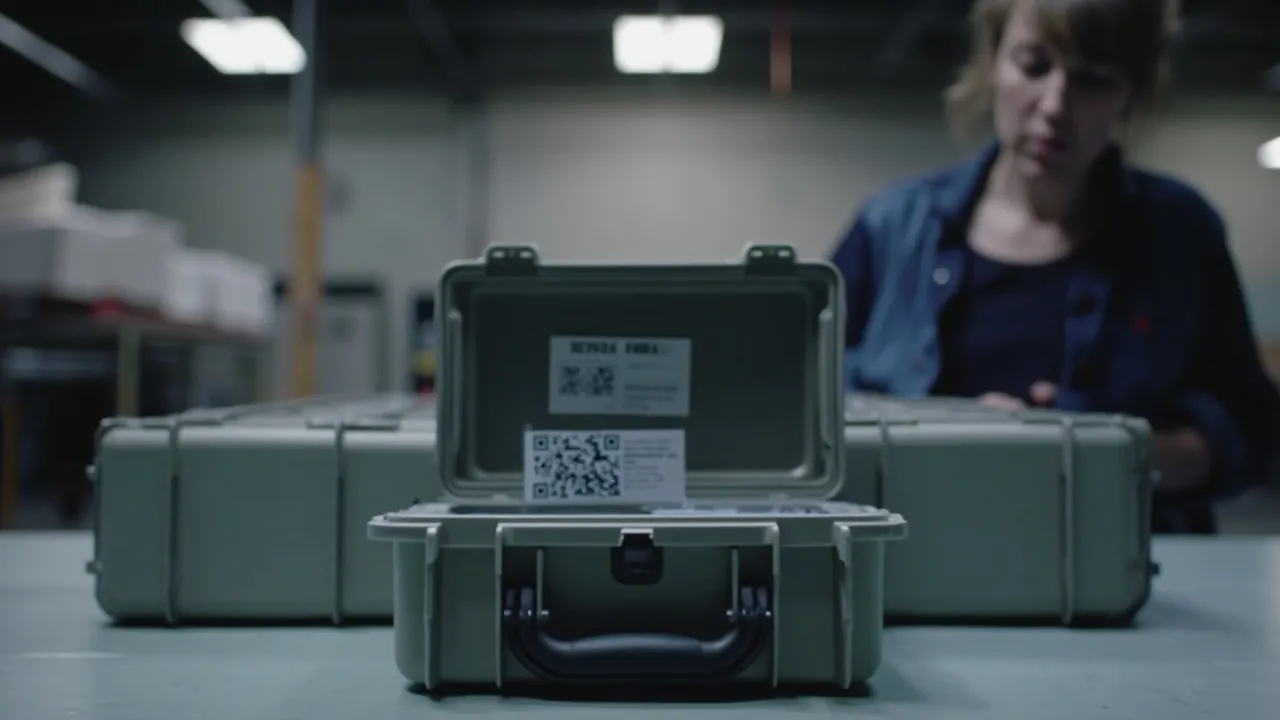
Short answer: digital management of protective cases does not require an expensive IoT platform. The minimum viable system is two things - an asset numbering rule that never repeats and never gets renumbered, and a QR code mark that scans reliably in any lighting. The number answers "whose case is this and which batch does it belong to". The code answers "where is it now, what condition is it in, and what maintenance is due next". Get these two right and a case that serves for more than a decade carries a complete service history. Get them wrong and the numbering collapses every time staff change, while the QR label is scuffed, smeared with oil or lifted off by the seal within six months, until the entire traceability system degenerates into a spreadsheet nobody trusts.
This article is written for B2B procurement teams, asset administrators, equipment engineers and warehouse supervisors. It breaks the problem into executable parts: how to structure a segmented numbering rule, how five marking carriers compare, how the GS1 system and QR code standards apply, where a label must never be placed, which data fields a case record actually needs, how scanning links to ERP and EAM, what the per-unit cost really looks like, and how to roll the whole thing out from pilot to full deployment. All dimensions, consumable lifetimes and prices quoted here are typical or empirical values; formal implementation should follow the company's own asset management policy, the drawings confirmed with the supplier, and the current edition of any standard cited. If you manage anywhere from a few hundred to tens of thousands of protective cases, military specification storage boxes, toolboxes or waterproof junction boxes, and you have already lost time because "they all look identical", this method can be used directly as a working procedure.
Contents
- Short answer: the number owns identity, the code owns location and status
- Why protective cases need traceability: four real pain points
- Designing the numbering rule: how a segmented structure works
- Choosing the marking carrier: label, laser, metal plate, QR and RFID compared
- The GS1 system and QR standards: GTIN, SSCC, GLN and application identifiers
- Where to place the code: four forbidden zones and three recommended positions
- Marking durability: abrasion, weather, chemicals and temperature limits
- The data model: which fields a protective case record should hold
- Lifecycle events: the traceability chain from goods-in to retirement
- Scanning workflow and system integration: connecting ERP, EAM and CMMS
- Cost analysis: per-unit comparison of labels, laser marking and RFID
- Rollout in six steps: from pilot to full deployment
- Frequently Asked Questions
- Conclusion and Related Reading
Short answer: the number owns identity, the code owns location and status
Start by separating the two goals, because almost every failed project mixes them together.
The first goal is uniqueness. Every case must carry a globally unique number that is never reused and never reordered. Many companies simply number cases 001, 002, 003 in arrival order. It looks fine until retirements and transfers create gaps, and the next new case collides with a retired number. Worse is the practice of renumbering annually by sequence. The moment that happens, historical records break: an inspection report from three years ago no longer maps to any physical case.
The second goal is readability. The number has to be readable by both machine and human. Humans read characters, machines read a QR code or an RFID tag. The decisive advantage of a two-dimensional code is error correction. Even if one corner is scuffed or partially covered in oil, the code can still be reconstructed. That is exactly why it outperforms a plain printed number in a real industrial environment.
One easily overlooked fact: protective cases have a different traceability requirement from precision instruments. An instrument record tracks accuracy, calibration values and operating hours. A protective case record tracks what it protected, which environments it passed through, how many times its seal was replaced, and how much service life remains. So a case asset record does not need to be complex, but it must include maintenance trigger events - the gasket replacement cycle, latch life, and structural damage history. These two topics connect directly to how to set a silicone gasket replacement cycle and how many years a protective case lasts, and they are the two most valuable field groups in any case record.
One line to memorise: the number answers "which case is this", the code answers "what has it been through". The former depends on rules, the latter on carriers.
Why protective cases need traceability: four real pain points
Not every case justifies traceability. The test is simple: high unit value, large quantity, visually identical, long service life, and consequential loss if misplaced. Meet three of the five and it is worth doing.
| Pain point | How it shows up | What traceability changes |
|---|---|---|
| --- | --- | --- |
| Identical units | Hundreds of the same model and colour, counting becomes guesswork | One scan returns the record; stocktake hours fall sharply |
| Unclear responsibility | Loaned out, never returned, departments blame each other | Issue records bind to a named custodian |
| Missed maintenance | Seal past its cycle, leaks only discovered on test | Due dates trigger automatically instead of failing silently |
| Silent loss | A few units missing, noticed only at the next stocktake | Variance surfaces immediately and the window for recovery widens |
Pain point one is "they all look the same". A protective case is a classic standardised industrial product. Put a hundred identical units side by side and the eye cannot distinguish them. When one of them holds test equipment worth tens of thousands, the case number effectively becomes part of that equipment's identity. This is the most direct return on traceability.
Pain point two is lending and rental. Defence, power utilities, testing laboratories and film equipment rental all routinely lend cases across departments, projects and even companies. Without numbers and records, a loan becomes a verbal promise, and the return rate depends entirely on individual diligence.
Pain point three is maintenance and life management. Protective case performance degrades slowly. Seal ageing, latch loosening and hinge wear never happen overnight. The real value of a traceability system is not "recording history" - it is converting reactive repair into proactive scheduled replacement. For more on how storage environment affects service life, see warehouse and storage rules for protective cases; for the connection between incoming inspection and batch traceability, see how to sample protective cases at incoming inspection.
Pain point four is stocktake efficiency. A full company stocktake done by hand-copying numbers across several thousand cases can consume multiple person-days. Scanning compresses the same work into a single shift with a materially lower error rate. Once the cost of a stocktake falls far enough, a company can move it from an annual event to a monthly routine.
Designing the numbering rule: how a segmented structure works
The numbering rule is the foundation. If the foundation is weak, changing labels and changing software is just repainting a leaking boat. The recommended approach is a segmented, structured number in which each segment carries one meaning, separated by hyphens so that both people and systems can parse it.
A workable general pattern:
| Segment | Meaning | Value method | Example |
|---|---|---|---|
| --- | --- | --- | --- |
| Segment 1 | Asset category | Fixed 2 letters | PC (protective case) |
| Segment 2 | Size or spec series | 2-character class code | S1 / M2 / L3 |
| Segment 3 | Owning organisation or site | 2-3 letters | SH |
| Segment 4 | Year | 4 digits | 2026 |
| Segment 5 | Serial number | Fixed 6 digits | 000137 |
The combined form looks like PC-M2-SH-2026-000137. Five design points matter.
Fixed length beats variable length. The serial number must have a fixed length, always six digits starting from 000001. Sorting, searching and form alignment all depend on it. Variable-length numbers sort incorrectly: 10 lands before 2.
Do not pack meaning in. Some companies embed colour, insert material and purchase batch into the number. The result is a number nobody wants to read, and any change in business rules forces a full renumber. The number only needs to express category, ownership, year and sequence. Everything else belongs in data fields. This is the "dumb number" approach: the number carries nothing volatile, the database carries the information.
The year segment marks the batch, not a renumbering cycle. It means the year the asset was booked in, and it never changes. Numbers keep incrementing across the year boundary.
Reorganisations do not change numbers. If the site segment needs updating after a restructuring, the correct move is to keep the original number and add a "current custodian" field. Renumbering once breaks history once.
Avoid confusable characters. Human-readable portions should avoid the pairs 0/O, 1/I/l, 2/Z and 5/S. A code can self-correct, but a human verifying by eye pays a higher price for confusion.
One hard rule: once allocated, a number may be voided but never recycled. A retired case's number moves to permanently reserved status, and no new case may use it.
Choosing the marking carrier: label, laser, metal plate, QR and RFID compared
Carrier selection is where money is most easily wasted. Many companies jump straight to RFID, then discover there is no reader anywhere on site and the tags become decoration. The correct order is define the reading scenario first, then choose the carrier.
| Carrier | Typical durability | Typical unit cost | Reading method | Suitable conditions |
|---|---|---|---|---|
| --- | --- | --- | --- | --- |
| Paper or synthetic self-adhesive label | 6-24 months | Very low | Visual plus scan | Indoor, dry, infrequent handling |
| Polyester synthetic label with laminate | 3-5 years | Low | Visual plus scan | Mixed indoor and outdoor, wiped down |
| Weather-resistant polyester with aggressive adhesive | 5-8 years | Low to medium | Visual plus scan | Outdoor, humid, oily |
| Laser marking directly into the shell | Same as the case | Low (one-off equipment cost) | Visual plus scan | Dark mouldings, no added material desired |
| Stainless steel plate, riveted or bonded | Over 10 years | Medium | Visual plus scan | High temperature, heavy abrasion, heavy duty |
| Etched or in-mould formed code | Same as the case | Medium (tooling required) | Scan | High-volume fixed models |
| UHF RFID inlay | 3-8 years | Medium to high | Bulk, long-range reading | Whole-pallet rapid stocktaking |
| NFC or high-frequency tag | 3-8 years | Medium | Short-range read and write | Need to write data, anti-counterfeit checks |
The paper label is the most common wrong starting point. It is cheap and easy to print, but protective cases almost always see friction, sunlight, rain, oil and temperature swings. The adhesive ages and lifts within six months, the paper face furs and moulds, and the whole label falls off. If the application is purely indoor warehouse circulation, paper survives; the moment outdoor use or long service life enters the picture, a synthetic material is mandatory.
Laser marking is underrated. Etching the code directly into the shell surface means no adhesive, no added material, no delamination, and a life equal to the case itself. It does have material requirements. Dark PP, ABS, PC and glass-filled grades usually respond well; light-coloured materials may lack contrast and need a pigment additive or a different process. For a fixed model in high volume, this is the best route.
Use RFID only where it pays. The value of a UHF inlay is bulk, contactless, long-range reading - whole pallets, whole trolleys, whole containers read in seconds. If the site only checks a few cases occasionally, scanning a QR code with a phone is already efficient enough. Before choosing RFID, answer three questions: how often is a stocktake run, how many units are involved each time, and is it worth paying several currency units per case per year in tags plus reader maintenance?
A pragmatic combination is dual-layer marking: a permanently etched or riveted number on the shell, plus a replaceable QR label in a position that does not affect sealing or stacking, carrying dynamic information such as the current project or custodian. The permanent layer guarantees the identity never disappears; the dynamic layer keeps information updatable.
The GS1 system and QR standards: GTIN, SSCC, GLN and application identifiers
If protective cases circulate between supply chain parties - drop-ship from a supplier, third-party warehousing, customer-site assets - the numbering rule should align with an internationally recognised identification system, otherwise every handover needs manual translation.
GS1 is the most widely used identification and data exchange system in the world. Four concepts are worth remembering.
| Identifier | Full name | Use in the protective case context |
|---|---|---|
| --- | --- | --- |
| GTIN | Global Trade Item Number | Identifies the product category, that is, a model of protective case |
| SSCC | Serial Shipping Container Code | Identifies a pallet or shipping unit for logistics traceability |
| GLN | Global Location Number | Identifies a receiving location, warehouse or site |
| AI 21 | Serial number application identifier | Appends a unit-level serial number after the GTIN for item-level traceability |
The codes themselves have standards too. ISO/IEC 18004 defines QR Code, ISO/IEC 16022 defines Data Matrix, and the ISO/IEC 18000 series defines RFID air interfaces, with ISO/IEC 18000-6C covering UHF. Two practical notes on symbology:
Data Matrix occupies less area and suits small parts. QR Code is more widely recognised and works with an ordinary phone camera straight out of the box, which suits human-operated scenarios. If scanning is done mainly by field staff with phones, the convenience advantage of QR Code is decisive.
Do not choose the lowest error correction level. QR Code error correction is normally offered at levels L, M, Q and H, recovering roughly 7, 15, 25 and 30 percent of the symbol respectively. Industrial labels will inevitably be scuffed, oiled or partly covered, so choose Q or H. The cost is a larger symbol area for the same data, and that cost is usually worth paying.
A note on ISO 9001. A quality management system requires identification and traceability of product status and the retention of traceable records. For a protective case carrying precision equipment, the numbering system is one practical expression of that requirement. If cases serve regulated industries such as defence, medical or aerospace, traceability depth must also satisfy the customer's contractual requirements.
Where to place the code: four forbidden zones and three recommended positions
Placing a label in the wrong position often costs far more than the label itself. A protective case has functional zones that a sticker must never occupy; a minor intrusion affects handling, a major one destroys sealing.
Four forbidden zones:
- Near the seal groove and sealing face. Any label standing proud of the shell creates a local gap when the lid closes and breaks the sealing path. This is the most serious placement error.
- Within the motion envelope of latches, hinges and handles. The label is scuffed away quickly and may jam a latch.
- The base and the stacking contact surface. When cases are stacked, a bottom label carries the entire load above it and is crushed, worn through, or transfers adhesive to the case underneath.
- The centre of a large flat panel, where deformation is greatest. A moulded flat panel bulges under load, and a label there is stretched until it splits.
Three recommended positions:
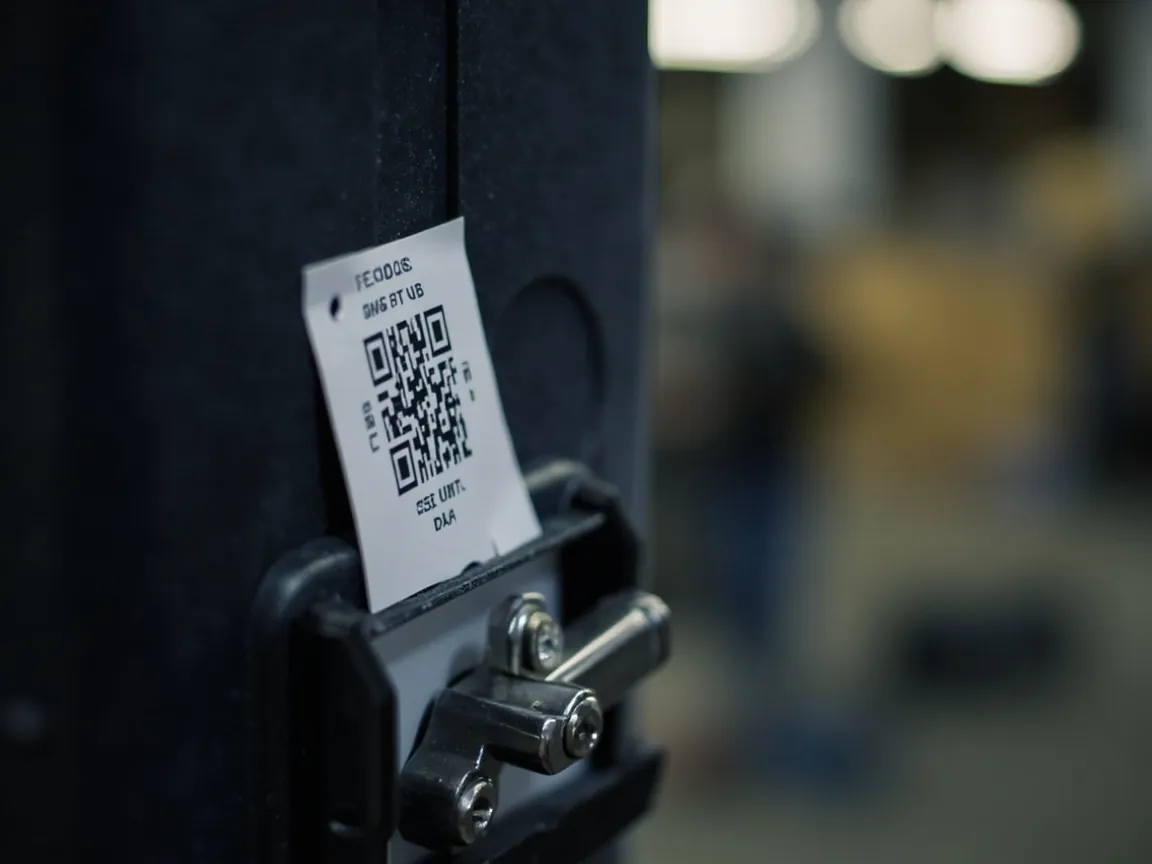
- A recess or reserved marking position on the lid sidewall. It contacts nothing in the upright or stacked position, and the scanning line of sight is good. If the product was designed with a dedicated marking recess at mould design stage - a shallow pocket on the order of 0.3 to 0.8 mm - the label sits inside it and is almost never grazed. This is the optimal solution.
- A flat area on the lower third of the front face. It avoids the maximum deformation zone and is easy to scan when upright cases sit on a shelf.
- Inside the lid, for internal information. Insert configuration, packing lists and inspection records that are not scanned frequently can live inside, keeping the exterior clean.
If a moulded marking recess or laser marking zone is required, that is a structural customisation and must be settled at the mould design stage. For more on structural design, read how the shell structure of a high-strength protective case is built; for tooling cost, read how to calculate custom protective case mould cost. JUNZHJIA, manufactured by KeXin New Materials (Guangdong) Co., Ltd., can reserve marking recesses, laser marking zones or nameplate mounting points at the moulding stage for custom projects, and provides external dimensions, weights and accessory cross-reference tables by model so procurement teams can adopt them directly when building asset registers.
Marking durability: abrasion, weather, chemicals and temperature limits
Whether a mark survives until the case is retired depends on four environmental stresses. Write the operating conditions down before choosing consumables.
| Stress | Typical source on site | Effect on the mark | Response |
|---|---|---|---|
| --- | --- | --- | --- |
| Mechanical abrasion | Stacking, dragging, dust, rack friction | Surface wear, falling code readability | Raise error correction level, choose an abrasion-resistant face, switch to laser etching |
| UV and heat | Outdoor sun, inside a vehicle, inside a container | Face yellows and embrittles, adhesive fails | Weather-resistant polyester, UV-resistant ink, avoid direct sun in storage |
| Chemicals and oil | Machine oil, solvents, cleaners, sea water | Ink dissolves, face swells, adhesive plasticises and fails | Chemical-resistant face material, protective laminate, or adhesive-free marking |
| Temperature and humidity cycling | Day and night swing, condensation, frozen transport | Adhesive creep, label lifts, substrate shrinks | Low-temperature adhesive, avoid large flat panel centres |
On temperature, distinguish two things: the case's operating temperature and the label's operating temperature. A case rated to -40 °C does not imply that a paper label on it also survives -40 °C. Low-temperature adhesives lose tack and may drop off entirely after returning to room temperature, while heat softens the adhesive until it flows and leaves residue that cannot be removed.
On cleaning, one practical warning: never wipe the code area with solvent. Ethanol, acetone and thinners are fatal to most label inks and adhesives. The correct method is a soft cloth with water or a mild neutral cleaner, followed by an air blower or soft brush for dust in crevices.
On replacement, treat the label as a consumable with defined retirement criteria: rising first-scan failure rate, corners lifting beyond a set proportion, visible discolouration or cracking of the face, characters worn beyond human recognition. Add label inspection to the routine patrol, and keep a buffer stock of spare labels. The stocking principle for spare labels matches that for service parts, and can follow the batch and retention practice described in how to sample protective cases at incoming inspection, so that newly printed labels map one-to-one onto original numbers with no duplicates.
The data model: which fields a protective case record should hold
The design principle is to hold just enough and avoid building tables for imagined requirements. A protective case asset record normally contains five field groups.
Group one: identity fields, never changed
- Asset number (unique primary key)
- Model and specification
- Manufacturing batch number and date of manufacture
- Manufacturer, recorded as JUNZHJIA where applicable
- Declared ingress protection rating and the reference number of the corresponding test document
- Brief description of material construction
Group two: configuration fields, versioned when modified
- External dimensions and empty weight
- Insert type (none, plain foam, pre-cut slots, fully custom) and foam material
- Gasket material and specification code
- Latch type, hinge type, presence of a pressure relief valve
- Electrostatic discharge (ESD) property, if any
Group three: ownership and location fields, changed frequently
- Current custodian or responsible department
- Current location (warehouse, workshop, project site, in transit)
- Issue and return records
- Whether the unit is currently on loan or on hire
Group four: maintenance and life fields, the most valuable group
- Date and result of the last inspection
- Date of the last gasket replacement and the recommended next replacement date
- Cumulative latch open and close cycles, where countable
- Structural damage records (cracks, deformation, missing parts)
- Cumulative repair count
Group five: disposal fields, end of life
- Retirement date and reason
- Whether the unit can be recycled or reused
- Disposal destination
For more on life and disposal, see how to repair a protective case with a cracked shell and whether retired protective cases can be recycled and reused. These two articles determine how granular the disposal fields need to be.
A design rule of thumb: anything visible on the physical unit should not be re-keyed; anything not visible on the physical unit must be recorded. Dimensions and colour belong to the first category; gasket replacement dates and cumulative loan counts belong to the second.
Lifecycle events: the traceability chain from goods-in to retirement
Fields alone are not enough. The system must also define which events trigger a record. A protective case lifecycle normally contains eight event types, each producing a timestamped log entry.
- Goods-in registration: allocate the number, apply the code, open the record, run the first appearance inspection, photograph for the file.
- Put-away into storage: bind to a bin location and record storage environment conditions. This step connects directly to warehouse and storage rules for protective cases.
- Issue and outbound: bind the custodian, purpose and expected return date. If equipment travels inside the case, link the equipment asset number.
- Transport and delivery: record the carrier, waybill number and receipt inspection result.
- In-use patrol: periodically check the sealing face, latches, hinges and handles, and record abnormalities.
- Maintenance and replacement: gasket replacement, latch replacement, insert replacement, cleaning.
- Repair: crack repair, structural correction, accessory refitting.
- Retirement and recycling: close the record, reserve the number, log disposal.
Of the eight, the one most often skipped and most valuable is the in-use patrol. Every other event has a natural trigger - the warehouse, the borrower, the technician. Only the patrol requires someone to act without being asked. Making the patrol a "scan and fill" flow with the minimum possible input is what keeps the completion rate up. As a rule of thumb, the form should hold no more than six fields and take under thirty seconds; anything longer will be filled in carelessly.
Number linkage is another high-value action. If a case permanently carries a specific instrument, writing that instrument's asset number into the case record enables bidirectional lookup: from case to instrument and from instrument to case. This is especially useful in testing laboratories, film equipment rental and defence supply chains.
Scanning workflow and system integration: connecting ERP, EAM and CMMS
A traceability system eventually has to land in software. Depending on company size, three tiers are realistic.
| Tier | Implementation | Suitable scale | Main limitation |
|---|---|---|---|
| --- | --- | --- | --- |
| Lightweight | Scanning app plus online spreadsheet | Up to a few hundred units | Weak permissions, concurrency and audit |
| Mid-tier | Scanning app plus a self-hosted database or low-code platform | Hundreds to a few thousand units | Self-maintained, limited integration |
| Standard | ERP fixed asset module or a dedicated EAM / CMMS | Several thousand units and above | Longer implementation, higher cost |
ERP is good at the asset ledger - value, depreciation, ownership. EAM and CMMS are good at the maintenance history - inspection, repair, replacement cycles. The two roles differ, so do not expect one module to do both. If the company already runs an ERP fixed asset module, the most economical path is to extend it with custom fields for maintenance dates rather than building a new system.
Four implementation points for the scanning app:
- Support offline scanning. Workshops, warehouses, underground car parks and field sites often lack reliable network coverage. The app must queue records offline and sync automatically.
- One scan, one task. Bring up the case record and history automatically on scan; the user only fills in what changed. Every additional field reduces completion rates.
- Tiered permissions. Borrowers register issue and return; technicians register replacement records; retirement authority stays with the asset administrator.
- Audit trail. Every record carries operator, timestamp and source device, and bulk back-editing must be blocked.
On data migration, watch for one common trap: legacy spreadsheets usually already contain duplicates and gaps. The correct sequence is to clean the data first, then allocate new numbers, keeping a mapping table between old and new numbers archived while both run in parallel until verified. Never build a system on top of unclean data - the system will only entrench the errors further.
Cost analysis: per-unit comparison of labels, laser marking and RFID
Cost is the real reason many projects are cancelled, and the disagreement usually comes from inconsistent accounting. Calculate whole-life cost per unit, not purchase price per unit.
| Option | One-off investment | Consumable cost per unit (empirical) | Annual maintenance per unit | Notes |
|---|---|---|---|---|
| --- | --- | --- | --- | --- |
| Paper self-adhesive label | Essentially zero | Very low | High, frequent replacement | Indoor short-cycle circulation only |
| Synthetic QR label | Label printer, low to medium | Low | Low | Best general-purpose value |
| Laser marking | Marking equipment or outsourcing | Near zero | Near zero | Best for high-volume fixed models |
| In-mould formed marking | Mould modification cost | Near zero | Near zero | Must be decided at tooling stage |
| Metal nameplate | Plate plus riveting fixture | Medium | Very low | Heavy load, high heat, severe abrasion |
| UHF RFID | Reader and antennas, medium to high | Medium to high | Medium, tag failure replacement | Only pays off in bulk stocktake scenarios |
Cost items most often left out:
- Labour. Applying labels, scanning and data entry all consume labour. A full build-out of the initial register frequently costs more in labour than in label materials; fold actual wage costs in.
- Rework. Labels falling off, placed wrongly, or duplicated numbers cause rework, and this is the largest hidden cost.
- Software and operations. App subscriptions, servers, interface development and routine maintenance recur annually.
- Downtime. Business disruption during a stocktake can be substantial in service-oriented operations.
A rule of thumb: if the annual maintenance cost per case is several times the label cost, the solution is too heavy; if a label must be replaced more than twice a year, it is too light.
Rollout in six steps: from pilot to full deployment
Six executable steps. Order matters; inverting the sequence is the main cause of failure.
Step one: fix the rules before choosing tools. Write the numbering rule, field list and event types into an internal policy document, confirmed jointly by procurement, warehouse, IT and user departments, then publish it. Do not buy any equipment before the rules are frozen.
Step two: pilot on a small scope. Pick a zone holding 200 to 500 cases and run the full path - numbering, marking, scanning, record creation, patrol, maintenance, retirement. The purpose of a pilot is to expose rule defects, not to demonstrate success.
Step three: revise and freeze the rules. A pilot almost always reveals problems: a specification that fits no category, a field nobody fills in, a position that is awkward to scan. Revise, freeze the version, and apply it company-wide.
Step four: clean and migrate data. Remove duplicates, gaps and contradictions from legacy data, then build and archive the old-to-new number mapping.
Step five: number and register everything. Work zone by zone. After each zone, immediately run a cross-check stocktake confirming no duplicates, no omissions and an acceptable first-scan success rate.
Step six: fold it into routine management and audit. Include scan records in monthly stocktakes, quarterly patrols and the annual asset audit, and make completion rate a performance measure for the warehouse and user departments. A traceability system with no audit attached will degrade within six months no matter how advanced the technology is.
Consumable and service part management belongs in the same routine, especially for items with a shelf life such as seals. For the ageing mechanisms and rejection criteria of sealing materials, see how to judge protective case gasket ageing, which is a key input when deciding how much life remains in a given case.
Frequently Asked Questions
Q: We only have a few hundred protective cases. Is a QR traceability system worth it?
A: Yes, but use a lightweight approach. The deciding factor is not quantity but the cost of error. If losing or mixing up one case would break the traceability chain for a high-value instrument, then a two-hundred-unit fleet still justifies a register. A lightweight solution can be built with no software purchase at all: agree a numbering rule, encode the number in a QR code, and record events with a phone scanning app linked to a spreadsheet or low-code platform. Three things must be done properly - allocate numbers once and never renumber, use a weather-resistant QR label placed in a correct position, and include scan records in the monthly stocktake. In practice a few-hundred-unit program runs perfectly well on the lightweight tier. Upgrade only when the fleet grows into the thousands or when integration with an ERP fixed asset module becomes necessary. Starting with a heavy platform wastes budget on capability that will not be used for years.
Q: Does a QR label on the outside of a protective case interfere with the ingress protection rating?
A: Not at all, provided it does not intrude on the sealing face. Water resistance depends on the gasket inside the seal groove forming a continuous compressed contact band, and that region sits on the inside of the case rim, independent of the outer wall surface. There are two genuine risks. First, a label placed close to the seal groove can prop the lid open locally when it closes. Second, an excessively thick label creates uneven pressure across the rim. Before applying any label, confirm two things: the position leaves adequate clearance from the sealing face, empirically at least five millimetres, and the total label thickness stays under about 0.15 mm. Also be careful with adhesive residue: do not flood the rim area with solvent, because solvent can migrate in and attack the gasket. If the project carries strict compliance requirements, confirm the marking scheme at the sampling stage and run a submersion verification with the label in place.
Q: Identical cases look the same. If the QR code wears off, how is the identity recovered?
A: This is exactly why dual-layer marking is recommended. Put a permanent layer on the shell - a laser-etched number or a riveted metal plate with a life equal to the case - and then apply a QR label in a position that does not affect sealing or stacking to carry the dynamic information. Even a faded permanent layer usually remains readable through the outline of the etch or the stamped characters, and once the number is recovered the full record can be retrieved from the system. If a company has only applied a QR label and it has been worn away, the fallback is to cross-reference the last stocktake record, issue records and the memory of the user department, then rebuild the record under a new number while reserving the old one to avoid confusion. The proper fix for this class of incident is to raise the error correction level, select a weather-resistant face material, and add a clear protective laminate where necessary.
Q: Can RFID tags completely replace QR codes?
A: Not today. The two are better used in complementary roles. The core strength of RFID is bulk, long-range, contactless reading: dozens of cases on a pallet can be read in seconds, far faster than scanning one by one. Its weaknesses are higher unit cost, sensitivity to metal and water - relevant when a case holds metal equipment - the need for readers, and the fact that tags themselves can fail or be damaged. QR codes are extremely cheap, universally recognised, readable with an ordinary phone, and immune to metal interference; their limitation is that each unit must be scanned individually. The established practice is a dual layer: QR as the base identity marking across the whole asset base, with RFID added in zones that need bulk stocktakes or on high-value assets. Work out stocktake frequency and units per stocktake first, then decide whether RFID pays for itself, and avoid paying high tag costs for a low-frequency scenario.
Q: Can the asset number embed the date, colour or department?
A: Not recommended. The longer and more meaningful the number, the higher the maintenance cost, and the moment any embedded attribute changes - a departmental restructure, a colour revision - the number itself becomes wrong information and forces a renumber. Use the "dumb number" strategy instead: the number carries only stable elements such as category, ownership, year and serial, while colour, insert, material and purchase batch live in data fields. A case whose insert is replaced or whose department changes keeps its number and simply has fields updated. Empirically, a total number length of 12 to 20 characters is the most practical range. Beyond that, the error rate in manual verification and verbal transmission rises noticeably while the benefit is essentially zero.
Q: Where does a scan-based traceability system most often fail?
A: Failure almost never happens in the technology; it happens in completion rates. Three failure modes dominate. First, the patrol form has too many fields, so field staff stop filling it in after a few attempts. Second, issue records are disconnected from the warehouse outbound process, so cases routinely leave without being logged. Third, there is no audit, so management never sees completion rate data and the problem stays hidden. The corresponding fixes are: compress the scanning form to six fields or fewer and under thirty seconds; embed the scan step into an existing mandatory node of the inbound and outbound process rather than adding an extra registration; and publish completion rate in the monthly stocktake report. Technology can be chosen in one step, but building the habit takes sustained effort, and that is the real dividing line between success and failure.
Q: If cases ship to external customers for long-term use, how should the numbering system be designed?
A: Align it with the customer's asset numbers. Three approaches work. First, keep your own number as the primary key and add a customer asset number field as a mapping, so each party uses its own scheme and communicates through the mapping table; this is the most flexible and most common. Second, adopt the customer number as the primary key with your internal number as a batch identifier, which suits large, well-managed customers. Third, use international identification: GTIN at product level, SSCC at shipping unit level and a serial number application identifier at item level, which gives the best compatibility across borders and third-party warehousing. Whichever you choose, write the numbering rule, label specification, position and replacement responsibility into the contract or technical agreement, so that a dropped label or a numbering clash does not become a dispute after delivery.
Q: How often should QR labels be checked or replaced?
A: Set the interval by usage intensity. For indoor storage with infrequent handling, a quarterly patrol is enough. For outdoor use, frequent handling or oily environments, inspect monthly. Use four criteria: whether first-scan success rate has dropped noticeably, whether corners are lifting, whether the face has discoloured, cracked or gone chalky, and whether characters are worn beyond human recognition. Any two of the four justify replacement. Replace on site while verifying the number, ensure the new label carries exactly the original number, and log the replacement in the asset record. Keep a buffer stock of spare labels, store them by batch on a first-in-first-out basis, and avoid discovering during an urgent replacement that the printer consumables or the label stock itself has expired.
Conclusion and Related Reading
Back to the question in the title: digital management of protective cases comes down to getting two small things right - the numbering rule and the marking carrier - and then locking them in with daily process. The number delivers uniqueness, the code delivers readability, the field list decides what gets recorded, lifecycle events decide when it gets recorded, and system integration decides where it lives. All five interlock, but the factor that actually decides success is the least technical of them: the habit of doing it.
Three actions you can take immediately. First, write a one-page numbering rule covering category, ownership, year and serial, freeze it company-wide, and allow numbers to be voided but never recycled. Second, upgrade the marking carrier from paper self-adhesive to weather-resistant synthetic material or laser etching, and confirm the position avoids the seal groove, latch motion zone, stacking contact surface and large flat panel deformation zone. Third, compress the scanning form to under thirty seconds and put it into the monthly stocktake and performance review, so that recording becomes a habit rather than a burden.
JUNZHJIA, manufactured by KeXin New Materials (Guangdong) Co., Ltd., covers protective cases, toolboxes, military specification storage boxes and waterproof junction boxes, and serves wholesale, distribution, OEM/ODM and global supply. For custom projects, the company can reserve marking recesses, laser marking zones or nameplate mounting points at the moulding stage, and supplies model dimensions, weights, gasket specifications and accessory cross-reference tables so procurement teams can adopt them directly when building asset registers. For programmes requiring long-term spare part supply, gaskets, latches, handles and other wearing parts can be supplied continuously by model.
Related Reading