

Start with a real case. A project bought three hundred "IP67 waterproof junction boxes," and the supplier shipped a test report with a bold "IP67 Pass" on the cover. The site engineer turned to page three and found that the sample was described as "protective enclosure, sample condition: no openings," while the boxes actually delivered had two knockouts in the bottom and cable glands fitted. Turning to the test record, the dust column read "not tested," and only the water test had been run to IPX7.
In other words, the report proved that a box without holes resists water, while the site was installing boxes with holes and glands. A whole ingress rating separates those two things. In this industry that does not even count as fraud; it counts as selective presentation. The report is genuine, the conclusion is genuine, it simply does not apply.
This article is about seeing through that. It covers what the IP code actually means, the difference between a test report and a certification, nine elements every report must contain, how to trace a report number back to its source, six common ways ratings are overstated, and a five-step field screen you can run without a laboratory. Criteria follow IEC 60529, with GB/T 4208 as the national equivalent, plus the usual conformity assessment systems. For a specific laboratory, always rely on its published scope of accreditation.
Contents
- Get the Terms Right: A Test Report Is Not a Certification
- The Structure of the IP Code: What Each Digit Says
- IP6X and IPX7: How the Two Tests Actually Run
- What the Common Certificates Each Cover
- Nine Elements Every Third-Party Report Must Contain
- Verifying a Report Number in Three Steps
- Six Common Ways Ratings Are Overstated
- A Five-Step Field Screen Without a Laboratory
- The Consistency Gap Between Sample and Production
- Writing Acceptance Clauses Into the Purchase Contract
- A Question List for Supplier Conversations
- Frequently Asked Questions (FAQ)
- Closing Thoughts and Further Reading
Get the Terms Right: A Test Report Is Not a Certification
This is the most confusion-prone point in the whole subject, and the one most easily exploited.
A test report answers "how did this sample perform in this test." It is a one-off result covering a specific sample, under specific conditions, to a specific method. It speaks to the sample submitted and, in legal terms, usually not to the production run.
A certification answers "does this product continuously comply with a standard." Beyond type testing it involves factory inspection, quality system assessment, and post-certification surveillance through annual audits and market sampling. CCC, UL Listing, and TUV marks belong in this category.
How much does the difference matter? Consider this: a report can prove that three samples submitted in May 2023 passed IPX7, but it cannot prove that the shipment in front of you will pass. For that you need certification with ongoing surveillance, or your own incoming inspection.
The most common trick in the market is dressing the first up as the second: "IP67 certified" on the brochure when all that exists is a sample test report; or a cover page shouting "Conclusion: meets IP67 requirements" while the line "this report relates only to the sample submitted" sits in small print on the last page.
None of this means a test report lacks value. Quite the opposite: a report with complete elements, from a credible laboratory, on a sample that matches your order, is one of the most useful documents in a purchasing decision. The point is knowing what it proves and what it does not.
The Structure of the IP Code: What Each Digit Says
The standard form is IP plus two characteristic numerals, plus an optional additional letter and an optional supplementary letter. Per IEC 60529 and GB/T 4208 the structure is:
``` IP 6 7 [additional letter] [supplementary letter]
| +----------------------------------- second digit: liquids (0-9) +-------------------------------------- first digit: solids (0-6) ```
| +-- H high voltage apparatus | ||
| M moving during water test | ||
| S stationary during water test | ||
| W specified weather conditions | ||
| +------------------------ A back of hand / B finger | ||
| C tool / D wire |
First characteristic numeral, solid objects and dust:
| Digit | Meaning | Test outline |
|---|---|---|
| --- | --- | --- |
| 0 | No protection | - |
| 1 | Objects of 50 mm and larger | Back of hand |
| 2 | Objects of 12.5 mm and larger | Finger |
| 3 | Objects of 2.5 mm and larger | Tool |
| 4 | Objects of 1.0 mm and larger | Wire |
| 5 | Dust protected, limited ingress allowed | Talcum chamber, some dust permitted |
| 6 | Dust tight, no ingress | Talcum chamber under reduced pressure |
Second characteristic numeral, liquids:
| Digit | Meaning | Test outline |
|---|---|---|
| --- | --- | --- |
| 0-2 | Vertical drips, drips at 15 degrees | Drip box |
| 3 | Spraying water up to 60 degrees from vertical | Oscillating tube or spray nozzle |
| 4 | Splashing water from any direction | Oscillating tube, 10 minutes |
| 5 | Water jets, 6.3 mm nozzle, 12.5 L per minute | Distance 2.5 to 3 m |
| 6 | Powerful water jets, 12.5 mm nozzle, 100 L per minute | Distance 2.5 to 3 m |
| 7 | Temporary immersion | 1 m, 30 min, temperature difference within 5 kelvin |
| 8 | Continuous immersion, conditions set by the maker and stricter than 7 | Depth and duration must be stated |
| 9 | High temperature, high pressure water jets | 80 C, 8 to 10 MPa |
Three details worth memorising:
First, X means "not tested," not "unspecified." IPX7 means dust was not tested and water protection reaches level 7. A product marked IPX7 may offer no dust protection whatsoever and will still fill with dust on a dirty construction site. Likewise IP6X means dust level 6 with water untested. Only a full two-digit IP67 asserts dust level 6 and water level 7 together.
Second, a high second digit says nothing about the first. A product labelled IP68 may only have been tested to IPX8, with dust never assessed. Complaints about "IP68 but full of dust" come from exactly here.
Third, IP ratings do not accumulate. Each level is defined separately, and passing IPX7 does not imply passing IPX5 or IPX6, because jet testing examines the kinetic energy of water prying at a joint while immersion examines slow penetration under static head. Different failure mechanisms. Where a product must resist both jets and immersion, as on port equipment, require both tests and make sure both appear in the report.
IP6X and IPX7: How the Two Tests Actually Run
Knowing how the tests run tells you what the report should contain.
The IP6X dust test, dust tight. The sample goes into a sealed chamber filled with airborne talcum powder at roughly 2 kg per cubic metre for 8 hours. The critical step is reduced pressure: air is drawn continuously from inside a sealed enclosure so that internal pressure sits below ambient, commonly with the differential held at no more than 2 kPa, or by extracting eighty times the internal volume at a rate not exceeding sixty enclosure volumes per hour. Afterwards the unit is opened and no visible dust deposit is permitted inside.
This matters a great deal for outdoor junction boxes, because it tests not just the gasket but every opening, plug, vent, and pinhole in the moulding. Plenty of products that are excellent against water fail right here.
The IPX7 immersion test, temporary immersion. The sample is fully immersed in the manufacturer's declared condition, with the lowest point at least 1000 mm below the surface and the highest point at least 150 mm below, for 30 minutes, with water temperature within 5 kelvin of the sample temperature before the test. Assessment is by opening and inspecting for ingress; the pass criterion comes from the standard or the product specification, commonly expressed as no quantity of water that would interfere with operation or compromise safety, and in practice applied as no visible water inside.
If a report omits those numbers - one metre, thirty minutes, 5 kelvin - and simply says "complies with IP67," its rigour deserves suspicion. Conversely, a report that states orientation, tightening torque, and whether glands were fitted is usually far more trustworthy.
What the Common Certificates Each Cover
Certificates you will meet during purchasing, and what each one actually governs:
| Name or mark | Nature | What it covers | Relationship to IP67 |
|---|---|---|---|
| --- | --- | --- | --- |
| Third-party test report | One-off test result | Specific items on a specific sample | Most directly relevant; check the elements |
| CNAS accreditation | Laboratory competence | The laboratory is competent to issue the report | Raises credibility; number is publicly checkable |
| CMA qualification | Institutional qualification in China | The body may issue publicly relied-upon data | Often a threshold for domestic projects |
| ILAC-MRA | International mutual recognition | Reports recognised across signatories | Useful for export projects |
| CCC certification | Mandatory product certification | Safety and EMC for listed products | Most general junction boxes are outside the mandatory list; verify first |
| CE marking | Declaration of conformity | Essential requirements of applicable EU directives | IP rating itself is normally not a CE requirement |
| UL Listing or Recognition | Third-party certification | North American safety requirements | Enclosure ratings use a separate Type system |
| NEMA 250 Type | North American enclosure rating | 3R, 4, 4X, 6, 6P and others | Not simply equivalent to IP |
On NEMA versus IP, one point needs emphasis: the two systems are defined differently, and NEMA includes corrosion resistance, external icing, and construction requirements alongside ingress. There is no official equivalence table. The industry shorthand "NEMA 4X is about IP66" is a rough reference and must not be written into a contract as an acceptance criterion.
Another easy trap: for most low-voltage products, CE is a manufacturer's self-declaration of conformity, not something an authority issues. When you see a "CE certificate," determine whether it is a third-party attestation or a document the factory printed itself. In the same way, a claim of "IP67 certified" with no certificate number almost always means a test report exists and nothing more.
Nine Elements Every Third-Party Report Must Contain
Work through these nine. Miss one and the report loses force; miss three or more and ask for a fresh one.
One, the report number. A formal report carries a unique number, usually combining an institution code, the year, and a serial. That number is the key to verification.
Two, the applicant and the manufacturer. Check that the applicant is the factory you are buying from. A frequent pattern is supplier A presenting supplier B's report, where the two are trading partners rather than the same producer. Not necessarily invalid, but you should know who you are really buying from.
Three, sample name and model. It must match your purchase exactly. A single suffix difference is enough to invalidate it: within one series, vented versus unvented, or with metal inserts versus without, are often different submitted models.
Four, description of sample condition. The most important item in the document. Was it a bare box or one with entry devices? Original plugs or the actual cable glands? What fastening method and what torque? Which orientation? Was a vent fitted? A report that says only "one sample" carries no information.
Five, the standard used. It should state number and version, for example "IEC 60529:1989+A1:1999+A2:2013" or "GB/T 4208-2017". Writing just "to IP67 standard" is not acceptable practice.
Six, test items and results. Dust and water listed separately, each with its level and conclusion. Watch for gaps such as "dust: not tested."
Seven, test conditions and raw data. Water depth, duration, water temperature, temperature difference, dust concentration, test length. Photographs or raw records are a bonus.
Eight, equipment and calibration. A proper report lists principal equipment by name, model, and serial number, with calibration validity. Often overlooked, but it filters out a good number of substandard laboratories.
Nine, seals and accreditation marks. CNAS, CMA, or ILAC marks; the signature or seal of the authorised signatory; issue date and any validity note. Note the standard caveats such as "relates only to the sample submitted" and "may not be reproduced in part without consent." Those are normal practice rather than a disclaimer trick, but they also remind you that a report is not a guarantee of the production run.
Put the nine on a one-page checklist. Five minutes per report, and they are the best-spent five minutes in the project.
Verifying a Report Number in Three Steps
A handsome report is worthless paper if its number cannot be traced.
Step one, confirm the laboratory exists and is qualified. In China, search the public platform of the national certification and accreditation authority for the institution name and qualification number. For accredited laboratories, search the CNAS public query channel by accreditation number and check its scope. The thing that matters is whether the scope includes the specific test item and standard you are checking - a CNAS mark does not by itself mean this particular test is accredited, and that is the point most often missed.
Step two, verify the report number itself. Many institutions offer online validation: enter the number and applicant name and a summary comes back. Where that is unavailable, telephone the laboratory's report enquiry desk with three items - number, applicant, sample name - which is usually enough to confirm authenticity. Give the full details rather than asking "does this report exist," so a genuine number cannot be paired with fabricated contents.
Step three, cross-check consistency. Compare the sample name, model, and test items returned by the website or telephone against your paper copy character by character. Model suffixes and test items are what forgers alter, because those are the easiest fields to upgrade.
Pass all three and authenticity is reasonably established. One more thing: the date matters. A three-year-old report does not describe what is being made now, especially if tooling has been reworked, the gasket supplier changed, or production moved site. Experienced buyers ask for reports less than two years old plus sampling records from recent batches.
Six Common Ways Ratings Are Overstated
Trick one, IPX7 presented as IP67. The report says IPX7 with dust untested; the brochure says IP67. Detect it by reading whether a dust item exists in the test list.
Trick two, a bare-box report applied to the assembly. Sample unopened or fitted with original plugs, while the field unit has glands. Detect it in the sample condition description and photographs.
Trick three, model substitution. The premium model was submitted; the decontented version is shipped. Detect it by comparing model designations character by character, suffix included.
Trick four, an in-house sheet passed off as third-party. A report from the factory's own laboratory, or "internal test record" instead of commissioned testing. Detect it by checking for a third-party seal and accreditation mark, and by looking at whether the letterhead belongs to a laboratory or a factory.
Trick five, a material report presented as a whole-unit report. The gasket supplier's weathering report, or a plastic resin card, repackaged as "the product passes IP67." These documents describe material properties, not enclosure ingress ratings - and no matter how good the material, poor assembly leaks.
Trick six, confusion with other standards. A "rainproof type" classification, or a pass under some sector standard, advertised as IP67. Detect it by checking whether the referenced standard is IEC 60529 or GB/T 4208.
The universal defence is three comparisons: compare the standard number, compare the sample condition, compare the model characters. Overstatement rarely invents data; it selectively presents those three.
A Five-Step Field Screen Without a Laboratory
Documents aside, inspect the hardware. These five need no laboratory.
Step one, visual and structural check, about one minute. Is the gasket continuous, with no joints or short shots? Any flash, distortion, or scratches on the sealing face? Count latches and check spacing, ideally not more than 120 mm. Is the hardware stainless, and is there any rust? Are plugs supplied for the entry holes?
Step two, feeler gauge around the joint, about two minutes. With the lid closed and latched, try a 0.05 mm feeler gauge along the whole seam. Anywhere it enters is under-compressed. This is a remarkably efficient criterion that needs almost no equipment.
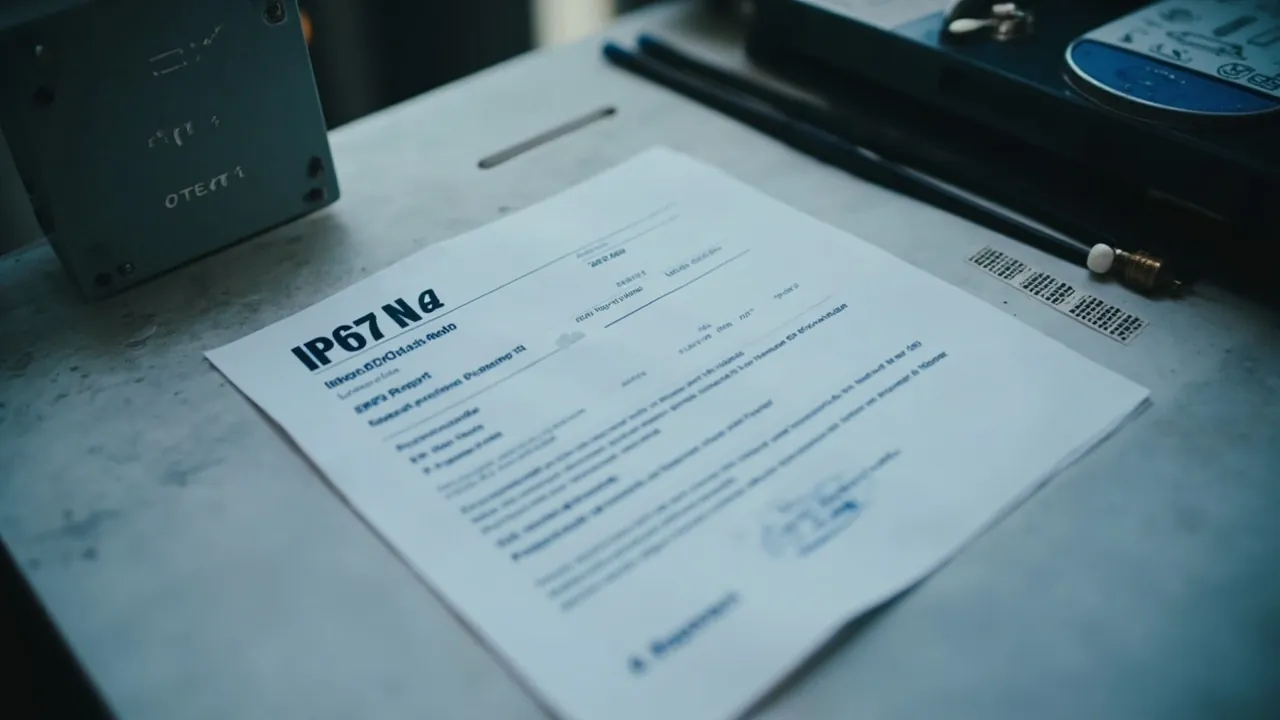
Step three, rough immersion screen, thirty minutes or more. Find a vessel deep enough to put the lowest point one metre below the surface. An ordinary bucket cannot; you need a pool, a large tank, or a fire water tank. Put dry tissue inside as the indicator, let the sample sit at room temperature first to remove temperature difference - never drop a sun-heated box into cold water - fit the real glands and plugs and tighten to declared torque, immerse for thirty minutes, then dry the outside before opening. This cannot replace third-party type testing, but it will catch missing seals, obvious assembly faults, and distorted shells.
Step four, pressure decay leak test, about five minutes with equipment. Fit an air fitting, pressurise to roughly 5 kPa, and watch the drop over thirty seconds. A loss beyond 10% to 20% indicates a real leak path. The advantage is that it is quantifiable and can be run on every unit; many factories use it as a mandatory end-of-line check, so ask for the per-unit records.
Step five, weight comparison, about one minute. Weigh three units drawn at random from the batch. Variation beyond 5% suggests inconsistent wall thickness or structure, and you should look further into tooling and material. Crude, but it finds material substitution.
None of the five needs a professional test house and all cost very little. Write them into a goods-in inspection work instruction, set the sampling ratio to an AQL scheme, commonly general inspection level II at AQL 1.0 or 2.5, and require full inspection on the critical item, which is the leak test.
The Consistency Gap Between Sample and Production
One problem is more common than outright overstatement and much harder to spot: the submitted sample is excellent and the production run is not.
Three causes cover most cases: tool wear drifting the sealing face dimensions; a change of gasket supplier or compound; and an assembly process with no torque control. None of these show up in a test report, because a report describes the sample as it was on the day of submission.
Controls that match each risk:
| Risk | Control | Frequency |
|---|---|---|
| --- | --- | --- |
| Tool wear | SPC sampling of critical sealing face dimensions | 3-5 pieces per batch |
| Gasket change | Require gasket batch traceability with compression set report per batch | Every batch |
| Torque not controlled | Torque drivers or torque guns on the line, set and recorded | 100% |
| Weak process capability | End-of-line leak test on every unit, records retained | 100% |
In purchasing terms, ask for two specific things: end-of-line leak test records shipped with each batch, showing unit number and result, and a sampling report on critical dimensions. Those two documents are worth more than a three-year-old type test report.
Writing Acceptance Clauses Into the Purchase Contract
Turning all of the above into contract terms, here is a set of clauses to adapt:
- The product shall achieve IP67 when tested to IEC 60529, or GB/T 4208-2017, and the test items shall include both first characteristic numeral 6 and second characteristic numeral 7. Reports covering only one item are not accepted.
- The supplier shall provide a third-party report from a laboratory holding CNAS or CMA qualification, issued within the last 24 months. The sample model shall match the delivered model exactly, the sample condition shall include the actual glands, plugs, and vents, and the tightening torque shall be stated.
- The report number shall be verifiable through the issuing body's public channel. Inability to verify, or inconsistency in the returned information, constitutes non-conformity.
- Each batch shall be accompanied by end-of-line leak test records, with unit number, criterion, and result, and the buyer may perform incoming sampling to AQL general inspection level II at AQL 2.5.
- Any non-conforming item found on incoming sampling leads to rejection of the entire batch, with costs borne by the supplier.
- Any change of tooling, gasket supplier, or production site requires advance written notice and a fresh type test report.
Clauses 2 and 6 are the two most often omitted and the two most likely to cause trouble. Clause 6 especially: changing gasket supplier is one of the most common cost-reduction moves in this industry, and it is quite enough to turn a compliant IP67 product into a non-compliant one.
A Question List for Supplier Conversations
Finally, a list you can use directly. Ask these and the supplier's competence becomes clear very quickly:
- "Did the sample in this report have cable glands fitted, and which model?" An answer that names the model and cites the page number signals credibility.
- "Dust and water are two separate tests. Does this report cover both?" Separates the professionals from the rest.
- "What tightening torque is stated? We will re-torque to that on site." Tests whether the report is actionable.
- "Can the report number be checked on the issuing body's website? Please send the link or contact." Willingness is usually a good sign.
- "Can you supply per-unit leak test records for this batch, and what is the criterion?" Reveals whether process control exists.
- "Who supplies the gasket, and can you provide the compression set report for this batch?" Tests material traceability.
- "If you change gasket supplier later, will you notify us in advance?" Tests change management.
A supplier who answers five of the seven crisply is usually worth keeping. One who cannot, or who starts changing the subject, deserves caution no matter how handsome the report.
Frequently Asked Questions (FAQ)
Q: What is the real difference between a test report and a certification? Is a report enough to say certified? A: No. A test report is a one-off result on a specific sample under specific conditions to a specific method, and it speaks to the submitted sample. A certification adds factory inspection, quality system assessment, and post-certification surveillance through annual audits and market sampling; it endorses continuing conformity. A report on samples submitted in 2023 proves those three samples passed IPX7; it does not prove the shipment in front of you will pass. So distinguish your needs: to show that a design can meet the requirement, look at a report; to show that continuing supply will meet it, look at certification plus incoming inspection. The robust approach combines them - a third-party report with complete elements, and a contractual requirement for end-of-line leak records with every batch.
Q: Are IPX7 and IP67 the same thing? A: No, they differ in the first digit. In the IP code, X means that item was not tested, so IPX7 means dust was not assessed and water protection reaches level 7. Such a product may still fill with dust in a dirty environment. Conversely IP6X means dust level 6 with water untested. Only a complete two-digit IP67 asserts dust level 6 and water level 7 together. The common practice in the market is to take an IPX7 report and advertise it as IP67, so the first thing to check is whether a dust item exists in the test list. Note also that levels do not accumulate: passing IPX7 does not imply passing IPX5 or IPX6, because jets probe the kinetic energy of water prying at a joint while immersion probes slow penetration under static head.
Q: Does a CNAS mark prove a report is genuine? A: CNAS accreditation shows that the laboratory has the technical competence to issue it, which raises confidence substantially, but it does not by itself prove that this report is genuine or that this test item falls within the accredited scope. Proper verification takes three steps: search the CNAS public query channel by accreditation number to confirm the institution and check whether its scope covers the test item and standard in question - the step most often skipped; confirm the report number through the laboratory's online validation or its enquiry desk, giving number, applicant, and sample name; and compare the returned information with your paper copy character by character, since model suffixes and test items are what get altered. All three must pass. Also check the date; anything older than two years should be refreshed.
Q: Is NEMA 4X the same as IP66 or IP67? A: No, it cannot be converted. NEMA 250 and IEC 60529 are different systems defined differently: NEMA includes corrosion resistance, external icing, and construction requirements alongside ingress, while the IEC IP code addresses only solid and liquid ingress. There is therefore no official equivalence, and the industry shorthand that NEMA 4X is roughly IP66 must never be written into a contract as an acceptance criterion. Where a project spans both systems, for example exporting to North America while satisfying a domestic client's IP requirement, run the tests to each standard and obtain separate reports rather than inferring one system's rating from another. For UL or NEMA projects, also confirm whether the enclosure rating was assessed to UL 50E or to NEMA 250.
Q: Can I verify IP67 myself with a bucket of water? A: You can run a meaningful rough screen, but a bucket is usually not deep enough. IPX7 requires the lowest point one metre below the surface and the highest point 0.15 m below, which an ordinary bucket cannot provide; you need a pool, a large tank, or a fire water tank. Four points matter: fit the real glands and plugs and tighten to declared torque; let the box sit at room temperature long enough to remove temperature difference, and never drop a sun-heated box into cold water, since the standard limits the difference to 5 kelvin; place dry tissue inside as an indicator; and dry the exterior before opening. The result cannot replace third-party type testing, because there is no temperature control, no standardised criterion, and no accreditation, but it will catch missing seals, assembly faults, and distorted shells. Half-burying the box in a basin, weighting it at an angle, or leaving it overnight all produce meaningless conclusions.
Q: A supplier says their material is IP67 grade. Is that credible? A: The statement is not meaningful as it stands. IP67 is awarded to a complete enclosure, never to a material. A gasket has material properties such as compression set, hardness, and temperature range; a sheet material has tensile strength, impact strength, heat deflection temperature, and flammability. "IP67 material" usually means the gasket supplier's weathering report or a resin certification is being presented in place of an enclosure rating. The best material in the world still leaks if assembly is poor, clamping is inadequate, or entries are badly made. Respond by asking directly for "the whole-unit dust and water test report to IEC 60529, and confirmation of whether the sample had glands fitted." If it arrives immediately, the original phrasing was merely sloppy. If it does not, be careful.
Q: The report is three years old. Is it still usable? A: That depends on what has changed in between. Reports carry no universal expiry, but their relevance depends on whether the product is still the same product. If tooling has been reworked, the gasket supplier or compound has changed, production has moved, or the structure has been modified in those three years, the report no longer describes the current item. The mature approach is to require a report issued within 24 months and to supplement it with sampling records from recent batches. If only an old report is available, ask for a written change confirmation statement declaring that tooling, materials, process, and production site are unchanged. That statement does not replace testing, but it becomes important evidence of responsibility if a quality dispute arises.
Q: How much should I sample on delivery, and what criteria should I set? A: Follow a sampling scheme to GB/T 2828.1, the national equivalent of ISO 2859-1, typically general inspection level II with an AQL of 2.5, tightened to 1.0 for safety or critical items. Criteria split into two groups: documentary items - report elements, number verification, accompanying records - checked on every batch; and physical items - visual, feeler gauge, leak test - sampled proportionally, with the leak test often run at 100% because it is quick and quantifiable, with per-unit records retained. Three practical notes: stratify the sample so different production dates and different tool cavities are represented; fix the criteria in the contract so they cannot be argued later; and treat a failure as rejection of the whole batch rather than a swap of the failed units, since the latter simply transfers risk back to the buyer.
Closing Thoughts and Further Reading
Three sentences carry this article: in an IP code, X means not tested rather than no problem; a report's force depends on whether the sample condition matches what you are buying; and even a genuine report only describes the sample on the day of submission, so batch consistency has to be underwritten by process records and incoming inspection.
In practice: check the nine elements, trace the number to its source, compare the standard number and the model characters; run visual, feeler gauge, and leak testing on delivery; and fix five clauses in the contract - both tests performed, sample includes the real glands, issued within 24 months, number verifiable, changes notified. Do that and overstated ratings have nowhere to hide.
JUNZHJIA enclosures are manufactured by Kexin New Materials (Guangdong) Co., Ltd. at its Zhongshan plant. Waterproof junction boxes and electrical enclosures are designed and validated to the IEC 60529 system, with third-party reports covering the real entry configuration, support for report number verification, and end-of-line leak records by batch. OEM/ODM and volume supply worldwide are available.
Further reading