

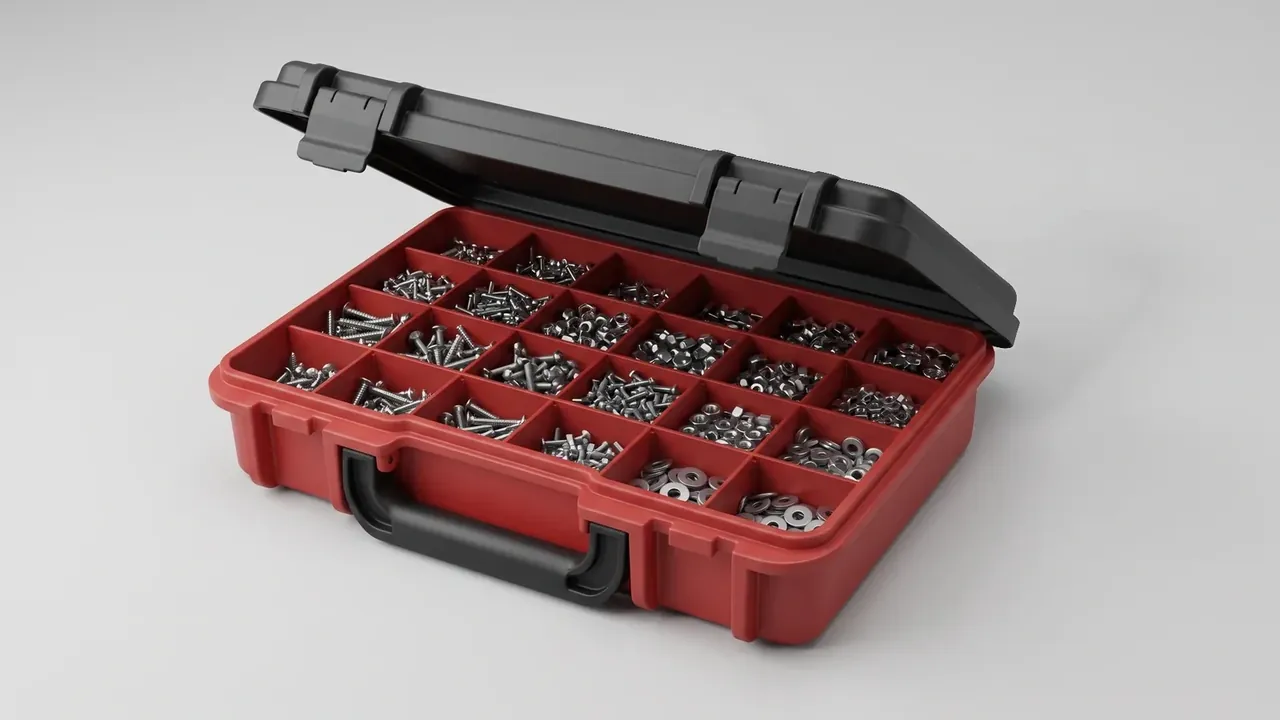
Quick answer: A Field Survey Equipment Case at 480×340×200 mm and 2.8 kg puts 18 kg on four φ9 mm shoulder bosses and holds offset under 15 mm.
Table of contents
- Carrying a Field Survey Equipment Case Overland
- Shoulder Bosses and Centre of Gravity
- Notched Impact in the Cold
- Lashing a Tripod to the Shell
- Resupply and Resetting on Long Lines
- FAQ
1. Carrying a Field Survey Equipment Case Overland
The last stretch from the vehicle to the survey point has no wheels on it. Carrying a Field Survey Equipment Case links three bearing surfaces on one person: straps on the shoulders, a belt around the hip bones, shell against the back, with load entering the walls through four bosses. Break one of the three and the other two carry double.
Boss position decides which part of the spine takes the weight. Four φ9 mm bosses sit at the corners of the back panel: the upper pair carries tension, the lower pair only pulls the shell in so it cannot roll outward. At 18 kg the upper pair shares half the load.
| Carrying mode | Load path | Weight band | Distance |
|---|---|---|---|
| Single sling | One strap across the body | Under 6 kg | Inside 500 m |
| Two shoulder straps | Two parallel straps | 6–15 kg | Inside 2 km |
| Straps and hip belt | Shoulders and hips share | 15–22 kg | 8 km class |
Take the mode that leaves no crack at the bosses after 18 kg over 8 km; a thinner wall suits vehicle transport only.
2. Shoulder Bosses and Centre of Gravity
Half of carrying comfort is where the mass sits. The empty shell is 2.8 kg, and at 18 kg the centre moves with how the load is stacked. Bosses are placed against the empty-shell centre, and a 15 mm offset is already felt through the straps; past 25 mm the walker leans forward.
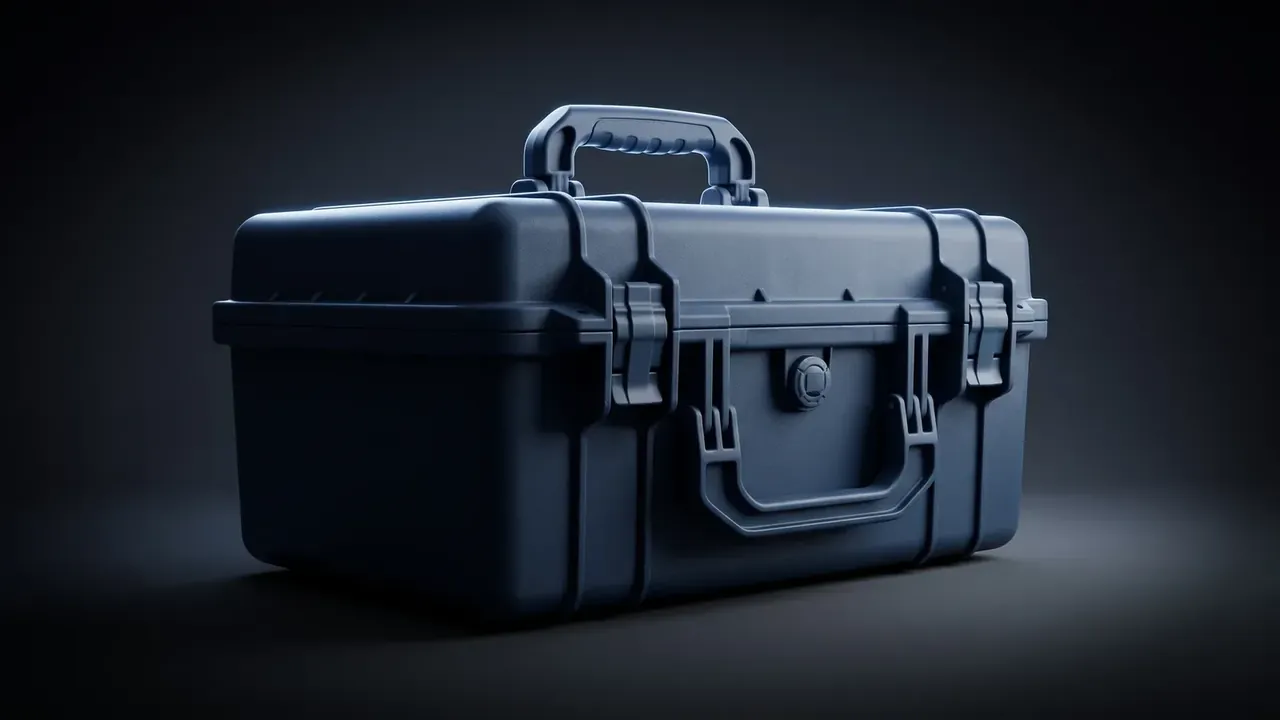
Split the shell into halves and the rule appears: top-heavy and the centre rises, so straps bite backwards after an hour; bottom-heavy and the hip belt takes shear. A Field Survey Equipment Case keeps cells and dense parts against the back at mid height. The pad behind each boss cannot be skipped. A φ9 mm hole in a 4.0 mm wall leaves under 3 mm of edge distance, and the rim whitens as tension concentrates. A local 6 mm pad spreads the pull over a 24 mm circle and cuts wall stress to about a third.
Nor should bosses crowd the edge. At 45 mm below the lid and 40 mm in from the sides the strap line stays straight; higher and the mass hangs below the anchor, so the shell rotates with every step.
3. Notched Impact in the Cold
Cold is the least considered part of a field specification. Notched impact in polypropylene falls away quickly: an ordinary homopolymer reads around 9 kJ/m² at 23 ℃ but only 3–4 kJ/m² at -40 ℃, where a knock on a corner starts a crack.
Impact-modified copolymer holds up better. In the Charpy notched arrangement of the GB/T 1043 family, a shell conditioned 4 h at -25 ℃ still reads 12 kJ/m², and embrittlement temperature sits at -40 ℃. The two answer different questions: impact strength is the margin to -25 ℃, embrittlement is what happens below.
| Cold level | Conditioning | Notched impact | Action |
|---|---|---|---|
| Ambient | 23 ℃ | Above 20 kJ/m² | Standard build |
| Cold region | -15 ℃ | Around 15 kJ/m² | Thicker corners |
| Extreme cold | -25 ℃ | 12 kJ/m² | Corner radius R8 or more |
Wall thickness and corner radius work as a pair: at the same 4.0 mm wall, a sharp R3 corner concentrates stress about threefold, while R8 brings it near 1.5. Toughness is already discounted by cold, and cracks begin at the corner.
4. Lashing a Tripod to the Shell
A tripod will not go inside, so it rides outside, and every lashing force lands on the shell. A Field Survey Equipment Case leaves 2 lashing positions on the back panel, aligned with the internal ribs, so a 25 mm strap loads structure rather than the thin field.
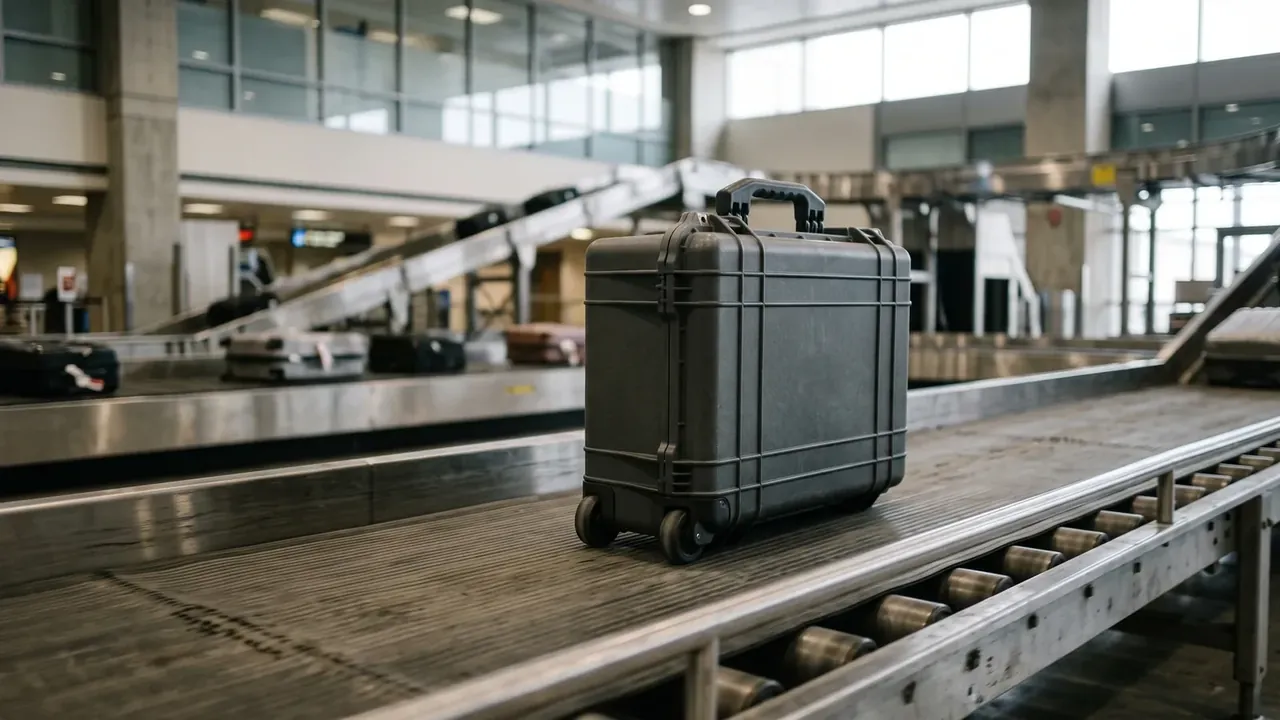
Keep the strap path short: the longer the run, the more it swings when walking, and swing becomes impact. Two positions, one high and one low, let the strap travel in a Z and hold the tripod flat against the back panel, with sway inside 20 mm.
| Lashing pattern | Strap path | Sway | Suitable load |
|---|---|---|---|
| Single top point | One strap over the lid | Around 60 mm | Short poles |
| Two side points | Two parallel straps | Around 30 mm | Tripod |
| Back-mounted | Strap joined to shoulder line | Inside 20 mm | Long pole with head |
Stacking 4 high is a static rating for the empty shell and does not survive an external tripod: hanging gear loads the rim, and four becomes three.
5. Resupply and Resetting on Long Lines
On an 8 km walk the case is opened twice a day, and each opening wears the catches. Resupply is counted in days, not kilograms: a one-day line carries one bottle and one set of cells, and the freed space is packed with a soft bag, because a large void lets contents knock with every step.
What matters over a long line is resetting: check the rim gap, listen for the catch, pull the webbing at each boss. A gap above 0.5 mm means a trapped liner; a catch without a crisp note means grit in the seat; twisted webbing pulls the shell off centre.
An IP67 shell need not be opened in the rain: the rating covers 1 m of immersion for 30 min, and the risky moment is opening the lid face-up, when water runs along the channel.
Conclusion
Carrying design for a Field Survey Equipment Case rests on three figures anyone can measure: edge distance at the bosses, centre offset, and notched impact in the cold. Give the bosses room, keep the centre at mid back and leave margin for cold, and the shell earns its place on a route with no wheels.
Related Reading
- Dividers and Labelling for Core Samples
- Temperature Bands for Calibration References
- Choosing Case or Crate for Field Work
Related Products
- 8 Series — Gun Cases; Military Equipment Cases; Camera Equipment Cases; Drone Cases; Watch Cases; Knife Cases; First Aid Cases; Electronics Equipment Cases
- WL8-2812 PP Gun Case — model WL8-2812
- All protective cases and toolboxes: 7 series, 158 models