

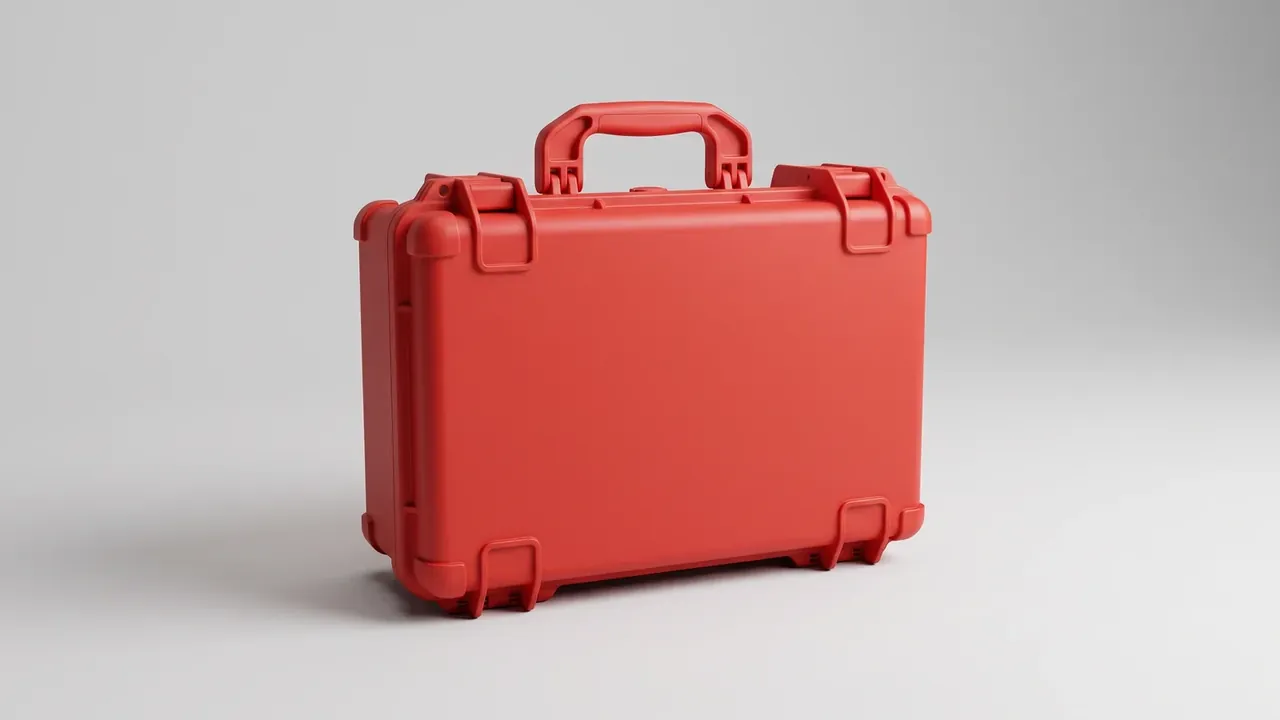
Quick answer: Forcible entry tools open in 6.5 seconds from a case with two cam latches, a lid held at 115 degrees and an 18 kg one-hand carry over 20 m.
Table of contents
- Access time for forcible entry tools: from lid to hand
- Lid opening angle and one-hand latches
- One-hand carry and modular inserts
- Marking and night readability
- FAQ
1. Access time for forcible entry tools: from lid to hand
Access time for forcible entry tools starts when the alarm sounds, not when a hand touches the case. Forty-five seconds from bay to vehicle, eight to lift the case aboard, 6.5 to open and pick at the scene: 59.5 seconds in total. Only the last leg is pure case geometry, which is why it is the one worth redesigning.
A two-person crew works from one case with six slots on two levels: reached-often items on top, spares below. Slots follow the order of actions rather than item size, because a mismatched order turns a pick into a search worth 4 extra seconds. Racking at 1.1 m and a 190 mm case stack two high without lifting above the shoulder, and a handle facing the door saves 2 of the 45 seconds.
Gloves are the hidden variable: a 2 mm palm halves what a thumb can feel, and finding a latch tongue by touch costs another second, so the latch should be visible rather than feelable.
2. Lid opening angle and one-hand latches
At 115 degrees the lid centre of gravity passes the hinge line and the lid holds itself, freeing both hands for the pick. Below 100 the lid drifts down and a gloved hand must hold it, so every pick costs an arm. Above 130 the lid leans back, the case centre of gravity follows, and a case on sloping ground tips as a whole.
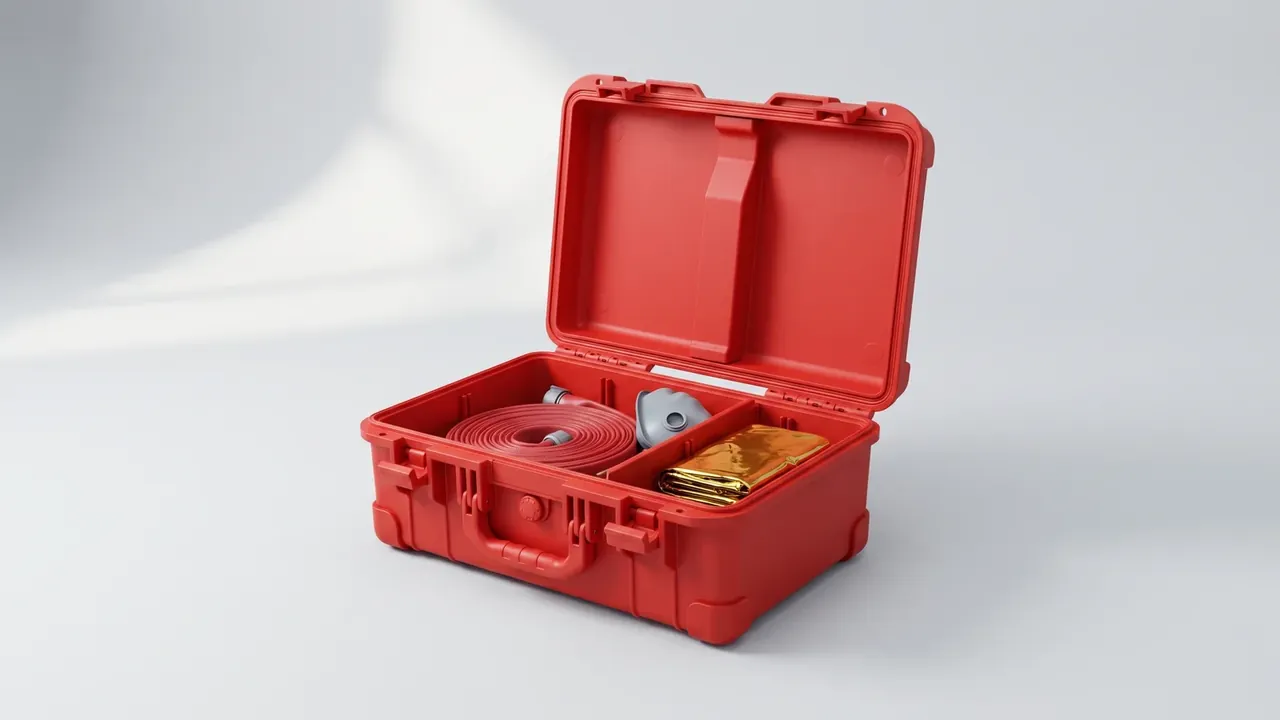
The two cam latches sit on the long sides of the mouth, tongues up, and 55 N of thumb pressure takes each to the stop through 2 mm gloves. Sitting outside the mouth rather than recessed into the lid edge keeps fingers out of the closing gap, a detail that matters most after dark.
Lid mass is 0.9 kg on a three-stage damper: 30 degrees under a light push, 60 supported, 25 settling slowly, so a gloved hand never has to modulate force. Stainless pins in self-lubricating bushes hold hinge play under 0.3 mm after 100,000 cycles.
| Action | Seconds | What the case side controls |
|---|---|---|
| Release first latch | 1.2 | Tongue up, 55 N push |
| Release second latch | 1.2 | 340 mm spacing, one-hand reach |
| Lift lid to stop | 0.8 | 115 degree hold, even damping |
| Locate and pick | 2.0 | Slot order matching the job |
| Close and re-latch | 1.3 | Self-aligning latch seats |
Closing takes 1.3 seconds and is usually ignored: a 3 mm chamfer on the latch seat catches the lid and presses it home without looking down.
3. One-hand carry and modular inserts
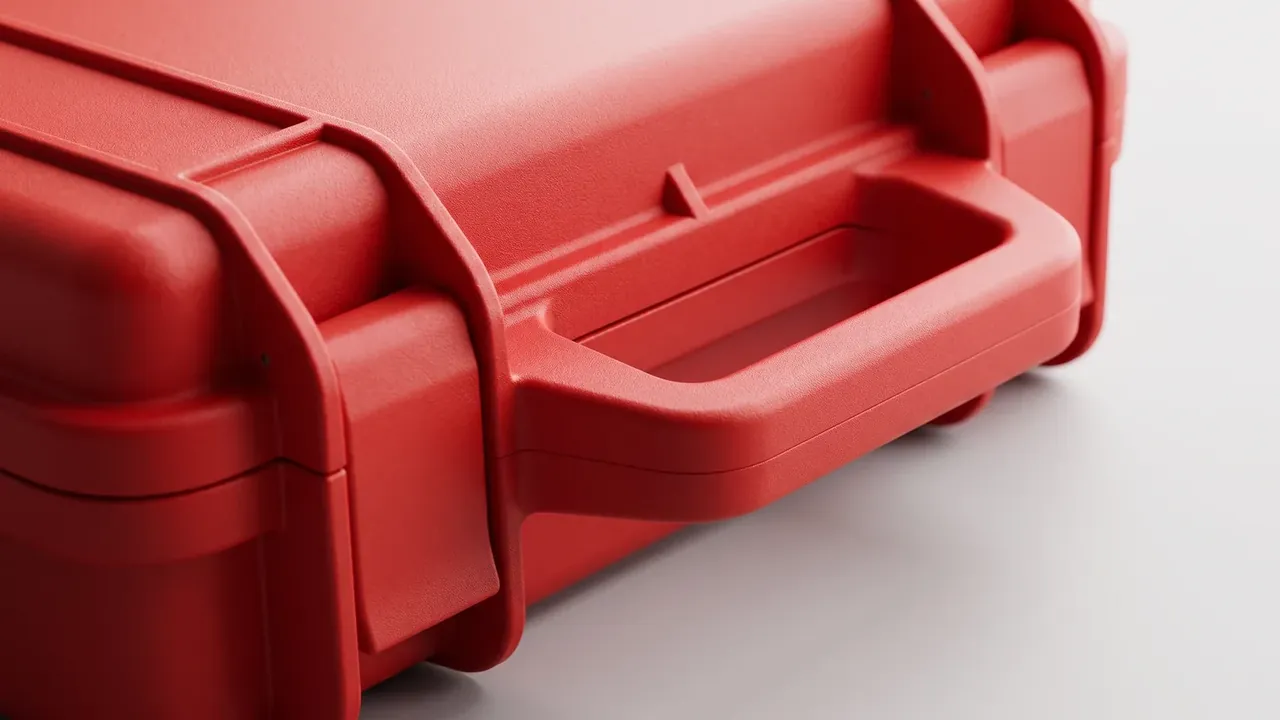
The handle is moulded in one piece, 32 mm wide with a four-finger slot; at 18 kg loaded it carries 20 m in one hand before a change. Below 25 mm the change comes at 10 m.
Empty weight is 5.4 kg, typical for this class. Lighter and the mouth flexes outward under load; past 7 kg and one-hand distance drops under 12 m, at which point two people are faster anyway. Around 5 kg is the line between the two habits.
| Lid type | Opening angle | One-hand open | Pick at the scene |
|---|---|---|---|
| Full flip lid | 115° | Yes | 6.5 s |
| Front door | 90° | Yes | 8.2 s |
| Drawer | Fully out | No | 11 s |
Modular inserts let one case cover several jobs: 3 mm PP, six slots, 8 N to pull, still tight after 2,000 cycles, swapped in 12 seconds without tools. A shift handover changes the insert rather than the case, so shell markings and the serial do not have to be redone. JUNZHIJIA holds insert-to-shell clearance within 0.4 mm, so a swapped insert does not rattle. The cavity runs 480 x 350 x 170 mm with 60 mm slot depth: past 80 mm the gloved fingertip cannot reach bottom, under 40 mm the lid presses on the contents.
4. Marking and night readability
Markings must read in two conditions: backlit daylight and low light. One 50 mm reflective strip on each side of the lid gives a silhouette at 30 m against headlights, and an 80 mm arrow points to the opening side so a person at the flank still knows which way is front. Shell colour works as a group code: fluorescent orange reads about 5 m further through smoke than signal red, and the group decides which to buy.
The serial sits in 20 mm white characters at the top right of the lid with a 40 x 25 mm barcode field beside it, set into a recess, and photoluminescent corner pads hold a 15-minute glow.
It also has to survive washing: film sits in a 0.5 mm recess so a pressure jet cannot get under it, the serial is screen printed under clear lacquer and still reads after 200 wipes, and four 8 mm drains let a washed case dry in 30 seconds upside down.
Readability at low light depends on contrast, not brightness. A dark shell with white characters stays legible at 0.5 lux; light grey with silver turns into a pale smear. Markings also group a fleet: one colour per group, fixed at purchase, so a case is sorted by shell at 20 m without a label.
Conclusion
Rapid access to forcible entry tools rests on three measurable numbers: 1.2 seconds per latch, a lid that holds at 115 degrees, and 20 m of one-hand carry at 18 kg. Meet all three and the pick takes 6.5 seconds inside a 59.5 second turn-out; meet two and it gains 2 to 4 seconds, which through smoke is three or four extra steps.
This article discusses only the container (case) side of specifications and design implications, and does not cover any handling, loading or use of the items inside.
Related Reading
- Case use in fire and rescue operations
- How fire equipment cases are built and protected
- Selection and configuration for fire equipment cases
Related Products
- 8 Series — Gun Cases; Military Equipment Cases; Camera Equipment Cases; Drone Cases; Watch Cases; Knife Cases; First Aid Cases; Electronics Equipment Cases
- WL8-2812 PP Gun Case — model WL8-2812
- All protective cases and toolboxes: 7 series, 158 models