

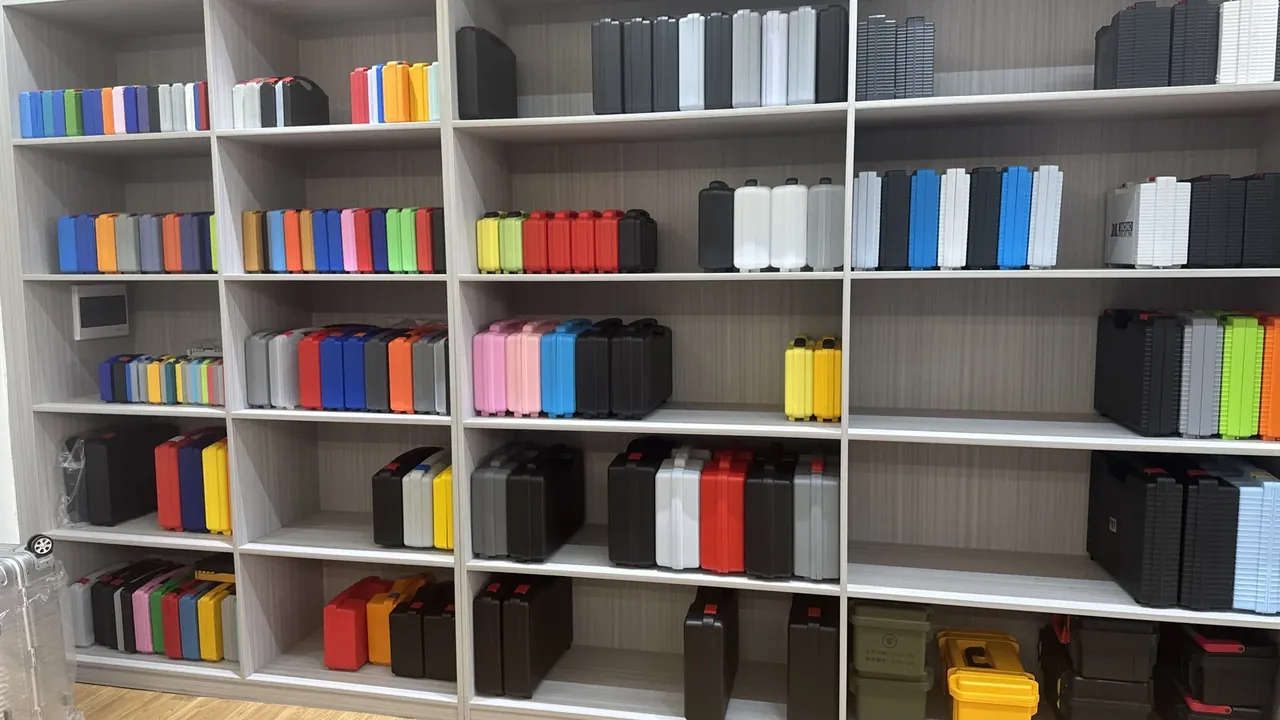
Quick answer: Quotes for a firearm protective case drawing diverge because each plant cuts the cost elsewhere. Split the price into five stated lines, keep tooling and sampling separate and amortised over the first order, negotiate MOQ against material, machine and hardware limits, and pin lead time to seven dated milestones.
Table of contents
- Five Lines That Make a Firearm Protective Case Quote Comparable
- How Tooling and Sampling Charges Amortise
- The Three Tiers Behind a Minimum Order Quantity
- Seven Lead-Time Milestones Pinned to Dates
- Incoming Inspection and Batch Release Records
- FAQ
1. Five Lines That Make a Firearm Protective Case Quote Comparable
Three quotes on one drawing spread by fourteen percent, and the gap is rarely profit: one folds tooling into the unit price, another hides the pallet in packing, a third treats the test as free.
| Cost line | Share | Basis |
|---|---|---|
| Body moulding | 55% to 60% | Shot weight times resin plus machine time |
| Hardware | 18% to 22% | Per set, latch and hinge |
| Insert | 10% to 13% | Density times routed area |
| Packing | 5% to 7% | Domestic or export basis |
| Testing | 2% to 3% | Per project, reports stated |
A 760 x 300 x 125 mm case weighs 3.4 kg bare. Polypropylene at 10.2 CNY a kilogram gives 34.7 CNY of resin; a 650-tonne press at 320 CNY an hour, 85-second cycle, adds 7.6. That 42.3 CNY floor is the line to watch: anything beneath that came out of wall thickness. Validity runs 20 days.
2. How Tooling and Sampling Charges Amortise
A single-cavity injection mould with a sliding core runs 126,000 CNY, the insert tool 18,000; a rotational mould costs 54,000 and loosens wall tolerance to plus or minus 0.5 mm. Tooling stays on its own line, ownership named, or first orders of a firearm protective case cannot be compared.
Amortisation is simple division: at 200, 500, 1,000, 2,000 and 3,000 pieces the injection tool adds 630, 252, 126, 63 and 42 CNY per case, against 270, 108, 54, 27 and 18 rotational. A rotational surface is reworked about every 2,500 parts at seven percent of tool value, so a seven percent reserve belongs in the price. Sampling is 4,800 CNY for three first-off parts with one modification, credited past 1,000; later rounds 2,600, tool life 300,000 shots.
3. The Three Tiers Behind a Minimum Order Quantity
A minimum order is three constraints stacked, not a number sales invents. A firearm protective case in natural resin reaches 200 pieces because a colour change burns 40 minutes of cleaning and 3 kg of compound; Pantone pushes the floor to 500.
Hardware is the second gate: general latches order 2,000 sets, die-cast customs 1,000, 4.2 CNY a set between them, and at 200 pieces a machined keeper saves about 14,000 CNY. The machine is the third, 90 minutes to change a mould and 40 to settle. Combine two same-size projects, take 200 with the balance inside 120 days, or hold 150 as consignment.
4. Seven Lead-Time Milestones Pinned to Dates
Thirty-eight days looks generous until spread over seven milestones with two or three days of slack. A firearm protective case schedule is written in dates, not weeks.
| Milestone | Days | Deliverable | Sign-off |
|---|---|---|---|
| Drawing freeze | 1 to 2 | 3D model, routing, hardware | Both |
| Tool build | 3 to 17 | Photos, steel certificate | Supplier |
| First-off trial | 18 to 22 | Three samples, first article record | Supplier QA |
| Sample approval | 23 to 28 | Signed sample, changes list | Buyer |
| Production | 29 to 35 | Daily report at 800 pieces | Supplier |
| Inspection | 36 to 37 | Sampling record, packing list | Both |
| Shipment | 38 | Bill of lading, pallet photos | Supplier |
The critical path sits in tool build and sample approval: a sliding-core mould reaching trial in 15 days is normal, sink marks buy four to six days. One free round, five days maximum, then 700 CNY a day. At 85 seconds a shot over 20 effective hours the line makes 800 pieces, so 3,000 take four days.
5. Incoming Inspection and Batch Release Records
A firearm protective case shipment is sampled at ten percent per pallet, never under six pieces, across three pallets: four mid-wall readings with a 3.2 mm minimum, each latch at 480 N for 15 seconds, sealing at 20 kPa for 60 seconds, two units dropped 1.5 m.
The release record must rebuild the batch later: batch, cavity, pieces sampled, failures, lowest wall, latch force, disposition, date. One cavity repeating a defect means ten pieces next time; failures are quarantined, cause due in 48 hours, concessions capped at 30 days.
Conclusion
Buying a firearm protective case compares boundaries, not totals: five cost lines, tooling and sampling on their own line, seven dated milestones. Put the figures in the contract annex and let release records follow the batch, and price becomes comparable while dates become enforceable. That shift is the point of buying a firearm protective case.
This article discusses only the container (case body) side of specifications and design intent, and does not cover any handling, loading or use of the contents.
Related Reading
- firearm-protective-case-maintenance
- Matching case dimensions to a specification
- Firearm Storage Cases for Ranges and Law-Enforcement Units
- What supplier qualification should prove
Related Products
- 8 Series — Gun Cases; Military Equipment Cases; Camera Equipment Cases; Drone Cases; Watch Cases; Knife Cases; First Aid Cases; Electronics Equipment Cases
- WL8-2812 PP Gun Case — model WL8-2812
- All protective cases and toolboxes: 7 series, 158 models