

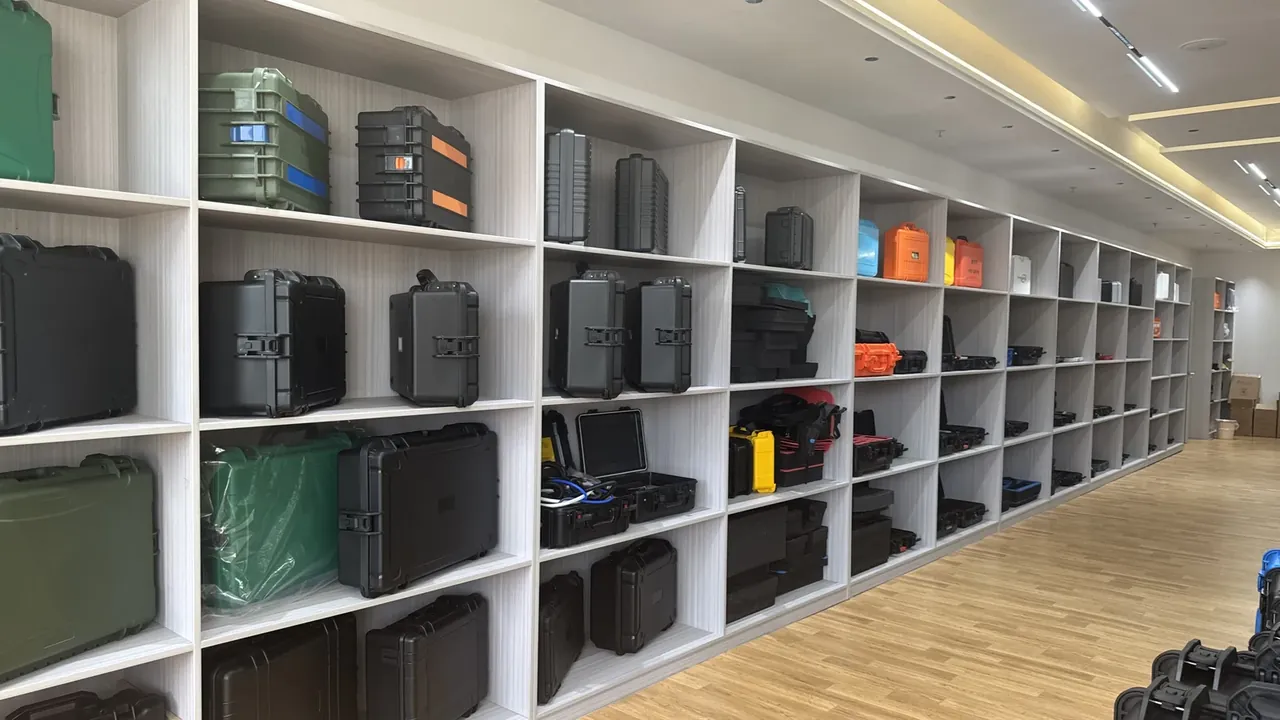
Quick answer: A firearm protective case specification is built backwards from the load list into four measurable numbers: internal size with one-way tolerance, wall thickness with rib spacing, static stack load, and sealing range.
Table of contents
- Deriving a Firearm Protective Case Spec from the Load List
- Internal Dimensions and Tolerances
- Wall Thickness and Rib Spacing
- Static Stack Load and Drop Height
- Sealing Class and Temperature Range
- FAQ
1. Deriving a Firearm Protective Case Spec from the Load List
Specifications start with an inventory: longest item 1080 mm, two units side by side 280 mm, a sighted unit 140 mm tall. Add 20 mm of handling clearance and the cavity lands at 1120 by 320 by 160 mm.
| Requirement | Drawing parameter | Marked as | Value |
|---|---|---|---|
| Item 1080 mm | Internal length | Basic size, plus only | 1120 mm, +2 mm |
| Two side by side | Internal width | Includes foam | 320 mm |
| Sighted unit | Internal height | Base to lid foam | 160 mm |
| Four-high storage | Top face load | 24 hour static | 180 kg |
Write "approximately" and nothing is written: one supplier works to the upper limit, another to the lower, and the same insert fits one case and jams in the next.
2. Internal Dimensions and Tolerances
Measure the cavity from the inner surface, excluding radii and foam, and give a one-way tolerance: larger, never smaller. Foam takes up slack; a wall cannot give material back.
Shrinkage of 0.5 to 0.7 percent means a one metre case cools 5 to 7 mm short of the tool, so the cavity is cut oversize. The lid step keeps 1.5 to 2.0 mm of clearance to stop rattle without starving the gasket.
| Internal length | Size tolerance | Lid step gap | Diagonal difference |
|---|---|---|---|
| Under 300 mm | plus or minus 0.8 mm | 1.0 to 1.5 mm | 1.5 mm |
| 300 to 800 mm | plus or minus 1.2 mm | 1.5 to 2.0 mm | 2.0 mm |
| 800 to 1200 mm | +2, minus 1 mm | 2.0 to 2.5 mm | 2.5 mm |
3. Wall Thickness and Rib Spacing
Thicker is not stronger. Past 6 mm, weight, cycle time and sink marks climb together, so a firearm protective case settles at 4.5 mm sides, 4.0 mm lid and 5.0 mm base, buying stiffness with ribs at 90 mm pitch, 12 mm tall on a 6 mm root.
Below 70 mm pitch, weld lines crowd where a dropped case splits.
| Zone | Wall | Ribs | Target |
|---|---|---|---|
| Side wall | 4.5 mm | 90 mm pitch, 12 mm tall | Lateral crush |
| Lid | 4.0 mm | Square grid, 110 mm pitch | Resistance to sag |
| Base | 5.0 mm | 6 mm root | Wear and load |
Runs on an 1800 tonne press; thickness is judged at plus or minus 0.2 mm on the lowest of four readings.
4. Static Stack Load and Drop Height
Load has two lives: time under pressure in a warehouse, distance fallen in a truck. An empty firearm protective case weighs 9.5 kg and carries 27 kg loaded, sitting four high, so the bottom unit takes about 81 kg; design to 180 kg on the top face for 24 hours with 1.2 mm of residual set.
Impact is separate. Drop at 1.5 m onto concrete across six faces, three edges and one corner, ten drops, then accept no through crack, no released latch and no lid shift beyond 1.5 mm. Below freezing the height falls to 1.2 m as the resin loses toughness at minus 25 Celsius.
5. Sealing Class and Temperature Range
Never write "waterproof" alone. IP67 means 30 minutes at one metre with no water inside; for rain and washdown, IP65 costs less and a firearm protective case rarely needs more.
Gasket compression belongs between 25 and 30 percent, so groove depth and cord diameter are paired: under 25 percent it leaks, over 35 percent it takes a permanent set. State minus 30 to 60 Celsius with a dwell time at each end.
| Test | Condition | Pass line |
|---|---|---|
| Ingress | IP67, 1 m, 30 min | No visible water |
| Cold | minus 30 Celsius, 4 h | No cracking, latches work |
| Heat | 60 Celsius, 24 h | Under 0.3 percent growth |
| Thermal shock | minus 25 and 55 Celsius, 3 cycles | Gasket free of set |
Operating tests add latch cycles: retention at 60 Celsius stays within 10 percent of 220 newtons.
Conclusion
A specification earns its name when four claims become four readings: it fits, does not crush, does not split, does not leak. Give the cavity a one-way tolerance, pair each wall with its rib pitch, keep static load and drop height apart, and attach dwell times to every temperature claim. Then a firearm protective case drawing controls the product rather than describing it.
This article discusses only the container (case body) side of specifications and design intent, and does not cover any handling, loading or use of the contents.
Related Reading
- Material options for firearm protective cases
- Common firearm protective case problems
- How long weapon cases are built
- Specifying a foam insert
Related Products
- 8 Series — Gun Cases; Military Equipment Cases; Camera Equipment Cases; Drone Cases; Watch Cases; Knife Cases; First Aid Cases; Electronics Equipment Cases
- WL8-2812 PP Gun Case — model WL8-2812
- All protective cases and toolboxes: 7 series, 158 models