

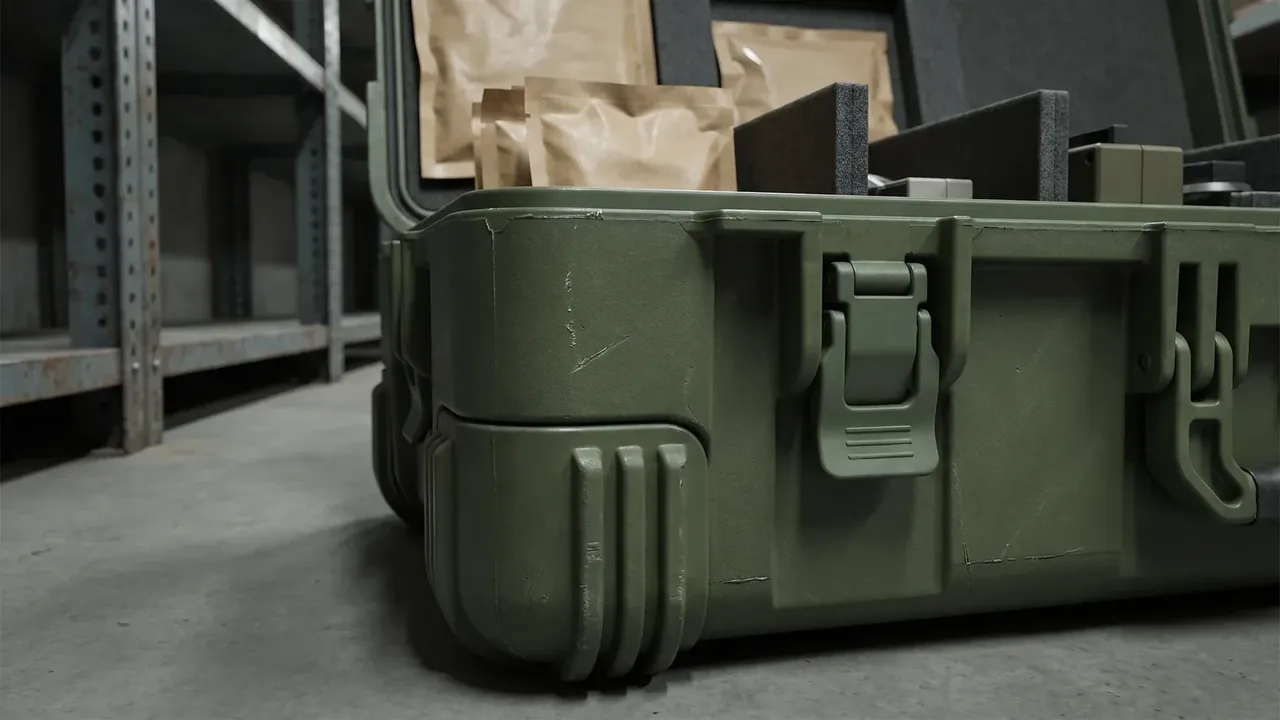
Quick answer: A forest patrol case carrying 12 kg over 6 km presses the shoulders at 1.6 kPa on two straps, a third of the 4.8 kPa a single sling delivers, and a waist belt plus a double-lip seal with 50 g of desiccant keep the load and the damp under control.
Table of contents
- Splitting 12 kg between shoulders and hips
- Case weight against volume
- Sling against twin straps
- Rain, condensation and wading
- FAQ
1. Splitting 12 kg between shoulders and hips
Carrying 12 kg over 6 km puts a third of the shoulder pressure on two straps that a single sling does. The arithmetic: 12 kg is 118 N, and a sling strap 70 mm wide by 350 mm long spreads it over 0.0245 m² at 4.8 kPa; two 60 mm straps spread it over 0.030 m² at 3.9 kPa.
Add a waist belt taking 60% of the load and the shoulders hold 47 N at 1.6 kPa. The difference is contact area and a belt, not fitness.
| Carry mode | Strap area | Belt share | Shoulder pressure | Feel after 6 km |
|---|---|---|---|---|
| Single sling | 0.0245 m² | 0 | 4.8 kPa | Sharp ache one side, 2 swaps |
| Twin straps, no belt | 0.030 m² | 0 | 3.9 kPa | Mild soreness, keeps walking |
| Twin straps plus belt | 0.030 m² | 60% | 1.6 kPa | Barely noticed |
The belt must sit on the iliac crest, not the lumbar hollow, or it slides down within 3 km. It needs 80 mm of width and 15 mm of padding; at 40 mm the pressure doubles and the shoulders get no relief.
2. Case weight against volume
A forest patrol case at 3.2 kg with 26 L of internal volume runs 0.12 kg per litre. Push that to 0.20 kg/L and the same 12 kg total carries 2 kg less gear.
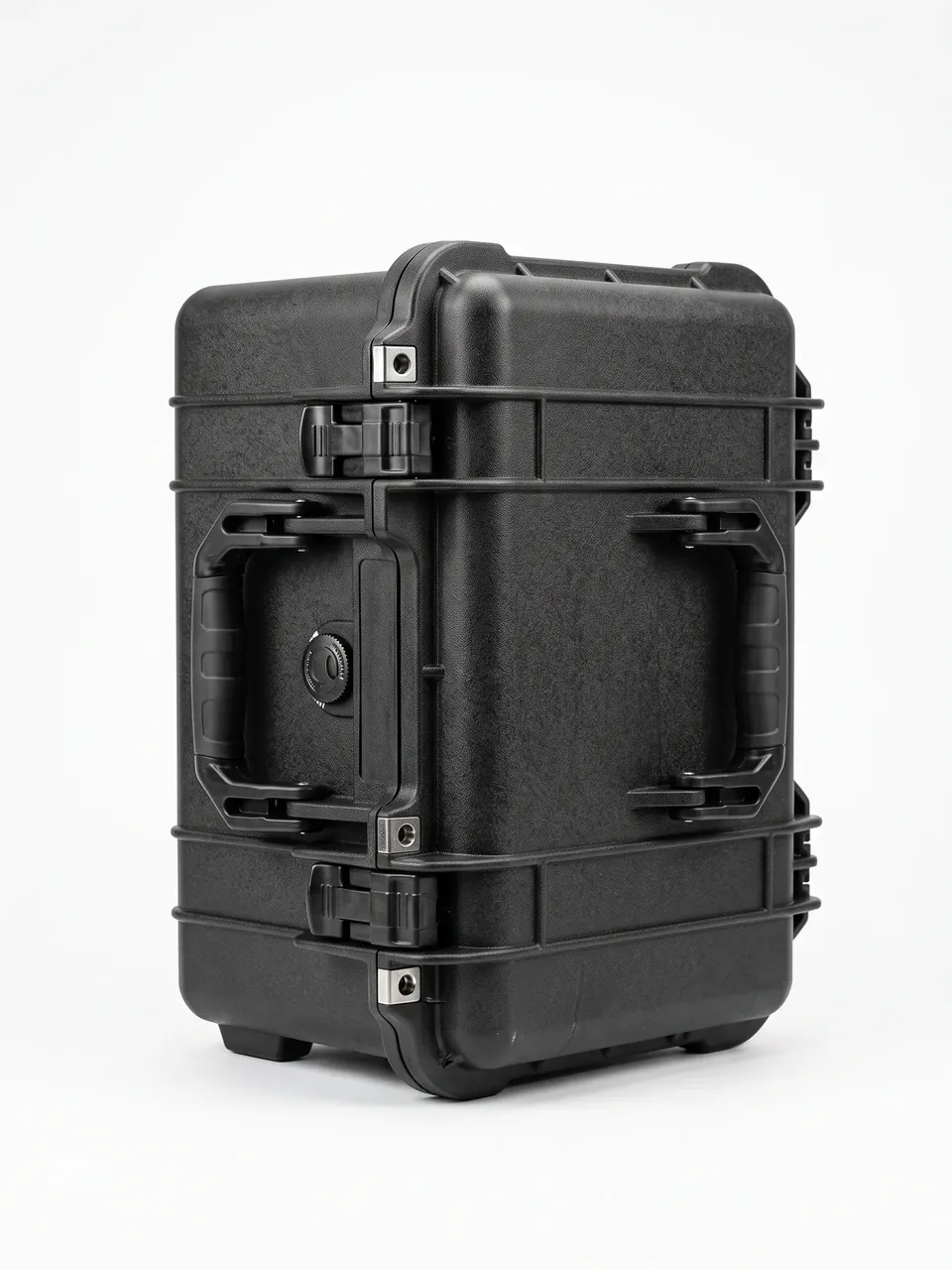
Most of the mass is structure: four metal corner caps around 0.4 kg, two moulded handles at 0.3 kg, casters at 0.5 kg, a pressure-equalising valve at 0.1 kg. That 1.3 kg buys drop resistance, a two-person lift and pressure relief, so it is not dead weight.
Volume has to mean usable volume: of the 26 L, 25 mm of foam lining takes about 5 L, leaving 21 L. Aim for 0.10 to 0.14 kg/L; below 0.10 the wall falls under 2 mm and corners crack on a drop, above 0.14 the extra mass buys no more protection.
Two-person lifting depends on handle height. At 30 mm below the lid, two people lifting 15 kg clear the ground by 250 mm, just above the knee. One-handed carry tops out near 6 kg, and past 8 kg a strap is the only option.
3. Sling against twin straps
A sling is quicker for the first 3 km and forces a swap past 6 km. Each swap shifts the centre of mass 120 mm and breaks stride for 4 s, costing 8 min over a 20 km day.
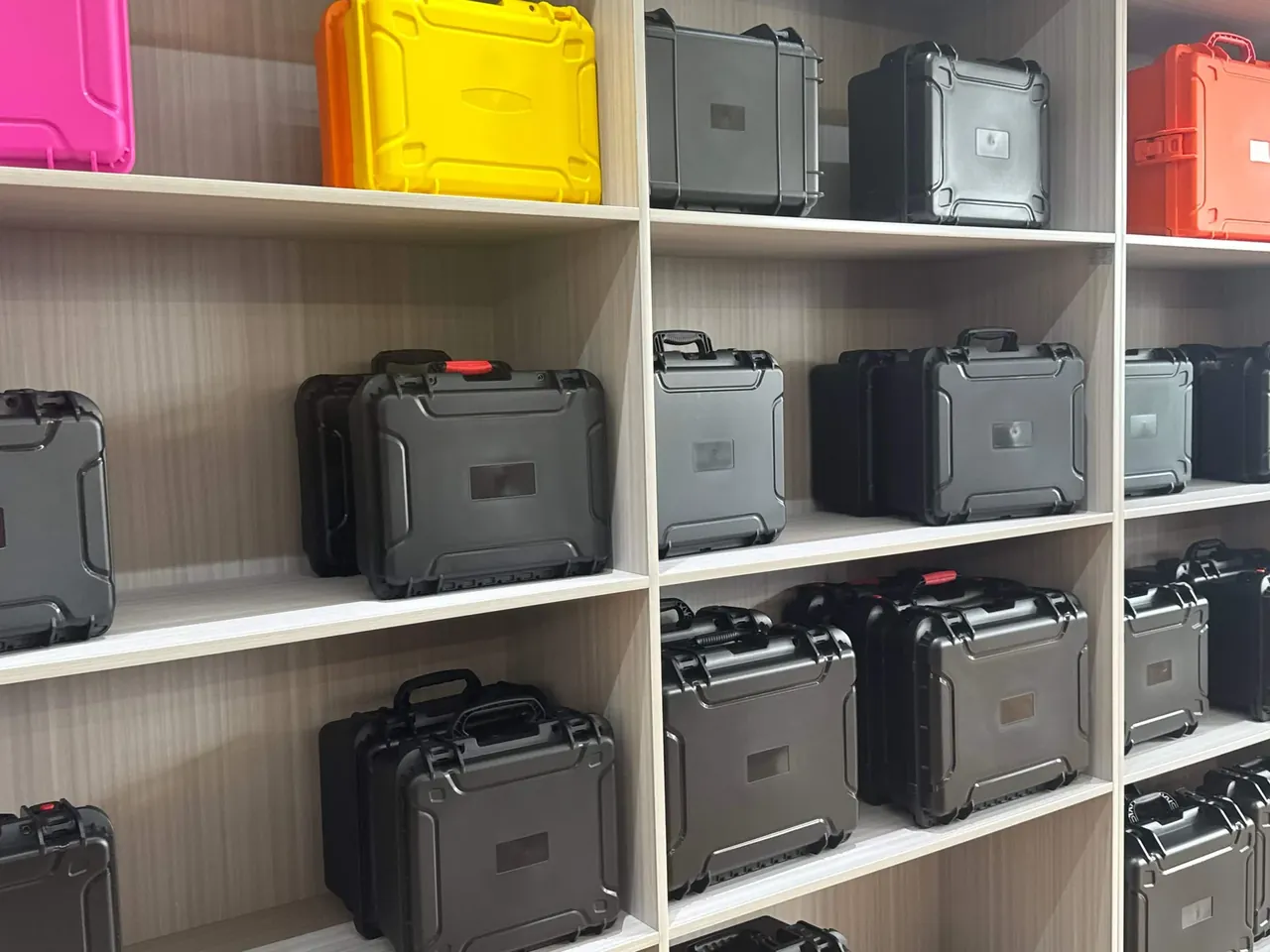
Volume decides the mode. An 8 L case weighs 1.1 kg empty and rides on one shoulder; a 40 L case passes 15 kg loaded and needs twin straps plus a belt. Sort by loaded weight, never by shell size.
Anchor position matters more than webbing. With straps anchored 40 mm below the lid the case sits flat against the back and swings least; drop the anchors to 120 mm and the top edge tips out, striking the hip with every step.
Twin straps cover the scapulae and cut 30% of the back's cooling area, so at 32 ℃ the back wets first; a sling leaves half the back open but triples one-side pressure.
Strap length needs adjustment: a 6 km carry and a 12 km carry differ by 40 mm, and the adjuster belongs mid-strap where one hand reaches it.
4. Rain, condensation and wading
Rain is rated at 100 L/m²/h, a 100 mm per hour downpour, which delivers 33 mm in 20 min. What keeps it out is the joint: a double lip with a 5 mm O-ring at 30% compression forces water through two turns before it reaches the cavity.
Condensation is separate. At 90%RH with a 12 ℃ day-night swing, the inner wall collects about 0.6 g an hour. Silica gel at 50 g absorbs 12 g, covering 20 h; at 100 g it covers 40 h.
Wading comes down to buoyancy. An outer envelope of 28 L displaces 28 L and gives 275 N of lift against 31 N of case weight, enough for about 24 kg. One unfastened latch lets half a case of water in within 30 s.
| Damp control | 20 min at 100 L/m²/h | Internal RH at 90%RH | Desiccant | Endurance |
|---|---|---|---|---|
| Single lip, no desiccant | Droplets on the wall | 82%RH | 0 | Under 4 h |
| Double lip plus O-ring | Wall stays dry | 68%RH | 0 | 8 h |
| Double lip, O-ring, 50 g | Wall stays dry | 45%RH | 50 g | 20 h |
| Double lip, O-ring, 100 g | Wall stays dry | 38%RH | 100 g | 40 h |
Two other paths leak: the valve seal and the handle screw bosses, so run a 70 Shore A O-ring on the valve and use blind bosses with bonded washers. Desiccant saturates near 25% of its own weight, and the gel revives at 120 ℃ for 2 h.
Wading has a 30 s criterion. At 0.5 m the outside sits 5 kPa above the inside, enough to push a weak lip open, which is why a forest patrol case spends its joint on two turns.
Conclusion
Two tables settle the specification. Sort by loaded weight first: above 12 kg go twin straps with a belt and pull shoulder pressure from 4.8 kPa to 1.6 kPa. Then sort by trip length: under 8 h a double lip and O-ring will do, 20 h needs 50 g of desiccant, 40 h needs 100 g. Two numbers sit between them and get missed: keep weight against volume between 0.10 and 0.14 kg/L, and anchor the straps 40 mm below the lid. Fix those four and the case behaves predictably in the forest; the rest is one walk with a pressure check and a humidity reading.
This article discusses container-side specifications and design implications only, and does not cover any handling, loading or use of the contents.
Related Reading
- Outdoor gear case carry and storage layout
- Damp control for field camp cases
- Why outdoor cases let water in
Related Products
- 8 Series — Gun Cases; Military Equipment Cases; Camera Equipment Cases; Drone Cases; Watch Cases; Knife Cases; First Aid Cases; Electronics Equipment Cases
- WL8-2812 PP Gun Case — model WL8-2812
- All protective cases and toolboxes: 7 series, 158 models