

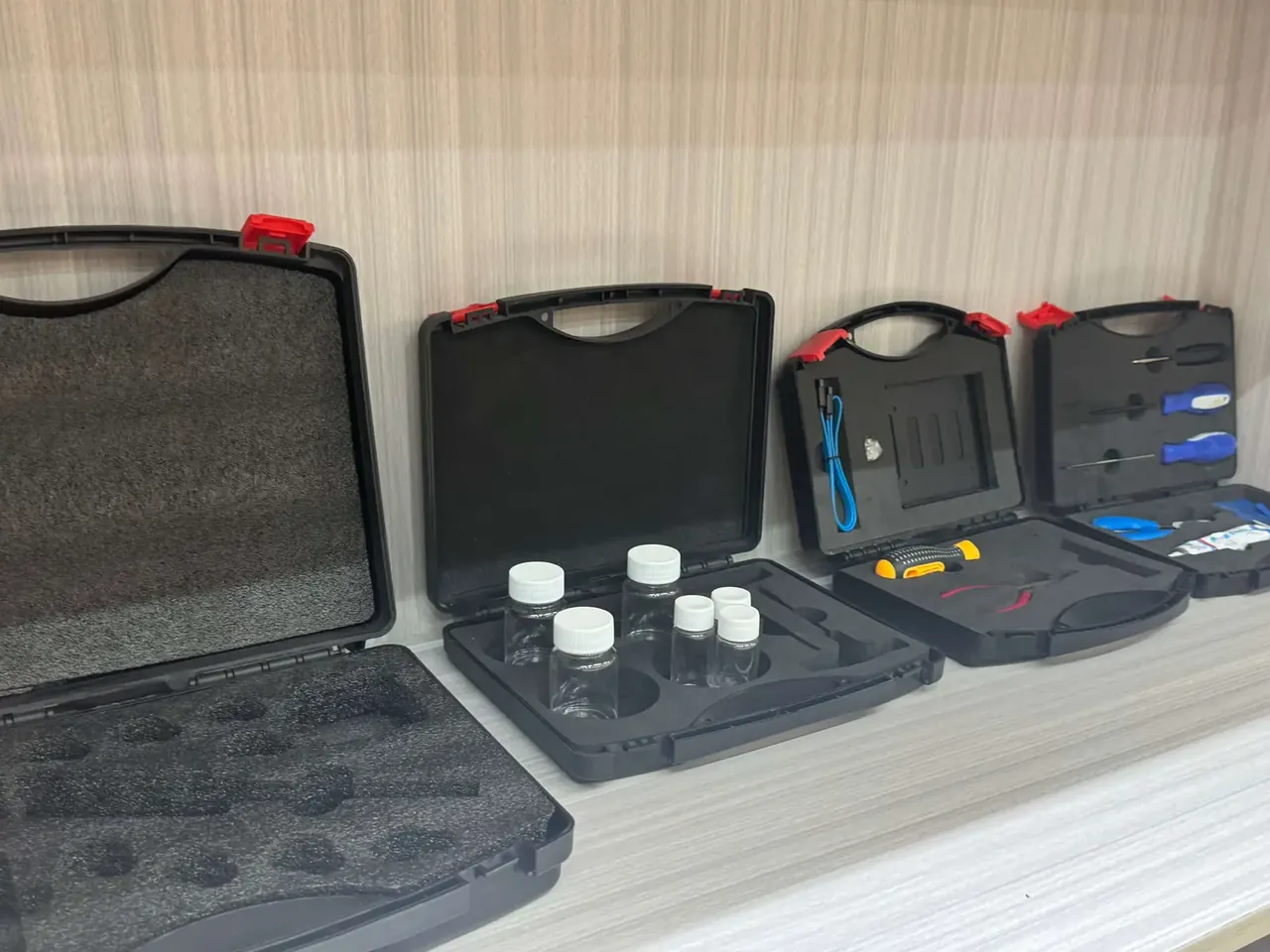
Quick answer: A grenade transport case stays serviceable through three routines: a 90-second pre-issue check, an 8-minute monthly check, and a 40-minute annual service. Replace the gasket at 24 months or 600 closures; scrap the body at 3.0 mm wall against a 3.6 mm nominal.
Table of contents
- Maintenance intervals for a grenade transport case
- Seals and foam inserts: inspect and replace
- Latches, hinges and handles: wear limits
- Wall thickness and surface re-measurement
- Spare parts kit and maintenance records
- FAQ
1. Maintenance intervals for a grenade transport case
Tie the schedule to how often a grenade transport case leaves the rack. Tooling separates the three levels: eyes and hands, then a feeler and pressure gauge, then a thickness gauge and torque wrench.
| Level | Trigger | Time per case | Tooling | Pass criterion |
|---|---|---|---|---|
| Pre-issue | Before every dispatch | 90 seconds | Visual and touch | Latches engage together, no rattle |
| Monthly | Fixed date each month | 8 minutes | Feeler, pressure gauge | No gasket nicks, inserts seated |
| Annual | Every 12 months | 40 minutes | Thickness gauge, torque wrench | Wall at or above 3.0 mm, seal holds |
Both latches must bite at once and the lid must close without a rattle; gasket nicks belong to the monthly routine.
2. Seals and foam inserts: inspect and replace
The gasket is the first part to expire, and compression decides, not appearance. With the lid closed, measure the remaining groove height: effective sealing sits between 28% and 35%. Below that the profile never loads up; above it the gasket collapses and takes a permanent set. Running a 0.4 mm feeler around the rim shows where it leaks.
Replace at 24 months or 600 closures. Wipe the groove with ethanol and lift old adhesive with bamboo. Foam is judged at a fixed point: a 3 mm set means replacement.
3. Latches, hinges and handles: wear limits
Most latch failures start in the spring. After 3000 closures a latch may lose 15% of its holding force; past that, replace the whole latch, since hook and seat have worn a slope no spring offsets. A 1 mm gap when pressing up on the lid means a tired spring.
Hinge bore play is read with a 0.3 mm feeler; two readings growing by 0.1 mm justify a new pin, and cracks cluster within 15 mm of each hinge end. Turning rivets or whitened seats mean a new handle assembly once bore wear passes 0.2 mm.
| Part | Replacement criterion | Spare requirement | Shop time |
|---|---|---|---|
| Gasket | 24 months or 600 closures, compression below 28% | Same mould batch, Shore A 55±5 | 12 minutes |
| Latch | Over 15% force loss after 3000 closures | Pair with hook and seat | 6 minutes |
| Hinge pin | Bore play grows over 0.1 mm twice running | Diameter tolerance ±0.02 mm | 9 minutes |
| EVA insert | 3 mm set at one point, or bonded edge lifting | 45 kg/m³, same cutting die | 15 minutes |
| Handle assembly | Rivet turns and seat shows whitening | Rivets included, bore wear under 0.2 mm | 10 minutes |
4. Wall thickness and surface re-measurement
Thickness readings compare only at fixed points. Twelve serve a grenade transport case: four base corners, four edge midpoints, two beside the hinge seats and two on the rim. Nominal wall is 3.6 mm; under 3.0 mm, a 17% loss, the case is scrapped. A probe held off-normal reads high by 0.1 mm.
A crack from a rib root longer than 8 mm retires the grenade transport case. Whitening that warm air does not clear means the polymer has yielded. Plating below 8 μm rusts within three months at 85% humidity.
5. Spare parts kit and maintenance records
For every 50 grenade transport cases keep 6 gaskets, 3 latch sets, 10 hinge pins and 2 insert sets; gaskets are consumed twice as fast as latches.
The record card needs six columns: case number, closures, last inspection, parts and batch, inspector, next due date. What matters is trend: if three in ten gaskets from one batch run early, the batch is the problem.
| Symptom | Common misreading | Correct criterion |
|---|---|---|
| Gasket looks intact | Return to service | Measure compression, replace below 28% |
| Latch closes but feels loose | Tighten the seat | Test force, replace after 15% loss |
| Rattle when closing the lid | Add lubricant | Check bore, replace pin after 0.1 mm |
Conclusion
Maintaining a grenade transport case is not technically hard; the difficulty is holding three routines, five replacement lines and one record card for two years. Put the numbers on the inspection card, and a grenade transport case still passes its seal test after 600 closures.
This article discusses only the container (case body) side of specifications and design intent, and does not cover any handling, loading or use of the contents.
Related Reading
- Grenade Transport Case and Storage Box: Retaining and Cush…
- Reading the specification sheet
- Preventing storage damage
- grenade-transport-case-applications
Related Products
- 8 Series — Gun Cases; Military Equipment Cases; Camera Equipment Cases; Drone Cases; Watch Cases; Knife Cases; First Aid Cases; Electronics Equipment Cases
- WL8-2812 PP Gun Case — model WL8-2812
- All protective cases and toolboxes: 7 series, 158 models