

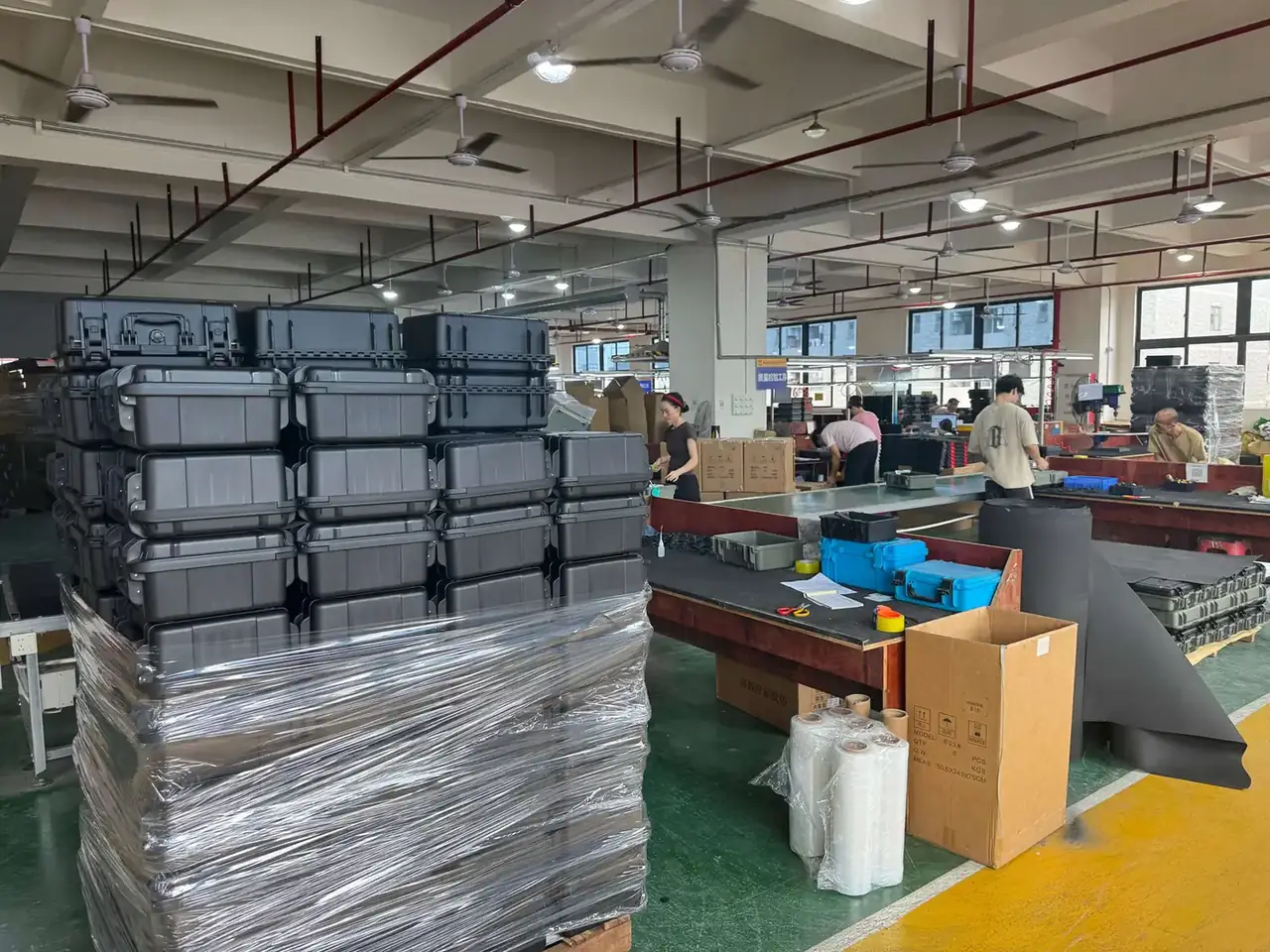
Quick answer: Case Warehouse Storage damage comes in three groups: dents from stack load, warp from heat, and UV aging. Dents follow contact stress times time, about 0.3 MPa at six tiers after 30 days. Warp starts where roof-deck air passes 45 °C. UV is cumulative; a window bay takes six times the aisle-centre dose. Sample 10 percent and reject dents over 1.0 mm.
Table of contents
- Where Case Warehouse Storage Damage Starts
- Stacking Dents: Contact Stress, Tiers and Time
- Warp from Heat and Residual Stress
- UV Aging: Dose, Colour Shift and Chalking
- Receiving Inspection, Sampling and Rejection
- FAQ
1. Where Case Warehouse Storage Damage Starts
A stored case carries no service load, only stack weight, heat and light. None breaks it outright; they change dimensions over months, and the fault shows at dispatch when the lid no longer sits flat.
Reversibility separates the three: a dent springs back partly, warp does not, and colour shift is chemical. The dent marks the base corners, where contact area is least.
2. Stacking Dents: Contact Stress, Tiers and Time
In Case Warehouse Storage the bottom case carries everything above through four corner pads: 7.5 kg a case at six tiers, 37.5 kg over 1200 mm², gives 0.31 MPa.
Creep doubles for every 10 °C above 30 °C: 0.2 mm at 25 °C after 60 days, 0.6 mm by day 20 under a 40 °C roof deck. Walls of 3.5 mm go eight high in a cool bay, six past 90 days; film above 20 N leaves a waist band that lingers.
| Tiers | Stress (MPa) | Dent, 30 days (mm) | Dwell (days) |
|---|---|---|---|
| 3 | 0.16 | 0.1 | 180 |
| 4 | 0.21 | 0.2 | 150 |
| 5 | 0.26 | 0.3 | 120 |
| 6 | 0.31 | 0.4 | 90 |
3. Warp from Heat and Residual Stress
Warp starts at moulding: a 3.5 mm wall and 2.2 mm rib root shrink 1.5 percent apart, freezing stress that releases above 45 °C and bows the shell toward the thin side.
Under a single-skin roof, 35 °C air becomes 52 °C a metre below the deck; a west-wall case runs 15 °C above ambient. Judge by diagonal: 1.8 mm on a 600 mm lid. Two-beam support bows the base; shim the full face.
| Bay | Peak air | Risk | Action |
|---|---|---|---|
| Air-conditioned | 26 °C | Low | Eight tiers, 180 days |
| Ventilated | 38 °C | Medium | Six tiers, off west wall |
| Under roof, still air | 52 °C | High | Four tiers, barrier |
| Open dock | above 60 °C | Severe | Under 7 days, shaded |
4. UV Aging: Dose, Colour Shift and Chalking
UV damage in Case Warehouse Storage is cumulative: a horizontal surface in southern China takes 1100 kWh/m² a year, 5 percent of it UV, and glass passes nine tenths of UVA.
A ΔE of 1.5 is noticeable, 3 shows two batches, and 5 fails the lot; dark cases climb 30 percent faster as heat adds thermal oxidation. Grade 2 chalk under ISO 4628-6 means tensile retention under 80 percent; keep cases 2 m from glass and cap open-dock exposure at 7 days.
| Bay | Dose (kWh/m²) | ΔE, 24 months | Surface |
|---|---|---|---|
| Aisle centre | 8 | 1.0 | No chalk |
| 3 m from glass | 22 | 2.1 | Slight gloss loss |
| 0.5 m from glass | 130 | 5.4 | Visible chalk |
| Open yard | 55 | 4.2 | Patchy chalk |
5. Receiving Inspection, Sampling and Rejection
Checks for Case Warehouse Storage start with latches and handles; sample dimensions, dent depth and colour by lot.
Sample 10 percent below 500 cases, 8 percent to 2000, 5 percent above. Dents over 1.0 mm fail, 0.5 to 1.0 mm becomes class B, warp past 0.3 percent fails, cracks fail. Log bay air every 30 minutes; drop a tier after three days above 45 °C.
| Check | Method | Sampling | Reject |
|---|---|---|---|
| Dent depth | Rule and feeler, deepest point | 10% | over 1.0 mm |
| Lid diagonal | Tape, difference of readings | 5% | over 1.8 mm |
| Colour | Spectrophotometer, D65 | 3 per lot | ΔE over 5 |
| Cracking | Visual plus 5x lens | All | any length |
Conclusion
Preventing damage in Case Warehouse Storage is not about a better building. It is three settings: tiers matched to dwell time, bay air under 45 °C, and light outside the glass. Sample 10 percent on receipt and reject at 1.0 mm; dispatch then stops producing lids that will not close. That is what Case Warehouse Storage is for.
This article discusses only the container (case body) side of specifications and design intent, and does not cover any handling, loading or use of the contents.
Related Reading
- How UV aging tests are run on cases
- Stacking and corner load on cases
- How stacking relates to moisture in cases
- Gasket aging and replacement limits
Related Products
- 8 Series — Gun Cases; Military Equipment Cases; Camera Equipment Cases; Drone Cases; Watch Cases; Knife Cases; First Aid Cases; Electronics Equipment Cases
- WL8-2812 PP Gun Case — model WL8-2812
- All protective cases and toolboxes: 7 series, 158 models