

Quick answer: Gun Case Production specs run backwards from the load: the cavity comes from the longest item plus buffer, the wall from drop height and stack weight. Each extra millimetre of wall costs about 11 CNY per unit; one rework costs 46 CNY.
Table of contents
- Starting from the load, not the outline
- What 6 mm and 10 mm walls really cost
- Ribs, lid lip and draft angle
- Latch count and hinge span
- Seal groove and insert fit
- FAQ
1. Starting from the load, not the outline
Gun Case Production specs start with the load case, not the silhouette. An item 1130 mm long and 4.2 kg takes a 3 g longitudinal shock in transit, concentrated at both ends. So the cavity runs 1180 mm with 25 mm of buffer each side, width adds 40 mm, depth adds 30 mm; fix those three numbers and the outline is locked.
| Item | Derivation | Value |
|---|---|---|
| Cavity length | Longest item plus 25 mm each side | 1180 mm |
| Cavity width | Widest point plus 40 mm | 320 mm |
| Cavity depth | Highest point plus 30 mm | 145 mm |
| Wall | 1.2 m corner drop | 8 mm |
| Latches | One pair per 380 mm | 4 |
Buffer is the first line cut in a cost review. Trim 25 mm to 12 mm and the case shortens by 26 mm, but the insert thins with it and the shock lands on the item ends. A rework means stripping the insert, fitting a seal and repeating the leak test: 18 minutes, 46 CNY.
2. What 6 mm and 10 mm walls really cost
Wall thickness is the costliest number in gun case production; it moves weight, cycle time and tooling together.
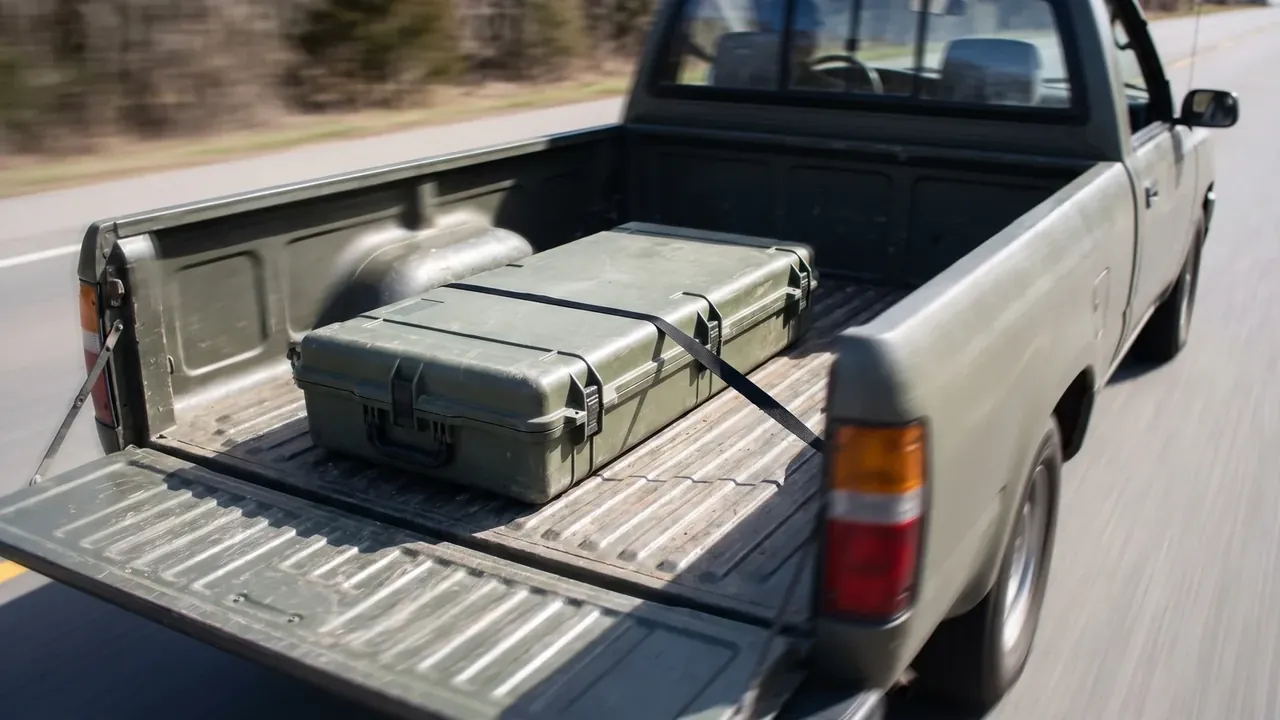
A 6 mm shell saves 22 CNY a unit, but in the 1.2 m corner drop the wall bulges before it cracks at a rib root. A 10 mm shell costs 22 CNY more, takes weight from 4.6 kg to 5.4 kg, and stretches the rotomould cycle from 22 to 28 minutes.
For vehicle duty, 8 mm is the turning point: no corner crack at 1.2 m, and 1.2 mm of residual set after 24 hours under 180 kg.
Never put one thickness on a drawing. Rotomoulded walls run thick at corners and thin on flats, so list eight measuring points, the lowest not under 90% of nominal.
3. Ribs, lid lip and draft angle
Ribs set stiffness and tooling cost. Gun case production geometry puts rib height at 3 times wall, so 24 mm, width at 6 mm, root radius 0.5 mm. Past 120 mm of spacing the wall drums under vacuum.
The lid lip is the sealing datum: 12 mm deep, 10 mm wide, meeting a tongue in a labyrinth fit. Flatness beyond 0.3 mm keeps the gasket from seating and the leak test fails. It adds about 8000 CNY to the tool, and skipping it doubles rework.
Draft is 1.5 degrees, corner radii 25 mm or more. At 0.8 degrees the wall scuffs on ejection.
4. Latch count and hinge span
Latch count in gun case production follows span:
- Up to 600 mm, two latches, span 300 mm or less.
- 600 to 900 mm, three, the middle one under the handle.
- 900 to 1200 mm, four in symmetric pairs, span 380 mm.
- Past 1200 mm, one more per 300 mm; hinge span within 1.2 times latch span.
With over 380 mm between latches and no mid support, pressure lifts the middle of the gasket and the leak curve steps.
The hinge side counts too: a 6 mm pin at 460 mm span, 8 mm at 600 mm, or the bores ovalise and the lid rocks.
5. Seal groove and insert fit
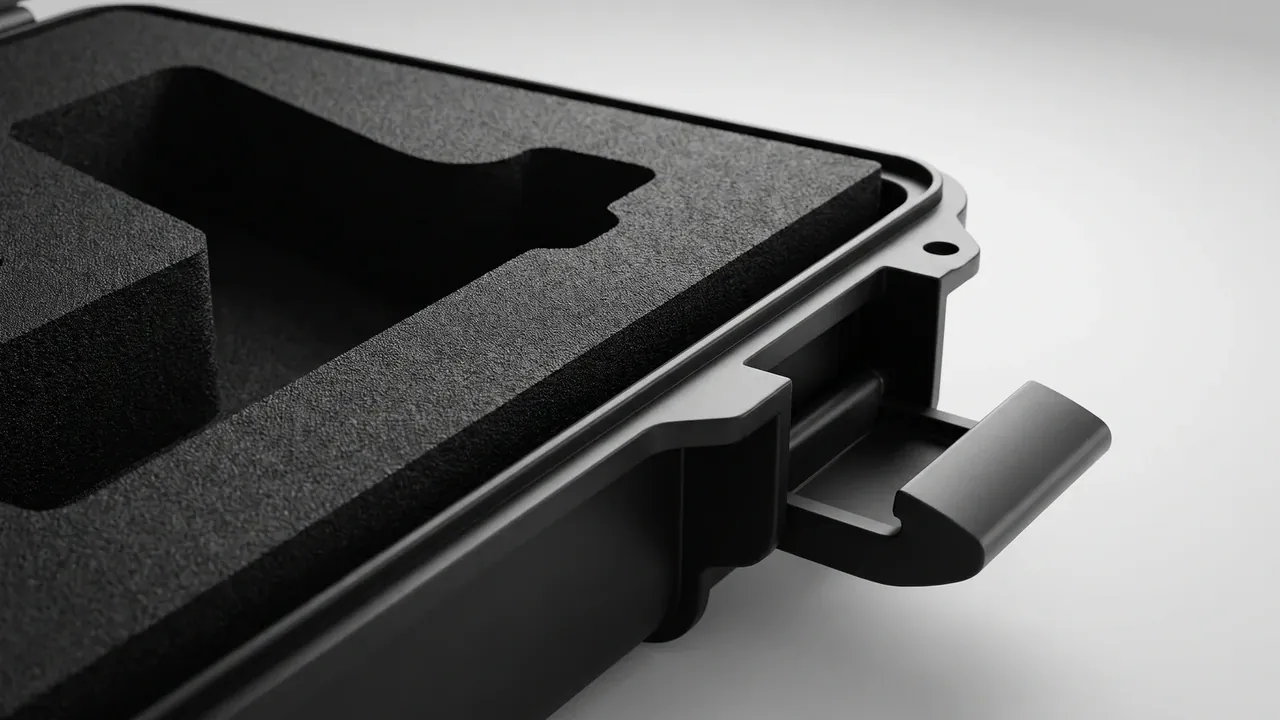
Gun case production grooves and inserts are drawn together. Width is gasket diameter minus 0.8 mm, depth 78% of diameter, which puts compression at 25 to 30%.
| Fit item | Size | Tolerance |
|---|---|---|
| Gasket diameter | 7 mm | 0.2 mm |
| Groove width | 6.2 mm | 0.15 mm |
| Groove depth | 5.5 mm | 0.15 mm |
| Insert thickness | 25 mm | 1 mm |
| Insert to wall gap | 1.5 mm | 0.5 mm |
Add 3 mm of foam and the lid presses harder: compression rises from 28% to 33%, tighter at first, then permanent set and a leak at year two.
Conclusion
Gun Case Production spec work is a one-way chain: load, cavity, outline, wall, weight, cycle time. Each link converts to money, about 11 CNY per millimetre of wall and 46 CNY per rework. Getting the chain right in gun case production beats arguing over a quotation.
This article discusses only the container (case body) side of specifications and design intent, and does not cover any handling, loading or use of the contents.
Related Reading
- Gun case production audit: equipment, process, records
- Gun case production: moulding, inserts and hardware
- Gun case selection guide: from item list to spec
- Standard work and control points in case production
Related Products
- 8 Series — Gun Cases; Military Equipment Cases; Camera Equipment Cases; Drone Cases; Watch Cases; Knife Cases; First Aid Cases; Electronics Equipment Cases
- WL8-2812 PP Gun Case — model WL8-2812
- All protective cases and toolboxes: 7 series, 158 models