

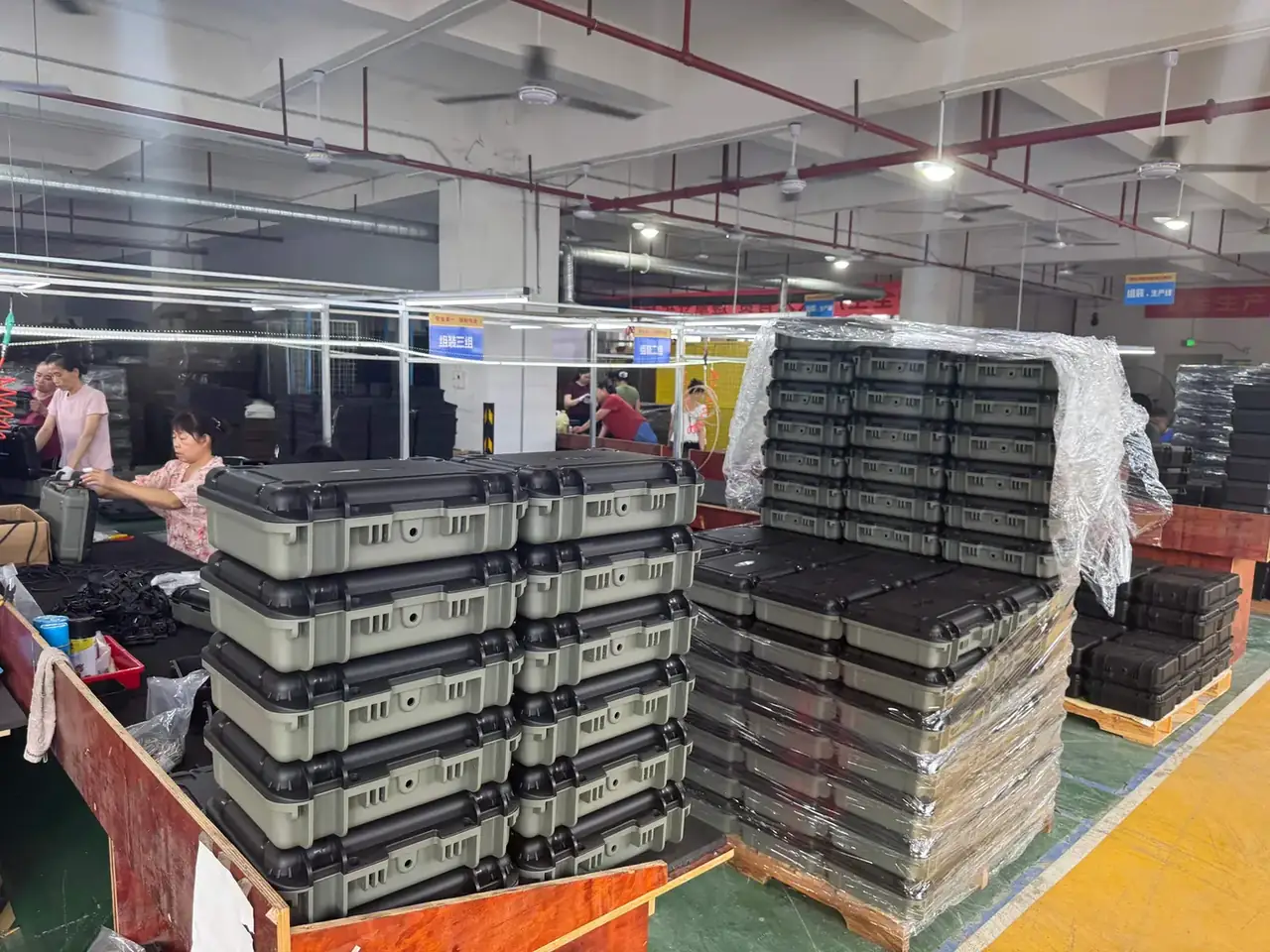
Quick answer: Gun Case Production runs through three steps. The mold fixes wall thickness and draft, the lining fixes cushioning and fit, the latches fix clamping force and sealing. Each step has its own window, and a drift leaves a trace sorting cannot repair.
Table of contents
- The Mold Step in Gun Case Production
- Foam Lining: Cutting and Bonding
- Latches: Torque and Fit Clearance
- Handoffs Between the Three Steps
- Changeovers and Capacity Balance
- FAQ
1. The Mold Step in Gun Case Production
Molding comes first, and tooling decides how much room the later steps have. Rotational molding fuses powder in a welded aluminium tool at 230 to 260 °C; injection molding fills P20 steel under 650 tonnes of clamping force.
Cavity design answers three questions: parting line, draft, thickness. The parting line clears the seal groove, draft runs 1.5 degrees rotomolded against 0.8 degrees injected, and corners thicken to 4.5 mm while flat walls hold 3.5 mm.
Thickness drifts first: a 3% charge error leaves plus or minus 0.3 mm, and a part ejected above 60 °C sags, so cooling runs 12 minutes.
| Process | Tool material | Wall range | Draft |
|---|---|---|---|
| Rotational | Welded aluminium | 3.0 to 4.5 mm | 1.5 degrees |
| Injection | P20 steel | 2.5 to 3.2 mm | 0.8 degrees |
2. Foam Lining: Cutting and Bonding
Lining starts with re-measurement, not cutting: length, width and depth are checked at three points each, the smallest reading drives the cut, and 0.5 mm of allowance is added.
EVA at 60 to 80 kg/m³ survives repeated compression and suits load layers; PE at 30 to 40 kg/m³ is harder and cheaper; EPE at 20 to 25 kg/m³ forms the inner face.
A CNC knife holds plus or minus 0.5 mm on EVA, hot-wire cutting PE leaves a 1 mm melted edge, cold bonding needs 8 to 12 minutes at 0.2 MPa, and heat bonding runs 140 °C for 25 seconds.
| Foam | Density | Thickness | Cutting |
|---|---|---|---|
| EVA | 60 to 80 kg/m³ | 20 to 30 mm | CNC knife |
| PE | 30 to 40 kg/m³ | 15 to 25 mm | Hot wire |
| EPE | 20 to 25 kg/m³ | 10 to 20 mm | Die cutting |
3. Latches: Torque and Fit Clearance
The latch step clamps body, gasket and lining into one assembly, so quality means clamping force and an even gap. Bodies are glass-filled PA66. The hard part of Gun Case Production is fitting every latch alike.
An M5 screw goes to 2.5 Nm with 3.0 Nm as the ceiling: below 2.3 Nm it works loose, above 3.0 Nm it cracks the boss. Eight perimeter points are checked with feeler gauges against 0.5 to 0.8 mm; one point past 1.0 mm means a warped body.
Gasket compression stays at 25% to 35%. Open force reads 40 to 70 N, and 200 cycles should move the gap under 0.1 mm.
| Item | Setting | Gauge | Accept |
|---|---|---|---|
| Screw torque | 2.5 Nm | Preset wrench | 2.3 to 2.7 Nm |
| Lid clearance | 0.5 to 0.8 mm | Feeler gauge | Even perimeter |
| Gasket squeeze | 30% | Caliper | 25% to 35% |
4. Handoffs Between the Three Steps
Each handoff has a release condition. Bodies leave the mold after a five-point thickness check at 3.5 mm plus or minus 0.3 mm; lining leaves once total thickness is within 0.5 mm at four edge midpoints; latches leave after a 30 second air hold.
Rework needs rules: a thin body may be downgraded to a non-load rating but must be relabelled and isolated, a lining bubble is re-bonded twice at most, and a screw past torque is replaced. Work in process needs a ceiling too, because a waiting body absorbs moisture and 0.1% pickup shifts the gap.
5. Changeovers and Capacity Balance
A rotomold cycle runs 18 to 25 minutes, and a two-cavity tool yields 4.8 to 6.7 parts per hour, against 48 for lining and 144 for latches. Molding is the bottleneck.
Swapping a tool takes 40 minutes plus 25 for first-article approval, so three changeovers a day burn two productive hours.
Conclusion
Gun Case Production is not three steps in a line but three parameter chains that grip each other: each step owns one measurable outcome. Write every release condition as a number, and batch variation converges, which is Gun Case Production at its core.
This article discusses only the container (case body) side of specifications and design intent, and does not cover any handling, loading or use of the contents.
Related Reading
- Rotomolded Cases: Rotational-Moulded Shell Structure & Pro…
- Injection molding versus rotational molding
- Designing a foam lining that fits
- Wall thickness and structural strength
Related Products
- 8 Series — Gun Cases; Military Equipment Cases; Camera Equipment Cases; Drone Cases; Watch Cases; Knife Cases; First Aid Cases; Electronics Equipment Cases
- WL8-2812 PP Gun Case — model WL8-2812
- All protective cases and toolboxes: 7 series, 158 models