

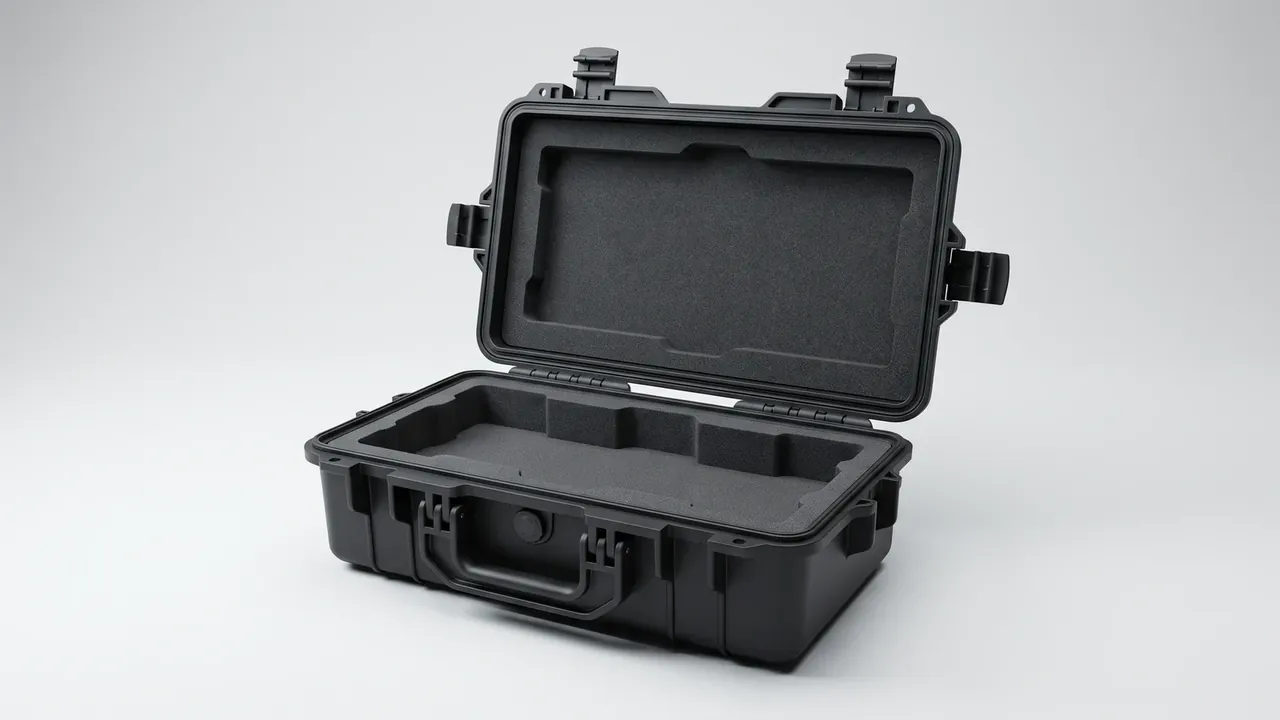
Quick answer: In Gun Case Production acceptance the hard part is naming the clause, not the verdict. Drops follow MIL-STD-810H 516.8 at 1.2 m for 26 drops, sealing follows IEC 60529 to IP67 at 1 m for 30 minutes, salt fog follows 509.6 for 96 hours.
Table of contents
- Gun Case Production acceptance: which standard governs what
- Drop and vibration: samples, drop count and pass lines
- Sealing, immersion and salt fog: three hours of arithmetic
- What to do with failures: three verdicts, four routes
- FAQ
1. Gun Case Production acceptance: which standard governs what
Three document families get squeezed into one sentence, which is where arguments start. MIL-STD-810H is a method standard: how to test, how often, how long. IEC 60529 covers enclosure ratings; ASTM D4169 transport simulation. None substitutes for another, so "meets military spec" alone guarantees a fight.
A workable clause names method, procedure, sample count and pass value: "810H 516.8, procedure IV, loaded, 1.2 m, 26 drops, three samples".
| Check | Clause | Measured on site | Pass line |
|---|---|---|---|
| Drop | 810H 516.8, proc. IV | 3 loaded samples, 26 drops, 1.2 m | No through crack, latches closed |
| Vibration | 810H 514.8 | 10 to 500 Hz, 1 hour per axis | Torque at or above 2.5 N·m |
| Immersion | IEC 60529 IP67 | 1 m still water, 30 minutes | Paper inside stays dry |
| Salt fog | 810H 509.6 | 5 percent brine, 35 °C, 96 hours | No pitting, force up to 20 percent |
| Tightness | In-house rig | 3 kPa held 60 seconds | Drop of 0.2 kPa or less |
2. Drop and vibration: samples, drop count and pass lines
In Gun Case Production, drop testing is the easiest item to thin out. The usual shortcuts are one sample, bottom face only, and 0.8 m instead of 1.2 m. Save those three moves and the reinforced corners never see an impact.
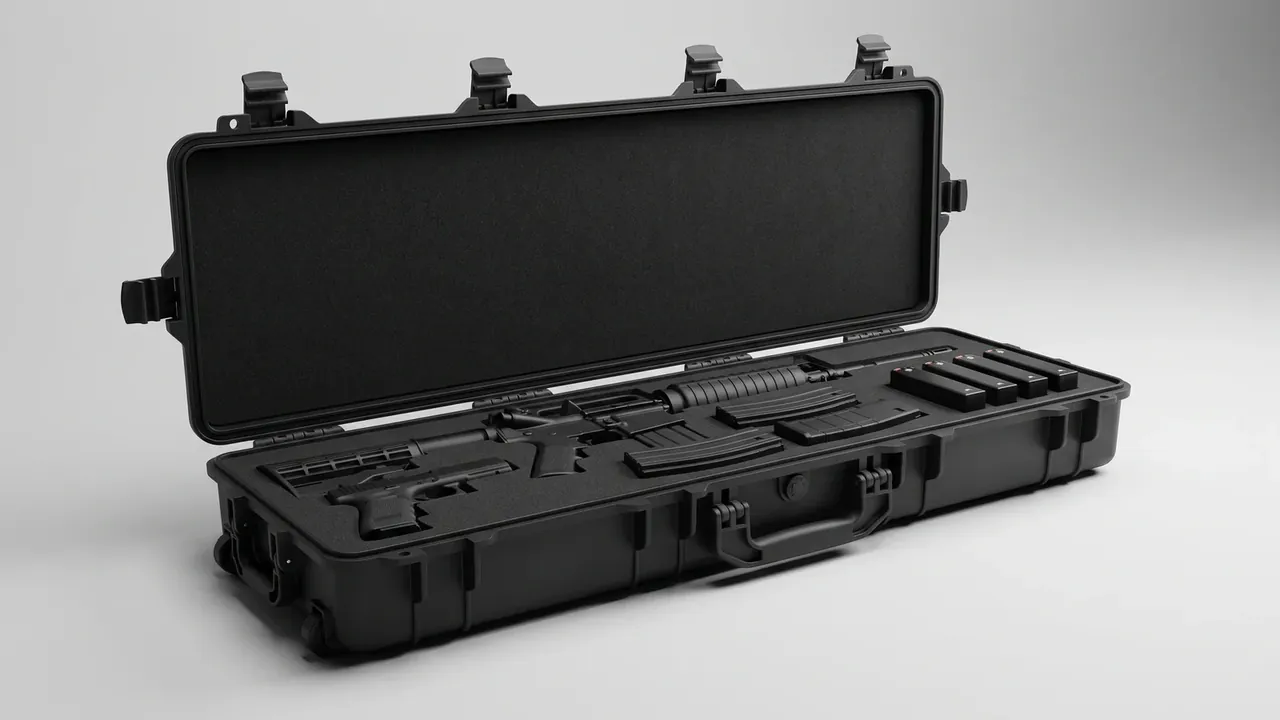
A full run is 26 drops across six faces, three corners and one edge, onto 50 mm steel, with three loaded samples. Run one set with foam and one empty, since foam shifts impact into the latches. Read three places: an opened parting line, a bent latch pin, and the tightness reading afterwards. A case that held 0.1 kPa over 60 seconds and then loses 0.35 kPa has a misaligned lip, and it will leak on the first long haul. Vibration is often skipped. Run 1 hour per axis, strapped as it will be stacked in transit. If retorque falls under 1.8 N·m from a 2.5 N·m start, move to threaded inserts, since self-tapping screws cannot hold preload in plastic.
| Item | Sample | Setting | Fail signal |
|---|---|---|---|
| Drop | 3 loaded, 1 empty set | 26 drops, 1.2 m, steel | Parting line open, pin bent |
| Vibration | 2 | 3 axes, 1 hour each | Torque under 1.8 N·m |
3. Sealing, immersion and salt fog: three hours of arithmetic
IP66 and IP67 differ by more than rain and a plunge: exposure time differs tenfold.
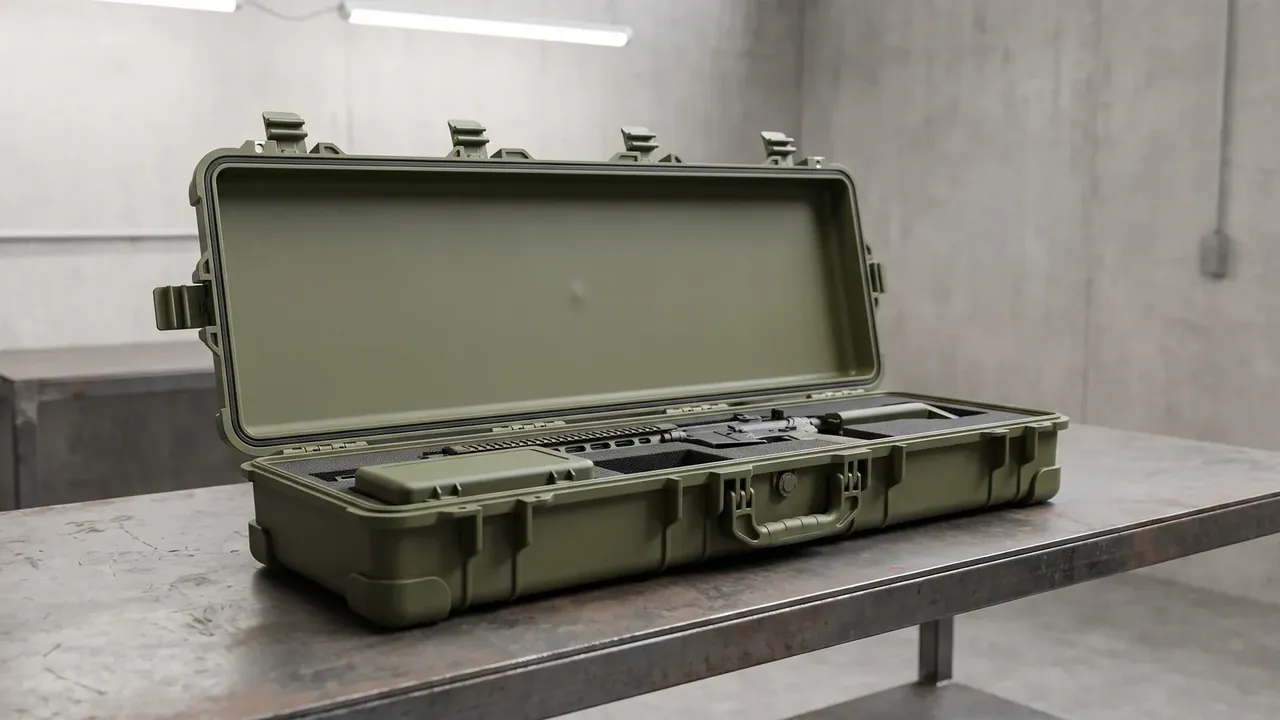
The on-site method costs nothing: two sheets of absorbent paper inside, a colour strip in each corner, then weigh, immerse, dry and reweigh. A gain of 2 g or less passes.
Count salt fog in cycles: 24 hours of spray plus 24 hours of drying, twice. White rust that wipes off to bright metal passes; blistering or a seized pin fails. The latch spring goes first.
In Gun Case Production, sealing acceptance is the swap from a firm feel to a stable number.
4. What to do with failures: three verdicts, four routes
Gun Case Production needs the verdict fixed before the closing meeting, or every department arrives with its own reading.
- Pass: all checks inside limits. Release the lot.
- Conditional pass: appearance only, or one unit between 0.2 and 0.3 kPa. Fifteen days for evidence, extra sampling on shipment.
- Fail: through crack, water inside, pitting, or a popped latch. Freeze the lot.
Four routes remain, ordered by cost. Rework means new latches, fresh gasket, extra sealant, always followed by a full retest. Downgrade strips the pressure rating for dry storage, label changed at once. Concession covers appearance only, capped at 5 percent of the lot. Scrap cuts the shell, the only guard against resale.
Retest sampling doubles: a failing first sample of 13 is followed by 26 units from three mould cycles.
Conclusion
Gun Case Production acceptance is a translation exercise: turn adjectives into clause numbers. Say 26 drops at 1.2 m, 30 minutes at 1 m, 96 hours in two salt cycles, 0.2 kPa of pressure drop, and the argument stops depending on who speaks loudest. Fix the verdicts early and rework will not be relabelled as scrap. Keep it on one annex page, and Gun Case Production finally has a scale worth reusing.
This article discusses only the container (case body) side of specifications and design intent, and does not cover any handling, loading or use of the contents.
Related Reading
- How to put case production SOPs and standards on paper
- Auditing a gun case factory: equipment, process and records
- Setting impact standards for airdrop cases
Related Products
- 8 Series — Gun Cases; Military Equipment Cases; Camera Equipment Cases; Drone Cases; Watch Cases; Knife Cases; First Aid Cases; Electronics Equipment Cases
- WL8-2812 PP Gun Case — model WL8-2812
- All protective cases and toolboxes: 7 series, 158 models