

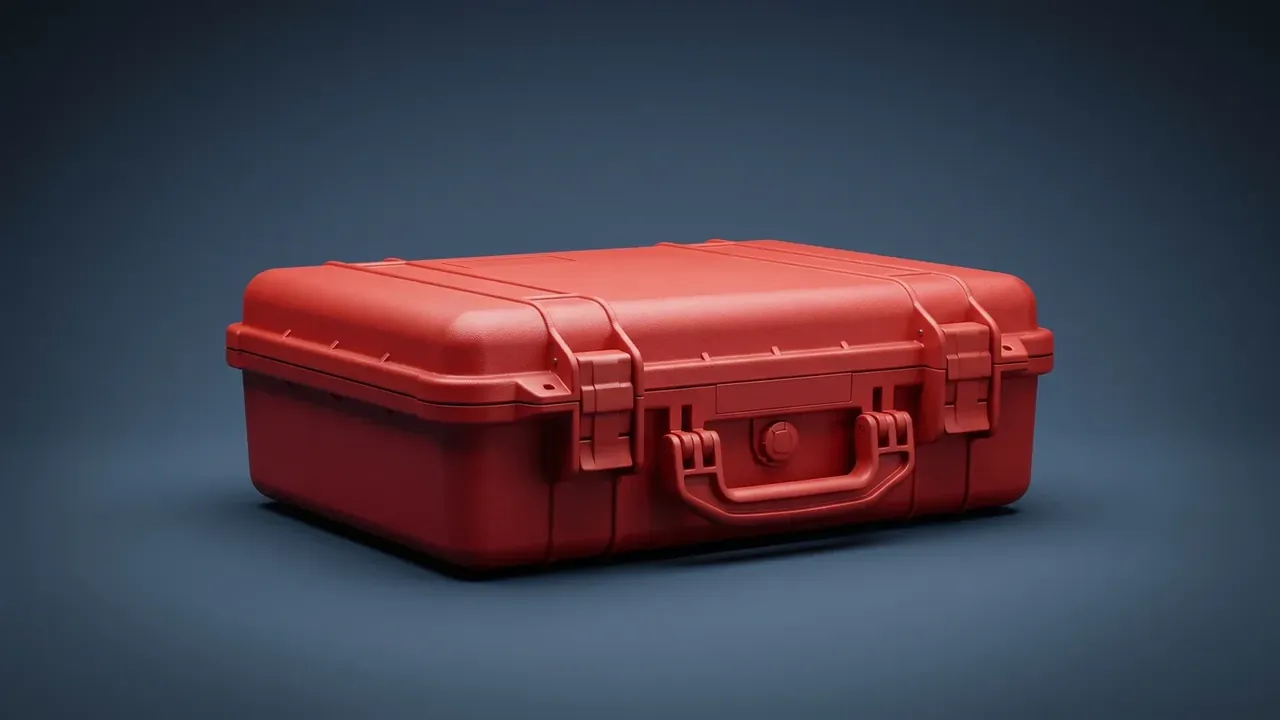
Quick answer: The weight of a heavy duty plastic tool box is never the empty mass. It is the stacking and handling the body must survive: stiffeners at 60 mm pitch on a 600x400x300 mm moulding, 150 kg resting on the bottom case at five high, and 45 mm of solid material above each fork pocket.
Table of contents
- The 600x400x300 body and where the wall thickness goes
- Five-high stacking: what the bottom case carries
- Fork pockets, pallets and nesting: three accounts
- Empty weight of 6 to 9 kg: rotomoulding or injection
- FAQ
1. The 600x400x300 body and where the wall thickness goes
The first divide in a heavy duty plastic tool box is how thickness is distributed, not colour or handle shape. Two bodies marked 600x400x300 mm leave the mould at 6.2 kg and 8.8 kg, and the 2.6 kg gap sits in the base frame and corners rather than the lid.
Turn the case over. Stiffeners under 60 mm pitch, 12 mm deep, with a closed solid rim around all four corners, and the body goes five high. Spread them to 100 mm and the floor feels rigid in the hand, then sags by the second layer.
| Zone | Wall | Resists |
|---|---|---|
| Lid centre | 4.0 to 4.5 mm | Top-of-stack load |
| Side walls | 4.5 mm | Fork clamp, rack squeeze |
| Base frame | 5.5 to 6.0 mm | Deflection at 30 kg |
A thin lid is tolerable because the interior sits behind it; a thin base is not.
Identical footprints split two ways: one heavy duty plastic tool box stays flush at five high, the other sags at three and squeezes its gasket off centre.
2. Five-high stacking: what the bottom case carries
Five high is the commonest warehouse request and the most under-estimated line on a heavy duty plastic tool box. At 30 kg loaded, the bottom unit takes 120 kg from the four above it and, with its own mass and the pallet, roughly 150 kg of static load on the lid. Load runs down the walls, the lid centre dishes, and at 6 mm of dishing the latches begin to carry load; once a latch yields, lid and body lose register and the gasket lifts. Stack square, never interlocked: interlocking makes the side wall load-bearing, and a side wall bulges 3 mm and stops. Square stacking sends everything through the four corner columns, moulded from lid to foot in one piece, which is the real line between a heavy duty plastic tool box and an ordinary one.
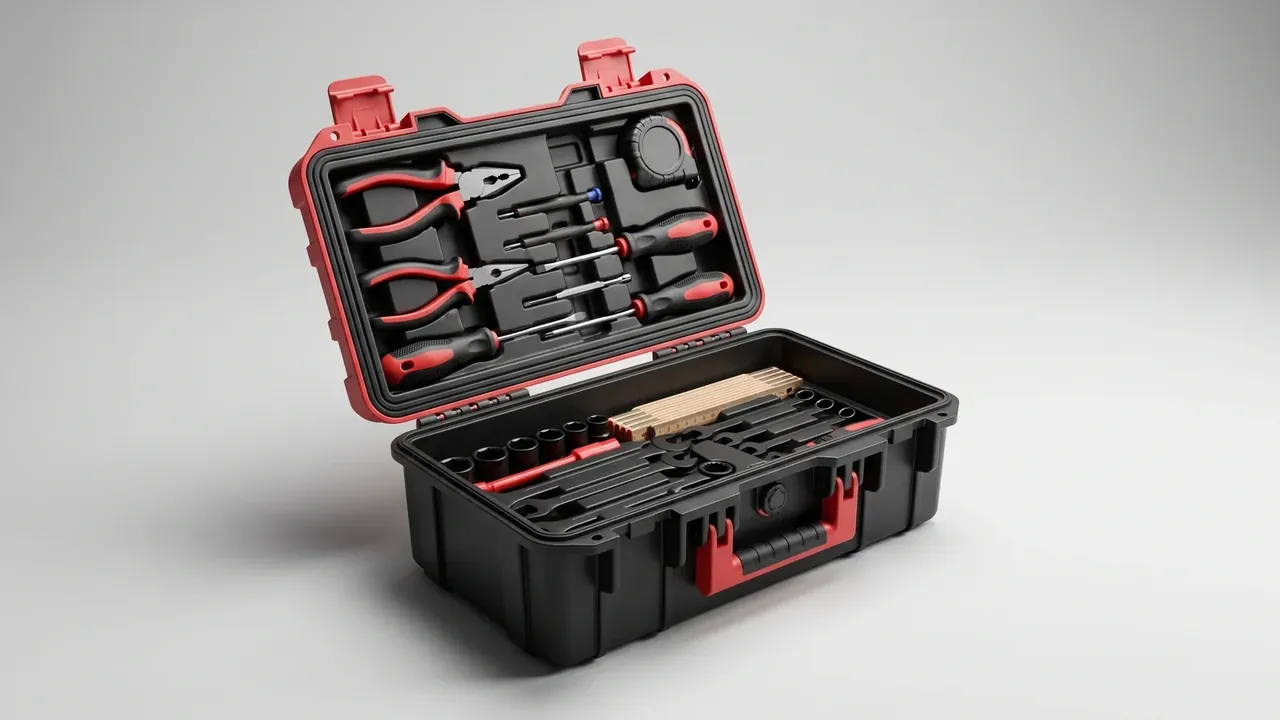
A lid that seats a person is not an acceptance item; a lid that stays flat under five is.
3. Fork pockets, pallets and nesting: three accounts
Warehouses read floor space saved and seconds gained, and a heavy duty plastic tool box answers in four places.
- Fork pockets: 200x60 mm each side, 45 mm of solid above the pocket so the first lift cannot tear the wall.
- Pallet: four bodies per 1200x1000 mm pallet, five layers, twenty units a load.
- Footprint: twenty cases in 1.2 square metres, 0.06 each.
- Nesting: empties nest 3.4 to 1, so twenty on return take the room of six.
Pocket height beats pocket size: at 90 mm off the base the lift arm is short and the body stays level, at 140 mm the case nods forward and a five-high centre of gravity swings.
A fixed internal partition drops 3.4 to 1 toward 1.6 to 1 and nearly doubles the return trip.
4. Empty weight of 6 to 9 kg: rotomoulding or injection
Empty weight between 6 and 9 kg is what buyers compare and most often misread. Light is not easier and heavy is not stronger; the question is where the grams sit.
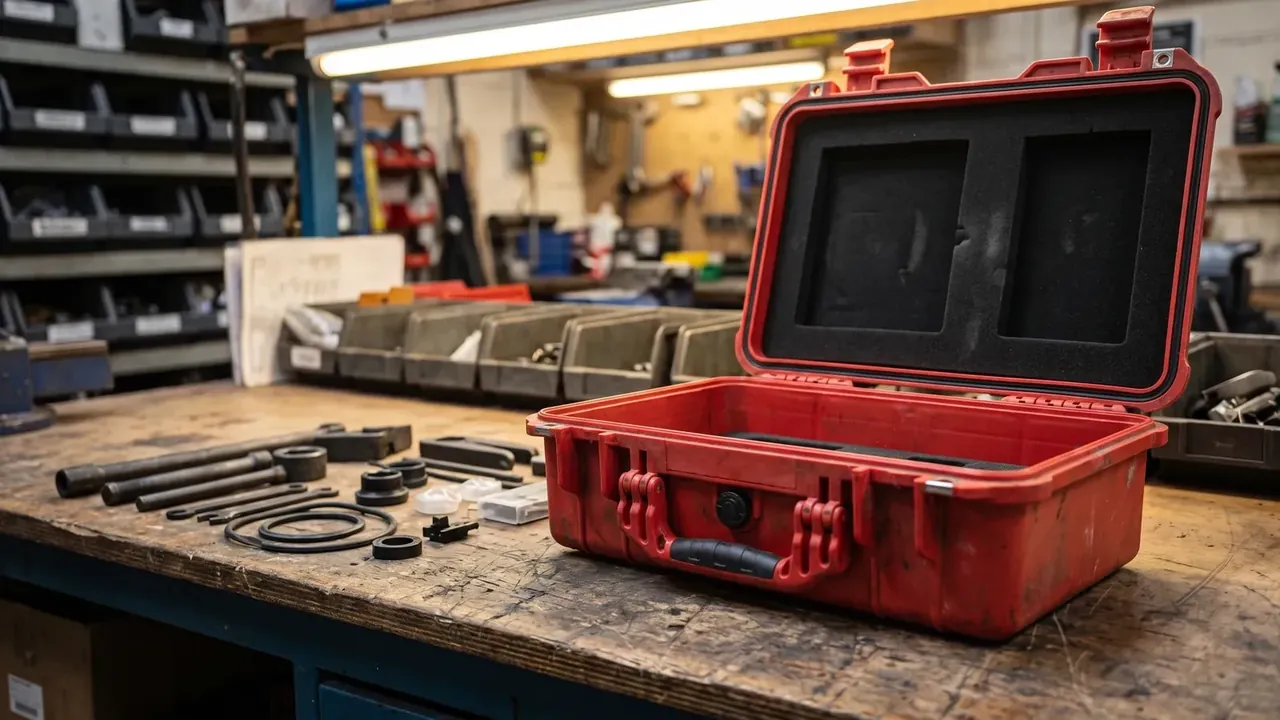
Rotomoulded corners gather material, up to twice a flat panel, and take drops well, but two bodies from one mould can differ by 1 kg, so a five-high stack of that heavy duty plastic tool box sits uneven. Injection holds wall thickness within 0.2 mm, closes five layers evenly, and pays for it in dense ribbing that forces a liner before instruments go in.
| Process | Wall | Consistency | Minimum | Suits |
|---|---|---|---|---|
| Rotomoulding | 5 to 8 mm | Near 1 kg spread | 200 units | Large, low volume |
| Injection | 4 to 6 mm | Near 0.2 mm spread | 1000 units | Fixed size, rack |
One line covers it: under 300 units a year with dimensions still moving, rotomould; tens of thousands at a fixed size for rack and conveyor, inject.
Conclusion
The weight of a heavy duty plastic tool box is three accounts added up: a 6 mm base frame holding 150 kg at five high, 45 mm of solid above each fork pocket buying handling speed, and a 3.4 to 1 nesting ratio setting the cost of the empty return. Meet all three and 8 kg empty is not excessive; miss one and the kilograms saved only move the problem downstream. Measure the stiffeners first, then discuss price on a heavy duty plastic tool box.
This article discusses only the container (case body) side of specifications and design intent, and does not cover any handling, loading or use of the contents.
Related Reading
Related Products
- 8 Series — Gun Cases; Military Equipment Cases; Camera Equipment Cases; Drone Cases; Watch Cases; Knife Cases; First Aid Cases; Electronics Equipment Cases
- WL8-2812 PP Gun Case — model WL8-2812
- All protective cases and toolboxes: 7 series, 158 models