

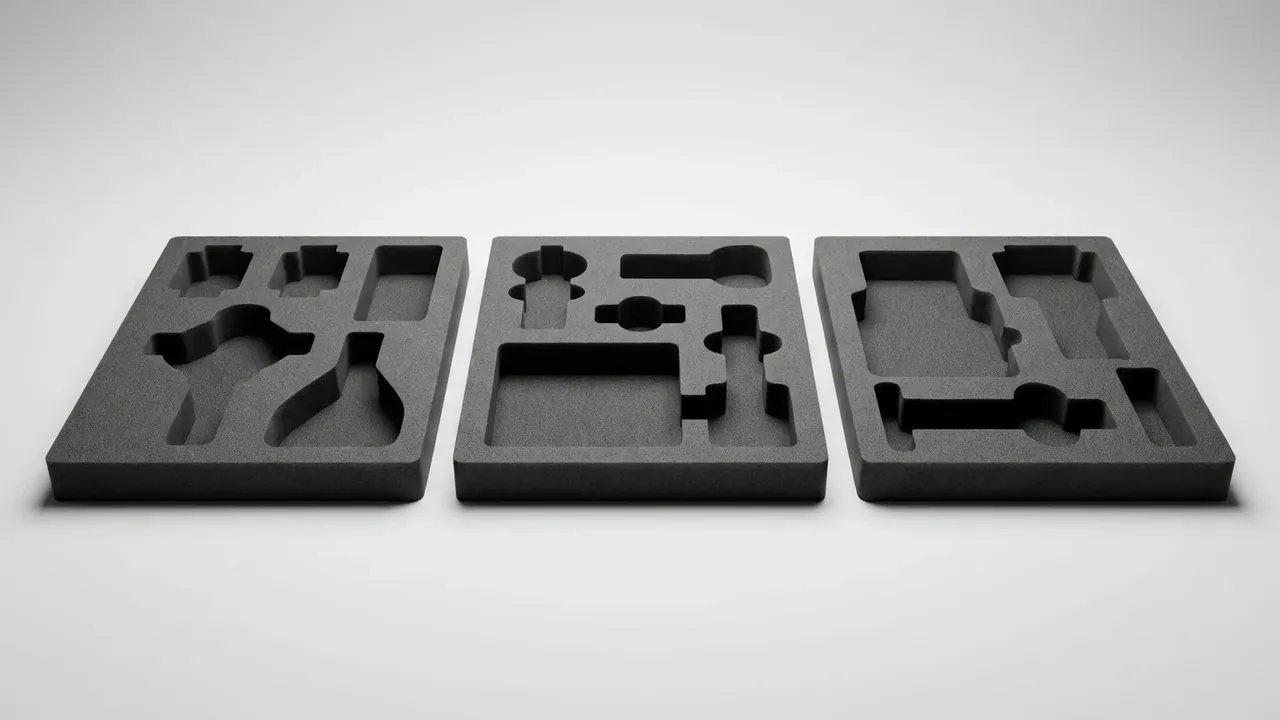
Quick answer: Three numbers describe the strength of a heavy-duty protective case, and they are not interchangeable: static load on a flat face, dynamic load from a drop, and stacking load held for months. Wall thickness is one input only, set by shot weight rather than by the mould, and it varies by roughly twenty percent across a part. Rib direction, corner blocks and hardware placement decide more. Ask for the test conditions behind any figure.
Table of contents
- Heavy-duty protective case loads: static, dynamic and stacking
- Wall thickness and shot weight: what rotomoulding can hold
- Where ribs and boss blocks belong
- How latches, hinges and hardware carry load
- Reading a specification table
- FAQ
1. Heavy-duty protective case loads: static, dynamic and stacking
A load figure for a heavy-duty protective case means little without its qualifier. A shell that holds a tonne with its base flat may carry a fraction on two bearers. A dynamic rating with no drop height, attitude or temperature cannot be repeated. An unqualified number is a rank, not a capacity.
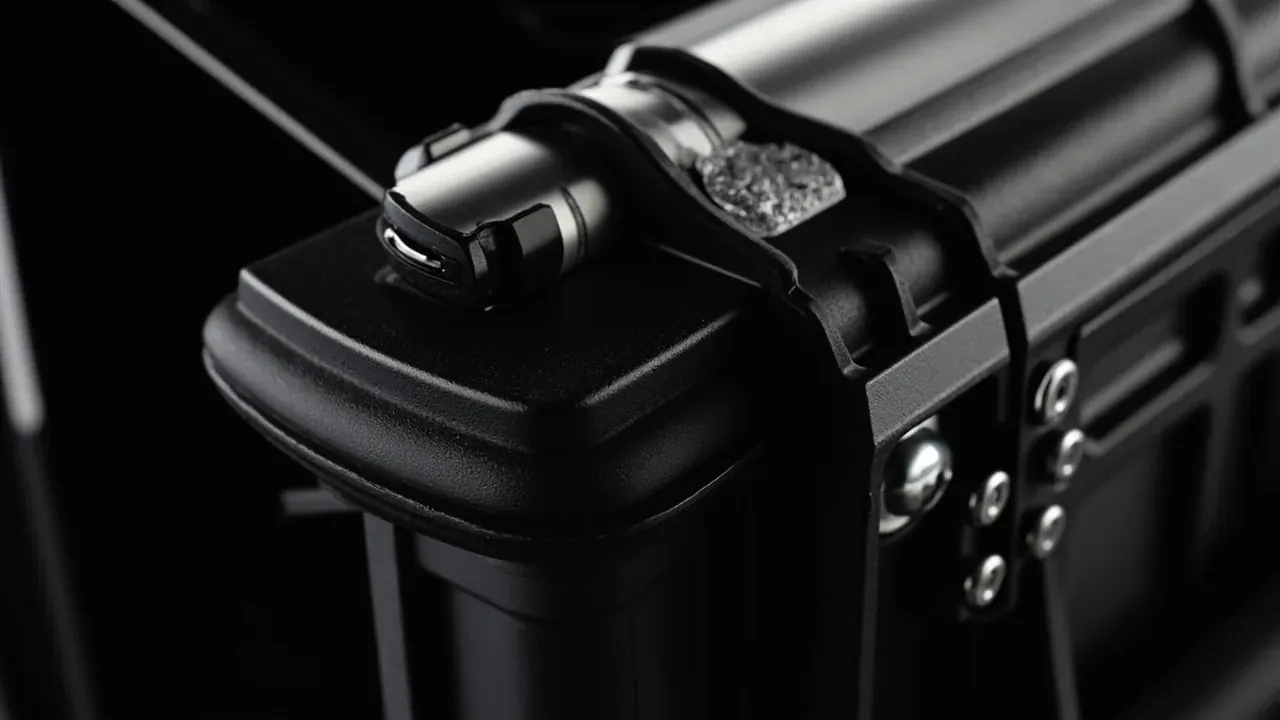
All three travel one path: base to walls, walls to corners, then keepers and hinges back to the shell. The rivets along the keeper's edge are where impact enters a heavy-duty protective case first. Stacking is the slow figure: unit weight times the tier count less one, times 1.5 to 2, with creep doubling deflection.
2. Wall thickness and shot weight: what rotomoulding can hold
Wall thickness in a heavy-duty protective case is an outcome, not a setting. Shot weight across the mould surface sets it, and four to eight millimetres covers most heavy builds. Below four, drop performance falls off; above eight, mass and cooling time climb.
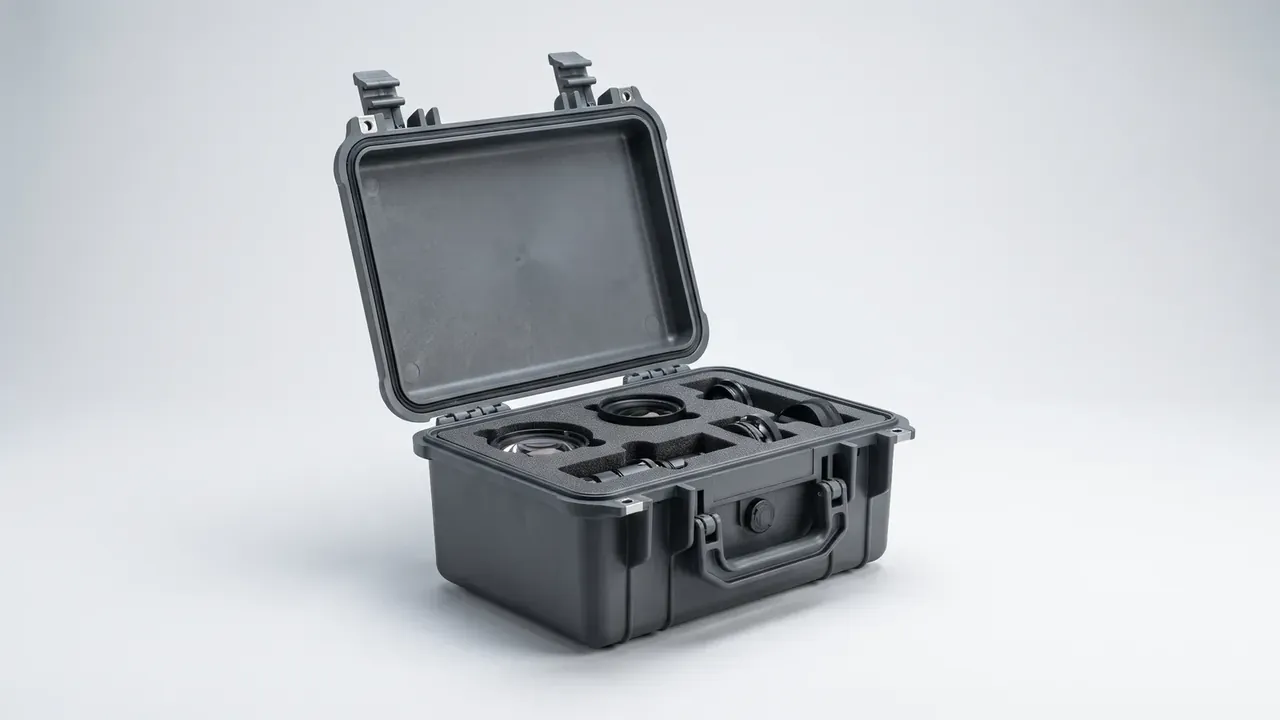
The arithmetic: surface area times thickness times density. Two square metres at six millimetres takes about eleven kilograms of polyethylene at 0.94 g/cm³. Foam sits inside, so each extra millimetre of wall costs a millimetre of cavity and a new liner. Ask for minimum wall and measuring points; nominal figures hide corners.
3. Where ribs and boss blocks belong
Ribs stop a heavy-duty protective case from bowing under vacuum or stack load. Boss blocks take point loads. Both go where load enters.
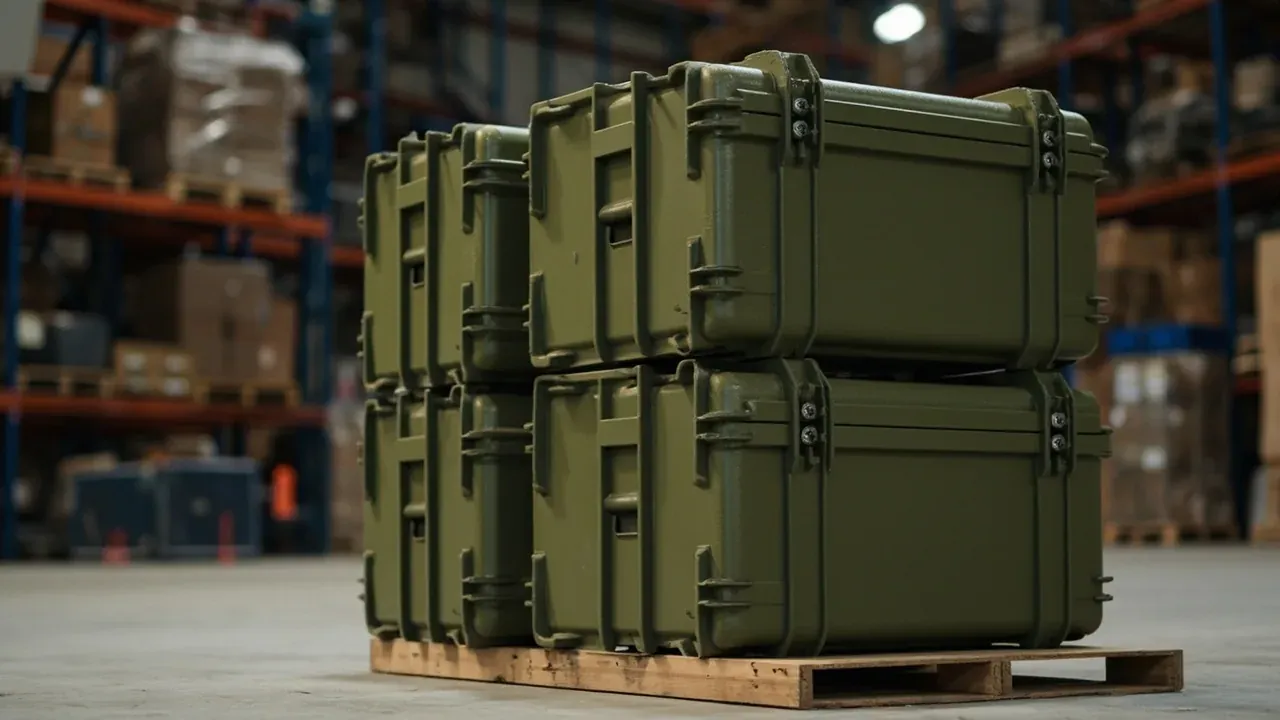
The olive cases stand two tiers on a pallet, corner blocks meeting. Load runs down four corners; shift the upper case half a width and the wall turns from compression to shear. Ribs follow a ratio: 0.6 to 0.8 times wall, height six to eight times wall, root radius at least half.
4. How latches, hinges and hardware carry load
Hardware closes the load chain, and on a heavy-duty protective case it usually fails first. One latch per 300 to 400 millimetres is a working rule. Past a metre, four is the floor.
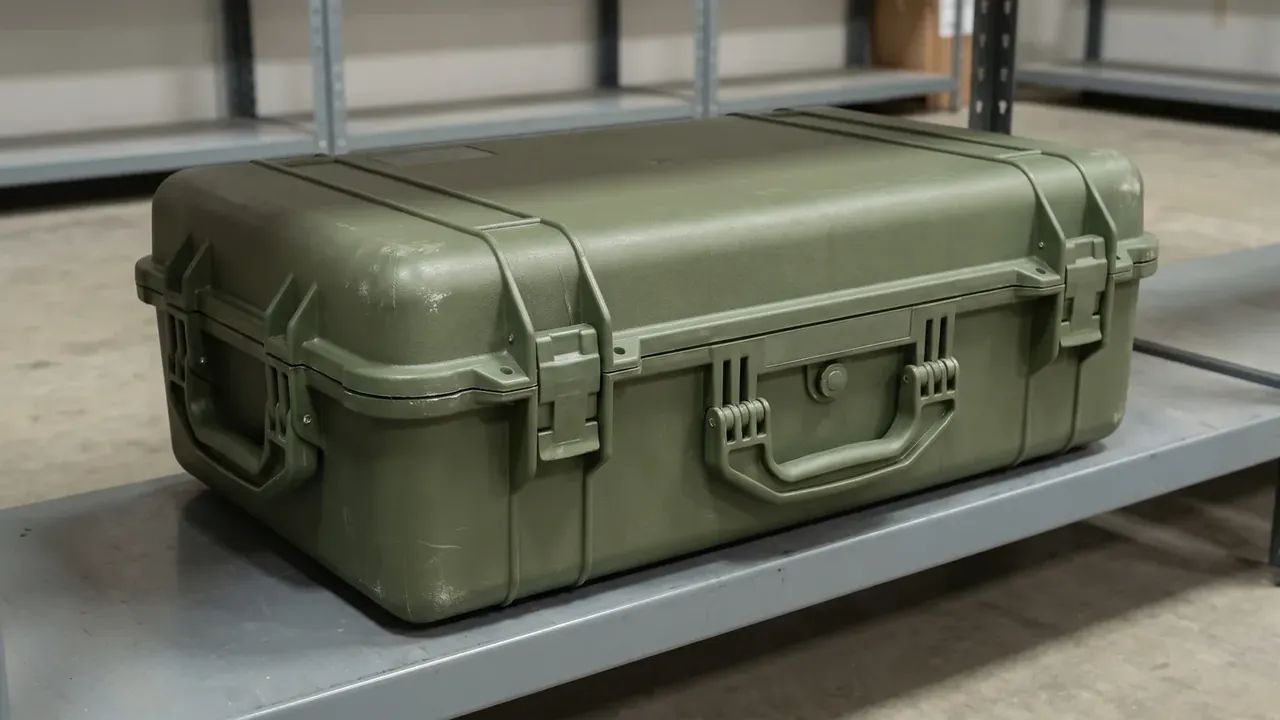
Four latches, two folding handles and a pressure valve line the front, with lid ribs above. Ribs resist bending, the edge abrasion, latches bulging and handles lifting. Latch preload must match gasket compression of 25 to 35 percent: tighter flattens the seal, looser lets water past. Hinges see lid weight times centre distance, so a wider lid needs a larger pin.
5. Reading a specification table
A specification table for a heavy-duty protective case is a screening tool, not a ranking. Only size and mass compare directly. Load and ingress need test conditions.
| Field | Usual entry | Ask instead |
|---|---|---|
| Internal size | L × W × H | To liner or shell |
| External size | Hardware included | Latches folded, handles stowed |
| Wall | One figure | Nominal, minimum, where measured |
| Load | Kilograms | Face or point support, time, temperature |
| Stack tiers | A number | Full or empty, pallet included |
| Ingress | IP67 | Test state, valve refitted |
- Internal and external sizes share one basis.
- Confirm whether wall is nominal or minimum.
- Fix the support method behind the load.
- Confirm how ingress was tested.
Self-weight with or without liner, load per case or per base area, tiers with or without a pallet: each moves the answer a grade. Where a heavy-duty protective case is listed without a basis, take the conservative reading. Ask which basis applies.
Conclusion
Read a heavy-duty protective case in this order: support method, duration, then temperature. Static figures answer for deflection, dynamic ones for drop height and attitude, stacking for tiers and creep. Accept wall thickness only as a minimum, check ribs run into the corners, count hardware against the length it holds.
This article covers container-side specifications and design implications only.
Related Reading
- Heavy-duty protective case applications on site
- Stacking design: load, interlock and stability
- Rotomolded Cases: Rotational-Moulded Shell Structure & Pro…
Related Products
- 8 Series — Gun Cases; Military Equipment Cases; Camera Equipment Cases; Drone Cases; Watch Cases; Knife Cases; First Aid Cases; Electronics Equipment Cases
- WL8-2812 PP Gun Case — model WL8-2812
- All protective cases and toolboxes: 7 series, 158 models