

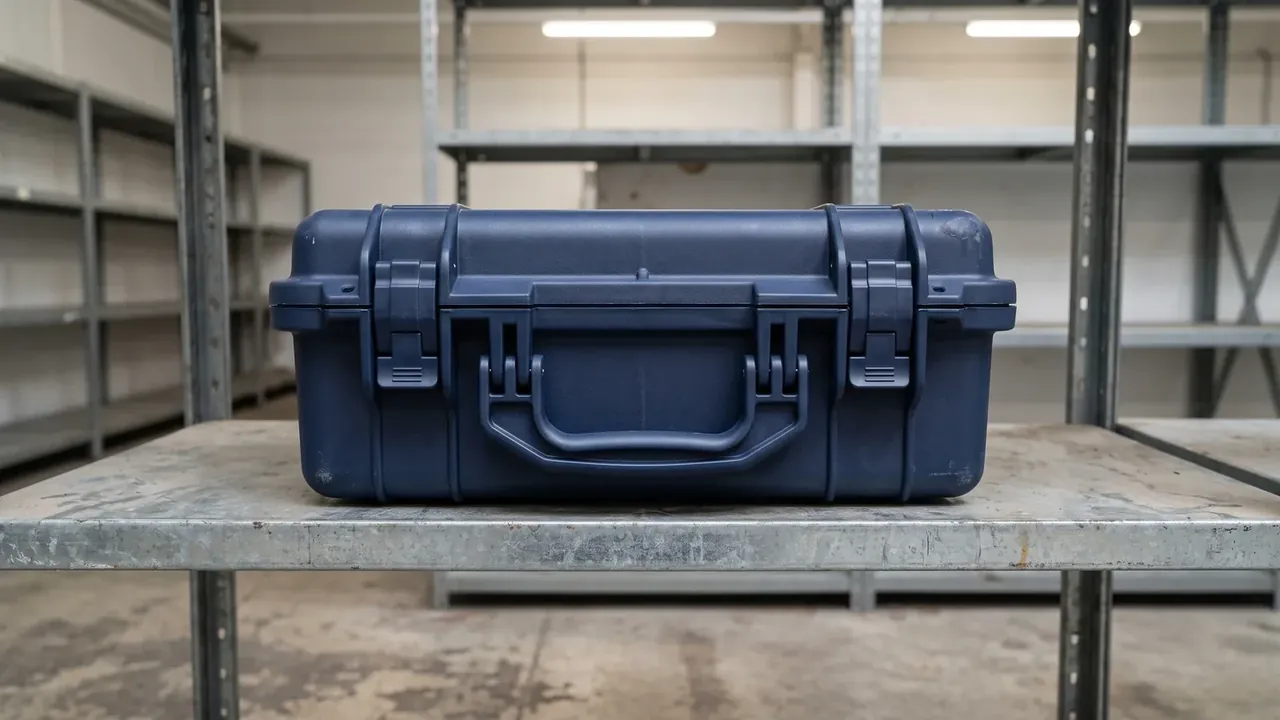
Quick answer: The Hiking drop-proof keys & gadget storage box uses a R10 mm corner radius, 2.6 mm wall, ≤28 N opening force and ≤0.4 mm latch gap after 4000 cycles.
Table of contents
- Corner radius of the Hiking drop-proof keys & gadget storage box
- Latch leverage ratio and single-hand opening force
- Corner-crack reading after six-face drops
- Latch gap across the opening-cycle rig
- Wall-thickness narrowing line for small batches
- FAQ
1. Corner radius of the Hiking drop-proof keys & gadget storage box
The four corners touch ground first in a drop, so the Hiking drop-proof keys & gadget storage box sets an outside radius of R10 mm on a body of 260 by 190 by 85 mm outside and 230 by 160 by 60 mm inside, with no sharp point at any corner. Corner wall follows the radius at 2.6 mm: a wider radius spreads the contact patch and lowers impact per unit area. Radius is checked with an R gauge at two heights, with a spread within 0.3 mm counting as one batch.
Walls are read empty at 0.8 kg and loaded at 1.6 kg, and the loaded corner may not thin by over 0.15 mm. Short ribs sit inside the shell corner, their ends clear of the radius tangent so the mould does not pile material into a sink mark. A sink mark hollows the local wall, and a 1.5 m drop opens a crack there first.
2. Latch leverage ratio and single-hand opening force
Two latches sit on the short sides at 180 N each; the Hiking drop-proof keys & gadget storage box moves the pivot forward so the finger arm beats the bolt arm, bringing single-hand opening force to ≤28 N. A force gauge pulls the latch tip at steady speed and takes the peak over the travel; a high peak goes first to flash jamming the leverage ratio, not to a lighter preload.
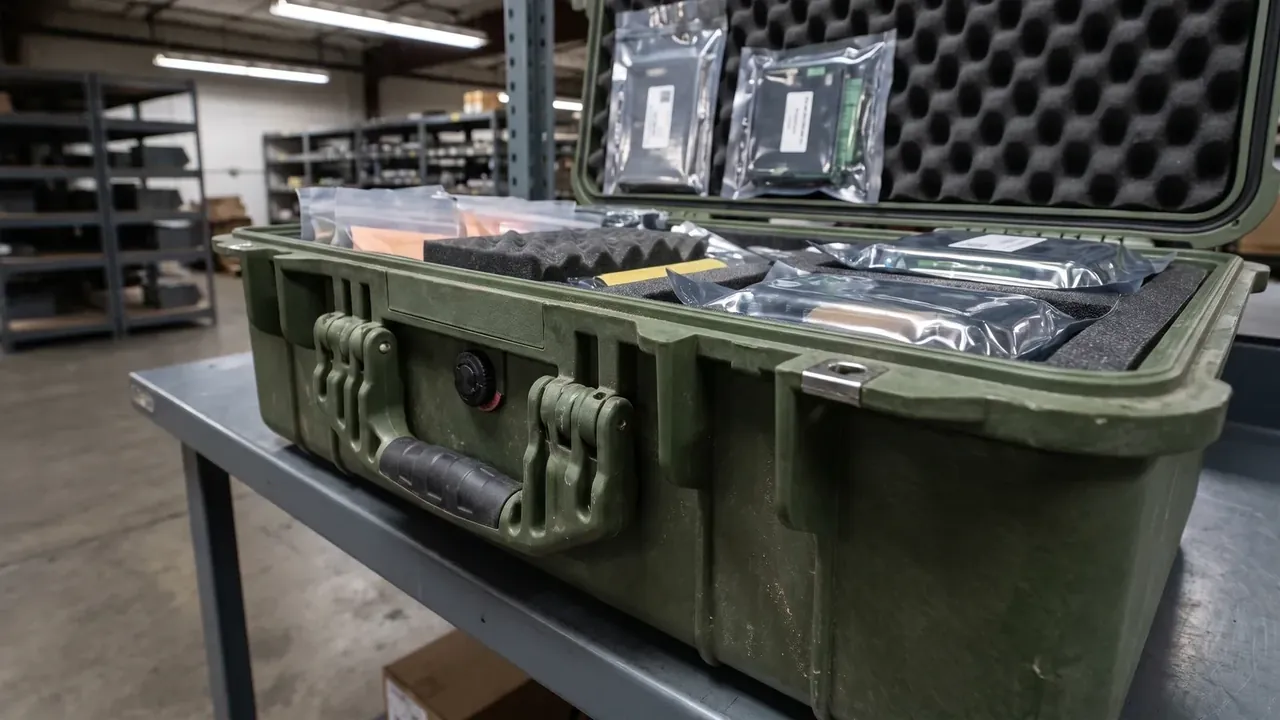
One gasket ring between lid and shell at 20% compression pushes back on the latch, so the opening-force reading already includes it. The range is -15 to 55 degrees Celsius: cold stiffens the ring and the force must still stay under 28 N, while heat softens it and lets the latch gap grow. The Hiking drop-proof keys & gadget storage box is conditioned at both ends and retested for force and gap.
3. Corner-crack reading after six-face drops
Drops run at 1.5 m onto each of the six faces, the closed shell released bottom-down, lid-down and onto four sides, with attention on corners and latch bosses. A 10x loupe scans the outer corner face, and a whitening hairline fails the unit. R10 mm radius and 2.6 mm wall work as a pair here: the radius spreads impact, the wall carries residual deformation, and losing either chips a corner by the third landing.
| Drop orientation | Contact point | Reading point |
|---|---|---|
| Bottom-down at 1.5 m | lower four corners | outer corner face and rib ends |
| Lid-down at 1.5 m | lid four corners | lid corner and latch boss |
| Long side down at 1.5 m | two end corners | radius tangent and closing seam |
Whitening on one corner means remeasure that R10 mm radius and local wall; a cluster points to insert wear.
4. Latch gap across the opening-cycle rig
The rig runs 4000 open-close strokes, pausing every 500 to measure the gap between latch bolt and keeper, and the Hiking drop-proof keys & gadget storage box caps the final value at ≤0.4 mm. One shell and one latch pair stay on the rig, and a feeler gauge reads both sides of the bolt. A growing gap is usually a keeper insert creeping back under repeated load, which loosens the leverage ratio and drags opening force down.
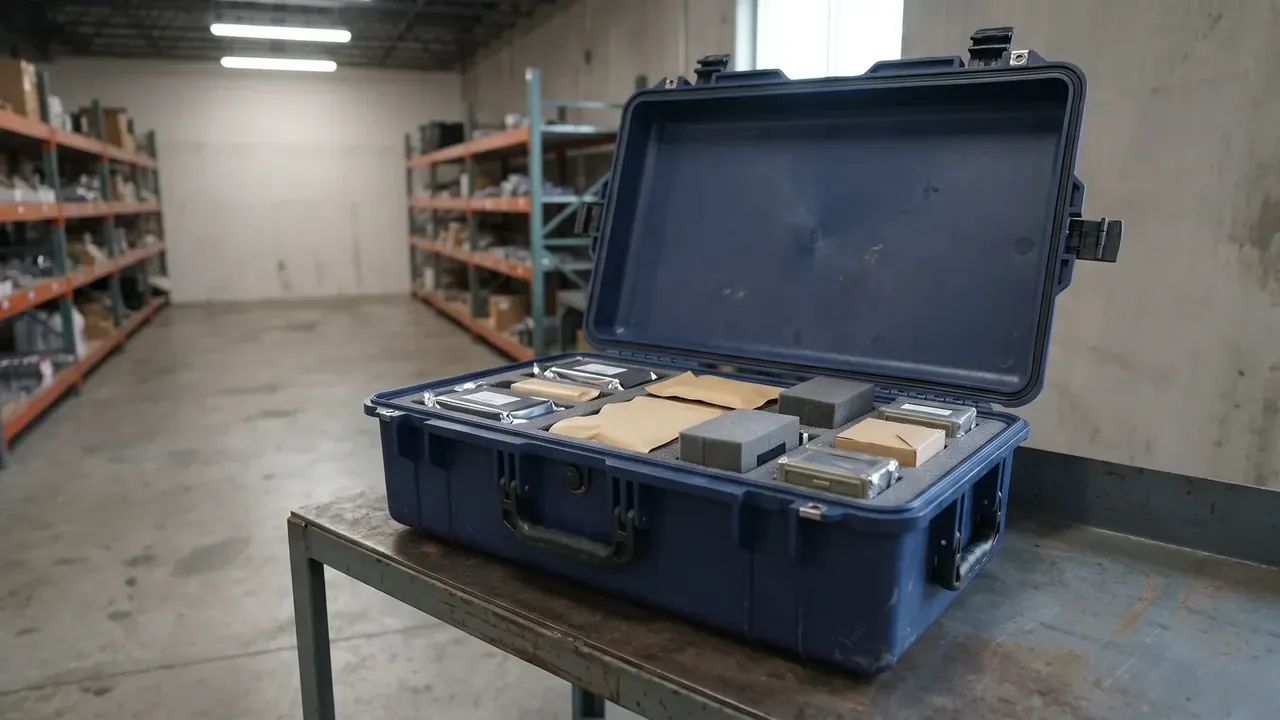
Reading the post-4000 gap against the first-pass force separates bolt wear from insert movement: gap up with force down suggests the insert retreating, gap up with force rising points to a burr on the bolt ramp. Both are logged together on the rig.
| Corner position | Gap point | Allowed gap |
|---|---|---|
| Front-left latch | inner bolt face | ≤0.4 mm |
| Front-right latch | outer bolt face | ≤0.4 mm |
| Lid corner close-off | keeper insert edge | ≤0.4 mm |
5. Wall-thickness narrowing line for small batches
Five shells per mould cycle are sampled to recheck corner wall, with the 2.6 mm nominal accepted between 2.5 mm and 2.7 mm; the thin side fails corner support, the thick side fails radius pile-up. The line reads wall only, since the 260 by 190 by 85 mm outline barely moves inside one mould while corner density shifts with hold pressure and mould temperature. The Hiking drop-proof keys & gadget storage box ties shell number, wall reading and drop result into one record, and a sample over the line stops the cycle.
| Force reading | Measuring point | Action |
|---|---|---|
| ≤28 N | latch tip peak | release |
| 28 to 32 N | bolt ramp | deburr and retest |
| over 32 N | pivot shaft | scrap |
Filing opening force, drop orientation and latch gap against one shell number gives the batch verdict on the Hiking drop-proof keys & gadget storage box its basis. Watching only for an uncracked drop misses slow corner-wall thinning: such shells sit near the 0.4 mm gap limit after 4000 cycles and are listed for retest.
Conclusion
Corner radius of R10 mm, a 2.6 mm corner wall and ≤28 N single-hand opening force are three readings that pull on each other in the Hiking drop-proof keys & gadget storage box. A 1.5 m six-face drop checks the no-crack point, while 4000 cycles bring out the ≤0.4 mm latch gap. The 260 by 190 by 85 mm shell, 180 N latches and one gasket ring share one closing seam.
Related Reading
- Corner guards of an EDC outdoor protective case
- Wall thickness choices for ABS cases used outdoors
- Opening force comparison in multi-purpose outdoor case specs
- Gasket and closing seam design of a small waterproof plastic box
Related Products
- 8 Series — Gun Cases; Military Equipment Cases; Camera Equipment Cases; Drone Cases; Watch Cases; Knife Cases; First Aid Cases; Electronics Equipment Cases
- WL8-2812 PP Gun Case — model WL8-2812
- All protective cases and toolboxes: 7 series, 158 models