

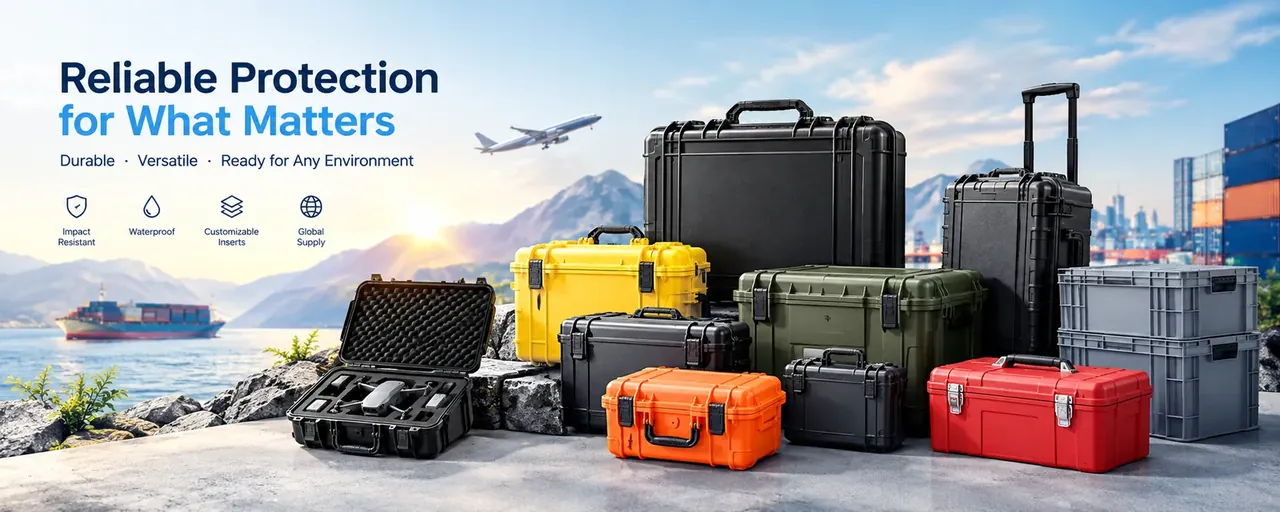
Quick answer: Fishing tackle waterproof small plastic box seals on one 3 mm O-ring squeezed 20% by two 40 N latches, not on thicker walls: 0.2 mm of lid bow breaks IP67.
Table of contents
- Why a fishing tackle waterproof small plastic box cannot seal with thicker walls
- A 3 mm O-ring squeezed 20 percent
- 0.2 mm of bow across a 260 × 180 mm span
- Six slots, 40 N latches and 5000 cycles
- 1.2 kg of buoyancy after a 1.5 m drop
- FAQ
1. Why a fishing tackle waterproof small plastic box cannot seal with thicker walls
Water reaches a fishing tackle waterproof small plastic box at one place only: the band of contact around the lid edge. Its lid spans 200 mm between two latches, and moving the wall from 2.5 mm to 3.5 mm lifts bending stiffness 2.7 times while the empty case grows from 0.62 kg to 0.81 kg.
The seal on a fishing tackle waterproof small plastic box is a line, not a face. It runs 880 mm around the rim, and once any section drops below 15% squeeze the line is broken. Two latches give 80 N in total, 0.09 N/mm; they do not block water, they only hold the lid onto the ring.
2. A 3 mm O-ring squeezed 20 percent
The rim of a fishing tackle waterproof small plastic box holds a 3 mm silicone ring in a groove 2.4 mm deep and 4.0 mm wide. Closed, it goes from 3.0 mm to 2.4 mm, which is 0.6 mm or 20%; the groove is 1.0 mm wider than the cord so the rubber bulges sideways, and that 1.1 mm bulge is the contact band. Under 15% the band closes to 0.8 mm and 10 kPa of head finds a path.
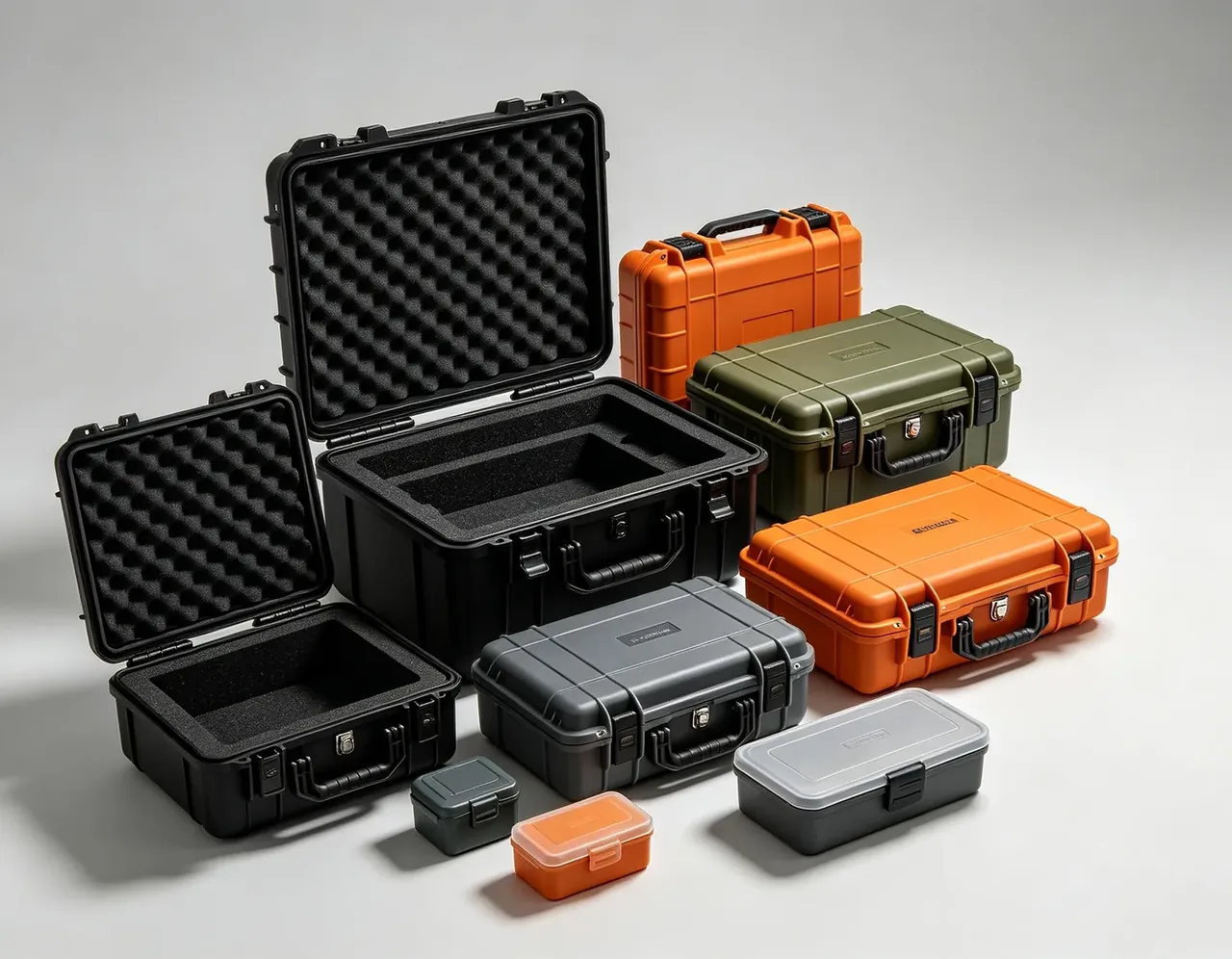
Groove position fails more often than size. It runs on the inner lip, 3.0 mm in from the edge; move it to the root and the lip meets the case mouth before the ring is loaded, so the lid feels shut while squeeze measures 8%. A 0.1 mm pressure film read for a continuous imprint catches that false closure.
3. 0.2 mm of bow across a 260 × 180 mm span
Bow on a fishing tackle waterproof small plastic box is the shape two latches impose, not a moulding fault. They sit 200 mm apart at 40 N each, so the middle of the lid sees a third of the end reaction; shrinkage in the first 24 h arches it 0.1 mm and the O-ring lifts it 0.05 mm, close to the 0.2 mm allowance.
| Water exposure | Sealing interface | Value |
|---|---|---|
| Rain during a carry | Full O-ring at the rim | 20% squeeze, 1.1 mm band |
| Sitting in bilge water | Hinge-side lip | Lip 6 mm high, no drain |
| 1 m immersion, 30 min | Rim ring and groove floor | Bow ≤0.2 mm, squeeze ≥15% |
On a fishing tackle waterproof small plastic box the cheapest fix is a third latch, cutting the span to 100 mm and bow to a quarter.
4. Six slots, 40 N latches and 5000 cycles
The cavity of a fishing tackle waterproof small plastic box measures 225 × 150 × 50 mm and takes six slots in two rows of three, 68 × 68 mm clear, with 2.5 mm dividers. Fingers set that size rather than volume: under 60 mm clear, a gloved hand catches on a divider.
| Open-close motion | Loaded part | Value |
|---|---|---|
| Lid lift | Hinge pin and lid lip | Pin 4 mm, root radius 1.5 mm |
| Lid close | Rim O-ring | 20% squeeze, recovery in 2 s |
| Latch pull | Trigger and catch seat | 40 N each, one edge |
| Carry | Handle and shell | Handle span 120 mm, wall 2.5 mm |
| Repeated cycling | Pin journal and seat face | 5000 cycles, play ≤0.3 mm |
At two cycles a day, 5000 cycles is 2500 days. After the 4 mm pin loses 0.3 mm the lid shifts 0.5 mm and life drops under 2000 cycles; once trigger travel reaches 10 mm, latch force falls to 30 N.
5. 1.2 kg of buoyancy after a 1.5 m drop
Buoyancy is the one figure a fishing tackle waterproof small plastic box proves by itself. The 260 × 180 × 70 mm envelope is 3.28 L, the empty case 0.62 kg and the load 1.4 kg, so 2.02 kg displaces 3.28 kg of water and the margin is 1.26 kg; 1.2 kg is the floor, leaving 60 g for hardware.
A 1.5 m drop spends that margin fastest. Lid-down is worst: impact lands on four corners and travels into the O-ring groove, whose wall is 1.2 mm, then pushes the ring 0.5 mm out of its seat, which only a water test catches.
| Check | Condition | Criterion |
|---|---|---|
| Positive buoyancy | Still water, 2.02 kg all-up | ≥1.2 kg, floats 30 min |
| Immersion seal | 1 m depth, 30 min | No trace inside, gain ≤2 g |
| Drop | 1.5 m, lid, edge and corner down | Latches shut, bow ≤0.2 mm |
| Salt spray | 48 h neutral | No red rust, travel ≤10 mm |
| Cycling | 5000 open-close | Latch force ≥30 N |
At −10 °C the shell keeps about 55% of its impact strength; at 55 °C the lid bows 0.05 mm more than at room temperature, spending a quarter of the margin.
Conclusion
The fishing tackle waterproof small plastic box is ordered by squeeze first and wall second: a 3 mm ring at 20% decides the 1 m, 30 min result, the 2.5 mm wall keeps the 880 mm rim in one plane, and 0.2 mm of bow is the tolerance on that plane.
Related Reading
- Compartment layout and water protection in fishing tackle cases
- What small waterproof box acceptance checks miss
- Sealing structure of outdoor IP68 waterproof small hard boxes
- IP ratings and test practice for waterproof plastic boxes
Related Products
- 8 Series — Gun Cases; Military Equipment Cases; Camera Equipment Cases; Drone Cases; Watch Cases; Knife Cases; First Aid Cases; Electronics Equipment Cases
- WL8-2812 PP Gun Case — model WL8-2812
- All protective cases and toolboxes: 7 series, 158 models