

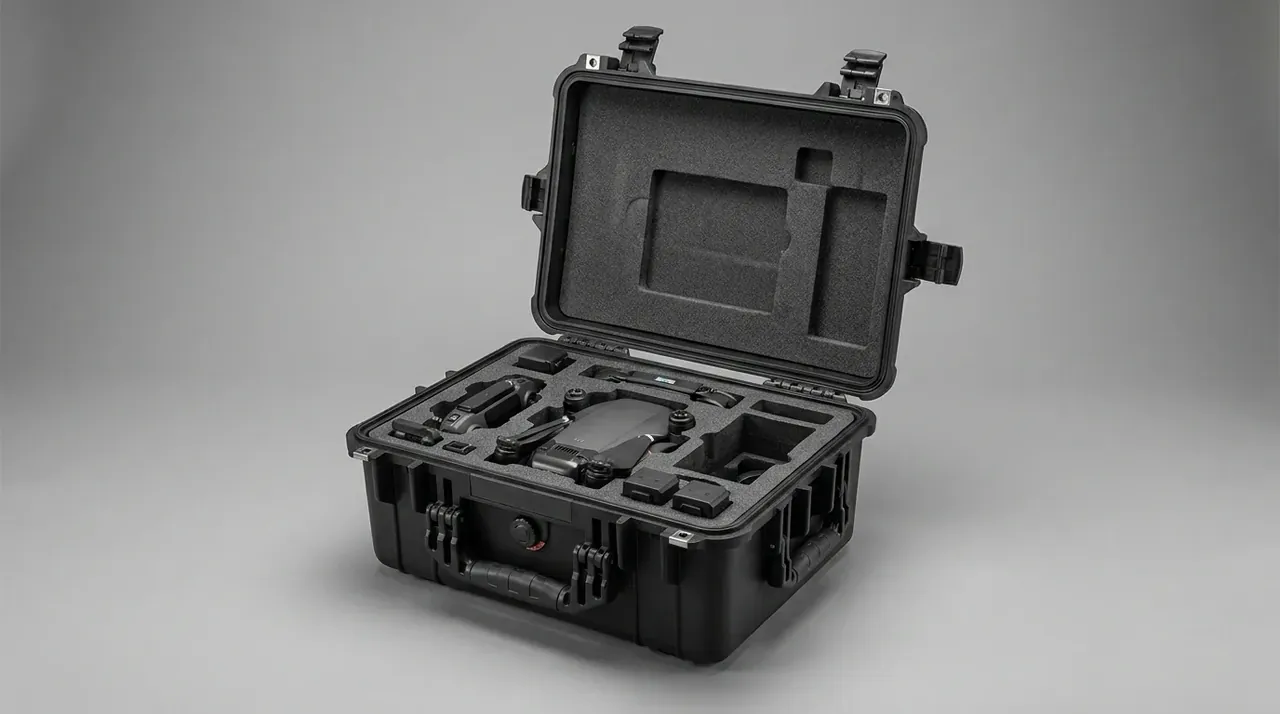
Quick answer: An outdoor IP68 waterproof dustproof small hard box is decided by three dimensions, not the rating label: a 2.4 to 3.2 mm main wall, a 5.0 mm gasket groove under a 5.2 mm dual-lip seal, and a dust labyrinth with 0.6 mm steps. Fix those and 30 minutes at 2 m plus six 1.2 m drops become repeatable.
Table of contents
- Wall, Ribs and Corner Radius
- Dust Labyrinth and the IP68 Gasket Groove
- Latch Holding Force and Opening Force
- Pressure Equalisation Across a 0.3 bar Gap
- Drop, Dust and Immersion Test Limits
- Six Cavity Sizes from 1.1 L to 6.5 L
- FAQ
Wall, Ribs and Corner Radius
A 1.1 L to 6.5 L cavity leaves 15 to 20 mm of shell per side, so the outdoor IP68 waterproof dustproof small hard box works with 2.4 to 3.2 mm of wall. Stiffness comes from ribs at 25 to 30 mm pitch, 2.2 mm high, which let a lid carry five stacked units at 40 degC without sag.
| Part | Material | Size | Process note |
|---|---|---|---|
| Lid | Modified PP | 2.4 mm | Four ribs at 28 mm pitch |
| Base | Modified PP | 2.6 mm | Two perimeter ribs, R8 corners |
| Gasket groove | Same shell | 4.6 mm wide, 5.0 mm deep | Dual lip, Shore A55 |
| Labyrinth | Same shell | Three steps, 0.6 mm gap | Moulded with the groove |
| Hinge lug | Modified PP | 4.0 mm local | Stainless pin, 2.5 mm |
Corners fail first. On a 1.2 m drop the corner lands before the face, and a shell below R5 tends to crack along the radius; R8 outside with R3 inside cuts that cracking from three units in ten to under one in ten. Empty weight is 0.62 kg at 1.1 L and 1.85 kg at 6.5 L, so mass sits in ribs, not in the wall.
Dust Labyrinth and the IP68 Gasket Groove
Dust is stopped by distance, not a filter. Three labyrinth steps outside the groove, each 0.6 mm, force air to turn three times before the lips, a 9 mm path; talcum at 2 kg/m3 for 8 hours leaves the lips clean, and one step short means a retest.
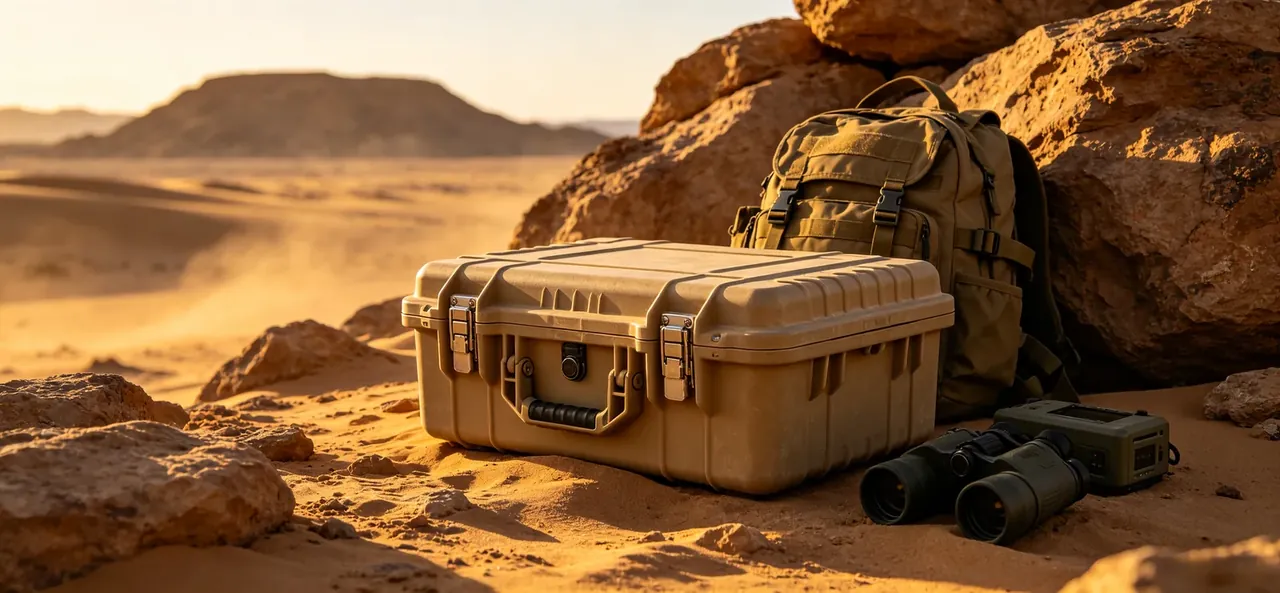
Water stops in the same groove. At 4.6 mm wide and 5.0 mm deep, a 5.2 mm dual-lip seal compresses 28 percent, preloading the lip by 1.4 mm. Below 22 percent, 2 m for 30 minutes leaks at the corners; above 35 percent the seal is crushed, opening force climbs from 55 N to 95 N, and a flat appears after 3000 cycles.
Depth is held within 0.08 mm and width within 0.06 mm, since the first 5000 shots of a 20,000 shot tool drift 0.05 mm.
Latch Holding Force and Opening Force
Two side latches are enough at this size. Each holds 120 N, so the pair gives 240 N, about four times gasket rebound, and opening force sits at 45 to 70 N, which a gloved hand clears in one press; a latch under 35 N pops open in a pack pocket and the water is found later.
The hinge lug is 4.0 mm on a 2.5 mm pin, good for 3000 cycles with bore ovality under 0.15 mm. Handles take 25 kg static with 2 mm deflection or less, six times a 4 kg load.
Pressure Equalisation Across a 0.3 bar Gap
A case in a car reaches 55 degC and falls to minus 20 degC overnight. That 75 K swing builds about 0.28 bar, and without a valve the cold side goes negative: the lid needs over 25 kg of pull and lip life drops from 3 years to 18 months. The outdoor IP68 waterproof dustproof small hard box vents through a 0.25 bar valve on the upper short side, with an ePTFE membrane passing 120 mL/min and holding back 0.5 bar of water.
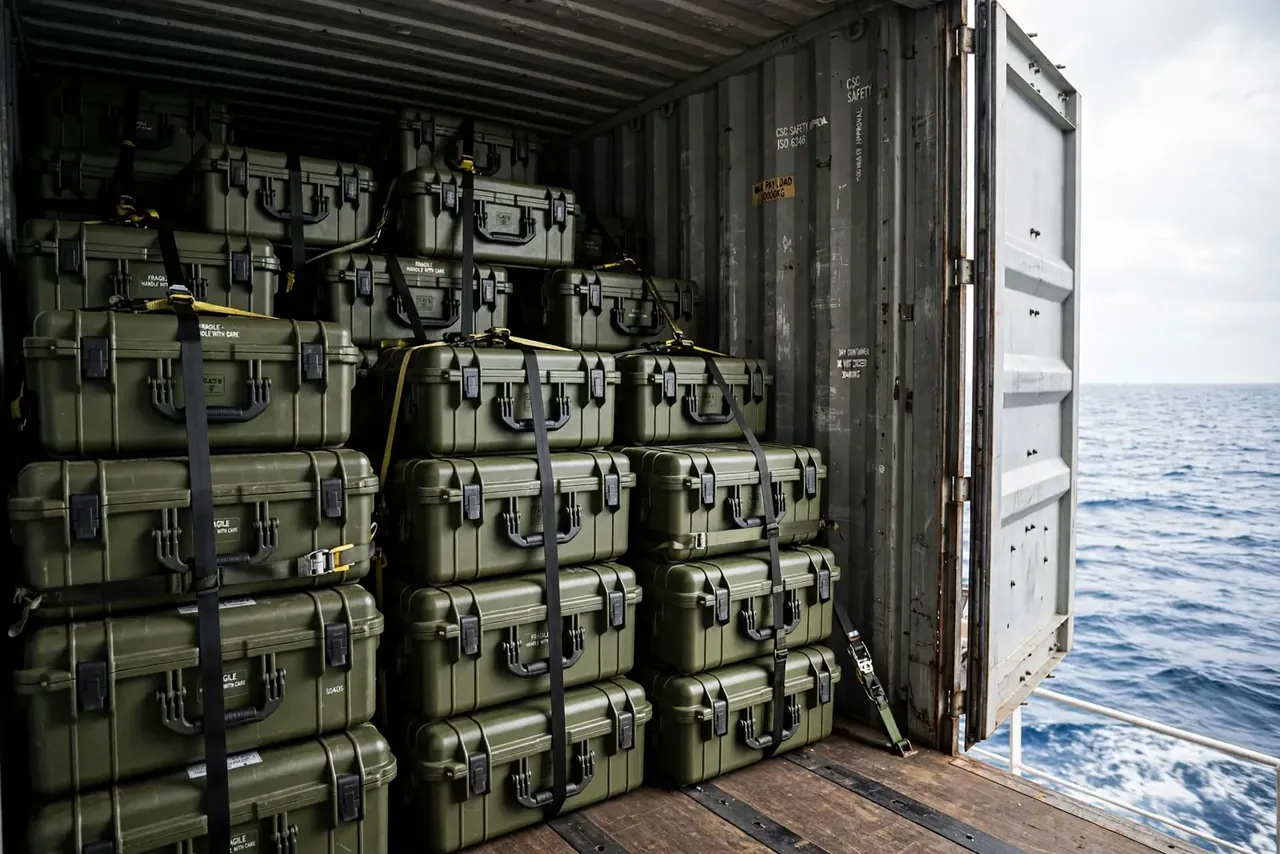
Cycle minus 20 to 55 degC, four hours at each end, five times, then immerse at once; reverse the order and water taken in before heating turns to mist and hides its path. Keep the valve off the bottom, where water collects: 15 mm below the lid line on a short side clears the port in every attitude.
Drop, Dust and Immersion Test Limits
Run vibration, then drop, then immersion. Vibration works latches loose, and a loose latch feeds water into the groove.
| Test | Condition | Pass | Sampling |
|---|---|---|---|
| Drop | 1.2 m, six faces, one 1.5 m corner | Peak 60 g or less | 3 per batch |
| Vibration | 10 to 55 Hz, 1.5 g, 30 min per axis | No fastener movement | 1 per batch |
| Immersion | 2 m, 30 min | Gain 0.5 g or less | 2 per batch |
| Dust | Talcum 2 kg/m3, 8 h | No powder in labyrinth | 1 per quarter |
| UV ageing | 340 nm, 0.76 W/m2, 500 h | Colour shift within 3 | 1 per quarter |
Read the weigh-in sheet, not the summary page: mass to 0.1 g either side of immersion, where 0.5 g equals 0.5 mL of water.
Six Cavity Sizes from 1.1 L to 6.5 L
| Size | Cavity | Volume | Empty weight |
|---|---|---|---|
| S1 | 150 x 100 x 75 mm | 1.1 L | 0.62 kg |
| S2 | 180 x 120 x 85 mm | 1.8 L | 0.78 kg |
| S3 | 210 x 145 x 90 mm | 2.6 L | 0.96 kg |
| S4 | 240 x 165 x 100 mm | 3.8 L | 1.18 kg |
| S5 | 270 x 185 x 105 mm | 5.0 L | 1.46 kg |
| S6 | 300 x 200 x 110 mm | 6.5 L | 1.85 kg |
Measure the largest item and add 8 mm of foam. Under 5 mm it scrapes the seal on the way in; over 12 mm the shell is mostly air, the load shifts in a drop and the foam loses its job.
Conclusion
An outdoor IP68 waterproof dustproof small hard box is four dimensions pulling against each other: wall sets weight, rib pitch sets stiffness, groove sets sealing, valve position sets opening. Write them on the drawing before colour, and the first sample is more likely to pass than the third revision.
This article covers only the specification and design meaning of the case (body) side, and does not deal with any handling, loading or use of the contents.
Related Reading
- IP68 case ratings and test conditions
- How dust protection is built into a case
- IP67 and IP68 immersion differences
- The six-face drop test sequence
Related Products
- 8 Series — Gun Cases; Military Equipment Cases; Camera Equipment Cases; Drone Cases; Watch Cases; Knife Cases; First Aid Cases; Electronics Equipment Cases
- WL8-2812 PP Gun Case — model WL8-2812
- All protective cases and toolboxes: 7 series, 158 models