

Quick answer: IP67 vs IP68 is not a step in quality but a difference in test conditions, because grade 7 fixes immersion at 1 m for 30 minutes while grade 8 leaves depth and duration to the manufacturer.
Table of contents
- Where IP67 vs IP68 test conditions diverge
- Pressure arithmetic: 0.1 MPa per 10 m of water
- What deeper water costs in hardware
- Reading the result once the case is open
- Writing the specification and spotting a padded rating
- FAQ
1. Where IP67 vs IP68 test conditions diverge
Both grades come from IEC 60529, adopted in China as GB/T 4208, where the first digit covers solids and the second water, each tested separately with no arithmetic between them. Grade 7 is fixed: the case bottom sits 1 m below the surface, at least 150 mm of water covers the lid, and the sample stays under for 30 minutes. Grade 8 states only that conditions are agreed between buyer and supplier and are harsher, so one label can mean 1.5 m for 30 minutes and another 10 m for 2 hours.
The usual comparison between IP67 vs IP68 assumes a shared frame that does not exist, since depth, dwell time and sample state all move, and the spread between mildest and harshest grade 8 claims passes a factor of three. Grade 7 is a still soak; grade 8 permits chamber pressurisation, or a case pre-charged internally before it goes under. Water and specimen must also stay within 5 K, because a cooling case pulls water inward.
| Item | IPX7 | IPX8 |
|---|---|---|
| Depth source | Fixed at 1 m | Declared by maker |
| Duration | 30 minutes | Declared by maker |
| Pressure form | Still water, about 10 kPa | External pressure allowed |
| Sample state | Closed as delivered | Stated clause by clause |
2. Pressure arithmetic: 0.1 MPa per 10 m of water
Every 10 m of water adds about 0.1 MPa, so 1 m works out to roughly 10 kPa, 1.5 m to 15 kPa and 3 m to 30 kPa. A lid of 400 mm by 300 mm has an area of 0.12 m², so 1 m of water puts about 1.2 kN of uniform load on it; at 3 m the load reaches 3.6 kN, and the extra 2.4 kN lands on the latches and the stiffness of the lid.
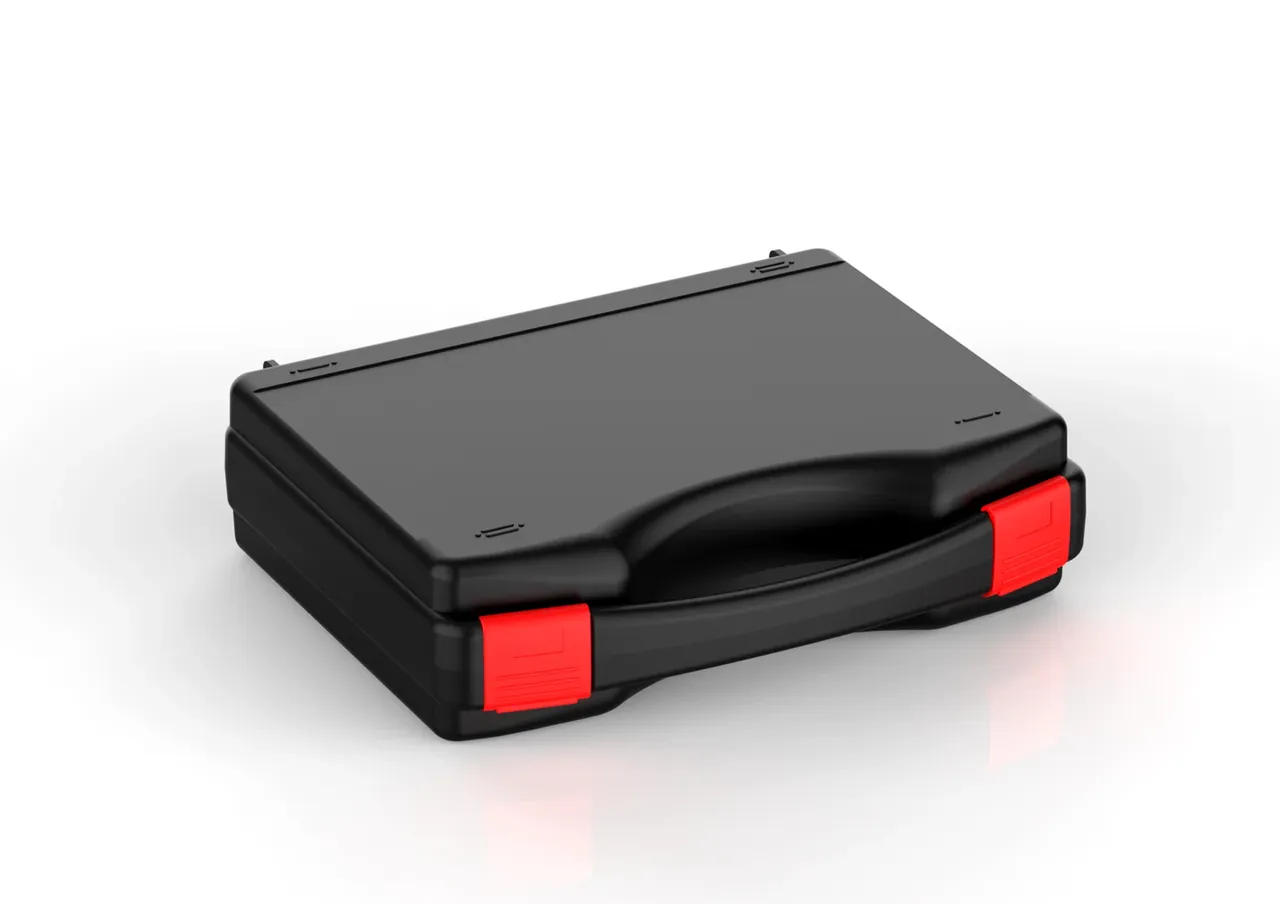
Direction matters as much as magnitude. Outside water pushes the lid inward, so latches carry tension; pre-charging reverses it, pushing the gasket out of its groove, which mimics transport pressure swings rather than immersion and is not grade 8 evidence.
3. What deeper water costs in hardware
The extra IP67 vs IP68 margin ends up in the parts list. A typical grade 7 build uses a single-lip O-ring and two latches: 5 mm cord in a 3.5 mm groove, about 30% compression, with the lid travelling 1.5 mm as latches close. Push that build to 30 kPa and the lid bows into an arc between the latches.
The IP67 vs IP68 step changes hardware in three places. The seal becomes double-lipped, or a second gasket runs in parallel as a backup; clamping moves to 8 to 12 M5 screws at 1.5 N·m in a diagonal pattern, spreading load from two points to a perimeter; and the lid gains ribs 6 mm tall at 80 mm pitch that hold mid-span deflection under 0.3 mm. Twelve screws slow every opening, which wears thin where inspection is hourly.
| Feature | Typical grade 7 | Typical grade 8 |
|---|---|---|
| Seal | Single-lip O-ring | Double lip or twin gasket |
| Clamping | 2 to 3 latches | 8 to 12 M5 screws |
| Compression | 25% to 30% | 30% to 35% |
| Usual depth | 1 m | Declared, often 1.5 to 3 m |
4. Reading the result once the case is open
The inspection is the same at either grade; only the pressure behind it changes. Wipe the outside dry when tank time ends, open within 30 minutes, and look for a water film running across the sealing face, then at the latch pockets, the hinge cavity and the base of the pressure valve. A continuous film or standing water in a groove fails the sample.
Condensation is logged apart from ingress. After a pressurised grade 8 run the interior sits below ambient and mist forms at once; mist that clears without droplets is condensation, while droplets on the seal face or water in the groove are ingress. Weighing the case before and after on a 0.1 g balance settles it: a 0.5 g difference rules out meaningful ingress. Re-checks run in order: seal inspection, 15 kPa held 45 seconds with a 0.3 kPa limit, then a short immersion.
5. Writing the specification and spotting a padded rating
A grade 8 requirement belongs in one reproducible sentence: IPX8, 3 m for 60 minutes, still water, closed as delivered, per IEC 60529. Leave a clause out and no lab can repeat it, and a datasheet printing IP68 alone hands interpretation to the supplier.
| Wording | Missing | Action |
|---|---|---|
| IP68 | Depth, duration, sample state | Ask for the full clause |
| IP68 waterproof | Standard and year | Ask for the reference |
| IPX8, 3 m, 60 min | Essentially complete | Acceptable |
Padded ratings leave fingerprints. The label and report disagree at 1.5 m for 30 minutes against a brochure claim of 3 m; the sample state was swapped, so an empty shell was tested and a fitted case sold; no preconditioning ran, so a gasket never faced cold hardening; the report holds a conclusion page but no specimen number. Any one of the four is enough to treat the case as unverified. Between IP67 vs IP68 the practical rule is the same: a brief dunk for 10 seconds is already covered by grade 7, and tank or underwater duty needs a grade 8 clause written around real depth and dwell time.
Conclusion
Choosing between IP67 vs IP68 means turning the label back into conditions: grade 7 is the fixed trio of 1 m, 30 minutes and still water, while grade 8 is a declaration that has to be filled in. Work out the pressure at 0.1 MPa per 10 m, check whether lid span and clamping carry it, then confirm the report matches the declared depth, duration and sample state. After those steps IP67 vs IP68 stops being a question of which grade is higher and becomes one of which conditions match the water the case meets.
This article discusses only the container (case body) side of specifications and design intent, and does not cover any handling, loading or use of the contents.
Related Reading
- Acceptance criteria for IP67 cases
- Conditions and judgement for IP68 cases
- Waterproof hard case grades and structure
- Gasket and O-ring material selection
Related Products
- 8 Series — Gun Cases; Military Equipment Cases; Camera Equipment Cases; Drone Cases; Watch Cases; Knife Cases; First Aid Cases; Electronics Equipment Cases
- WL8-2812 PP Gun Case — model WL8-2812
- All protective cases and toolboxes: 7 series, 158 models