

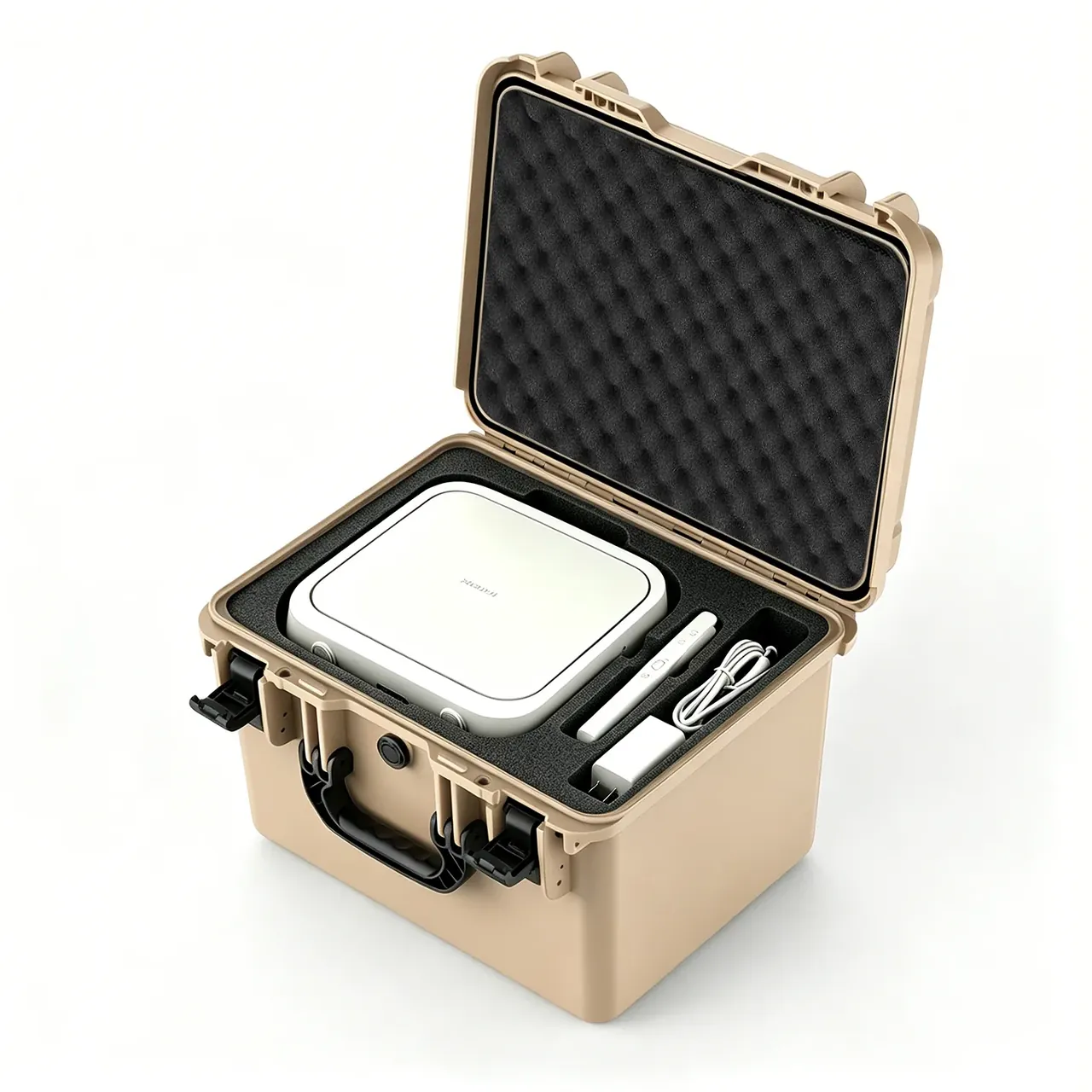
Quick answer: An industrial anti-static electronics repair tool box holds 10^6–10^8 Ω at the shell and under 10 Ω at the chain, so charge leaves by one path.
Table of contents
- The Discharge Path Through an Industrial Anti-Static Electronics Repair Tool Box
- Shell Surface Resistance and Liner Choice
- Grounding Chain and Latch Contacts
- Continuity Between Workstations
- Wiping and Surface Resistance
- FAQ
1. The Discharge Path Through an Industrial Anti-Static Electronics Repair Tool Box
Before a board comes out, the box and the person have to sit at the same potential. Charge does not vanish because a shell is called anti-static; it travels a real route to earth, from shell surface through the latch contacts into the grounding chain. Three links in series: one open link kills the route.
Series makes the judgement clear and fragile at once. Surface resistance of 10^6–10^8 Ω is the first link, a chain at or under 10 Ω is the last, and five orders separate them. A total reading is dominated by the shell, so a rusted chain hides inside a passing number.
Discharge also has a time scale. For a shell falling from 1000 V to 100 V the interval follows resistance times capacitance: seconds in the dissipative band, minutes in the insulating one. An industrial anti-static electronics repair tool box does not chase the lowest figure, because too fast a discharge delivers the spike a slow one avoids.
2. Shell Surface Resistance and Liner Choice
The shell is 470 × 360 × 180 mm outside, 430 × 320 × 145 mm inside, with a 3.5 mm wall, 12 compartments and a 95 × 70 × 60 mm cell. Its electrical identity comes from the compound rather than the wall: the same mould in another grade moves surface resistance by six orders of magnitude.
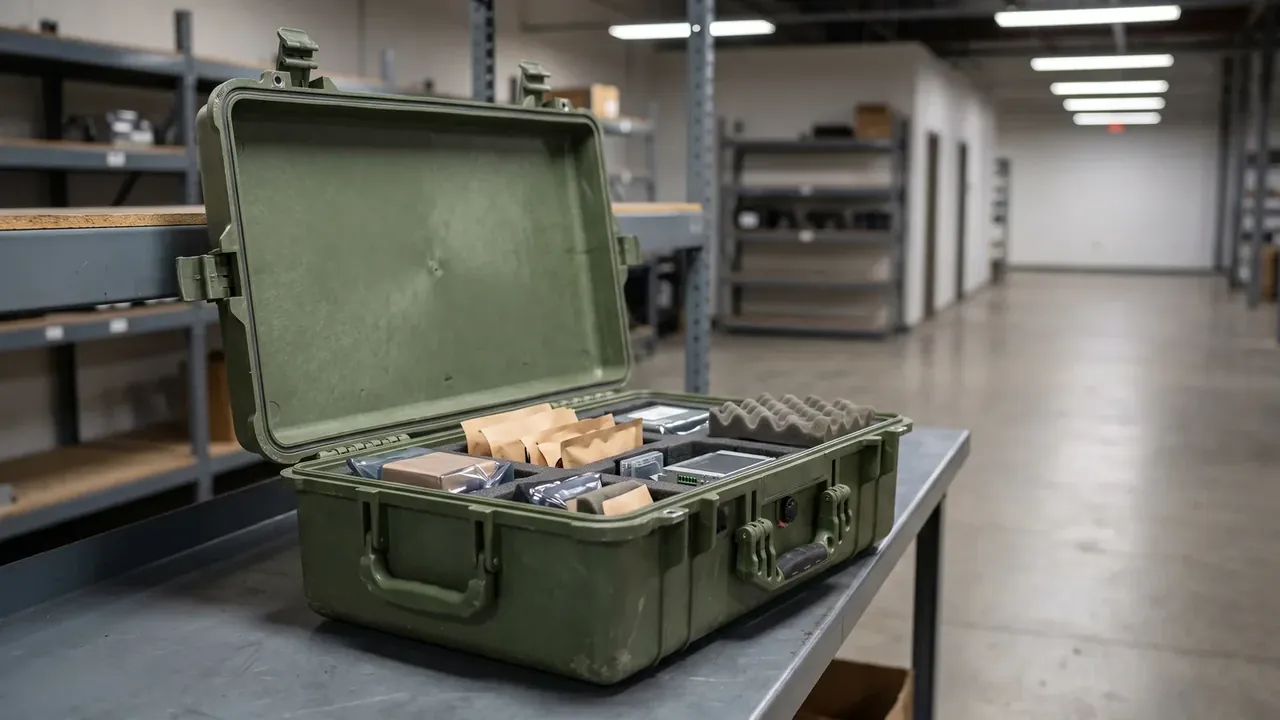
Three bands cover every option. Conductive, below 10^6 Ω, spikes hard on contact; dissipative, 10^6–10^9 Ω, lets charge drift; insulating, above 10^12 Ω, stores it. An industrial anti-static electronics repair tool box takes 10^6–10^8 Ω, the lower half of the dissipative window.
| Surface resistance | Range | Discharge | Typical use |
|---|---|---|---|
| Conductive | Below 10^6 Ω | Instant, high spike | Bonded trays |
| Dissipative | 10^6–10^9 Ω | Seconds, controlled | Repair shells |
| Insulating | Above 10^12 Ω | Minutes, retained | General totes |
The liner on an industrial anti-static electronics repair tool box is the second variable. PE foam at 20 mm reading near 10^12 Ω puts an insulator between tool and shell, so a perfect shell never sees the charge; both go to test in one batch.
Repeatability comes from test conditions. Under GB/T 1410 the sample sits at 23 ± 2 °C and 50 ± 5% RH for 24 h, electrodes are 100 mm apart, voltage is picked from 10 V or 500 V, and nine points are read with the highest taken.
| Discharge path | Joined by | Break point |
|---|---|---|
| Tool to shell | Liner and cells | Insulating liner |
| Shell to chain | 3 contact points | Loose latch |
| Chain to earth | Bench or cart | Temporary set-down |
3. Grounding Chain and Latch Contacts
The latch is the loosest link. An industrial anti-static electronics repair tool box has 2 latches rated 260 N of closing force, and the tongue presses the contact plate between lid and body as it comes down.
The 3 contact points of an industrial anti-static electronics repair tool box do different jobs: the hinge carries continuity while the lid swings, the latches carry the main path once closed. Pin pressure and spring travel differ, so all three are measured apart.
| Contact point | Location | Contact type | Target |
|---|---|---|---|
| First | Hinge side | Pin press-fit | ≤0.5 Ω |
| Second | Latch seat | Tongue plate | ≤0.5 Ω |
| Third | Chain terminal | Bolted lug | ≤1.0 Ω |
The chain is braided copper rather than a single conductor. Across 5000 open-close cycles a solid wire breaks strand by strand at the bend while looking clean, climbing from 1 Ω to tens of ohms.
4. Continuity Between Workstations
Moving a 5.2 kg industrial anti-static electronics repair tool box between benches cuts the route into pieces: lifting breaks shell-to-bench contact, a wrist strap keeps that segment alive, a cart makes its own bond the second, and setting down closes the third.
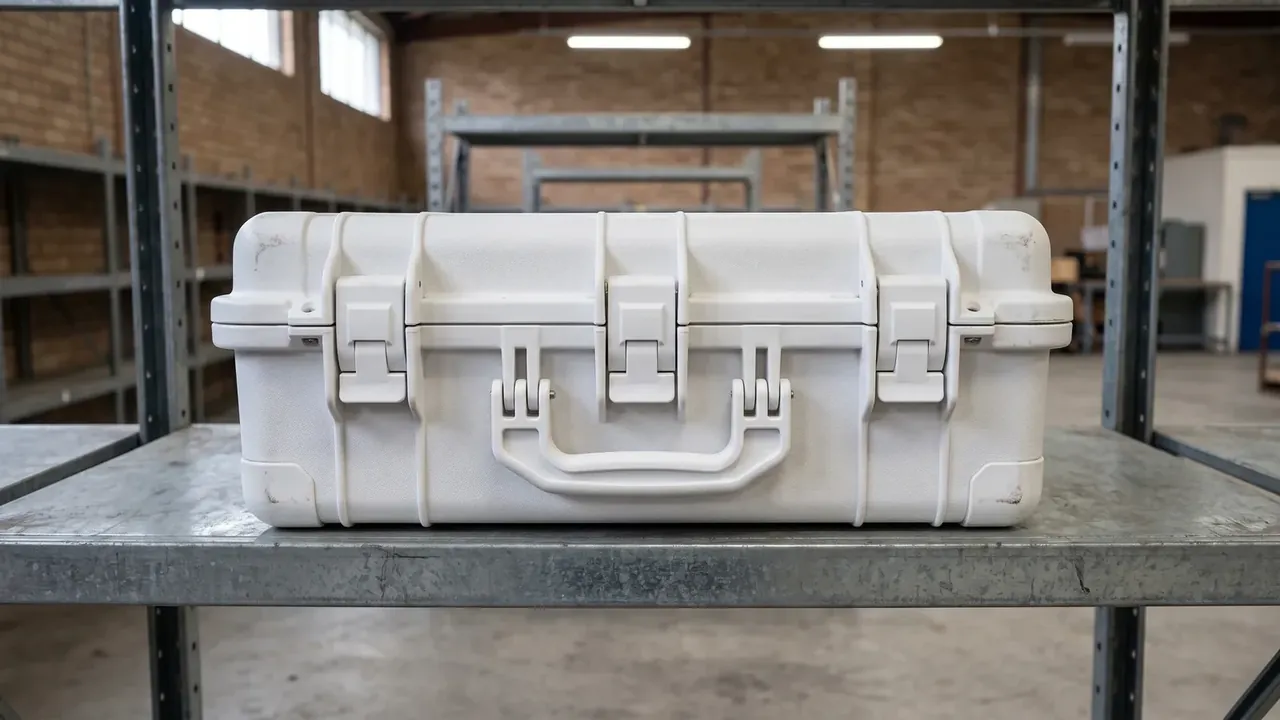
Breaks happen during a temporary set-down. Wood, plastic mat and cardboard are insulators, so charge waits on the shell until the next touch releases it. Writing a bonded bench into the procedure does more than any feature on the shell.
4-high stacking is the other weak spot. The bottom latch carries three boxes for weeks, the tongue loses spring travel, and the meter shows 0.5 Ω climbing to 3 Ω with nothing visible outside.
5. Wiping and Surface Resistance
Wiping is the most common cause of drift. Wet a cleanroom cloth with 70% isopropanol, rub one area 50 times, dry and re-measure: a migratory additive jumps two orders, while permanent and carbon-filled grades stay within 0.5 of an order, and 0.15 is typical.
Drift almost always runs upward. Wiping strips the conductive layer, the bulk cannot resupply it fast enough, and the reading climbs until it leaves the 10^8 Ω ceiling; "no more than 0.5 of an order after 50 wipes" in acceptance flattens that curve.
Timing matters. Just after the solvent flashes off, polar residue holds the reading low; 10 min of re-equilibration settles it. Across −10 °C to +50 °C the cold end reads one step higher.
IP54 is the rating: level 5 dust lets a little in without harm, level 4 splash covers water from any direction. It handles bench fluid, not immersion, and water reaching the latch plate changes contact resistance first.
Conclusion
An industrial anti-static electronics repair tool box stands or falls on one series route: 10^6–10^8 Ω at the shell is the entry, 3 contact points and a chain under 10 Ω are the exit, and one loose joint opens everything. The 3.5 mm wall, 20 mm PE foam and 12 compartments handle storage; the resistance window handles discharge.
Related Reading
- Usable Volume of Small Compartments
- Packing for Repair Round Trips
- EVA Lining for Line-Side Tool Boxes
Related Products
- 8 Series — Gun Cases; Military Equipment Cases; Camera Equipment Cases; Drone Cases; Watch Cases; Knife Cases; First Aid Cases; Electronics Equipment Cases
- WL8-2812 PP Gun Case — model WL8-2812
- All protective cases and toolboxes: 7 series, 158 models