


Quick answer: Case volume calculation starts at the cavity mouth, then deducts R10 corners, R25 fillets and draft, so a 42 L case yields 34.2 L of usable space.
Table of contents
- Three volume figures and where the gap comes from
- Measuring cavity length, width and depth
- What corners and ribs subtract
- Wall thickness, shrink and draft allowance
- Usable ratio bands and sizing math
- FAQ
1. Three volume figures and where the gap comes from
A case rated 42 L measures 500 × 362 × 232 mm across the cavity mouth, multiplying to 42.0 L. Loaded with boxy equipment the clear space is 480 × 362 × 197 mm, or 34.2 L, so 18.6% of the label disappears.
Case volume calculation needs three figures kept apart. The label multiplies the mouth and deducts nothing. The geometric cavity, 40.0 L, deducts corners, fillets, ribs and groove. The usable volume, 34.2 L, counts only what a rectangular load can occupy.
Only the third figure depends on load shape. A sharp corner must sit inside the radius, so length loses two radii while width loses nothing, cutting section area 4.0%.
| Rated volume | Cavity mouth L×W×D | Geometric cavity | Rectangular envelope | Usable volume | Usable ratio |
|---|---|---|---|---|---|
| 22 L | 410×290×185 mm | 22.0 L | 390×290×149 mm | 16.9 L | 76.6% |
| 42 L | 500×362×232 mm | 40.0 L | 480×362×197 mm | 34.2 L | 81.4% |
| 68 L | 600×430×265 mm | 65.2 L | 580×430×225 mm | 56.1 L | 82.0% |
| 95 L | 670×480×295 mm | 90.6 L | 650×480×252 mm | 78.6 L | 82.8% |
| 130 L | 760×540×320 mm | 125.2 L | 740×540×272 mm | 110.3 L | 84.0% |
The smallest case scores worst because fixed overhead scales against depth: 36 mm of boss, rib and step against 185 mm.
2. Measuring cavity length, width and depth
Measure the narrowest section: tape 10 mm below the rim, wall to wall, at both ends and mid-length, keeping the minimum. Depth runs from floor rib to rim, with the lid land measured separately.
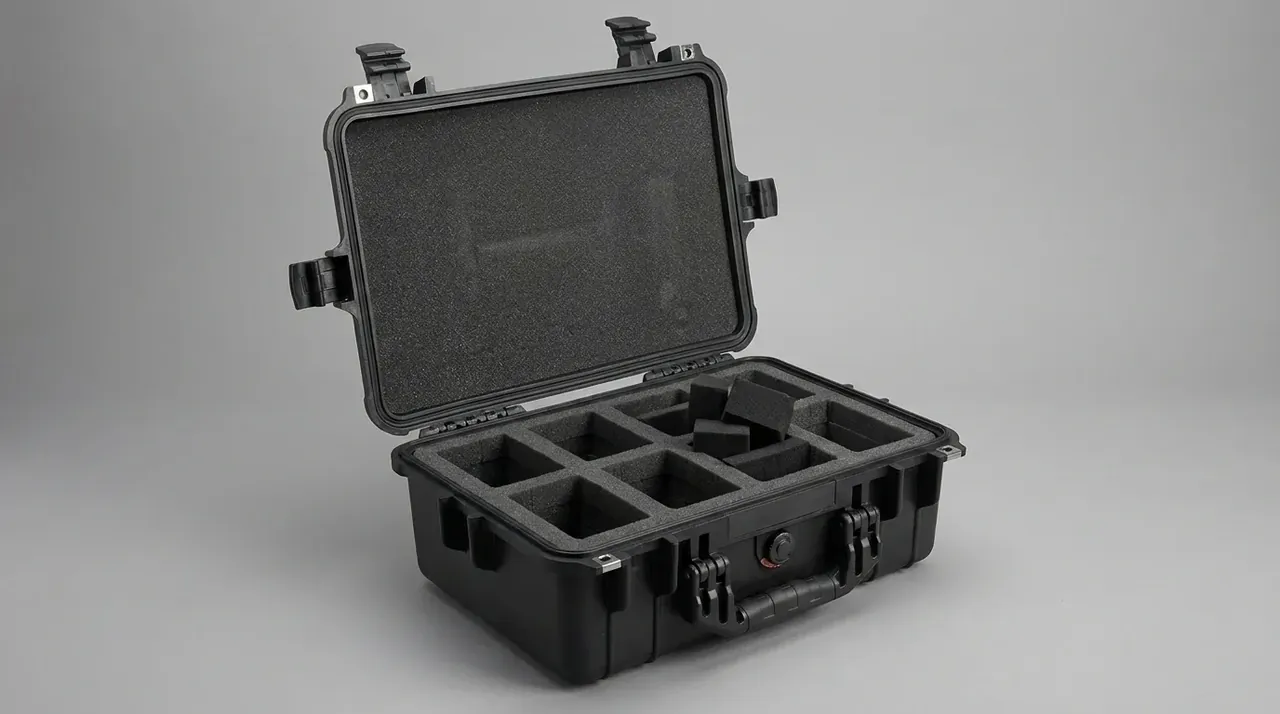
Rim readings add 1.5 to 2.0 mm, worth 0.3 L. Ribs sit on one wall, so a mid-span reading reads 3 to 6 mm narrow, which the minimum rule folds in.
Lid depth stands alone: a 15 to 20 mm ring boss and a 6 to 9 mm gasket groove are structure, not space. Adding lid to base overstates the total by 1.2 to 1.8 L.
| Measured item | Tool | Reading position | Tolerance |
|---|---|---|---|
| Cavity length | Tape, 1 mm graduations | 10 mm below rim, minimum of 3 | ±1.0 mm |
| Cavity depth | Depth gauge | Floor rib top to rim | ±1.5 mm |
| Corner radius | Radius gauge | All four corners | ±1.0 mm |
| Wall thickness | Ultrasonic gauge | 3 points per face, averaged | ±0.3 mm |
3. What corners and ribs subtract
Corners and ribs hit case volume calculation twice, and only once in the arithmetic. Each corner removes 0.2146 × R² × depth, so R10 at 232 mm deep costs 0.02 L for four corners, 0.05% of the label.
The geometry costs more than the volume. Clear length falls 20 mm and section area drops from 181 000 to 173 760 mm², a 4.0% loss. At R25 the load gives up 30 mm and usable volume falls 3.2 L.
Floor fillets multiply by perimeter: R25 on 1724 mm is 0.23 L. Eight ribs 4 mm wide, 6 mm high and 190 mm long take 0.07 L, yet each narrows clear width by 6 mm. Gasket groove and lid boss add 0.52 L, and neither can go without losing the IP rating.
| Deduction | Formula | Volume removed on a 42 L case | Share of label |
|---|---|---|---|
| Four R10 corners | 0.2146×R²×H×4 | 0.02 L | 0.05% |
| R25 floor fillet | 0.2146×R²×perimeter | 0.23 L | 0.55% |
| Gasket groove and lid boss | Groove area×perimeter + boss | 0.52 L | 1.24% |
| Eight side ribs | Width×height×length×count | 0.07 L | 0.17% |
| 1.5° draft taper | Frustum volume difference | 1.20 L | 2.86% |
| Total | — | 2.04 L | 4.86% |
4. Wall thickness, shrink and draft allowance
Draft is the largest deduction: 1.5° over 232 mm pulls each side in 6.1 mm, so the floor section shrinks to 487.8 × 349.8 mm and the cavity falls from 42.0 to 40.8 L.

Wall thickness sets the per-side loss. At 7.0 mm instead of 5.5 mm the same outside dimensions cost 1.3 L, and recovering it means thinning the wall, which trades against stiffness.
Shrinkage is the missed layer. PP runs 1.5% to 2.0%, so a 500 mm direction comes out 8 to 10 mm short and the cavity sits 4.5% to 6.0% under the drawing. A quote built on mould dimensions hands that offset to the buyer.
Usable height assembles from mouth step 8 mm, lid boss 18 mm and floor rib 9 mm, leaving 197 mm of 232 mm. A four-point boss in place of a full ring recovers 9 to 11 mm.
5. Usable ratio bands and sizing math
Across more than 30 case types, usable ratio spans 72% to 85%: flat cases under 0.5 depth-to-width sit at 76% to 79%, mainstream shapes at 80% to 83%, deep cavities above 0.8 at 83% to 85%, and heavy ribbing at 72% to 75%.
Running case volume calculation backwards is more useful. 30 L of clear space at 81% needs a 37.0 L label, rounded up to 38 to 40 L; the same load in a 77% case needs 39.0 L, a full size higher. Three numbers belong in the purchase order: mouth dimensions, rectangular envelope, usable volume, at ±1.0 mm and ±0.3 L. A label reading about 42 L is not inspectable.
Conclusion
Case volume calculation reduces to three moves: read the mouth, deduct the structure, close the envelope around a rectangle. A 42 L case survives all three at 34.2 L, and 81.4% is its real capacity. Set thresholds accordingly: above 82% release the lot; between 78% and 82% check the load shape, pricing square equipment at the low end while round or soft loads can use the label; below 78% request the measured cavity drawing and envelope table, and price at 75% if neither arrives.
This article discusses container-side specifications and design implications only, and does not cover any handling, loading or use of the contents.
Related Reading
- How to measure case interior dimensions
- Corner radius trade-offs for cavity and stiffness
- Reinforcement rib layout and inward offset
- Sizing a case from equipment dimensions
Related Products
- 8 Series — Gun Cases; Military Equipment Cases; Camera Equipment Cases; Drone Cases; Watch Cases; Knife Cases; First Aid Cases; Electronics Equipment Cases
- WL8-2812 PP Gun Case — model WL8-2812
- All protective cases and toolboxes: 7 series, 158 models