

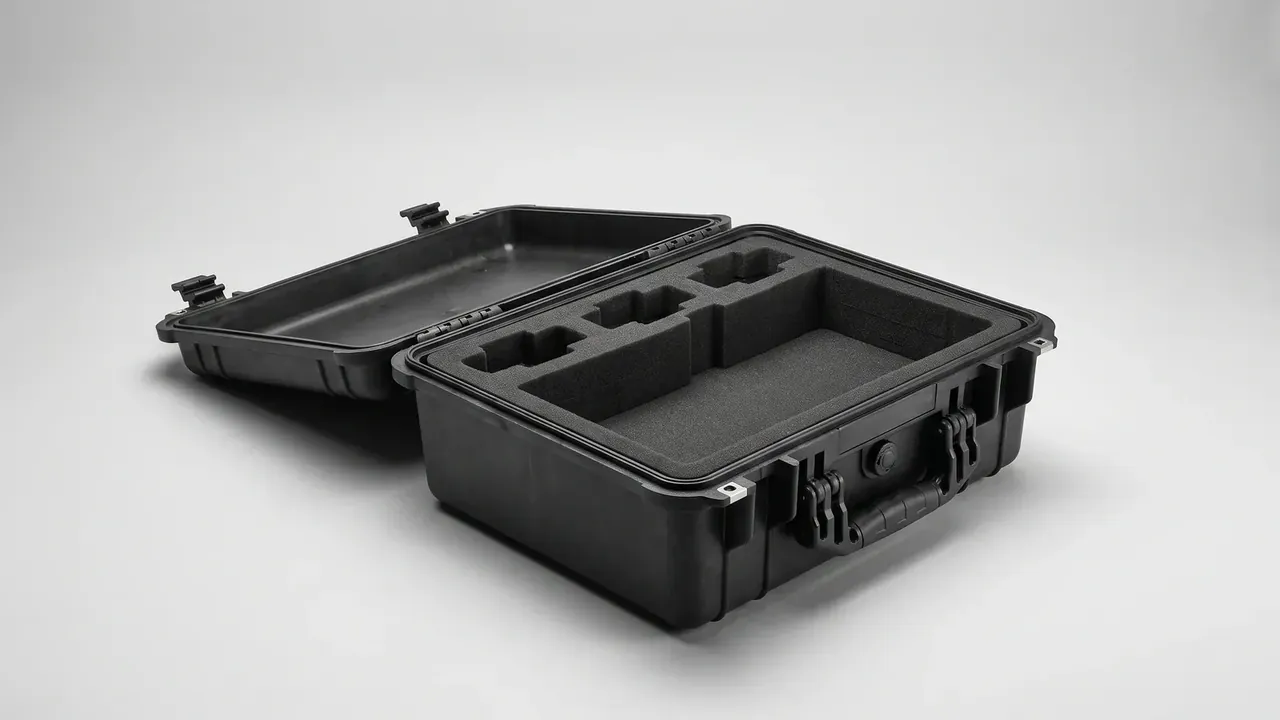
Quick answer: An Industrial Case ODM Manufacturer quotes only after five design inputs arrive; drawing ownership and ΔE 1.5 colour control decide the deal.
Table of contents
- Design Inputs You Have to Hand Over
- Where Exterior Changes Stop
- The ID and MD Interface
- Drawing and Structure Ownership
- From Change Request to Mass Production
- FAQ
1. Design Inputs You Have to Hand Over
Design inputs come before the quotation, the first fork between ODM work and stock. An Industrial Case ODM Manufacturer owns the shell; the buyer adds five items, and one missing item parks the change.
The five are outline and weight, ports and cut-outs, foam zoning and packing order, humidity and drop exposure, and colour with marking. Each sounds obvious until it reaches a drawing.
Packing order is the item buyers forget. Unit first and cable coiled after sends the foam slots one way; cable first and unit pressed down sends them the other. Get it backwards and the prototype will not close, so the die is cut twice. An Industrial Case ODM Manufacturer replies on day 3 with the five items restated for signature.
| Input | Handed over as | If it is missing |
|---|---|---|
| Outline and total weight | Three views plus a weighed sample | Feet and wall unchecked, prototype sags |
| Ports and cut-outs | Hole drawing with coordinates | A hole lands on a rib, insert work follows |
| Foam zoning and packing order | Zoning sketch plus packing note | Slots run backwards, die cut again |
| Humidity and drop exposure | A short application note | No basis for gasket or desiccant choice |
| Colour reference and marking | Colour chip plus artwork | Prototype colour misses, batch rework |
Weight has to become a number. Units of 8 kg and 15 kg share neither rib spacing nor wall thickness, and shell walls commonly run 2.0 to 3.5 mm; below that the base bows when lifted, and 2 mm of bow shifts the foam.
2. Where Exterior Changes Stop
Three things can change outside: colour, texture and marking position. Colour follows a chip with ΔE held inside 1.5, texture is etched into the cavity, and marking is limited by draft.
What cannot change is the parting line, the draft angle and the wall. Move the parting line and the cavity is re-cut; run out of draft and the rim whitens. Wall follows moulding shrinkage, 1.0 to 2.5 percent for PP, 0.4 to 0.7 percent for ABS and 1.5 to 3.0 percent for HDPE, so a wall change recalculates the cavity.
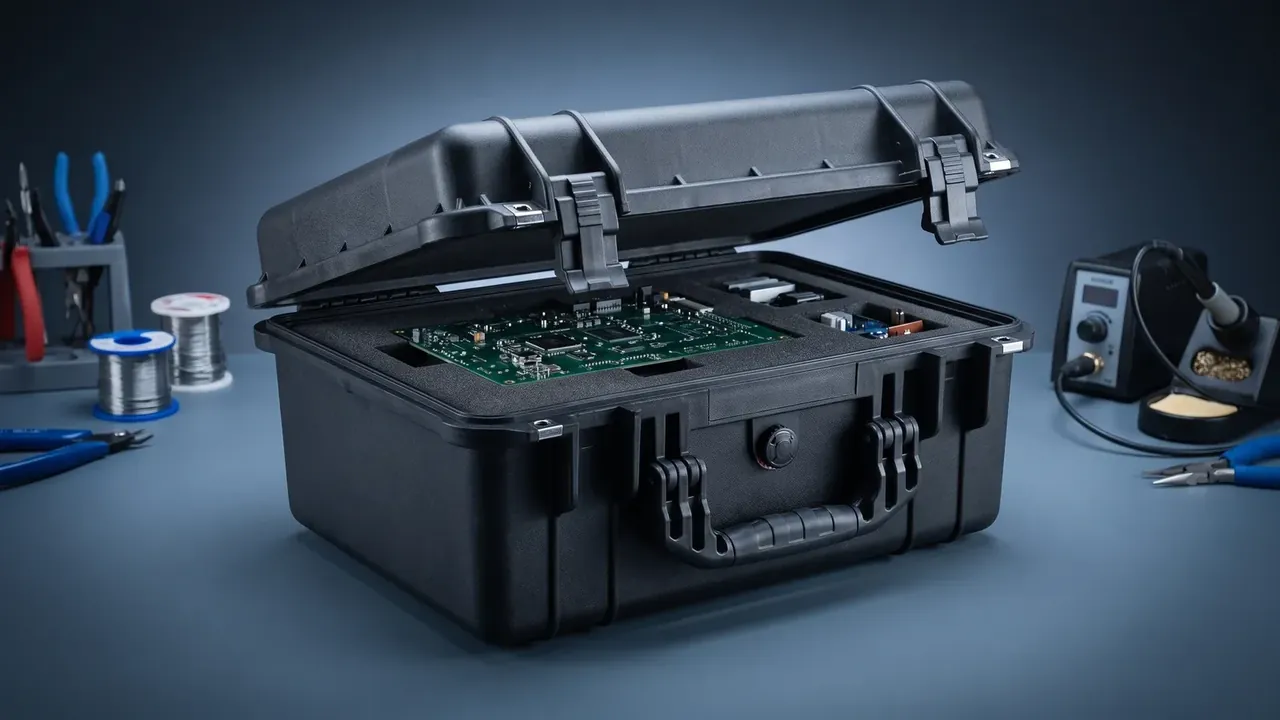
Three change points in one request is a safe envelope. Past that, tooling moves from inserts to cavity, and cost and time rise together. An Industrial Case ODM Manufacturer sorts the list into those buckets at review, pushing the rest onto pad printing.
Texture and colour often change together, and that is where trouble hides. Deeper etching makes the same chip read darker, so either the chip or the texture depth is redone.
3. The ID and MD Interface
Industrial design owns the outer form, colour chips and marking layout. Mechanical design owns wall thickness, ribs, latch seats and hinge positions. The single interface is the freeze date of the outer surface: structure starts ribbing only after the surface is locked.
| Interface point | Belongs to ID | Belongs to MD |
|---|---|---|
| Outer surface | Finalise and freeze | Derive wall from surface |
| Colour and marking | Chip, position on face | Check face is not a draft plane |
| Latches and hinges | Appearance requirement | Seat size and retention force |
| Foam zoning | Packing order | Foam thickness and slot direction |
A blurred interface has an easy symptom: the surface changes three times, the ribs change three times and every round issues a revision. An Industrial Case ODM Manufacturer freezes that date in the schedule, then allows only colour and marking.
Structural limits must reach the design side early. Latch retention of 200 to 400 N, hinges rated for 20,000 cycles and gasket compression of 25 to 30 percent decide whether a handle grips and a lid closes flat. Without them a designer draws a handle that squeezes nothing.
4. Drawing and Structure Ownership
A drawing number should carry three things: project number, case code and revision. Whoever sets that rule usually decides who owns the drawing. When an Industrial Case ODM Manufacturer numbers the work itself, the buyer holds a licensed copy that cannot leave.
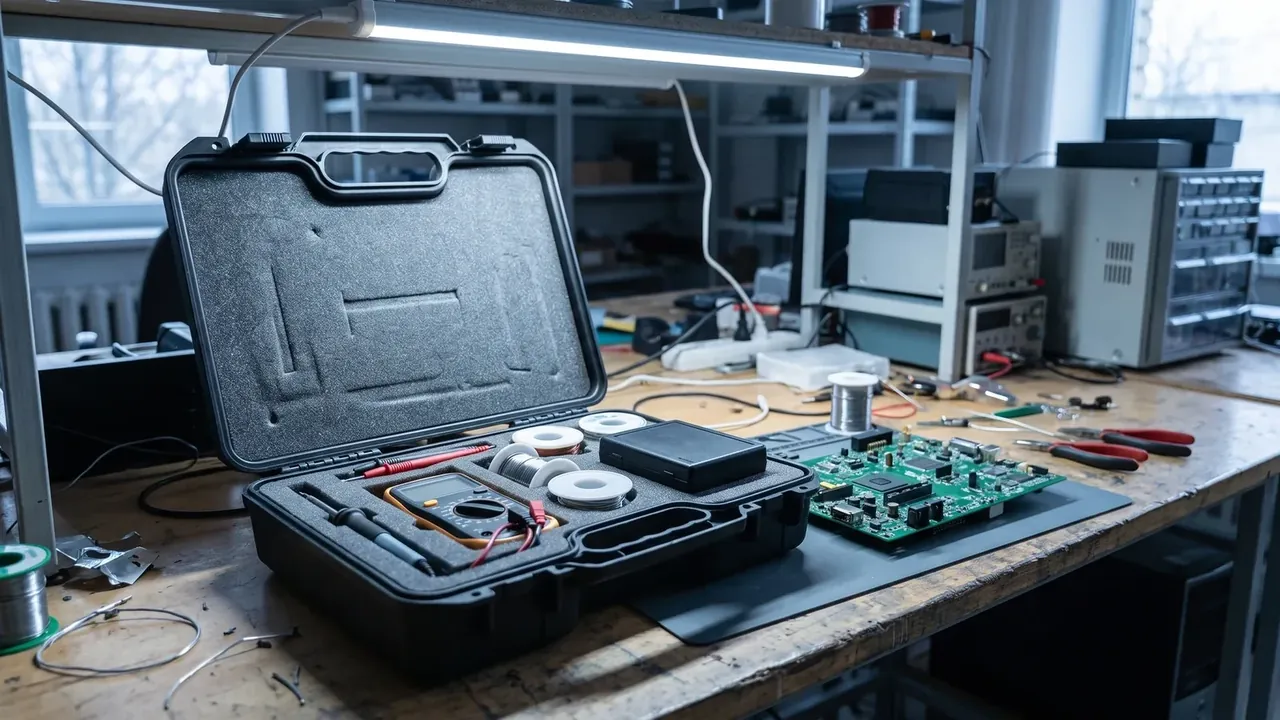
Ownership is written three ways: purchase, joint holding and licence. Purchase takes both drawing and tooling, so a later factory move is possible. Joint holding leaves each side a copy neither may dispose of alone. An Industrial Case ODM Manufacturer granting a licence keeps the drawing on site and limits the buyer to a scope.
Two clauses decide a licence: whether the drawing may be copied when production moves, and who owns drawings derived from a change. Many Industrial Case ODM Manufacturer contracts assign derivatives to the factory; strike that before signature, or the second-generation structure belongs to somebody else.
Tooling ownership belongs in the same clause: name the mould number, its storage location and the handover conditions, or the buyer owns a mould it cannot reach.
5. From Change Request to Mass Production
Thirty days is the usual envelope: 7 days of change design, 7 for the first prototype, 5 for chip sign-off, 11 for trial shots and pilot preparation. A set of one to three units shows outline and fit, not drop performance.
| Stage | Days | Deliverable |
|---|---|---|
| Change design | 7 | Revised structure and hole drawings |
| First prototype | 7 | One prototype set |
| Colour and appearance | 5 | Chips and signed sample |
| Trial shots and pilot | 11 | Trial parts and inspection sheet |
Change ruling: if the first prototype and production parts differ by more than ΔE 1.5, or the assembly gap exceeds 0.4 mm, the change goes back for a new insert.
An Industrial Case ODM Manufacturer usually starts production at 500 units. Below that, mould change and machine setting cannot be spread thin, so the unit price rises. Keep 20 units from the first 500 as a reference set.
Colour chips stretch the schedule. A chip confirmed in week 4 pushes trial shots back, and a compressed trial carries prototype faults into production. Treat chip sign-off as a precondition, not as a buffer day on a chart.
Conclusion
Two documents sit on an ODM table: a change list and an ownership clause. The list says where the change stops, the clause says who keeps it afterwards. An Industrial Case ODM Manufacturer that lays out both unasked deserves the drawing.
This article discusses only the container (case body) side of specifications and design intent, and does not cover any handling, loading or use of the contents.
Related Reading
- ODM customisation that starts with a proposal
- Where OEM ends and ODM begins
- Drawing and mould confidentiality clauses
- Reading an ODM supplier quotation
Related Products
- 8 Series — Gun Cases; Military Equipment Cases; Camera Equipment Cases; Drone Cases; Watch Cases; Knife Cases; First Aid Cases; Electronics Equipment Cases
- WL8-2812 PP Gun Case — model WL8-2812
- All protective cases and toolboxes: 7 series, 158 models