

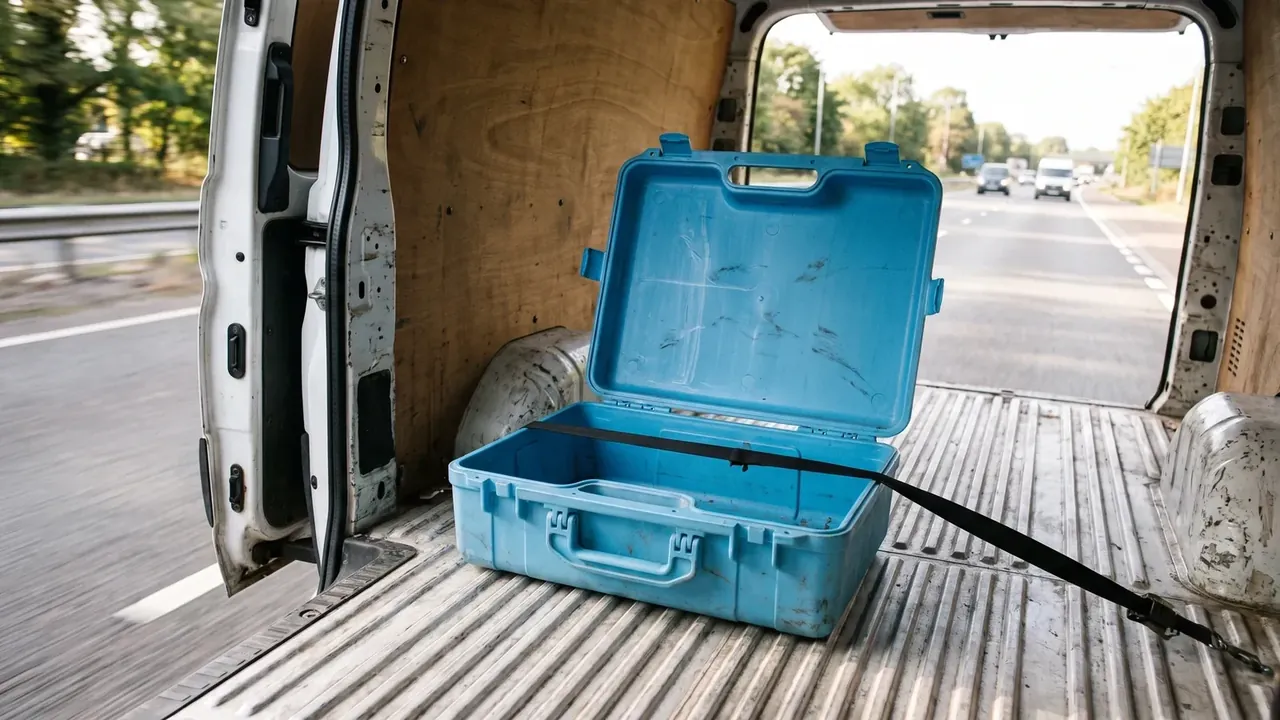
Quick answer: Loose tools are rarely a weak shell problem. The usual culprits are slots wider than the tools, pressure bars that press nothing, and a handle rated on paper. Below: dividers, the 15–40 kg total, a handle proven at four times its rating and 5000 fatigue cycles, liner compression, and fixing the case in a truck bed.
Table of contents
- Why tools come loose inside an industrial tool carrying case
- Dividers and pressure bars: one position per tool
- Distributing 15 to 40 kg: handle rating against total
- Liner compression and sag after repeated opening
- Fixing the case in a truck bed
- FAQ
1. Why tools come loose inside an industrial tool carrying case
The complaint is a weak case. Open the lid and the cause is inside: sockets rolled against a grinder, a wrench under a drill body, bars resting on nothing.
Loose tools get a runway. With 20 mm of clearance, one speed bump lets a socket strike another tool hard enough to ruin paint and engravings.
Harder shells make it worse. A rigid wall returns impact instead of absorbing it, while a soft bag deforms and eats part of the energy. After three months on the same route, tools in a hard case wear faster.
2. Dividers and pressure bars: one position per tool
Dividers fix position, bars fix movement, and either alone fails. A divided industrial tool carrying case with no bars dumps everything against the lid the first time it is inverted.
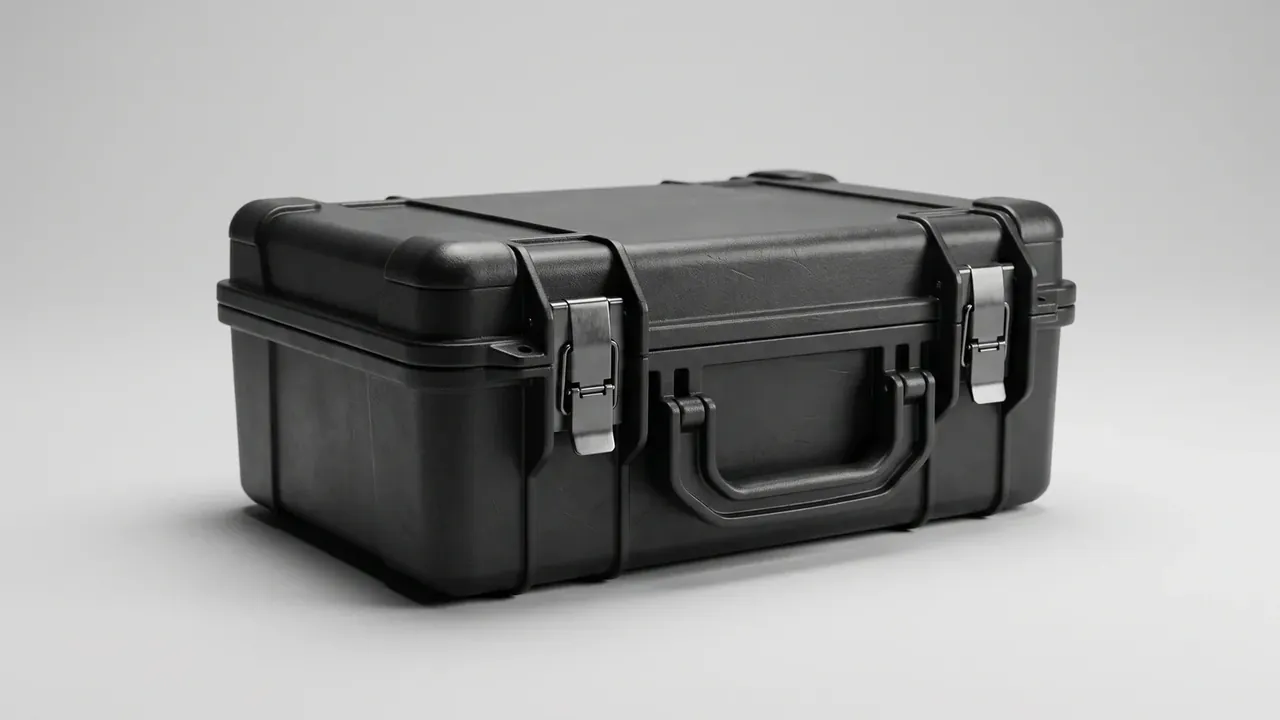
Dividers have to move. Fixed slots look tidy at purchase and are useless with the next tool set; adjustable bars on 2 mm steps work, slot 2 mm wider than the body. At 6 mm the tool turns in its bay.
The bar is 2 mm aluminium extrusion over the upper edge, both ends locked into teeth in the side wall. It only needs to hold a tool when inverted; overtighten and the liner lifts with it.
No bar means no divider.
3. Distributing 15 to 40 kg: handle rating against total
Four kits, weighed in the same case family.
| Tool group | Typical total | Dividing method |
|---|---|---|
| Torque wrench and socket set | 15 kg | vertical slots, one hole per socket |
| Drill and angle grinder | 22 kg | horizontal bay plus bar, no stacking |
| Hydraulic crimper | 31 kg | single bay, 18 mm foam all round |
| Pipe cutter and expander | 40 kg | two-level tray, top hanger board |
Forty kilos is the practical limit for one hand. Past that it needs wheels or a second person, and most industrial tool carrying case ranges stop there.
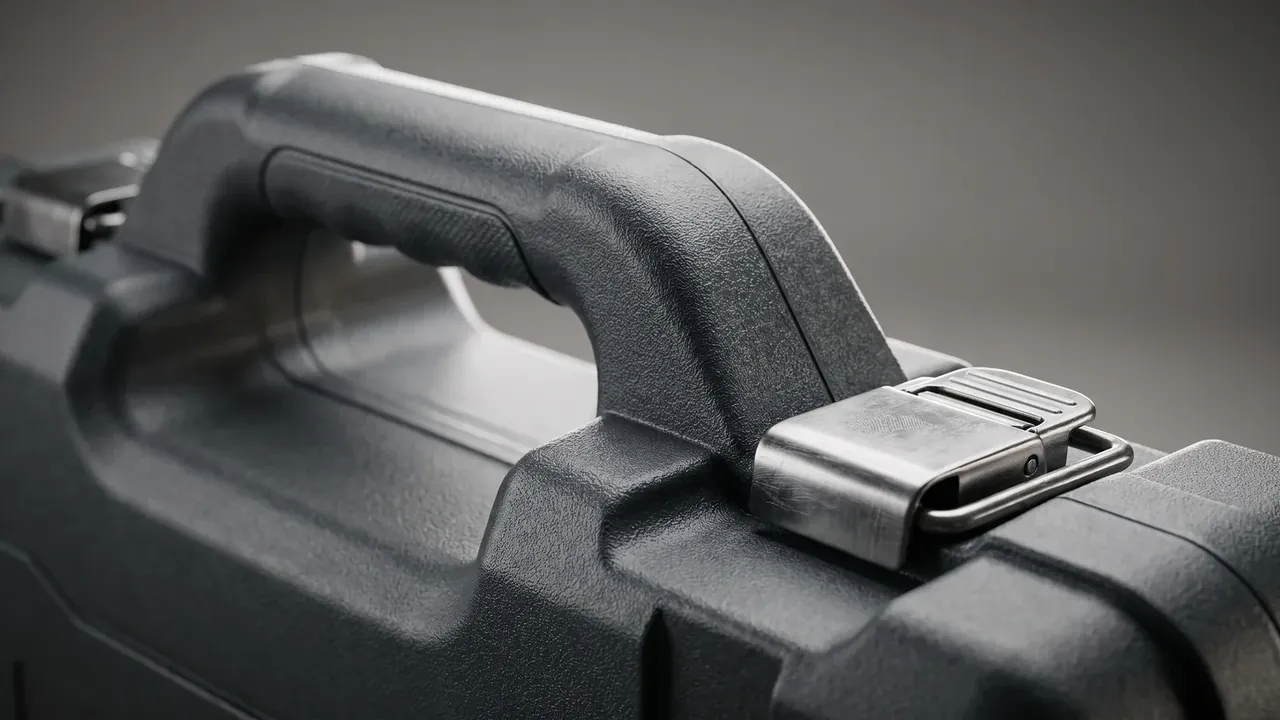
The handle rating is not the case weight, it is the handle's own capacity. Acceptance asks for four times that rating in static load — 88 kg hanging ten minutes on a 22 kg case — with residual set under 1.5 mm, then 5000 cycles under a 4 kg drop weight with no cracks.
Corners get cut here. A case proven at 1.5 times passes every lab check and cracks at the handle root after three months on site, because field load arrives with impact. Handle width of 28 mm and a 110 mm grip decide whether a gloved hand keeps hold.
Heavy items sit under the handle, light ones at the ends. With the centre of mass 40 mm off the handle line the case tilts, the user hugs it to the chest, and that is when it gets dropped.
4. Liner compression and sag after repeated opening
Liner sag in an industrial tool carrying case is usually a compression choice, not poor material.
Compression is how far the liner deflects under a tool: 8% to 12% is the working range. Below 8% the tool rattles; above 12% the walls stop returning after 200 openings.
Hardness has to be paired. 30 Shore A against the body with a 50 Shore A base pad outlasts 50 throughout, because base load and wall contact are separate jobs.
All-hard liners collapse first.
One detail gets missed: a 2 mm transition layer between liner and wall, spreading side impact instead of letting a rib cut a groove into the liner back.
5. Fixing the case in a truck bed
Twenty-eight millimetres of slide inside an industrial tool carrying case is enough to hit the next rack. Done properly, slide stays under 5 mm. Six rules that held up:
- two downward strap points, never over the handle
- strap angle to the bed floor no more than 45 degrees
- webbing rated 400 daN, sleeves at wear points
- a 3 mm rubber mat under the case
- case pushed against the bulkhead, no gap behind
- buckle teeth checked after every unload
Strapping over the handle of a loaded industrial tool carrying case is convenient and damaging. The handle is built for vertical load; a sideways strap bends the root, and after a few thousand vibrations the crack starts there.
Conclusion
Tools coming loose is a chain: slot width, pressure bar, handle, liner, strapping. A weak link passes impact down the line, so what matters is not shell thickness but five places that each take their share. Ask about those five before ordering an industrial tool carrying case.
This article discusses only the container (case body) side of specifications and design intent, and does not cover any handling, loading or use of the contents.
Related Reading
- Hardware tool boxes configured for repair work
- Wheels and load paths in rolling tool cases
- Fixing vehicle tool cases in place
- Liner layout and bay planning in tool box organizers
Related Products
- 8 Series — Gun Cases; Military Equipment Cases; Camera Equipment Cases; Drone Cases; Watch Cases; Knife Cases; First Aid Cases; Electronics Equipment Cases
- WL8-2812 PP Gun Case — model WL8-2812
- All protective cases and toolboxes: 7 series, 158 models