

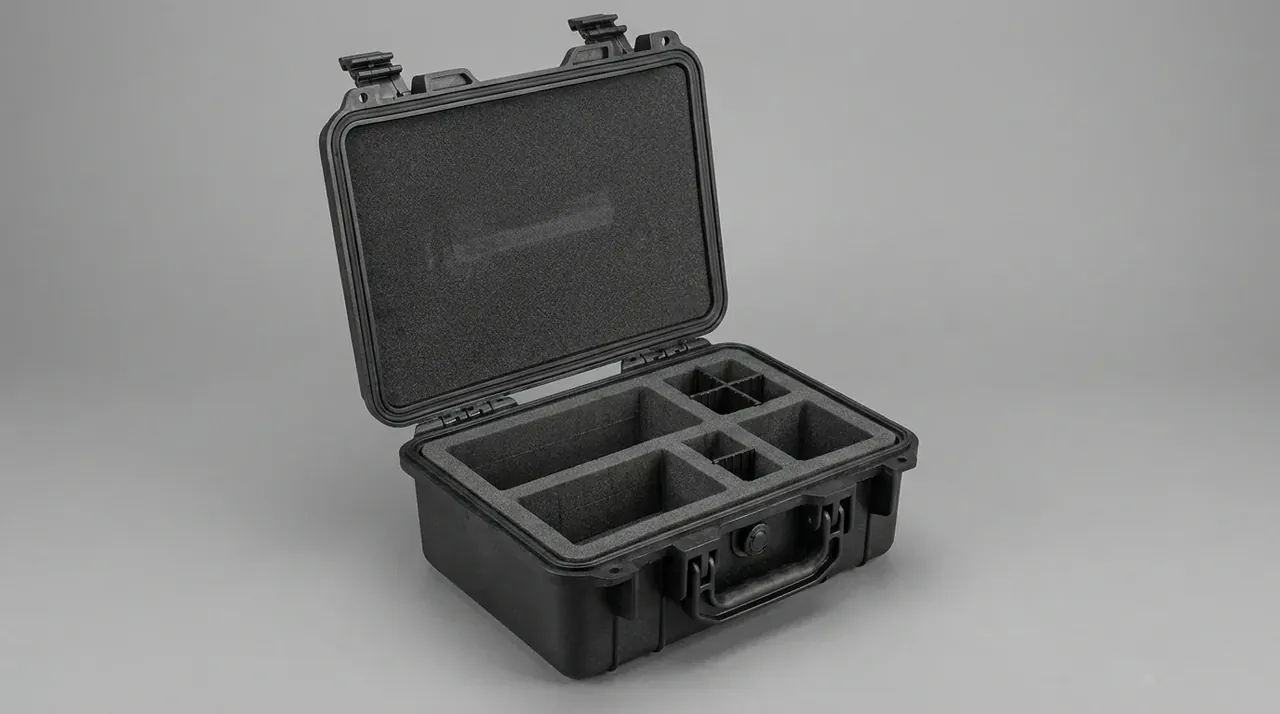
Quick answer: A Jungle off-road plastic hard tool box with a 2.4 mm dust lip and 8.5 mm lid overlap holds drag under 6 degrees and sand intake below 0.04 g after 6 h.
Table of contents
- Dust lip on the latch of the Jungle off-road plastic hard tool box
- Depth of the lid overlap
- Opening drag angle after six hours of deposition
- Sand intake at the lid mouth after cleaning
- Lip setting for the off-road batch
- FAQ
1. Dust lip on the latch of the Jungle off-road plastic hard tool box
Fine sand settles into the latch seam layer by layer; a taller lip and a deeper overlap decide the effort needed to open the lid after six hours. The Jungle off-road plastic hard tool box measures 560×395×220 mm outside and 495×335×160 mm inside, with a 4.5 mm wall fixing the stiffness of the mouth ring. A dust lip 2.4 mm high runs around the lid edge, so grains must clear that step before reaching the latch bite. Raise it too far and the shell lips meet first at closing, pushing the gasket off its seat; drop it too low and six hours of sand packs into a wedge.
Within one mould a 0.3 mm change in lip height splits the sixth-hour opening feel, so the lip height of the Jungle off-road plastic hard tool box is locked at the trial stage. The lip is moulded with the shell in one shot, leaving no bonded step, and inspectors take one depth-gauge reading on each of the four edges.
2. Depth of the lid overlap
Lid overlap is how far the upper skirt sinks into the lower shell mouth once shut; here it is 8.5 mm, more than three times the 2.4 mm lip. Even grains that clear the lip must climb a folded-back channel before reaching the cavity. A deep overlap lengthens the contact face, and across −20 ℃ to 55 ℃ the two shells expand differently, eating part of the gasket's 20% compression.
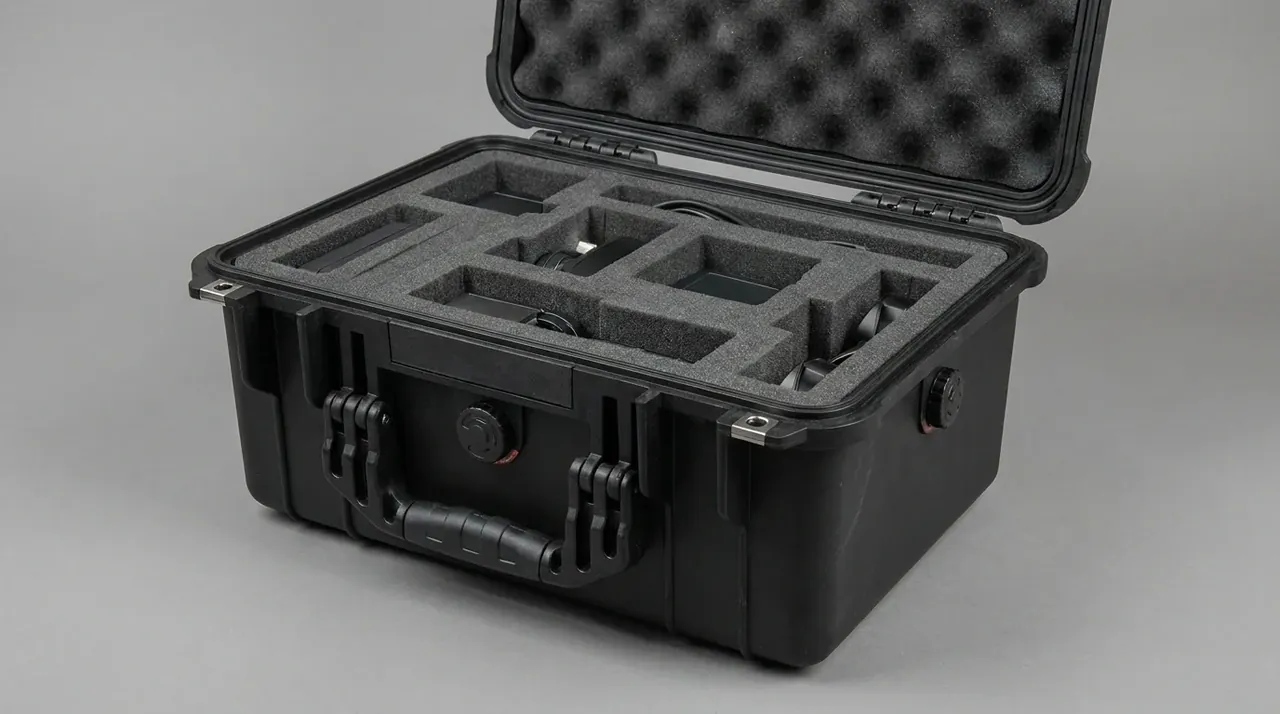
Read back from the deposition rig, the 8.5 mm overlap and the 2.4 mm lip are a matched pair; changing either alone makes the intake reading meaningless. The mouth of the Jungle off-road plastic hard tool box is gauged at both points with one jig, and the four latches at 385 N each are re-checked here, since a loose latch lets the rim gape mid-test.
3. Opening drag angle after six hours of deposition
The rig follows IP6X dust for 6 h, dropping a fixed concentration of fine sand from above the mouth, with the lid cycled every half hour. The reading is the angle the latch turns from locked to released, the opening drag angle, held at ≤6°. Past 6° the lid must be lifted before the latch moves, shedding the 385 N force onto the grains. The drag angle of the Jungle off-road plastic hard tool box is not lid weight but the combined result of sand, lip and overlap.
A sample with only the lip shifted one band separates at hour six, so the Jungle off-road plastic hard tool box uses drag angle as a coarse screen, not the sole basis for a setting. The table lists three lip bands, shortest to tallest.
| Lip band | Lip and overlap pair | Hour-six drag angle | Intake verdict |
|---|---|---|---|
| Shortest | 2.4 mm / 8.5 mm | ≤6° | under 0.04 g, accept |
| Middle | lip raised one band | just above 6° | on the line |
| Tallest | lip raised again | rim binds first | kept off the list |
4. Sand intake at the lid mouth after cleaning
At hour six, loose sand on the outer rim is brushed off without opening the case, the lid is re-closed, and the sand that fell through the mouth is weighed; the line is ≤0.04 g. This reads outcome, not process: drag angle says how hard the lid opens, intake says whether grains crossed the 2.4 mm lip and 8.5 mm overlap.
The Jungle off-road plastic hard tool box logs both on one sheet; if either crosses, that lip band is re-set rather than passed on lucky samples. The cleaning re-check also shows whether the two gasket beads leave a continuous imprint. For the Jungle off-road plastic hard tool box both load states, 5.3 kg empty and 13 kg loaded, are run separately.
| Deposition interval | Dust concentration | Cycling action | Cumulative intake |
|---|---|---|---|
| Hour 1 | IP6X constant | once per half hour | below 0.04 g |
| Hour 3 | IP6X constant | once per half hour | mid-band reading logged |
| Hour 6 | IP6X constant | stop, brush, re-weigh | basis for the setting |
5. Lip setting for the off-road batch
The load states 5.3 kg empty and 13 kg loaded go on the rig first, the four latches tighten to 385 N, the two gasket beads stay at 20% compression, and the shell is benchmarked against IP67; none may move while the band is chosen. All three lip bands run the same 6 h.
The lip setting takes the shortest band whose hour-six intake is still below 0.04 g, and any shorter lip is left off the tool box configuration list. A band whose drag angle has crept to 6° stays as a sample record. The off-road batch of the Jungle off-road plastic hard tool box recognises one matched pair only, with lip height, overlap, drag angle and intake signed together.
| Drag reading | Matching lip band | Intake re-check | Batch destination |
|---|---|---|---|
| ≤6° and steady | shortest | below 0.04 g | onto the list |
| near 6° | middle | on the line | kept as sample |
| over 6° | tallest | rim binds | returned for re-tooling |
Conclusion
The Jungle off-road plastic hard tool box reduces dust protection to one matched pair, a 2.4 mm lip and an 8.5 mm overlap, with the ≤6° drag angle and ≤0.04 g intake after 6 h as the sole basis for a band. Empty at 5.3 kg, loaded at 13 kg, four latches at 385 N and two gasket beads at 20% compression are fixed rig conditions. The off-road batch keeps only the shortest band whose intake stays below 0.04 g; the rest become samples or go back for re-tooling.
Related Reading
- Plastic Portable Tool Box: Material and Weather Resistance
- Electrician/plumber portable plastic tool box
- Outdoor UV-resistant weatherproof plastic case
- Plastic Tool Box, Portable: Four Sites, Four Configurations
Related Products
- 8 Series — Gun Cases; Military Equipment Cases; Camera Equipment Cases; Drone Cases; Watch Cases; Knife Cases; First Aid Cases; Electronics Equipment Cases
- WL8-2812 PP Gun Case — model WL8-2812
- All protective cases and toolboxes: 7 series, 158 models