

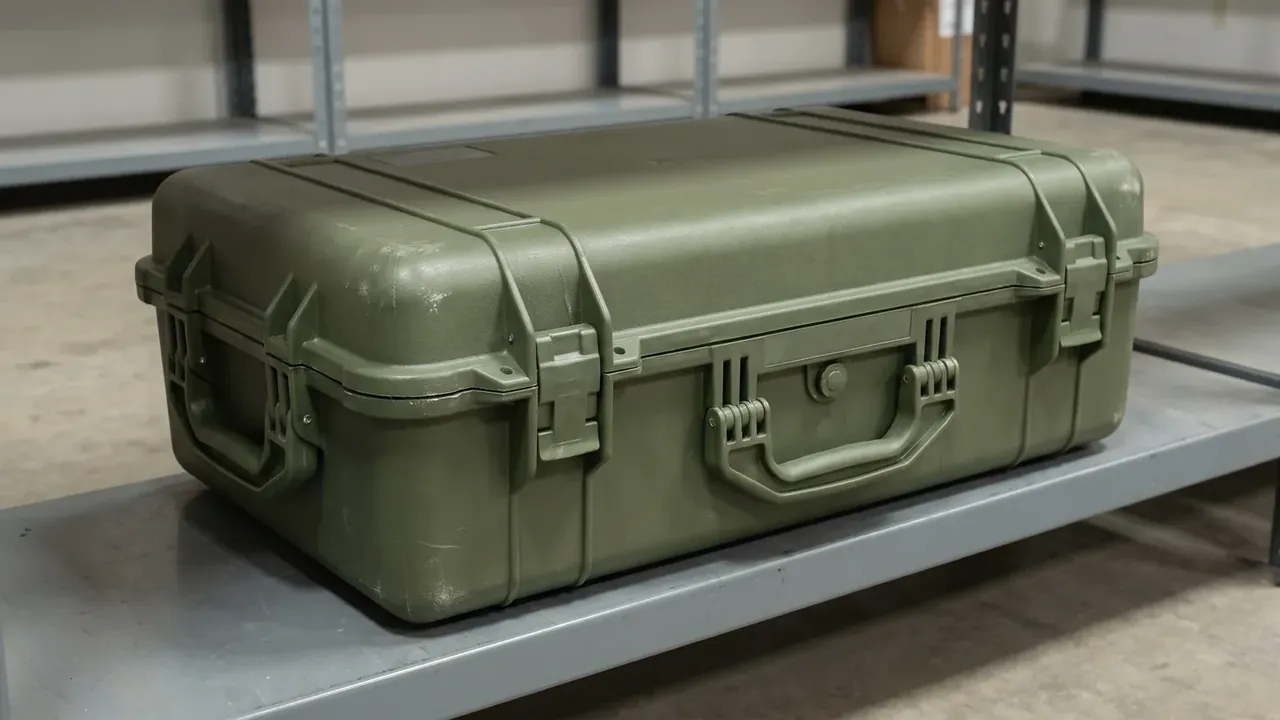
Quick answer: An Outdoor UV-resistant weatherproof plastic case holds lid colour shift to ΔE 2.5 and 82% impact retention after 1000 h xenon ageing at 0.55 W/m².
Table of contents
- Additive dosing in an Outdoor UV-resistant weatherproof plastic case
- Lid colour shift and retained impact strength
- Seal-strip recovery after xenon-arc exposure
- Reading cracks from the low-temperature drop weight
- Additive sampling limits for weatherable batches
- FAQ
1. Additive dosing in an Outdoor UV-resistant weatherproof plastic case
Dosing starts with the base resin. An Outdoor UV-resistant weatherproof plastic case moulds its shell from a copolymer polypropylene, with UV stabiliser fed as a masterbatch at 0.6% by mass through twin-screw compounding before injection. Too little stabiliser lets surface chains break down under ultraviolet; too much blooms onto the lid as a hazy film. A 4.0 mm wall sets the blending boundary, since thin sections cool fast and narrow the dispersion window, so corner and gate regions end up with different content.
The outer 580×420×230 mm and inner 515×360×170 mm dimensions fix the lid area and the masterbatch charge per shot. A batch log records each weighed dose to 0.01% against its compounding lot, so one lid traces back to the hopper on duty. Irradiance in the xenon chamber stays at 0.55 W/m², with black-panel temperature and spray cycles held apart from the dosing level.
The 0.6% figure belongs to this lot alone. A different resin or wall calls for a fresh ageing curve.
2. Lid colour shift and retained impact strength
Colour is read on the lid rather than the body. An Outdoor UV-resistant weatherproof plastic case pulls one piece at 0 h, 250 h, 500 h and 1000 h for ΔE, while a pendulum strikes notched bars to log retained impact strength. Ultraviolet energy consumes surface stabiliser first, so colour climbs as retention falls; both curves are accepted at the 1000 h mark, ΔE at or below 2.5 and retention at or above 82%.
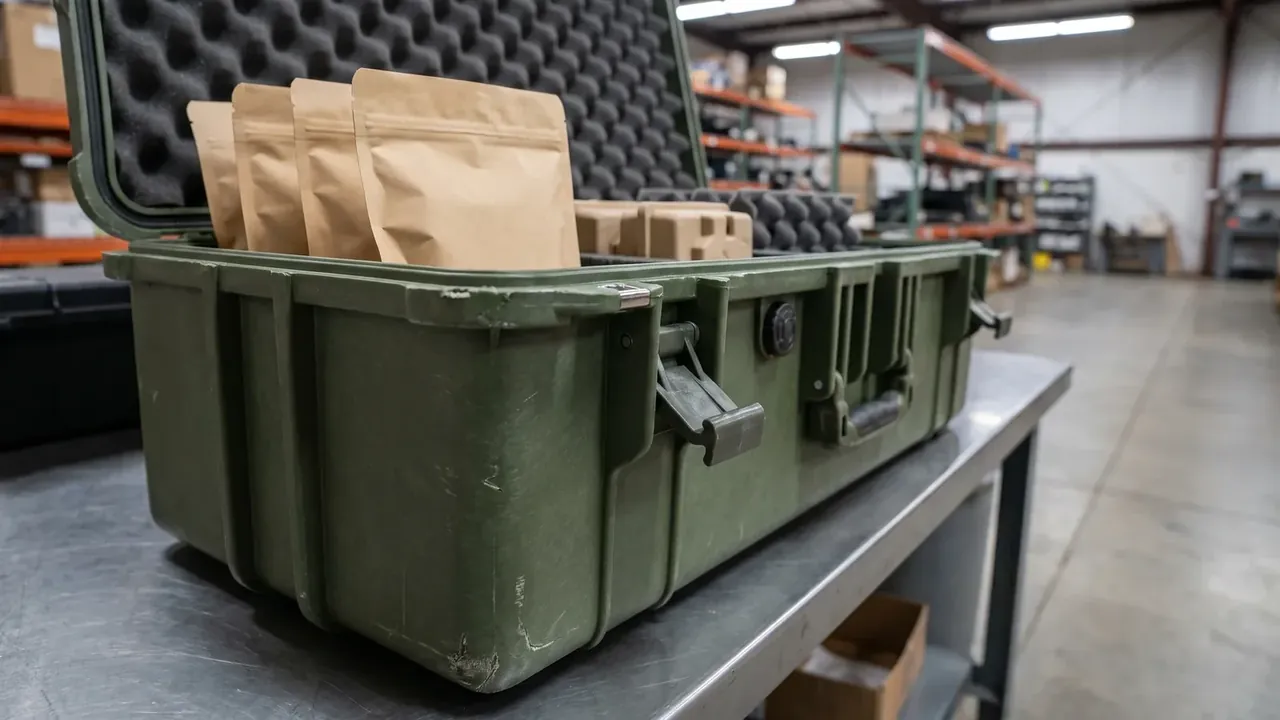
The table gathers those four checkpoints, with exposure time in the first column.
| Exposure time | Colour ΔE | Impact retention |
|---|---|---|
| 0 h | 0.3 | 100% |
| 250 h | 1.1 | 94% |
| 500 h | 1.8 | 88% |
| 1000 h | 2.5 | 82% |
Lid regions do not receive equal light. An Outdoor UV-resistant weatherproof plastic case also samples the lid centre, rib root, corner and gate zone separately; irradiance stays 0.55 W/m² but rib roots and corners yellow first where wall thickness steps. All four readings land in one log, and one region over the line sends the lot back for a dispersion check.
| Lid region | 1000 h ΔE | Local verdict |
|---|---|---|
| Lid centre | 2.1 | Pass |
| Rib root | 2.4 | Pass |
| Corner | 2.5 | Boundary |
| Gate zone | 2.3 | Pass |
3. Seal-strip recovery after xenon-arc exposure
The seal strip sits in a groove around the mouth and is squeezed to 22% compression when the lid closes. For an Outdoor UV-resistant weatherproof plastic case the ageing metric is compression set: the strip runs through 1000 h of xenon light with its lid, then thickness recovery is measured after unloading and rest, and set must stay under 18% for the mouth to keep sealing.
Recovery is averaged over three sections of the same strip, measured on the rig without pulling the lid off. Sealing verification is registered against the IP67 test method, with no certificate attached; shell, lid and strip deformation share one sheet so colour and seal lots can be read side by side.
4. Reading cracks from the low-temperature drop weight
The cold stage runs its own drop-weight pass. An Outdoor UV-resistant weatherproof plastic case conditions samples at −20 ℃ then places them under a 2 J striker hitting the lid centre and one corner; the verdict looks only for cracks, whitening or delamination in shell and lid. Ageing thins surface toughness first, so this pass uses the same pieces that finished 1000 h rather than fresh material.
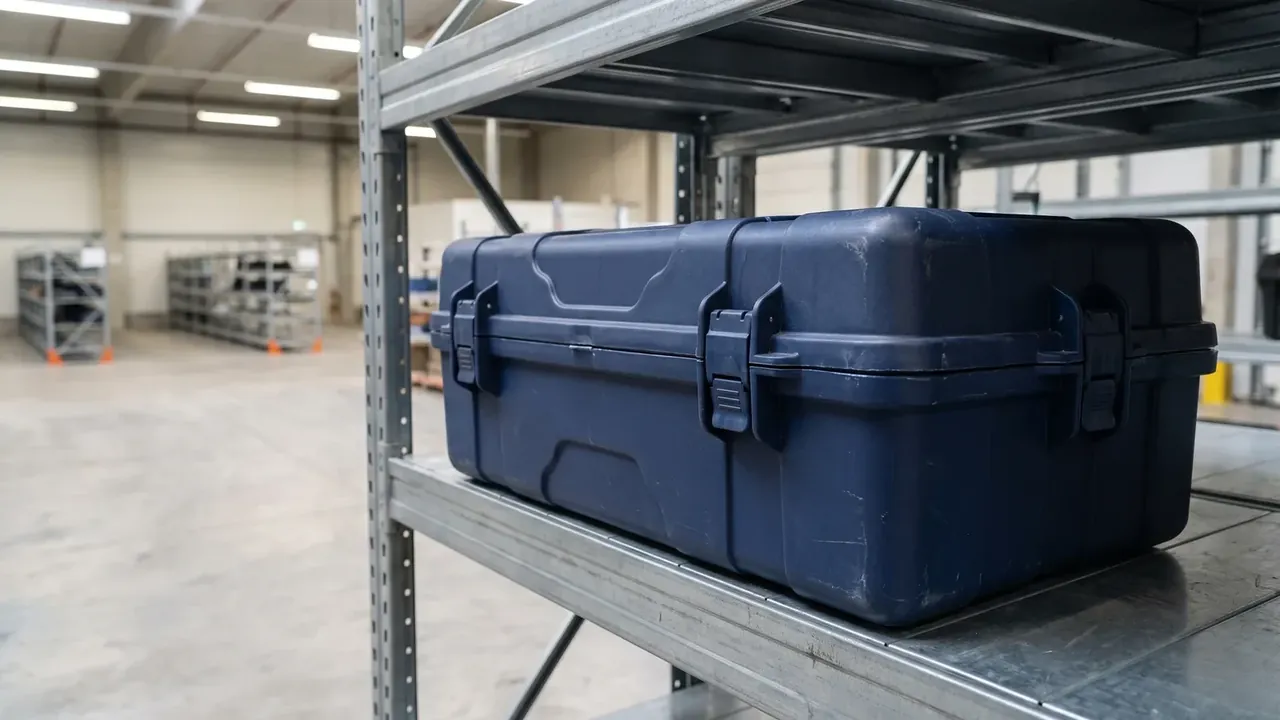
Two latches each holding 350 N must not turn brittle at low temperature; after the strike each is cycled while the seat and lid ear are checked for chipping. One empty 5.0 kg shell and one loaded to 10 kg are dropped, mouth flatness is remeasured, and a blend near its lower limit tends to crack first at the gate zone.
5. Additive sampling limits for weatherable batches
Production lots send one piece per shot through the xenon chamber. An Outdoor UV-resistant weatherproof plastic case sets its sampling line on the 1000 h ΔE band, with the 0.6% figure in the dosing log acting only as a reference. If any piece passes ΔE 2.5, its stabiliser content is reread, then the compounding dispersion record is pulled, and a mismatch returns the lot.
| Colour ΔE band | Lot verdict | Action |
|---|---|---|
| ΔE ≤1.5 | Wide margin | Release |
| ΔE 1.5 to 2.1 | Normal | Log and file |
| ΔE 2.1 to 2.5 | Boundary | Retest additive |
| ΔE over 2.5 | Reject | Full lot recheck |
Irradiance 0.55 W/m², 1000 h and ΔE ≤2.5 go into the sampling ledger together, with the 2 J drop weight and ≤18% compression set as two parallel checks.
Conclusion
An Outdoor UV-resistant weatherproof plastic case takes 0.6% stabiliser dosing as its weathering start, then closes on ΔE ≤2.5 and ≥82% impact retention after 1000 h of xenon light at 0.55 W/m². A seal strip at 22% compression and ≤18% compression set, plus a 2 J strike at −20 ℃ with no cracks, adds the cold-toughness gate. Two latches at 350 N each and sealing registered against IP67 are reviewed together, and the 580×420×230 mm shell is released by the whole-lot ΔE band rather than a single best reading.
Related Reading
- UV stabiliser dosing in case shells
- Outdoor uses of ABS case shells
- Dust-seal design for outdoor cases
- Shell toughness in cold weather
Related Products
- 8 Series — Gun Cases; Military Equipment Cases; Camera Equipment Cases; Drone Cases; Watch Cases; Knife Cases; First Aid Cases; Electronics Equipment Cases
- WL8-2812 PP Gun Case — model WL8-2812
- All protective cases and toolboxes: 7 series, 158 models