

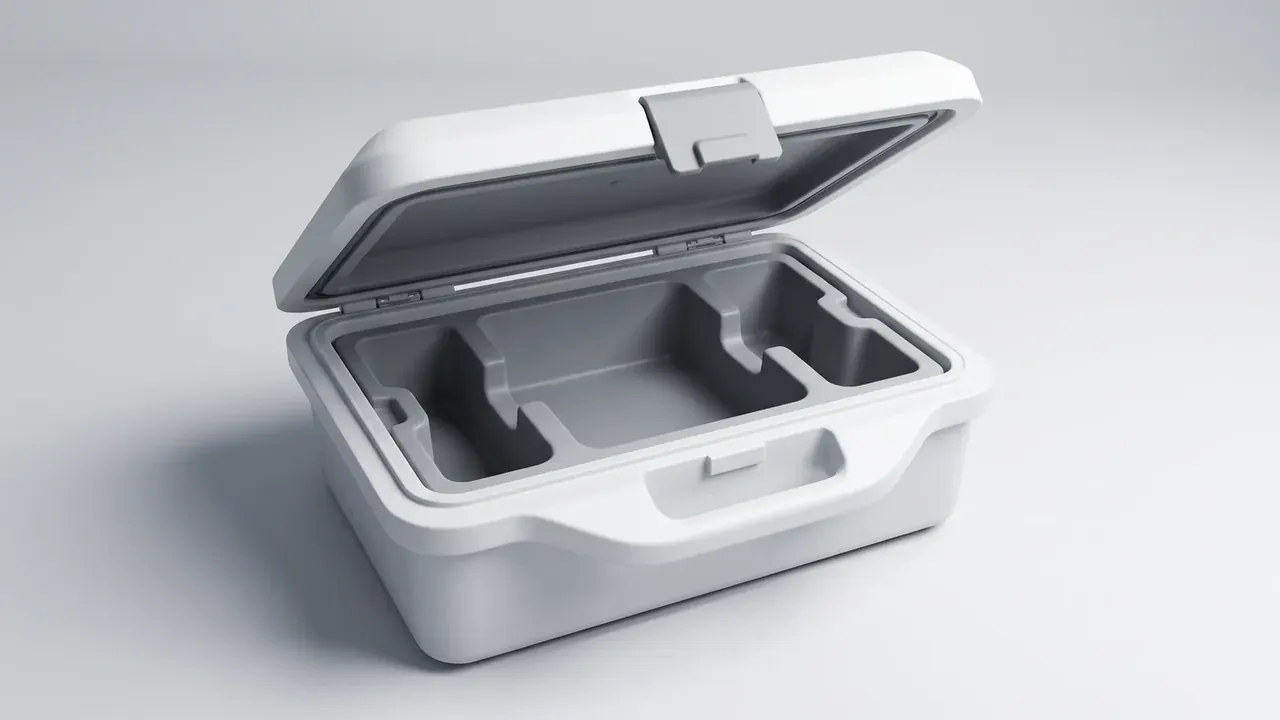
Quick answer: A case that grinds open at -20 °C has not lost its gasket, it has gained hardness, so bleed the valve, release the latches in diagonal pairs, lift in 5 mm stages and let the rubber warm two hours before closing.
Table of contents
- What -20 °C Does to Gasket Hardness
- Bleed, Release, Lift: Three Steps That Cut Opening Force
- Lifting in 5 mm Stages to Protect the Lip
- Where Each Elastomer Runs Out of Cold
- Two Hours of Warm-Up Before You Close It
- FAQ
1. What -20 °C Does to Gasket Hardness
At -20 °C the lid of a sealed case grinds rather than swings. The gasket has not failed, it has stiffened, and the extra force comes from rubber rather than from the shell. Silicone enters its glass transition near -60 °C, EPDM near -50 °C, NBR near -40 °C and TPE near -30 °C, yet all four feel hard at -20 °C. Glass transition says whether a material bends, not how fast it springs back. A 4.0 mm double-lip gasket reading 50 Shore A at room temperature reads 62–68 Shore A after four hours at -20 °C, and its recovery stretches from 0.8 s to beyond 3 s. Every extra 10 Shore A raises the force needed for the same compression by about 30%.
| Material | Glass transition | Hardness at -20 °C | Set after -20 °C × 22 h |
|---|---|---|---|
| Silicone | -60 °C | 55 Shore A | 18% |
| EPDM | -50 °C | 62–68 Shore A | 26% |
| NBR | -40 °C | 68–72 Shore A | 34% |
| TPE | -30 °C | 75 Shore A | 45% |
Measure on the lip: three readings 12 mm above it with a durometer, one second each, taken within five minutes of pulling the case out or the surface warms and the number falls by 4–6 points. Above 75 Shore A points at material choice rather than weather.
Recovery under 1 s and residual set under 0.3 mm are the two numbers that decide.
2. Bleed, Release, Lift: Three Steps That Cut Opening Force
The suction pinning the lid is pressure, not adhesion. A case closed at 20 °C and carried into -20 °C loses about 14% of its internal air volume; with the valve frozen shut, the differential reaches 2 kPa, or 30 kg across a 0.15 m² lid.
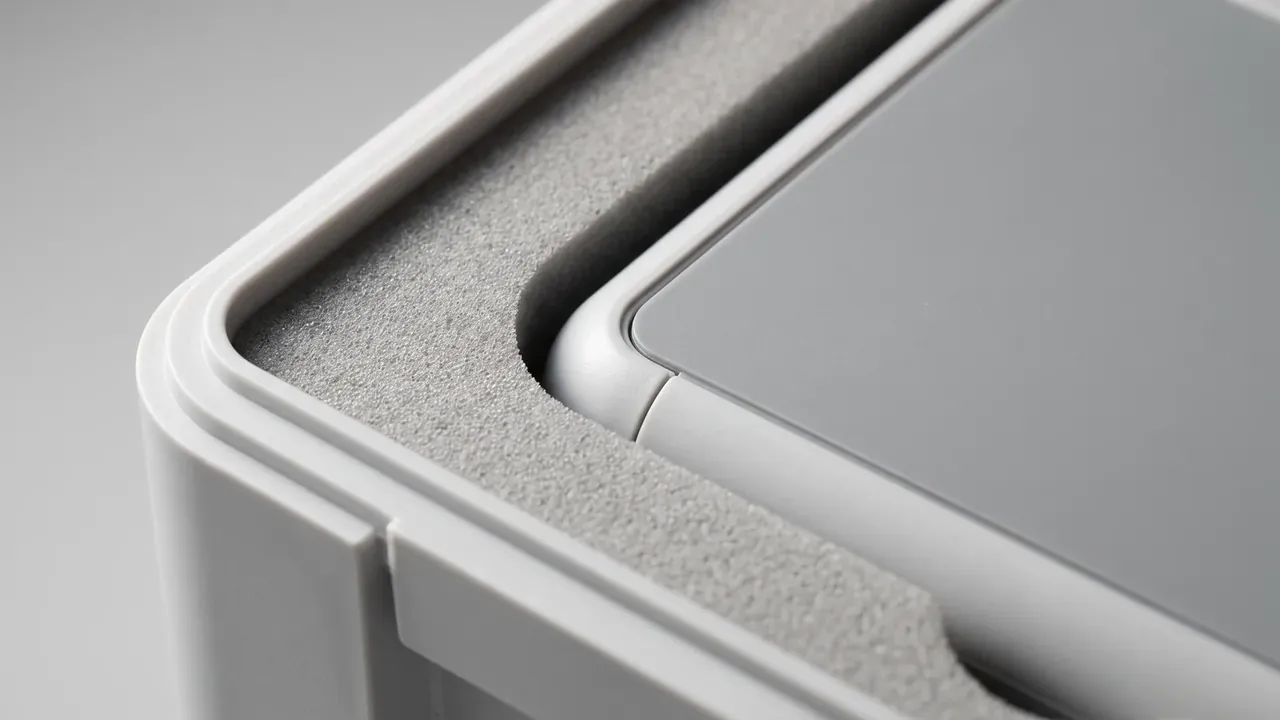
Press the relief valve first. A 6 mm bore with a 0.5 mm diaphragm should go fully in for 2 s and spring back within 2 s with an audible intake. Three seconds, or silence, means the diaphragm is stiff or iced.
Release the latches in diagonal pairs, windward side first, 3 s apart. Flipping all four at once lets the differential throw the lid up 8–10 mm and sets the lip into a permanent stretch.
3. Lifting in 5 mm Stages to Protect the Lip
Open in stages: lift 5 mm, hold 10 s, lift another 5 mm, hold again. A case with 25 mm of travel opens in about 40 s without marking the lip.
| Shortcut | What happens on site | Result |
|---|---|---|
| Screwdriver in the seam | tip lands on the lip | 0.8 mm gouge, seal fails |
| Heat gun on the gasket | 120 °C locally | silicone hardens, cracks in 3 months |
| Boiling water on the rim | 100 °C at the surface | 0.3 mm distortion, lid misaligns |
Opening force can be measured. Hook a 50 kg spring scale into the handle, pull straight up and read the peak: 38 N at room temperature and 90–120 N at -20 °C are both inside the design envelope. Above 150 N the lip is stuck in its groove, so warm the case instead of pulling harder.
A notch 0.5 mm deep, or 1 mm long along the lip, will not pass a leak test.
4. Where Each Elastomer Runs Out of Cold
The dividing line between these compounds is low-temperature compression set, not glass transition. Tested to ASTM D1229 at -20 °C for 22 h under 25% compression, silicone recovers to 18% set, EPDM to 26%, NBR to 34% and TPE to 45%. Past 30% the lip no longer returns to full height and the lid closes on a gap that will not hold pressure.
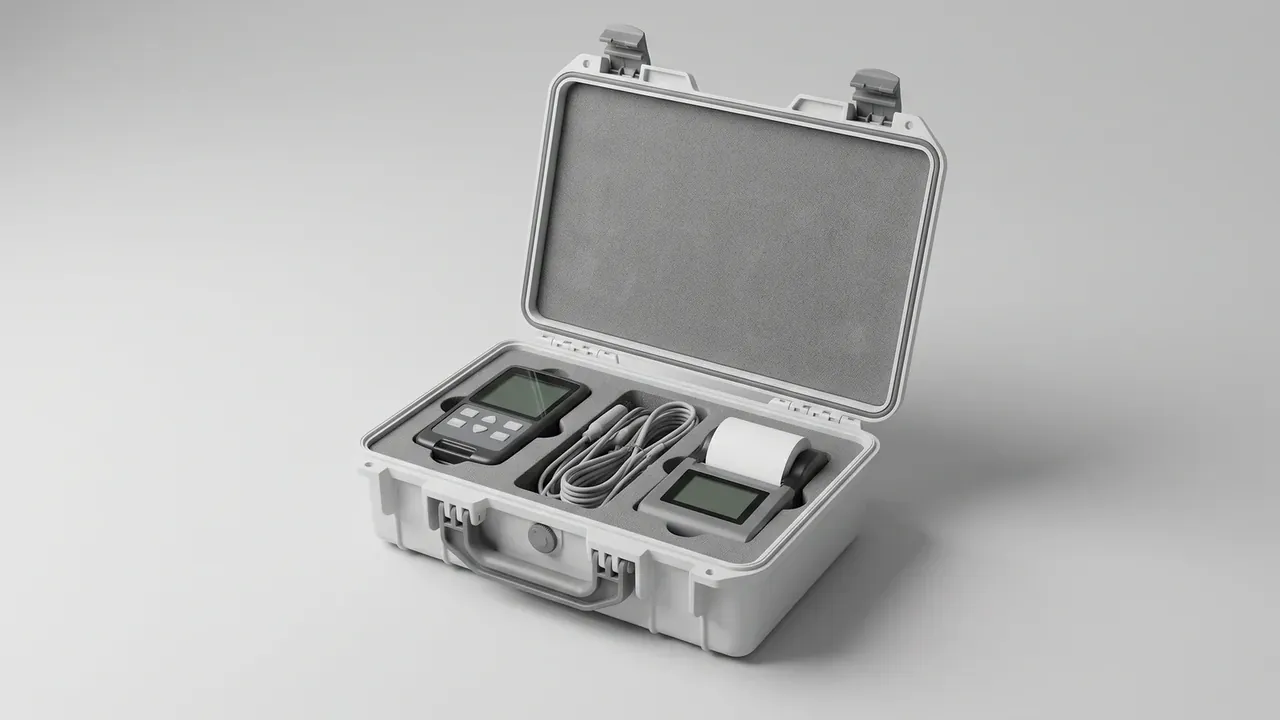
Choose against temperature, not price. For work below -20 °C, silicone holds roughly 55 Shore A down to -40 °C. EPDM suits intermittent work above -30 °C and costs 15–25% less, but hardens after 200 h of continuous cold. NBR is for oil, not cold, so keep it above -25 °C. TPE is the cheapest and -20 °C is its limit.
Moving from EPDM to silicone adds 15–25% to part cost, cuts opening force by 15–20 N and takes lip life from 3 years to more than 6.
5. Two Hours of Warm-Up Before You Close It
Do not close the case within 30 min of bringing it in from -20 °C. Latching cold rubber performs a 30% compression and leaves a flat spot after a few cycles.
Wait two hours at 20 °C so shell and gasket reach the same temperature; above 15 °C on an infrared thermometer is close enough to latch.
Petroleum jelly turns waxy at -20 °C and adds drag, while silicone grease flows at -40 °C, so apply 0.05 mm and buff the excess.
Then re-test: immerse the closed case in 1 m of water for 30 min, or pressurise to 20 kPa and accept a 2 kPa drop in 60 s.
Conclusion
Opening a case at -20 °C is a force problem long before it becomes a wear problem. Hardness rising from 50 to 62–68 Shore A and opening force climbing from 38 N to 90–120 N are normal for that temperature, and a 2 kPa differential released through the valve explains most of the rest. Lift in 5 mm stages, close again after two hours at 20 °C, keep 0.05 mm of silicone grease on the lip, and confirm the seal with a 2 kPa drop over 60 s. Replace the gasket only when recovery passes 1 s, residual set passes 0.3 mm, or low-temperature set passes 25%.
This article discusses only the container (case body) side of specifications and design intent, and does not cover any handling, loading or use of the contents.
Related Reading
- Cold brittleness: where a case shell cracks
- Low-temperature brittleness testing and its pass line
- Outdoor cases from -30 °C to 70 °C
- Gasket ageing and replacement signals
Related Products
- 8 Series — Gun Cases; Military Equipment Cases; Camera Equipment Cases; Drone Cases; Watch Cases; Knife Cases; First Aid Cases; Electronics Equipment Cases
- WL8-2812 PP Gun Case — model WL8-2812
- All protective cases and toolboxes: 7 series, 158 models