

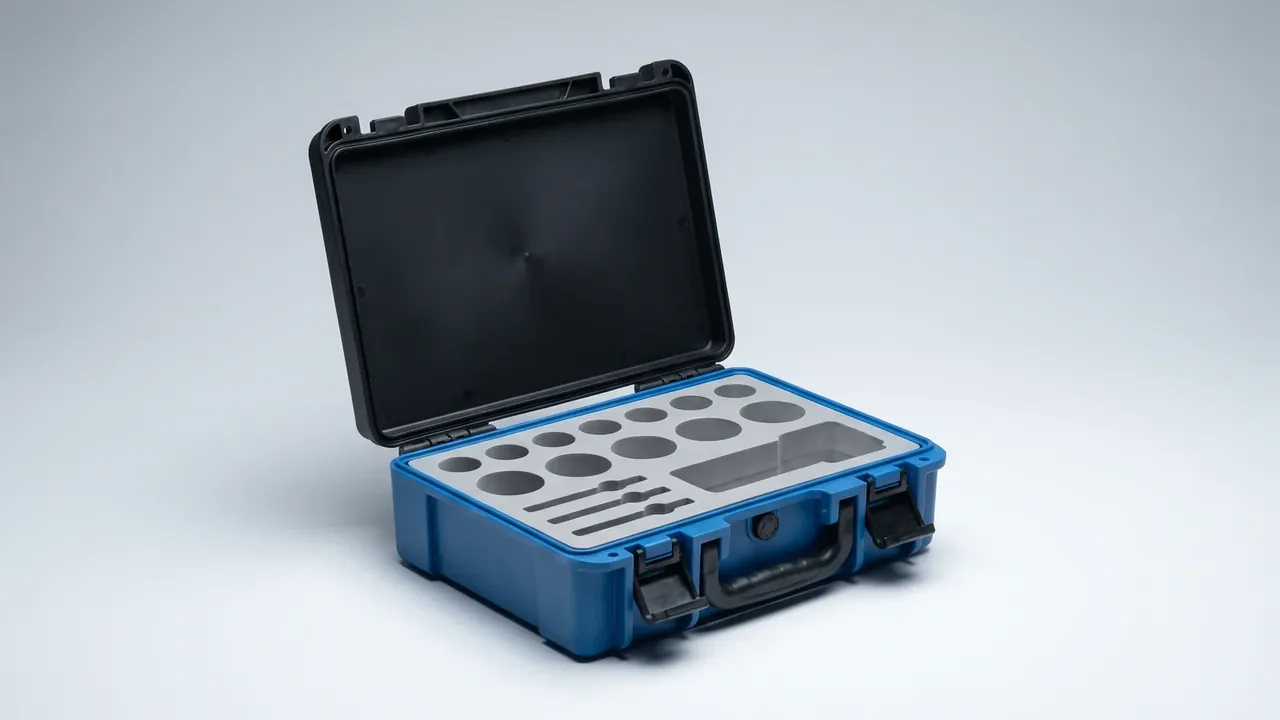
Quick answer: Size a custom protective box from one hand, not from a catalogue. Below a 400 mm cavity the wall floor is 2.2 mm and the working figure 3.0 mm, two latches suffice, five layers stack, and loaded weight stays under 11.5 kg.
Table of contents
- Sizing a custom protective box for one hand
- Cavity tiers and the clearance around them
- The minimum wall and what the ribs do
- Latch count and how these boxes stack
- Writing weight and load into the sheet
- FAQ
1. Sizing a custom protective box for one hand
One hand sets the limit. A 6.8 kg box carried 50 m burns the fingers, and at 11.5 kg most people switch sides before 20 m. So the first line of a custom protective box sheet is loaded weight, not volume.
Three tiers cover the range: 3.2 kg, 6.8 kg and 11.5 kg; past 11.5 kg the box wants two hands.
| Tier | Outer L×W×H | Cavity | Side wall | Empty | Loaded |
|---|---|---|---|---|---|
| Small, one hand | 260×190×90 mm | 230×160×70 mm | 2.5 mm | 0.9 kg | 3.2 kg |
| Standard, one hand | 360×250×110 mm | 320×210×90 mm | 3.0 mm | 1.6 kg | 6.8 kg |
| Two-hand threshold | 420×310×130 mm | 380×270×105 mm | 3.5 mm | 2.4 kg | 11.5 kg |
The handle is a load part: an R8 root radius, a 28 mm grip face, and a 15 kg static hold for an hour at 2.5 times the load.
2. Cavity tiers and the clearance around them
A longer cavity lengthens the moment arm: a 320 mm custom protective box at 6.8 kg feels like a 260 mm box at 9 kg, so weight comes down as length grows.
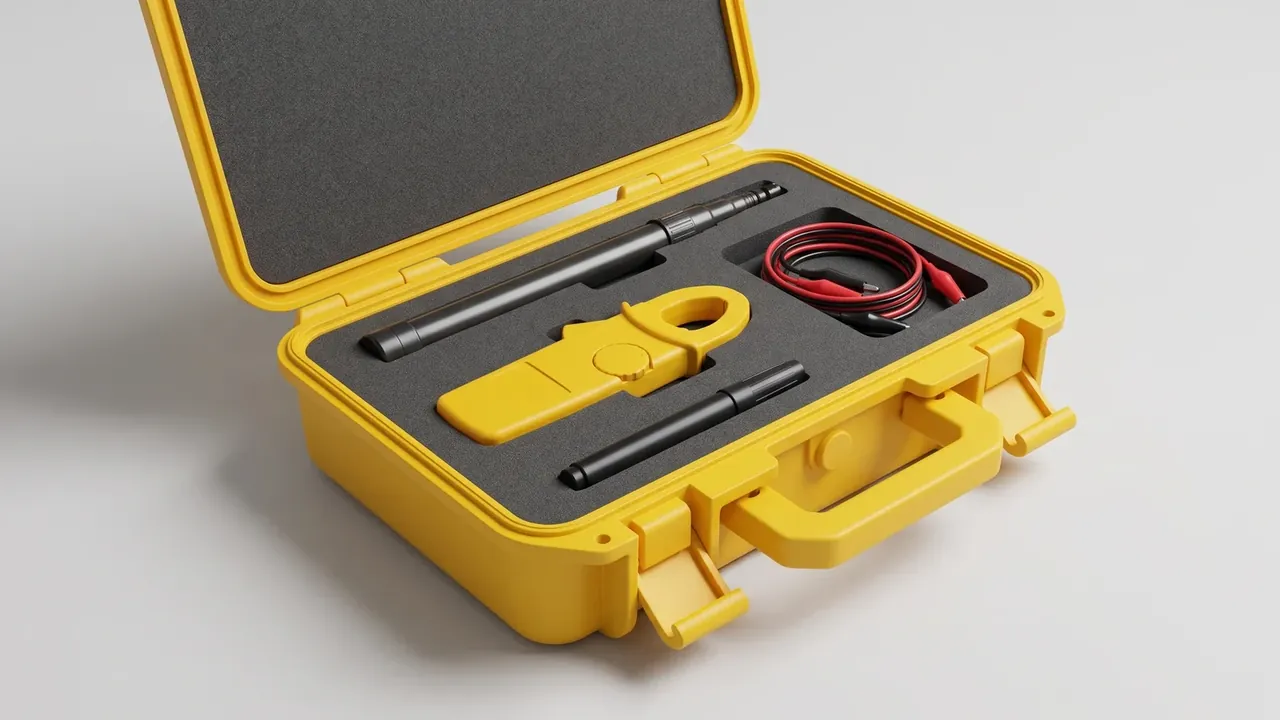
Clearance is set per item: 3 mm single unit, 5 mm with foam, 2 mm ribs between items. Cavity tolerance is ±0.3 mm, tighter than ±1.2 mm on a large case.
Height adds up separately: 8 mm of lid foam, a 4 mm stacking lip and 8 mm of base ribs, so a 90 mm cavity sits inside a 110 mm shell.
3. The minimum wall and what the ribs do
The 2.2 mm floor is a processing limit. Below it a panel sinks 0.5 mm after ejection, the latch seats follow, and the lid needs force to close. A 2.5 mm wall on a custom protective box works because the flow path is short.
Walls are zoned: 3.0 mm sides, 2.5 mm lid, 3.5 mm base, 4.0 mm corners, 4.5 mm at the handle root. Ribs run 1.6 mm thick, 8 mm high, 45 mm apart, capped at 0.6 of the wall.
Moulding data sits beside it: 380 tonne press, two cavities, 42 second cycle, 40 °C tool, shrinkage 1.4 to 1.8 percent. Cutting the cavity to the upper figure keeps every box large enough for foam.
4. Latch count and how these boxes stack
Two latches hold a sub-400 mm box. At 180 N each and 160 to 200 mm apart, a thumb seats them one-handed; a third needs two hands, while a large case takes six at 1400 mm.
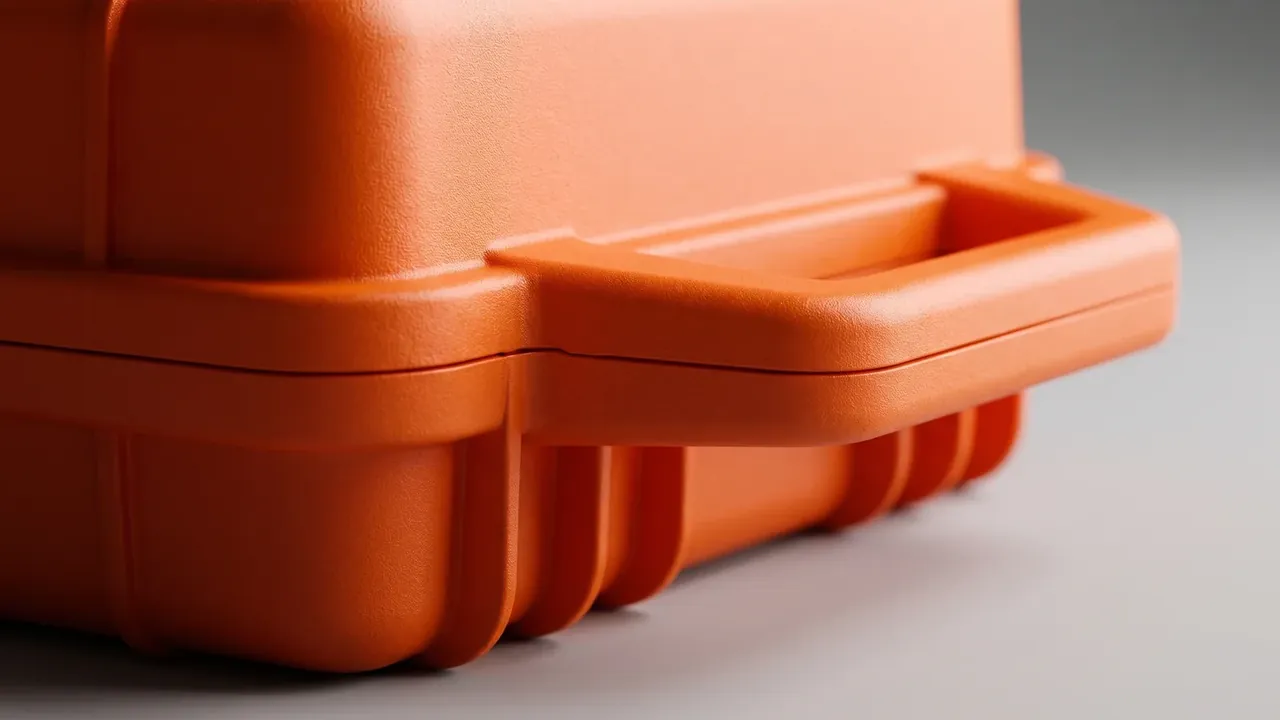
Stacking differs: four bosses drop into lid recesses, so walls never press on walls. Shift a boss 10 mm inward and it lands on the lid centre, denting it by the third layer.
| Tier | Stack layers | Bottom load | Design value | Boss height | 48 h set |
|---|---|---|---|---|---|
| Small, one hand | 5 | 16.0 kg | 40 kg | 3 mm | 0.4 mm |
| Standard, one hand | 5 | 27.2 kg | 60 kg | 4 mm | 0.6 mm |
| Two-hand threshold | 4 | 34.5 kg | 80 kg | 5 mm | 0.8 mm |
5. Writing weight and load into the sheet
Load goes on the sheet as three numbers: loaded weight, handle static load, bottom-of-stack load. One merged figure leaves the line nothing to check.
Drops run at 1.5 m, higher than a large case, because a light box tumbles; at -20 °C the height falls to 1.2 m, where polypropylene keeps about 60 percent of its impact strength.
A living hinge 0.8 mm thick takes 8000 cycles, bought-in catches are nickel plated and clear 72 hours of salt spray. Service range is -20 °C to 60 °C, and above 60 °C latch force drops about 15 percent.
Conclusion
Three numbers hold a small box together: loaded weight, a wall floor that keeps its shape, bosses that spread a stack. A custom protective box is won by calculation, never by material.
This article discusses only the container (case body) side of specifications and design intent, and does not cover any handling, loading or use of the contents.
Related Reading
- Hand-carry hard case structure and use
- Selection method for small plastic cases
- Specification values for die-cut foam inserts
- How protective case size ranges are split
Related Products
- 8 Series — Gun Cases; Military Equipment Cases; Camera Equipment Cases; Drone Cases; Watch Cases; Knife Cases; First Aid Cases; Electronics Equipment Cases
- WL8-2812 PP Gun Case — model WL8-2812
- All protective cases and toolboxes: 7 series, 158 models