

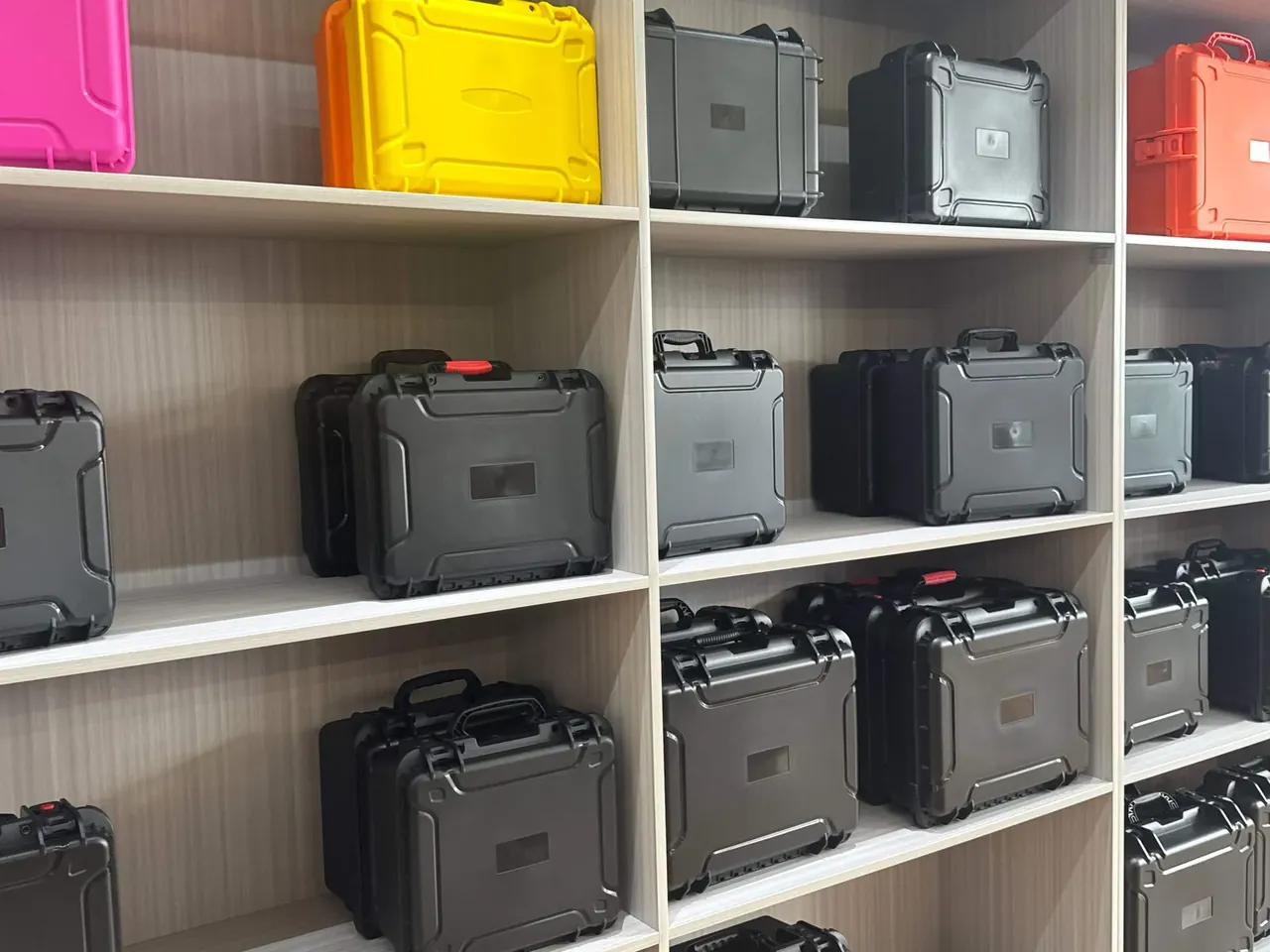
Quick answer: Force enters a Hand Carry Hard Case at three points: the handle root, the hinge pin and the latch hook. At 20 kg loaded the root peaks near 44 kg while walking, hinge bending tops out at 105 degrees, and each latch pulls 180 N to hold the gasket at 30 percent squeeze.
Table of contents
- The Three Load Entry Points
- Handle Root: Grip to Wall
- Hinge Pin: Moment and Diameter
- Latch Hook: Pull into Rim Squeeze
- Ratios and Order of Failure
- FAQ
1. The Three Load Entry Points
A Hand Carry Hard Case looks like one shell, yet load travels three routes. The handle feeds vertical force into the lid or front wall, the hinge feeds tipping moment into the back wall, the latch feeds its pull into the rim; others spread force.
Strength is decided where metal meets plastic. Steel and polypropylene differ two orders of magnitude in modulus, so plastic yields first at equal strain. Every insert therefore needs a boss and a fillet.
| Load point | Direction | Peak at 20 kg | Failure |
|---|---|---|---|
| Handle root | vertical | 44 kg | boss crack |
| Hinge pin | moment | 26 N·m | bore elongates |
| Latch hook | closing | 180 N | tip rounds off |
2. Handle Root: Grip to Wall
Span sets the root moment. At 120 mm the 44 kg splits into 22 kg per end on a 60 mm lever; at 160 mm the moment rises a third at equal weight, so a wide grip needs a thicker root.
Root wall starts at 5 mm on a boss never under 34 mm across, spreading clamp load over 900 square millimetres; an M6 washer alone covers 80 and creeps at 3 N·m.
Inside radii matter more than wall. R2.5 holds stress concentration near 1.8 while R1 pushes it to 3.2, an order of magnitude in fatigue life.
| Span | Load limit | Root wall | Pin |
|---|---|---|---|
| 100 mm | 15 kg | 4.5 mm | 5 mm |
| 120 mm | 20 kg | 5 mm | 6 mm |
| 160 mm | 28 kg | 6 mm | 8 mm |
| 200 mm | 35 kg | 7 mm | 10 mm |
3. Hinge Pin: Moment and Diameter
The hinge limits travel, not load. A lid swinging 105 degrees puts its centre of gravity furthest from the axis near 60 degrees, where a 10 kg lid on a 260 mm arm applies 26 N·m, split by three knuckles into 8.7 N·m each.
Diameter follows it. A 4 mm stainless pin carries 1.1 N·m at 180 MPa, so 8.7 N·m needs an 8 mm pin or five knuckles; on a 560 mm body, three 26 mm knuckles sit a quarter length from each end.
Pins rarely shear; bores elongate. After 5,000 cycles a 4.2 mm bore reads 4.8 mm and the lid rocks; a pressed bronze bush holds 4.1 mm.
4. Latch Hook: Pull into Rim Squeeze
The latch is the only part turning force into sealing. Its 8 mm travel pulls the rim down 2.4 mm, squeezing a 12 mm gasket to 8.4 mm, the 30 percent compression where rubber returns best.
Each latch pulls 180 N. Two latches on a 560 mm body give 64 N per 100 mm of rim; over 800 mm the middle falls to 45 N, the gasket stops seating, and water enters there first.
| Body | Latches | Per latch | Rim per 100 mm |
|---|---|---|---|
| 400 mm | 2 | 180 N | 90 N |
| 560 mm | 2 | 180 N | 64 N |
| 800 mm | 3 | 180 N | 68 N |
| 1000 mm | 4 | 200 N | 80 N |
5. Ratios and Order of Failure
Rank the three so an overload fails in sequence. The handle root must be strongest, taking the dynamic peak; the hinge follows; the latch stays weakest, being replaceable while a torn shell is scrap. Ratios run at 3x, 2.5x and 1.8x rated load.
Stiffness matters as much. A root that never cracks but deflects past 1.5 mm lets the case swing, and every step adds a second impact worth another third of the peak, so each side carries a 4 mm diagonal rib.
Conclusion
Structure is decided at three transitions, not wall thickness: a 5 mm root on a 34 mm boss, three knuckles on an 8 mm pin, one latch every 200 mm of rim. Ranked at 3x, 2.5x and 1.8x, an overload fails in order, and a Hand Carry Hard Case survives daily lifting.
This article discusses only the container (case body) side of specifications and design intent, and does not cover any handling, loading or use of the contents.
Related Reading
- Ergonomic Design of Case Handles
- How a High-Strength Hinge Is Built
- Latch Hardware Selection Guide
- Balancing Case Weight and Strength
Related Products
- 8 Series — Gun Cases; Military Equipment Cases; Camera Equipment Cases; Drone Cases; Watch Cases; Knife Cases; First Aid Cases; Electronics Equipment Cases
- WL8-2812 PP Gun Case — model WL8-2812
- All protective cases and toolboxes: 7 series, 158 models