

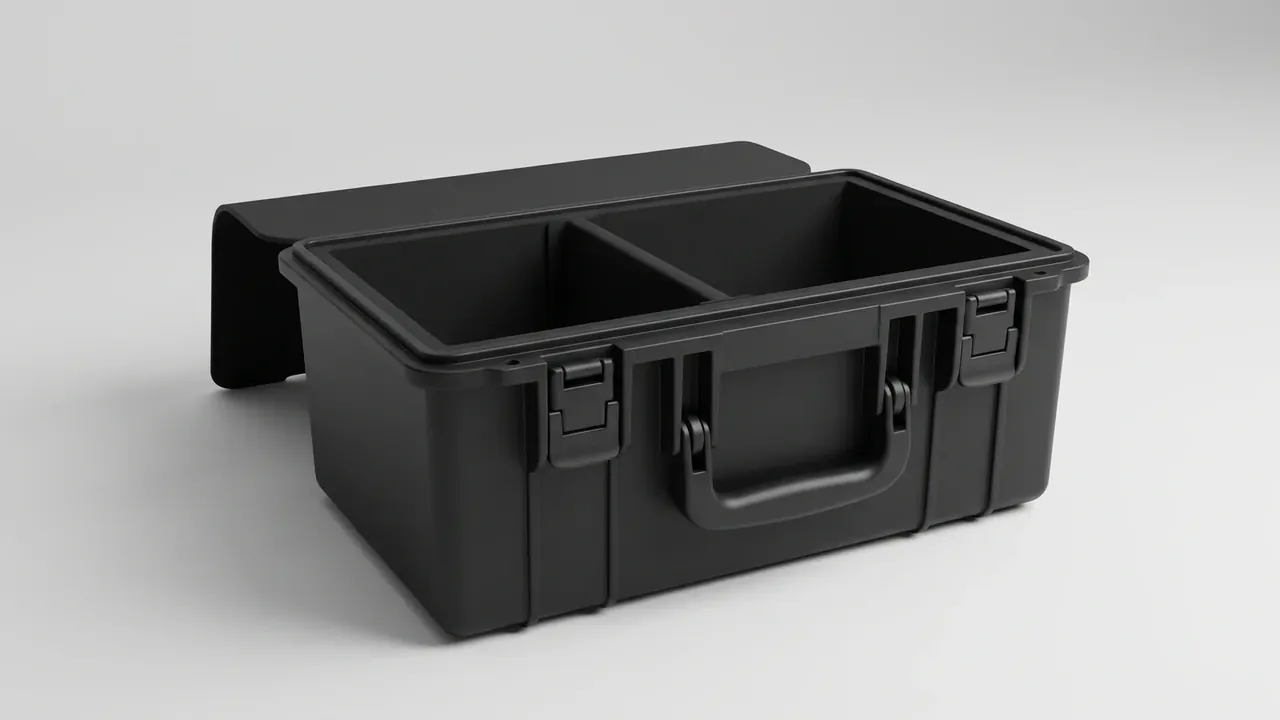
Quick answer: Measure tube diameter and wall thickness, then section count and travel, then block footprint, rear-wall groove clearance and finally cycle and salt-spray data. When all five line up, the case tracks straight and the block lasts past year two.
Table of contents
- A trolley case begins at the tube wall
- Section count and real travel
- Where the handle block meets the shell
- Shell tolerances around the tubes
- Acceptance data for a production run
- FAQ
1. A trolley case begins at the tube wall
Push travels palm, grip, tube, block, rear wall, wheels. The first number to measure is tube diameter.
Three sizes cover the market: 22, 25 and 28 mm outside diameter with 1.0, 1.2 and 1.5 mm walls in 6005-T5 aluminium; at 18 kg and 45 degrees a 25 mm tube carries 90 N sideways, peaking 30 mm above the block.
| Tube OD mm | Wall mm | Case volume L | Suggested load kg |
|---|---|---|---|
| 22 | 1.0 | 20–35 | 18 |
| 25 | 1.2 | 35–60 | 25 |
| 28 | 1.5 | 60–90 | 35 |
Under-sized tubes are routine: a 25 mm tube often measures 23.6 mm, and the 1.4 mm gap forces a new block mould plus 0.7 mm of play.
2. Section count and real travel
Two-section tubes give 380 mm of travel from 300 mm collapsed; three give 620 mm from 260 mm; four reach 780 mm from 230 mm on a trolley case. Each extra section adds a sliding interface, and play climbs with it.
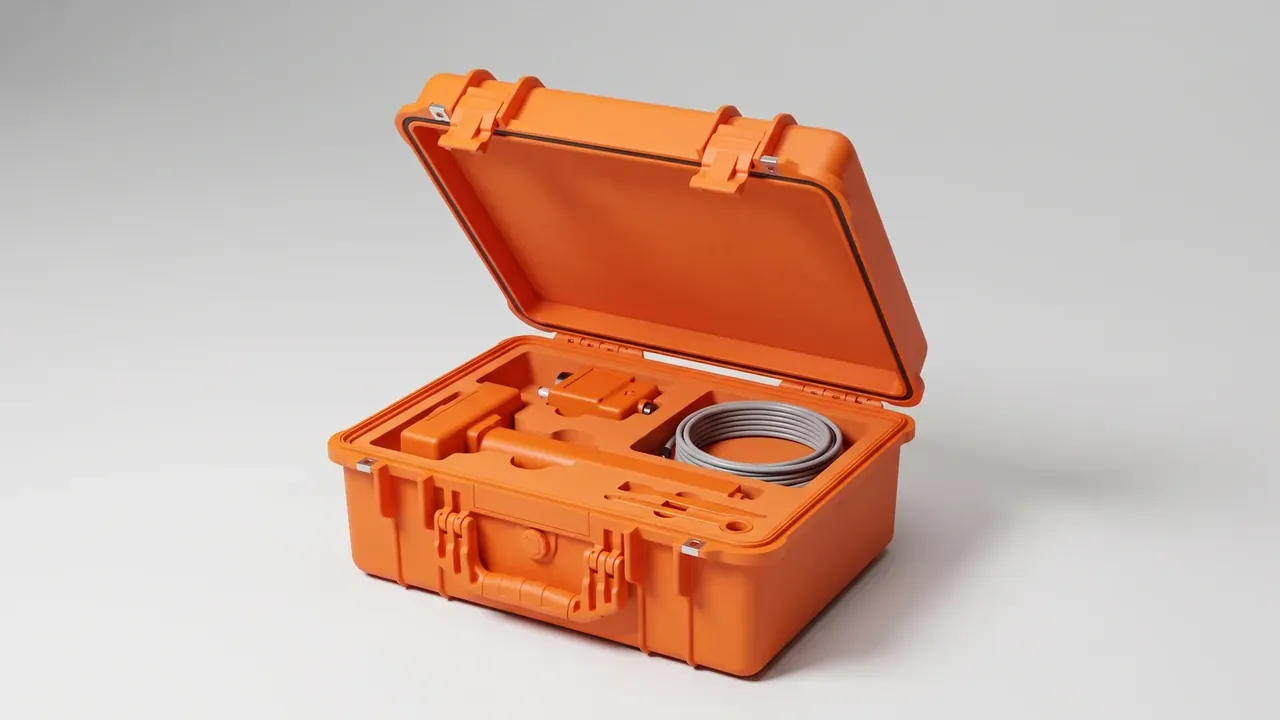
Close the handle, measure grip top to body top, repeat fully extended. A 1.70 m user wants the grip 1.45 m off the floor, a 620 mm stroke on a 600 mm body.
Play at 500 mm, read with a dial gauge and a 50 N push: 2 mm for two sections, 3 mm for three, 4 mm for four. Past 5 mm the case yaws.
3. Where the handle block meets the shell
On a trolley case the block alone joins handle to shell: PA66 with 30 percent glass fibre, on four M5 screws or brass nuts at 2.4 N·m. Below 1.8 N·m the threads wear oval after two thousand drags; above 3 N·m the block cracks from the bosses.
Contact area matters more than screw count. Aim for 1800 mm² of block base with a 2 mm raised pad inside; the same handle at 50 kg for 24 hours whitened 18 percent at 1200 mm² and 4 percent at 1900 mm².
A moulded rear-wall boss removes the screws but adds a slide and 1.6 yuan per part, paying back above 5000 units a month.
4. Shell tolerances around the tubes
The rear wall of a trolley case needs two channels 6 mm deep and 0.3 mm wider than the tube. Too tight, aluminium rubbing PC/ABS at 40 °C leaves white scars in six months; too loose, the tube rattles.
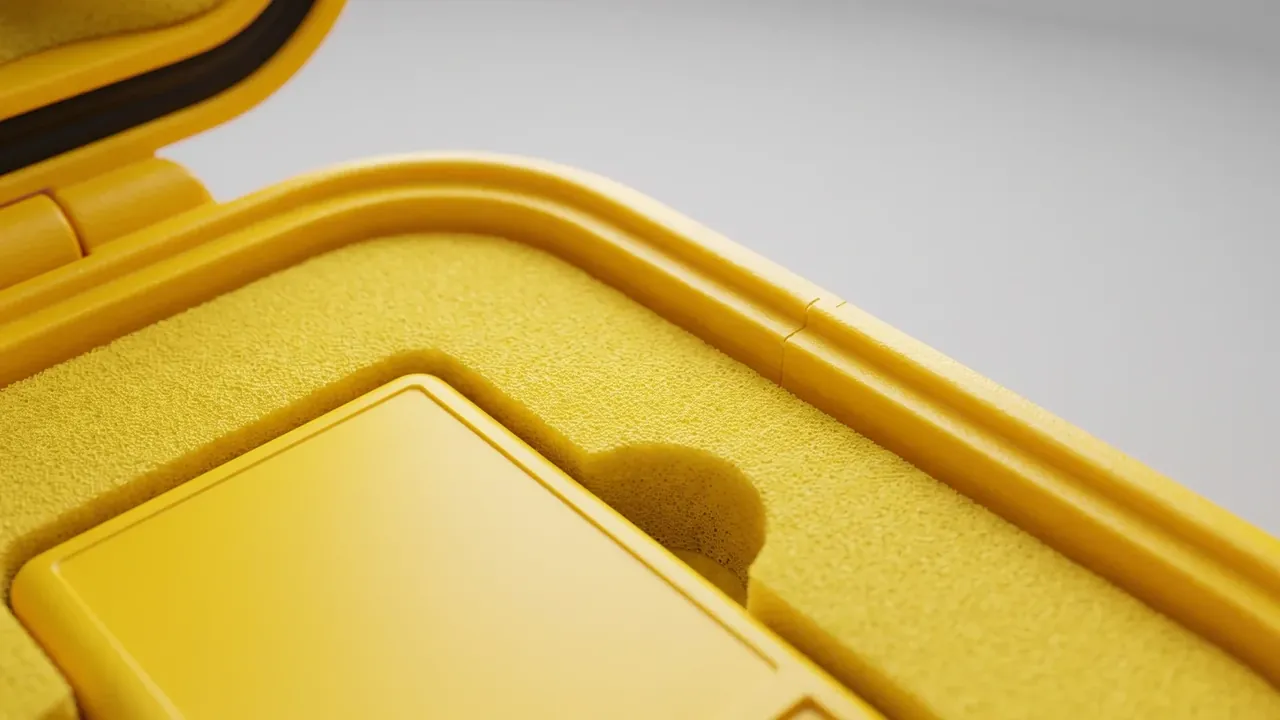
Tube centres of 180 or 200 mm set spacing; wider cuts sway but needs a broader wall. Walls of 2.2 to 3.0 mm with a 1.5 mm rib per channel lift section modulus 22 percent for 60 g.
Temperature matters too: four hours at -20 °C cuts PP impact strength 40 percent, when bosses are brittle; six hours at 60 °C drops ABS modulus 15 percent and pulls locking force from 75 N to 62 N.
5. Acceptance data for a production run
Four checks settle a batch: cycle life, locking force, screw torque, salt spray. Run 5000 empty cycles at 20 per minute with travel loss under 5 percent, and locking force of 60 N to 90 N.
Salt spray runs 48 hours neutral with no red rust; coastal orders move to 96 hours and 304 screws. Sample AQL 2.5, twenty units per 500.
| Check | Method | Limit |
|---|---|---|
| Cycle life | 5000 empty cycles, 20 per minute | No sticking, travel loss ≤5% |
| Locking force | Push-pull gauge, full extension | 60–90 N |
| Screw torque | Re-torque with a wrench | Holds 2.4 N·m |
| Salt spray | 48 h neutral | No red rust |
A four-cavity block mould on a 250 t machine at 38 s yields 3200 parts a day; lock the masterbatch lot for colour matching.
Conclusion
Six measurements decide a trolley case: tube diameter, wall thickness, section count, stroke, block contact area and channel clearance, each matched to load and temperature. Right values keep travel loss under 5 percent after 5000 cycles; one wrong value starts failure 30 mm up. Service life is the fit between two rear channels and four screws on a trolley case.
This article discusses only the container (case body) side of specifications and design intent, and does not cover any handling, loading or use of the contents.
Related Reading
- Carry-on luggage sizes and three-side limits
- How to choose a wheeled protective case
- Case fittings and handle assemblies
- Carry-on luggage: shells, wheels and expansion
Related Products
- 8 Series — Gun Cases; Military Equipment Cases; Camera Equipment Cases; Drone Cases; Watch Cases; Knife Cases; First Aid Cases; Electronics Equipment Cases
- WL8-2812 PP Gun Case — model WL8-2812
- All protective cases and toolboxes: 7 series, 158 models