

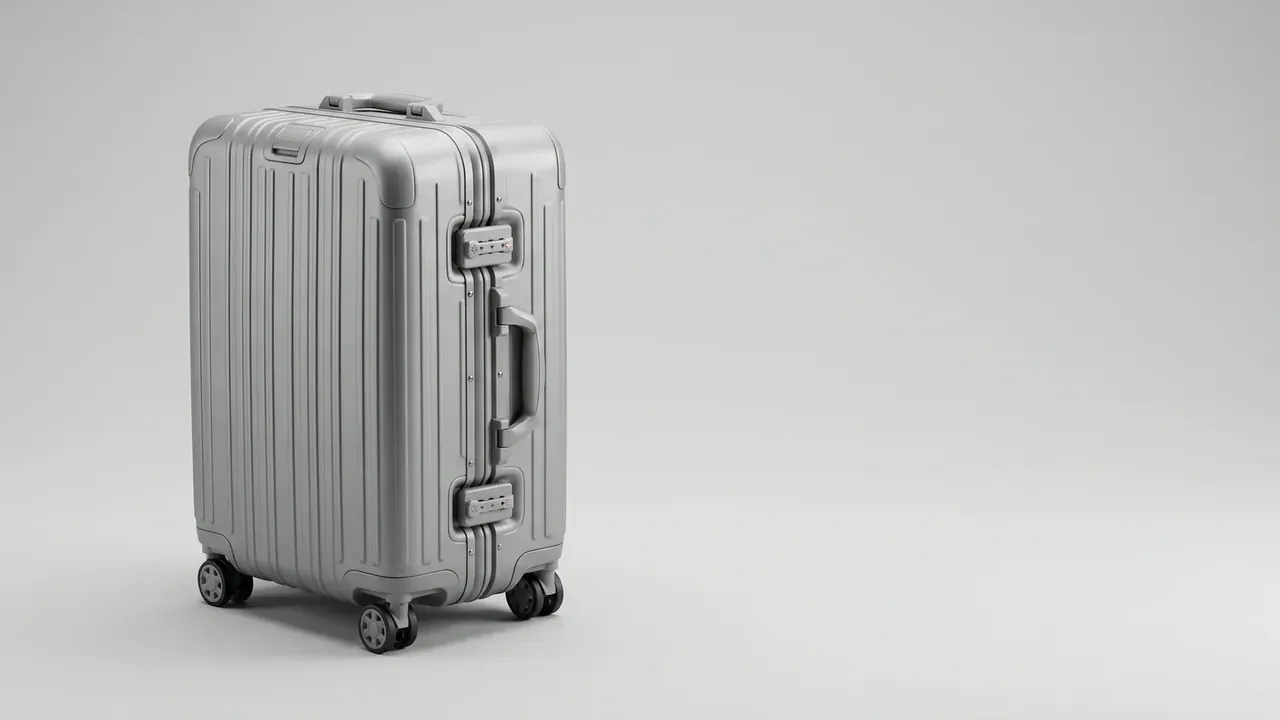
Quick answer: Reverse the usual order: wheels and trolley first, shell second, capacity last. A broken wheel scraps the case; two fewer litres costs one packing decision. Sum of sides under 115 cm, wheels 50 mm or more, trolley play under 5 mm.
Table of contents
- Measure three sides first
- Hard or soft: how the load travels
- Wheels: the first thing to fail
- Handle and grip: the force path
- Expansion: five extra centimetres
- FAQ
1. Measure three sides first
The sum of sides is the only measure that travels: under 115 cm, or 55×40×20 and 56×36×23 cm. A 23 cm depth can pass and still jam in a smaller bin.
The trap is wheels. Some brands quote the body alone, and the shell runs 4–6 cm longer. Inside, housings take 40–50 mm and trolley tubes 20 mm, so a 20-inch carry-on holds 32–38 L.
| Cabin | Sum limit | Single side | Usable volume |
|---|---|---|---|
| Full-service | 115 cm | ≤ 56 cm | 32–38 L |
| Low-cost | 105–115 cm | depth ≤ 20 cm | 28–34 L |
| Regional | 100–110 cm | depth ≤ 20 cm | 25–30 L |
2. Hard or soft: how the load travels
The difference is load path, not hardness. A hard shell spreads a point impact across the panel and never springs back. A soft shell hands impact to fabric and frame, and passes pressure to the contents.
Hard shells fear prying: under a stack the rim becomes a lever, so the weak line is always the joint. Soft shells fear sustained pressure, which prints hard objects into clothing.
Opening style matters daily: a clamshell opens halfway in an aisle, a front lid works upright.
| Item | Hard | Soft |
|---|---|---|
| Impact path | spreads across the panel | handed to fabric and frame |
| Weak point | rim pried at the joint | sustained pressure inside |
| Water | needs an intact gasket | depends on coating |
3. Wheels: the first thing to fail
Wheels touch the ground and fail first. Diameter sets clearance: a 50 mm wheel stops at a 15 mm lip, a 60 mm wheel rolls over it, costing 10 mm of internal height. Carpet punishes small wheels.
The housing concentrates stress. Moulded housings spread load through the shell; screw-fixed ones add a base plate that can be replaced; riveted ones are strongest and unrepairable. Flip the case and look for screws: that decides whether year three costs a wheel or a case.
Sand and salt enter through the hub gap; the first sign is a grinding note. Uneven wear shows as drift: push two metres, let go, and a veer means one wheel is 0.5 mm smaller.
| Diameter | Clearance | Carpet drag | Best for |
|---|---|---|---|
| 45–50 mm | 10–12 mm | high | city paving |
| 55 mm | 15 mm | medium | mixed use |
| 60 mm+ | 18–20 mm | low | gravel |
4. Handle and grip: the force path
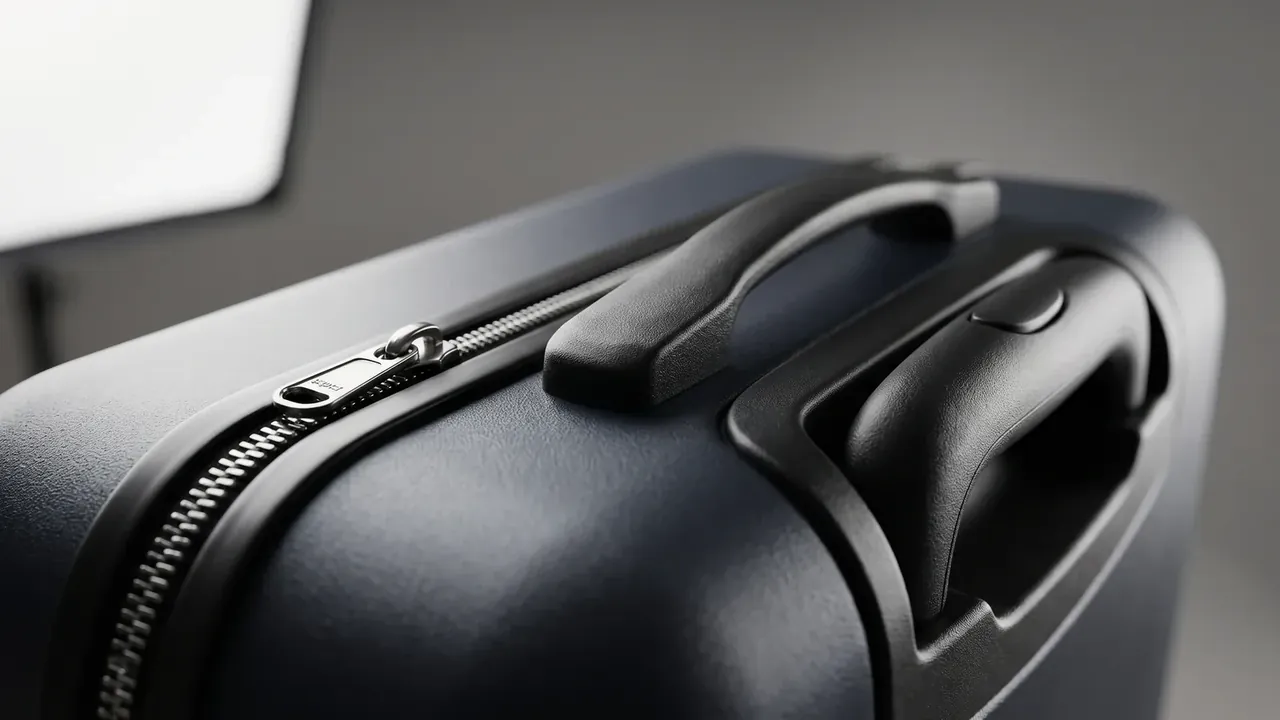
The trolley transmits pull through every clearance. Extend it, hold the shell, push the top sideways: over 5 mm means the fit is worn. A 0.8 mm aluminium tube bows at 12 kg; 1.0 mm holds its line.
The grip is misread. The trolley pulls; the grip lifts the case onto a rack as an impact load. A riveted grip whitens at the rivets; a moulded one spreads force but cannot be replaced.
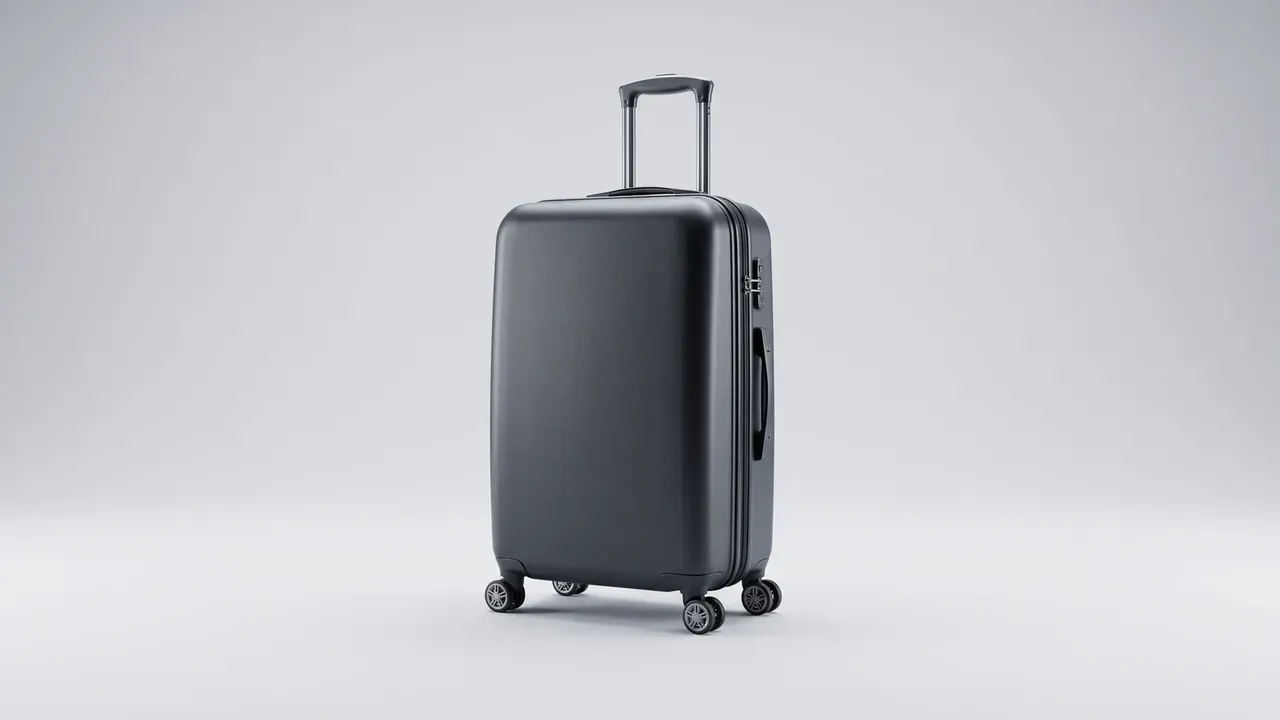
5. Expansion: five extra centimetres
Expansion adds 3–5 cm at the joint. A 20-inch carry-on goes 20 to 25 cm, gains about fifteen percent volume, and its sum of sides climbs from 115 to 120 cm: a compliant case becomes checked baggage once the gusset opens.
Hard shells pay twice. An open gusset inserts a flexible band between panels and turns the shell from a plate into a membrane, soft under the thumb. Judge the zip: a double slider closes fully; a single slider opens halfway.
Conclusion
Choosing carry-on luggage comes down to three moves: measure the sides, inspect the housings, push the trolley once. The sum decides whether the carry-on boards, the housing whether year three is a repair, the trolley how tired your arm is. Colour changes looks, not lifespan.
This article covers container-side specifications and design implications only, not the handling, loading or use of the contents.
Related Reading
- Luggage case structure and selection
- Case wheels and trolley handle
- Carry-on travel cases and TSA locks
- Common travel case formats
Related Products
- 8 Series — Gun Cases; Military Equipment Cases; Camera Equipment Cases; Drone Cases; Watch Cases; Knife Cases; First Aid Cases; Electronics Equipment Cases
- WL8-2812 PP Gun Case — model WL8-2812
- All protective cases and toolboxes: 7 series, 158 models