

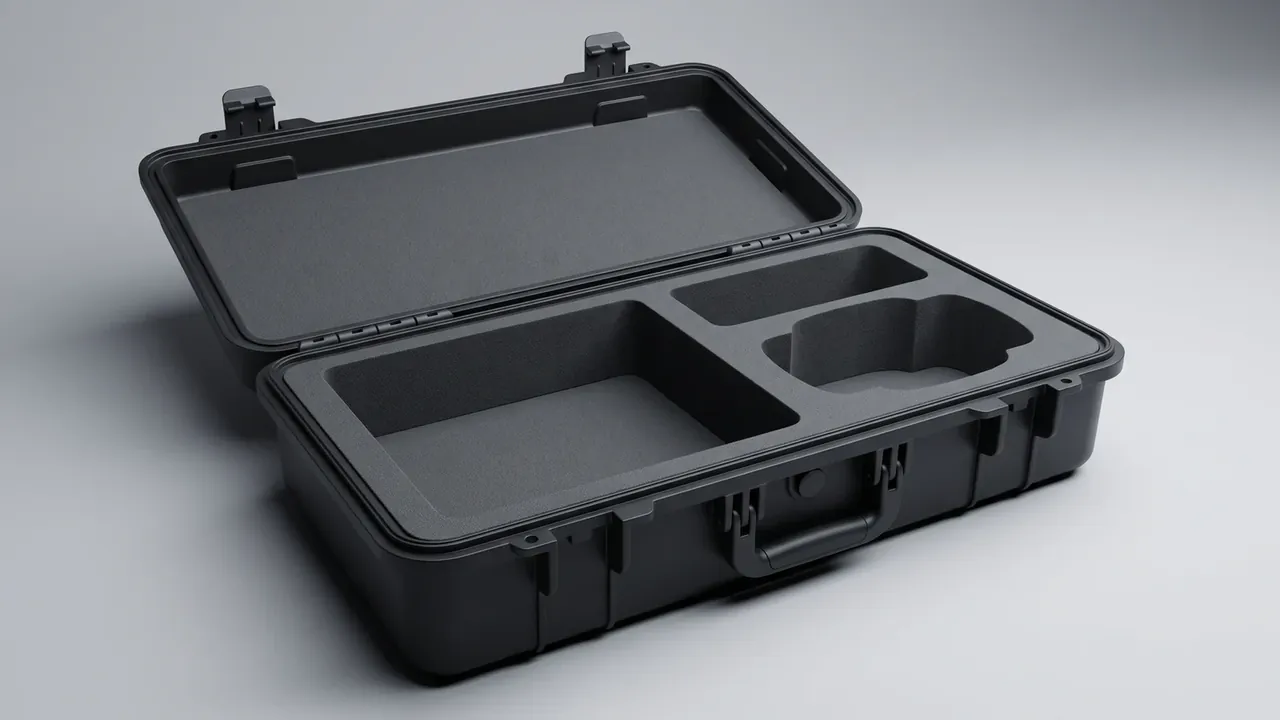
Quick answer: Most of the price gap between two portable plastic case quotes comes from the moulding route and the resin, not the look. Pick injection, blow or rotomoulding from annual volume, choose the grade from service temperature, fix rib and draft details, then agree latch design and incoming tolerances.
Table of contents
- Portable plastic case moulding sets wall and batch
- Resin grade decides heat resistance and impact
- Ribs radii and draft angles carry durability
- Latches and hinges moulded in or metal
- Tolerances and batch consistency on arrival
- FAQ
1. Portable plastic case moulding sets wall and batch
Injected, a portable plastic case with a 440×320×160 mm cavity runs a 2.5 mm wall on a 48-second cycle, tool from 80,000 CNY. Blow moulding gives 4 mm for 30,000 CNY but keeps corners rounded; rotomoulding reaches 6.5 mm at the lowest tool cost and holds the machine 20 minutes.
An injection tool built for 300,000 shots spreads its cost at 500 pieces; blow moulding starts at 200, rotomoulding at 50.
| Route | Wall | Tool | Minimum | Cycle |
|---|---|---|---|---|
| Injection | 2.5 mm | 80,000 CNY | 500 | 48 s |
| Blow | 4.0 mm | 30,000 CNY | 200 | 90 s |
| Rotomould | 6.5 mm | 18,000 CNY | 50 | 20 min |
2. Resin grade decides heat resistance and impact
PP copolymer is the default for a portable plastic case: 0.91 density, 100 °C deflection, 6 kJ/m² impact holding at -20 °C. Homopolymer PP is 15 percent stiffer but keeps a third of that impact in cold.
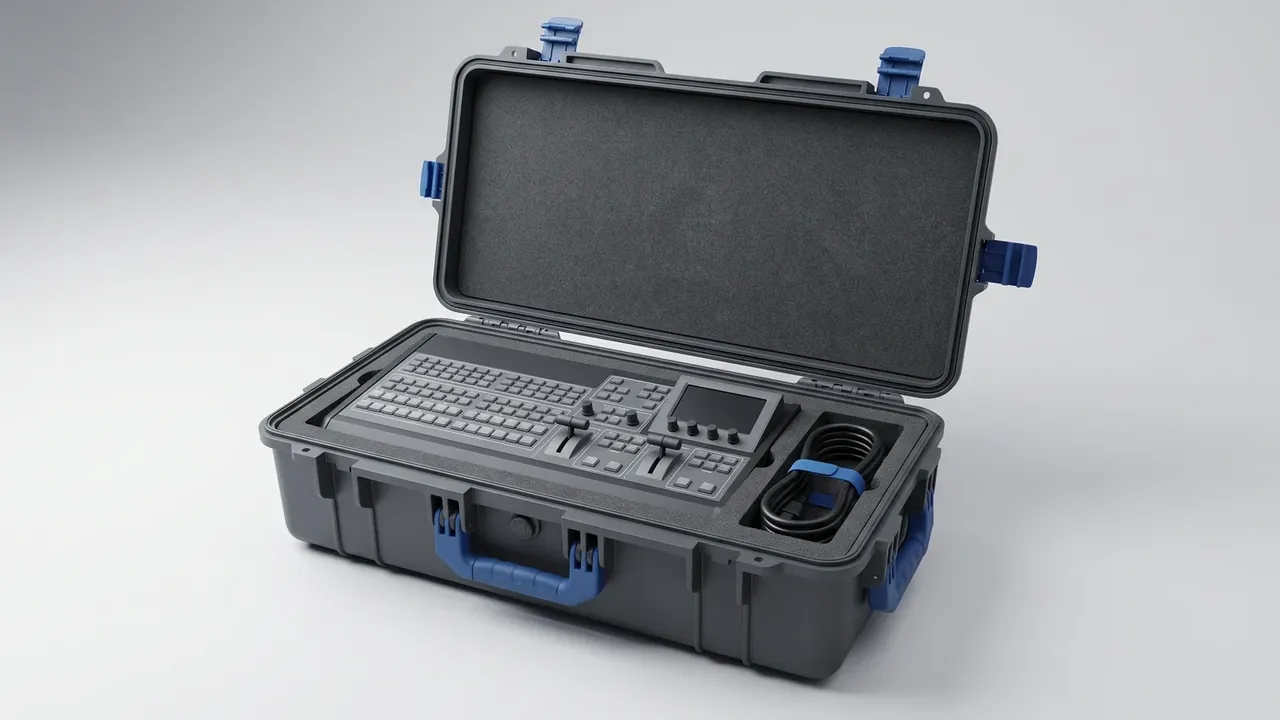
HDPE wins on chemical resistance and cracks under load; ABS gives gloss at 15 percent more weight; PC reaches 60 kJ/m² at three times the PP price.
| Grade | Density | Deflection | Impact | Trade-off |
|---|---|---|---|---|
| PP homopolymer | 0.91 | 105 °C | 2 kJ/m² | stiff, brittle cold |
| PP copolymer | 0.91 | 100 °C | 6 kJ/m² | best balance |
| HDPE | 0.95 | 85 °C | 5 kJ/m² | chemicals, cracks |
| ABS | 1.05 | 95 °C | 12 kJ/m² | looks, weight, price |
Regrind hides in cheap quotes: at 20 percent impact falls a fifth and colour greys, so visible parts stay at 10 percent.
3. Ribs radii and draft angles carry durability
Ribs are structural: on a portable plastic case the rib runs 0.6 times the wall, past 0.8 the outer face sinks into a read-through. Height stays under 12 times the wall; a 1.5 mm root radius cuts stress concentration about 40 percent.
Draft decides whether the tool survives: walls at 1.5 degrees, cavities at 1 degree, plus 1 degree per 0.025 mm of texture. Too little drags the wall white. Cooling takes 18 seconds at 2.5 mm, 26 at 3.5 mm, at 45 °C.
4. Latches and hinges moulded in or metal
A moulded PP living hinge folds 100,000 times at no cost while the lid stays under 1.2 kg. Heavier lids need a steel pin and eight rivets, face flat to 0.3 mm.
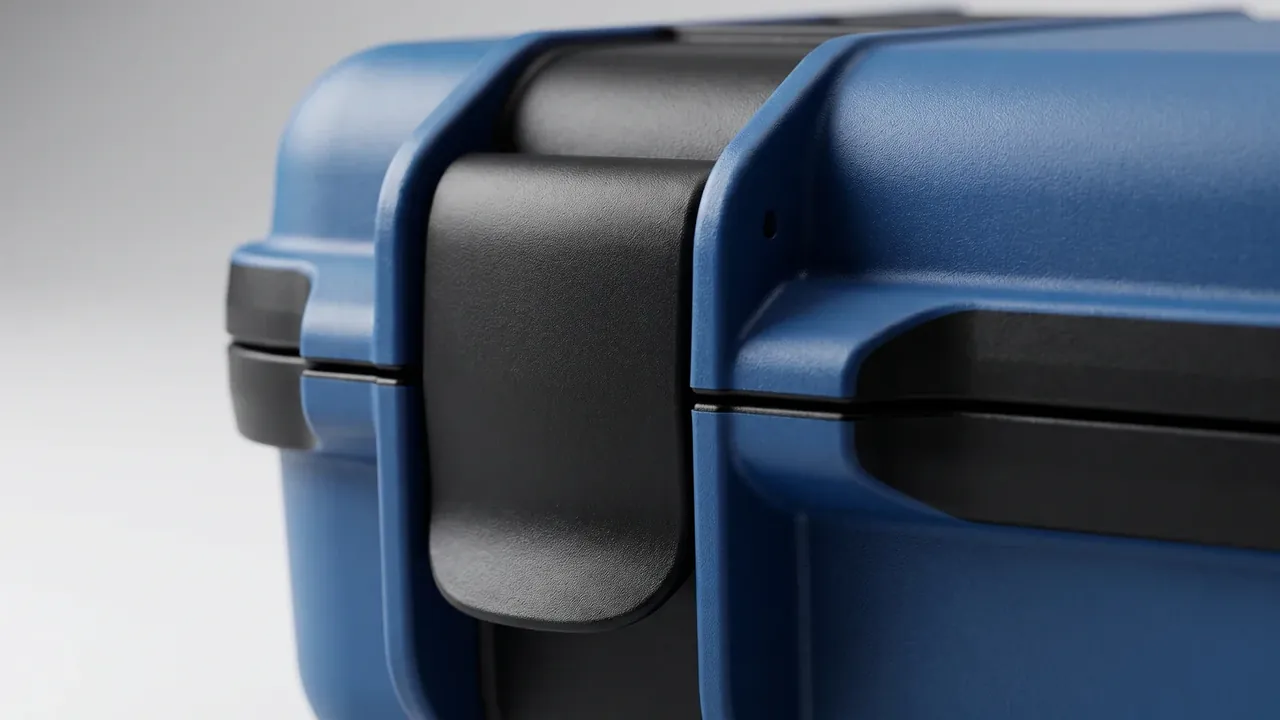
Latch pull force near 80 N is the useful band: under 60 N the lid pops open on rough ground, over 120 N a gloved hand fails. Past 500 mm, two latches hold the middle.
5. Tolerances and batch consistency on arrival
Warp comes first: corner height across the base of a portable plastic case stays within 0.8 mm over 300 mm, or it rocks on a bench.
Colour is held at ΔE 1.5 across three samples. Moisture above 0.05 percent leaves silver streaks, and drop testing runs at 1.2 m and -10 °C.
| Check | Method | Pass line | Failure |
|---|---|---|---|
| Warp | plate and gauge | 0.8 mm per 300 mm | rocking base |
| Gap | feeler gauge | under 0.5 mm | light leak |
| Colour | spectrophotometer | ΔE 1.5 | grey batch |
| Moisture | analyser | 0.05% | silver streaks |
| Drop | 1.2 m at -10 °C | no through-crack | chipped corner |
Warp and colour drift most by the second shipment as tools wear and lots move; comparing each lot to the first-article report beats sorting parts.
Conclusion
Choosing a portable plastic case is subtraction: no injection tool for a small batch, no saving on copolymer where cold is real, no living hinge under a heavy lid. Run the five criteria and every line on the quote has a reason. The right portable plastic case is the one whose route, grade and tolerances fit the job.
This article discusses only the container (case body) side of specifications and design intent, and does not cover any handling, loading or use of the contents.
Related Reading
- Choosing a PP plastic case by grade
- PP case against ABS case
- How an injection moulded protective case is made
- Size ranges for small plastic cases
Related Products
- 8 Series — Gun Cases; Military Equipment Cases; Camera Equipment Cases; Drone Cases; Watch Cases; Knife Cases; First Aid Cases; Electronics Equipment Cases
- WL8-2812 PP Gun Case — model WL8-2812
- All protective cases and toolboxes: 7 series, 158 models