

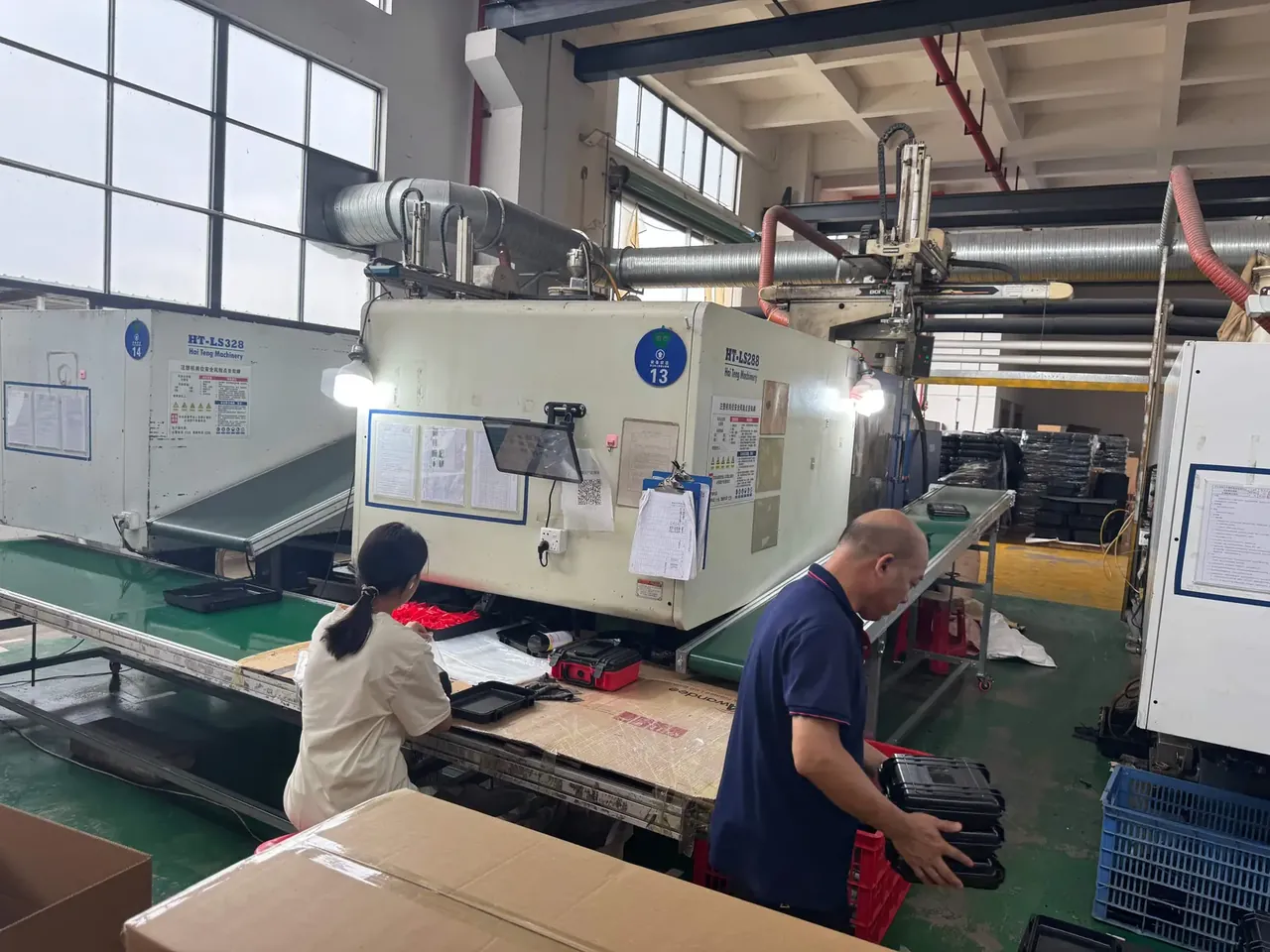
Quick answer: PP Plastic Case selection runs in three steps. Grade follows service temperature: block copolymer below minus 10 C, homopolymer indoors. Melt flow follows flow ratio, so a shell above 280 needs 20 g/10min. Tooling follows batch size, from pre-hardened steel under three thousand units to a hardened mould past a hundred thousand. Shrinkage is the step most often skipped, and the one that stops lids closing.
Table of contents
- Three Decisions Behind PP Plastic Case Selection
- Three Grades and Their Melt Flow Trade-offs
- Melt Flow and Flow Ratio Decide Fill
- Shrinkage and Mould Dimension Compensation
- Batch Size, Tool Steel and Cost per Unit
- FAQ
1. Three Decisions Behind PP Plastic Case Selection
Three variables lock in order: temperature sets the grade, depth and wall set melt flow, order size sets steel. Below minus 10 C only a block copolymer survives; indoors homopolymer is enough.
2. Three Grades and Their Melt Flow Trade-offs
Homopolymer crystallises hard at 1500 MPa, stiff enough for a PP Plastic Case indoors, but glass transition sits near 0 C and 5 to 15 g/10min suits shallow shells.
Block copolymer carries the market: 7 to 9 kJ/m2, embrittlement below minus 25 C, melt flow 8 to 25 g/10min, and a hazy finish.
| Grade | Melt flow | Notched impact | Embrittlement | Fits |
|---|---|---|---|---|
| Homopolymer PP-H | 5 to 15 | 3 to 4 kJ/m2 | minus 5 C | Shallow indoor shells |
| Random PP-R | 8 to 20 | 4 to 6 kJ/m2 | minus 10 C | Clear covers |
| Block PP-B | 8 to 25 | 7 to 9 kJ/m2 | minus 25 C | Cold store, outdoor |
| Glass-filled PP-GF20 | 6 to 12 | 5 to 7 kJ/m2 | minus 15 C | Heavy pallet bins |
3. Melt Flow and Flow Ratio Decide Fill
A 620 mm cavity, gated off centre, has 420 mm to travel; at a 2.8 mm wall the ratio is 150. Gate the short side and the path reaches 700 mm, a ratio of 250. Under 200, 8 g/10min is enough; 200 to 280 wants 12 to 15; above 280 needs 20 or more.
Clamp force: 0.24 m2 at 30 to 40 MPa needs 720 to 960 tonnes for a PP Plastic Case.
4. Shrinkage and Mould Dimension Compensation
Shrinkage is a set of numbers. Along flow a PP Plastic Case runs 1.2 to 1.4 percent, across flow 1.6 to 1.8, and a 3 mm wall shrinks 0.2 percent more than 2 mm. One 1.6 percent figure is a compromise.
Post-shrinkage adds 0.3 percent over 30 days. Lid and body must come from one tool with one coefficient. A 620 mm cavity cut for 1.2 percent measures 627.5 mm in steel; at the 1.8 percent the short side really shrinks, the part comes out 616.2 mm and the latch never engages. At 1.6 percent the steel measures 630.1 mm and the error closes.
| Feature | Measured shrink | Compensation | Cost of ignoring it |
|---|---|---|---|
| Long side, along flow | 1.2 to 1.4 percent | 1.4 percent | 1 to 2 mm short |
| Short side, across flow | 1.6 to 1.8 percent | 1.8 percent | Too wide, lid will not sit |
| 3 mm wall section | plus 0.2 percent | plus 0.2 percent | Local sink |
| After 30 days | plus 0.3 percent | Allowance | Loose after a month |
5. Batch Size, Tool Steel and Cost per Unit
Under three thousand units, one cavity in 718H at 30 to 34 HRC costs 80,000, lives 300,000 shots, or 27 per PP Plastic Case.
Ten thousand to fifty thousand takes two cavities in S136 at 48 to 52 HRC, 3.6 per PP Plastic Case. Past a hundred thousand, four cavities in H13 run 1.5 million shots at 1.2 per PP Plastic Case.
| Batch | Cavities | Steel | Hardness | Life | Tool cost |
|---|---|---|---|---|---|
| under 3,000 | 1 | 718H | 30 to 34 HRC | 300,000 shots | 80,000 |
| 10,000 to 50,000 | 2 | S136 | 48 to 52 HRC | 1,000,000 shots | 180,000 |
| 50,000 to 100,000 | 2 to 4 | S136 | 50 HRC | 1,200,000 shots | 260,000 |
| above 100,000 | 4 | H13 | 48 to 52 HRC | 1,500,000 shots | 350,000 |
Conclusion
Grade from temperature, melt flow from flow ratio, tooling from batch size. A wrong grade splits corners in a cold store, a low melt flow leaves the base short, and a wrong compensation puts the lid off. Selecting a PP Plastic Case is arithmetic done early.
This article discusses only the container (case body) side of specifications and design intent, and does not cover any handling, loading or use of the contents.
Related Reading
- Advantages of PP outdoor cases
- Engineering plastic cases versus ordinary ones
- Choosing engineering plastics for outdoor cases
- How an injection moulded case is made
Related Products
- 8 Series — Gun Cases; Military Equipment Cases; Camera Equipment Cases; Drone Cases; Watch Cases; Knife Cases; First Aid Cases; Electronics Equipment Cases
- WL8-2812 PP Gun Case — model WL8-2812
- All protective cases and toolboxes: 7 series, 158 models