

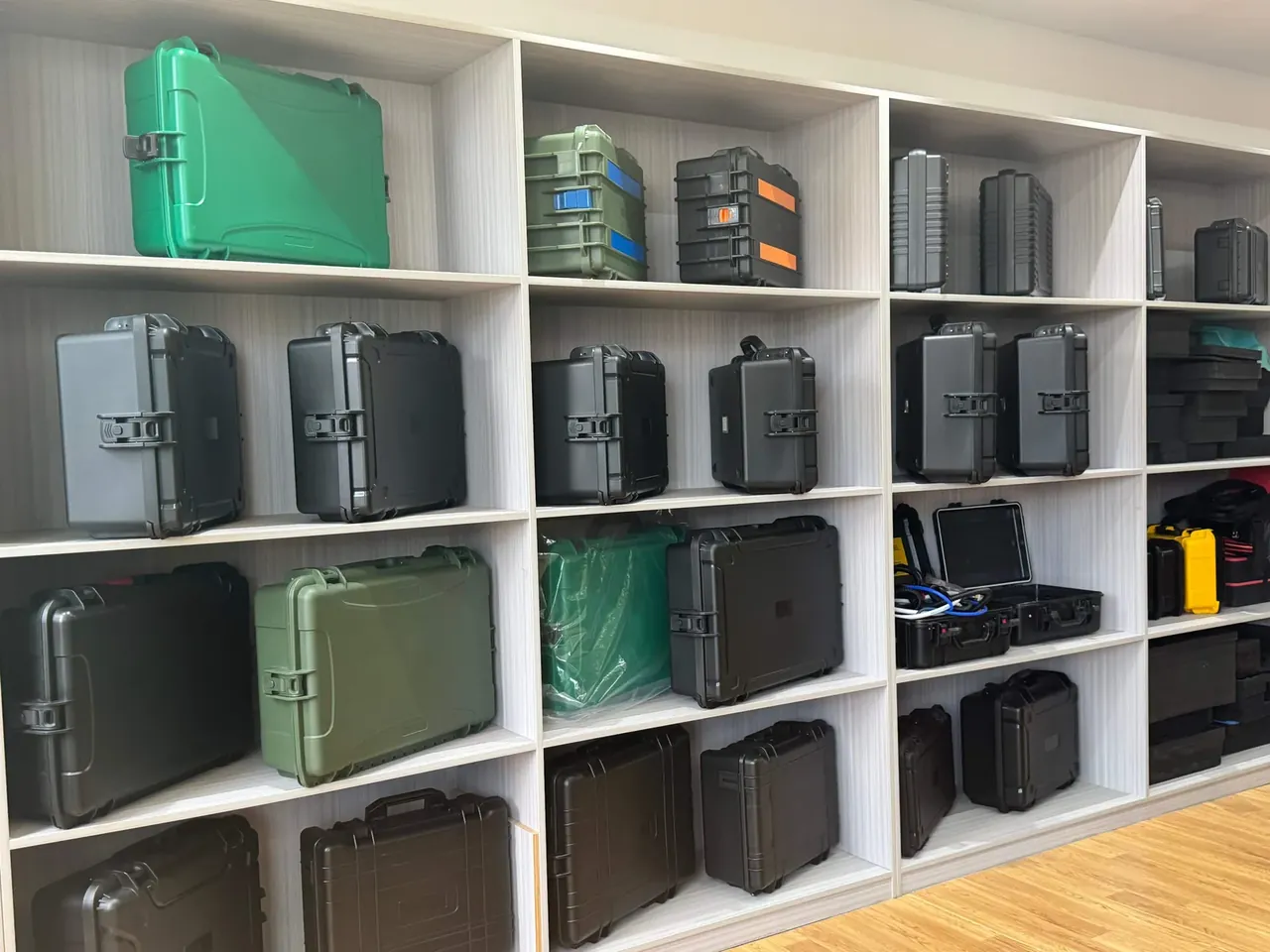
Quick answer: A PP Plastic Case and an ABS case differ in three places. ABS has twice the notched impact at 23 C, while a PP Plastic Case keeps more toughness at minus 20 C. ABS takes gloss and solvent bonding; the PP shell resists acids and fights paint. At one cavity it also weighs a tenth less, with 0.4 mm more wall.
Table of contents
- Four Comparable Points in a PP Plastic Case and an ABS Case
- Notched Impact and How the Two Materials Break
- Gloss, Texture and Secondary Processing
- Drop Hammer Results at Minus Twenty
- Weight, Wall Thickness and Material Cost at One Size
- FAQ
1. Four Comparable Points in a PP Plastic Case and an ABS Case
A PP Plastic Case beside an ABS case shows little: both black, both textured, both latched alike. The gap sits in impact, surface, cold and shrinkage, and those four decide whether a corner dents or splits.
ABS wins at 23 C and owns the surface: gloss, hot stamping, solvent bonding. Below zero the PP Plastic Case holds value better and draws level at minus 20 C. Shrinkage splits next: 1.2 to 2.0 percent against 0.4 to 0.7, so a 590 mm mould pulls 4 to 7 mm more.
| Point | PP Plastic Case | ABS case | Where it lands |
|---|---|---|---|
| Density | 0.90 to 0.91 | 1.04 to 1.06 | 13 to 15 percent lighter |
| Shrinkage | 1.2 to 2.0 percent | 0.4 to 0.7 percent | Flat walls warp |
| Surface energy | 30 to 31 mN/m | 38 to 42 mN/m | Paint needs a primer |
2. Notched Impact and How the Two Materials Break
Charpy bars at 23 C: ABS crazes through its butadiene phase and reads 16 to 20 kJ/m2, while a PP Plastic Case, a block copolymer with rubber particles in the matrix, reads 7 to 9.
Lower does not mean first to fail. ABS breaks flat and rings; a PP Plastic Case breaks white and stringy, and the crack stops halfway. At a ribbed corner, blunting beats the figure.
| Temperature | PP Plastic Case | ABS case | Retention PP / ABS |
|---|---|---|---|
| 23 C | 8.0 kJ/m2 | 18.0 kJ/m2 | 100 / 100 percent |
| 0 C | 7.2 kJ/m2 | 12.5 kJ/m2 | 90 / 69 percent |
| minus 10 C | 6.0 kJ/m2 | 8.0 kJ/m2 | 75 / 44 percent |
| minus 20 C | 5.1 kJ/m2 | 5.2 kJ/m2 | 64 / 29 percent |
| minus 30 C | 3.2 kJ/m2 | 3.6 kJ/m2 | 40 / 20 percent |
Minus 10 C is the turn: ABS drops from 18 to 8, while the PP ethylene segment sits near minus 40 C. The lines cross at minus 20 C.
3. Gloss, Texture and Secondary Processing
Gloss at 60 degrees reads 85 to 92 GU on ABS against 6 to 12 on a textured PP Plastic Case. Mirror black means ABS; matte sand texture suits PP.
Etch depth follows. ABS takes 0.20 mm at 1.5 degrees of draft; a PP Plastic Case holds 0.10 to 0.15 mm at 3 degrees, because PP grips the cavity and a shallow draft tears it white.
Paint favours ABS at 38 to 42 mN/m. A PP Plastic Case sits at 30 to 31, so printing needs flame or primer and a dyne reading above 38. Acetone bonds ABS to 80 percent of bulk strength; a PP shell is welded only.
4. Drop Hammer Results at Minus Twenty
A 5 kg head from 1.2 m at minus 20 C, striking a corner: a PP Plastic Case dents 3 to 4 mm with no crack, and splits 8 mm on a second hit. ABS cracks 12 mm first time, along the weld line. Weld strength is 60 percent of bulk, nearer 55 in PP, which ductility covers.
Cold moves size too: from 23 C to minus 20 C a PP Plastic Case shrinks 0.3 percent, ABS 0.15. Thirty days cold moves PP 0.25 percent, ABS 0.10.
5. Weight, Wall Thickness and Material Cost at One Size
A 590 by 410 by 230 mm cavity: PP wall 2.8 mm, 3.1 kg; ABS 2.4 mm, 3.5 kg. That is 400 kg per thousand shipped.
Material lands at 26.7 against 39.9 per part; cycle is 45 seconds against 55. Shrinkage compensation goes to 1.6 percent for a PP Plastic Case against 0.5 for ABS.
Conclusion
Choose ABS for room-temperature impact and mirror gloss; choose a PP Plastic Case for cold, weight and chemical resistance. Minus 20 C is where the curves cross, near 5 kJ/m2. What decides whether a case still closes after a drop is the corner weld line. Choosing a PP Plastic Case means spending the margin on cold.
This article discusses only the container (case body) side of specifications and design intent, and does not cover any handling, loading or use of the contents.
Related Reading
- ABS versus PP protective cases
- PP, ABS and PC compared
- PP and ABS toolboxes
- Injection versus rotational moulding
Related Products
- 8 Series — Gun Cases; Military Equipment Cases; Camera Equipment Cases; Drone Cases; Watch Cases; Knife Cases; First Aid Cases; Electronics Equipment Cases
- WL8-2812 PP Gun Case — model WL8-2812
- All protective cases and toolboxes: 7 series, 158 models