

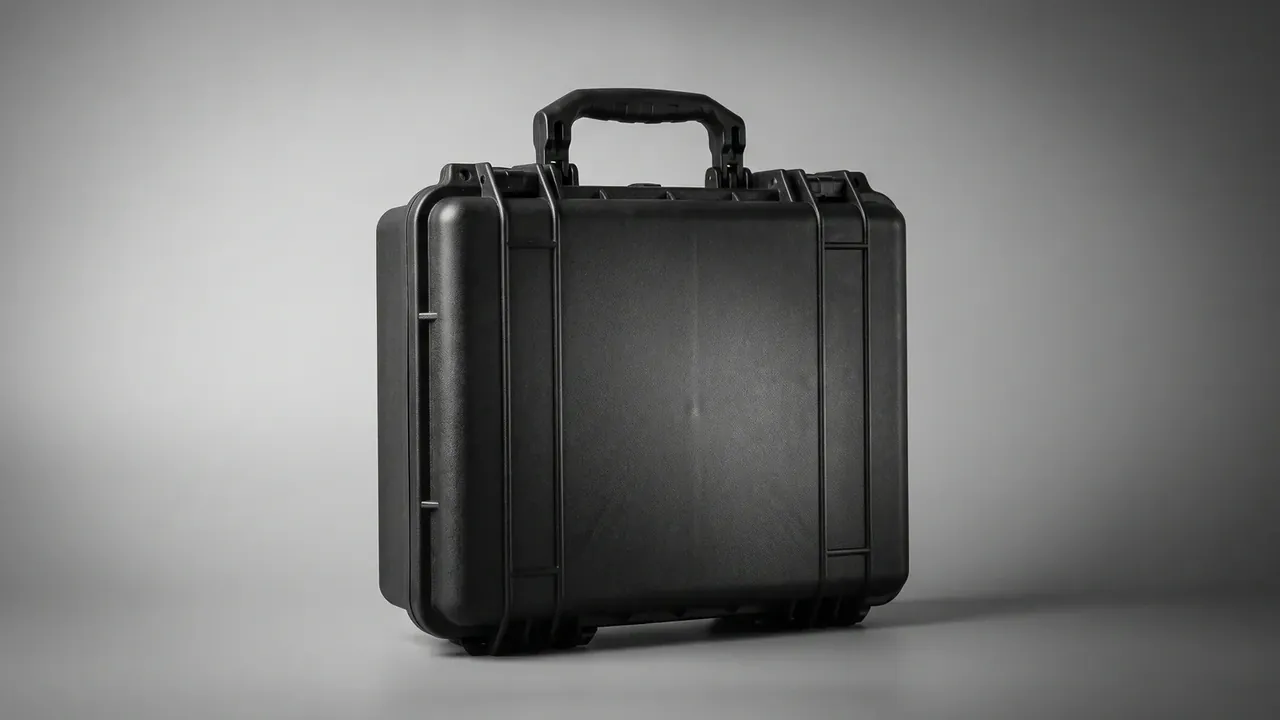
Quick answer: Choose a battery transport case by mode first, packaging class second, paperwork third: battery report, performance certificate, appraisal, drop and stack records, shell marks. A case that cannot be matched to paper will not fly.
Table of contents
- How a Battery Transport Case Is Chosen
- Where Battery Tests Stop and Case Tests Begin
- Three Details on the Packaging Certificate
- Transport Tests: Drop, Stack, Water Spray
- Matching Marks to Paperwork
- FAQ
1. How a Battery Transport Case Is Chosen
A battery transport case follows a different order from ordinary packaging: mode first, class second, dimensions last. Air, sea and road use different rule sets, so one shell may need another test when the mode changes.
Five checkpoints run in that order: mode, class, battery report, performance and appraisal, mark-to-unit match. The first two drive the last three.
| Mode | Rule set | Evidence the case must supply | Paperwork |
|---|---|---|---|
| Air | Aviation DG rules | Class, drop, stack | Certificate, appraisal |
| Sea | IMDG code | Spray, stack, marks | Certificate, declaration |
| Road and rail | Domestic DG rules | Drop, marks, mass | Certificate, waybill |
2. Where Battery Tests Stop and Case Tests Begin
A battery test report covers cells and batteries, not packaging. Its eight procedures are altitude simulation, thermal cycling, vibration, shock, external short circuit, impact and crush, overcharge, forced discharge. Passing all eight means the battery may travel, not the case.
Only two figures there touch the case: thermal cycling from minus 40 to 72 degrees Celsius, and shock at 150 g for 6 milliseconds. They set foam grade and pack restraint; the case still needs its own drop and stack tests.
Read four pages: summary, cell and battery model, laboratory and date, conclusion. A model number one letter off counts as another product.
3. Three Details on the Packaging Certificate
What the trade calls the packaging certificate is two documents: the performance certificate, which proves the design passed testing and runs 12 months, and the use appraisal, issued per shipment.
Three details fail most often: certificate number against lot, class against the mark letter (X for I, Y for II, Z for III), and box code against shell. A rigid plastic box is 4H2; 4G means fibreboard.
There is also a timing trap: a certificate valid at production start may expire before the shipment leaves, and renewal takes two to three weeks.
4. Transport Tests: Drop, Stack, Water Spray
Drop height steps with packaging class: 1.8 m for class I, 1.2 m for II and 0.8 m for III. Stacking applies a 3 m equivalent load for 24 hours; water spray runs 30 minutes.

Six orientations are used: bottom, top, long side, short side, one vertical edge and one corner. The corner is hardest, so keep its radius above 12 mm.
Only three outcomes count as failure: leaking, broken inner packaging, illegible marks. Scuffs and deformed corner pads do not count, and that belongs in the contract.
| Class | Drop height | Mark letter | Typical use |
|---|---|---|---|
| I | 1.8 m | X | High risk, repeated handling |
| II | 1.2 m | Y | Standard export packs |
| III | 0.8 m | Z | Low risk, short distance |
5. Matching Marks to Paperwork
The mark is the part of a battery transport case that speaks to strangers: UN, box code, class letter, gross mass, year, separated by slashes. 4H2/Y30/S/26 reads as rigid plastic box, class II, 30 kg gross, 2026.
Four lines get checked before loading: mark against certificate, box code against shell, mass against a scale, year against validity.
| Check | Where to look | Common error | Fix |
|---|---|---|---|
| Mark | Side of shell | Gross as net | Reprint code |
| Box code | Second character | 4H2 written as 4G | Swap case |
| Class letter | After the slash | X and Y mixed | Ship lower class |
| Year | Last two digits | Old mould reused | Re-mould, reprint |
The mark also starts traceability: lot and certificate numbers chain back to a resin batch.
Conclusion
Selecting a battery transport case looks like choosing a shell, yet the real object is evidence: mode, class, battery report, performance, appraisal, mark against unit. Break one link and the case is just a sturdy plastic box. Line the five documents up at sampling and nothing stalls at the port. The battery transport case worth buying is the one whose paper matches its shell.
This article discusses only the container (case body) side of specifications and design intent, and does not cover any handling, loading or use of the contents.
Related Reading
- How to choose a battery safety case
- Export packaging in practice
- Transit case structure and classes
- Pallet and case marking standards
Related Products
- 8 Series — Gun Cases; Military Equipment Cases; Camera Equipment Cases; Drone Cases; Watch Cases; Knife Cases; First Aid Cases; Electronics Equipment Cases
- WL8-2812 PP Gun Case — model WL8-2812
- All protective cases and toolboxes: 7 series, 158 models