

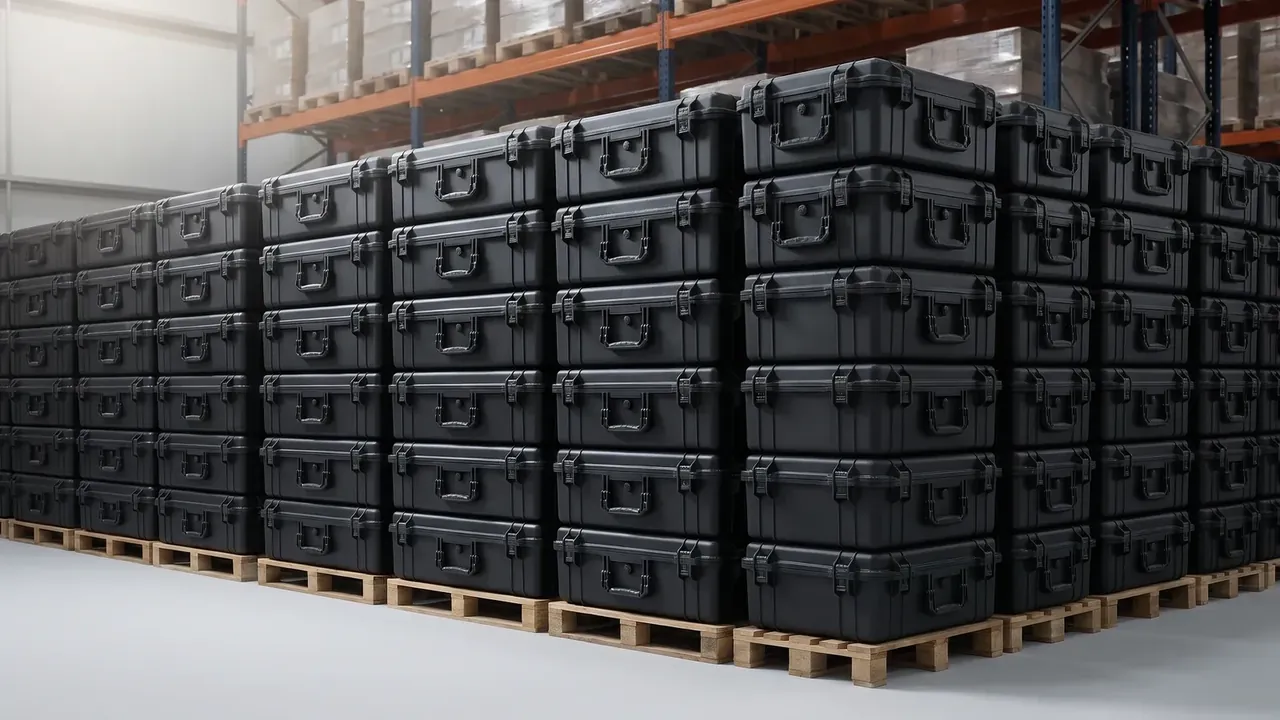
Quick answer: An electric tool box is specified by what it must survive, not by what it carries. Five scenes map onto four parameter groups: wheels, sealing, venting and locks.
Table of contents
- Five Scenarios an Electric Tool Box Serves
- How Transport Decides the Case Form
- Sealing and Drainage at Temporary Site Power Points
- Heat and Cable Exit at Charging Stations
- Numbering and Locks in Rental Circulation
- FAQ
1. Five Scenarios an Electric Tool Box Serves
Sort an electric tool box by hours away, not by contents. A same-day trip takes one loading shock, a multi-week posting eats dust and rain, a rental batch absorbs stacking.
Two figures draw the line: hours away per trip and transfers per shift. Under eight hours and four transfers a 2.6 mm single-wall shell suffices; past twenty-four hours and eight transfers, wheel mounts, gasket and lock are re-selected, because fatigue shows first.
| Scene | Away per trip | Case priority |
|---|---|---|
| Site construction | 6 to 10 hours | Corner bumpers |
| Building maintenance | Under 4 hours | Latch life |
| Charging station | Never leaves | Top load, venting |
| Multi-week posting | 5 to 20 days | Sealing, drainage |
| Rental circulation | By batch | Numbering, locks |
2. How Transport Decides the Case Form
Hand carry and towing are different problems: hand carry is about centre of gravity, where dropping ballast 15 mm toward the base is felt at once; towing is about torsional stiffness in wheel mounts and handle sockets.

An electric tool box loaded to 12 kg costs the carrier after 200 m on foot; on wheels the same weight covers 800 m with less wrist strain. Wheel diameter decides: 75 mm clears a 20 mm kerb and a 15 mm duct, while below 60 mm drag on broken brick roughly doubles.
3. Sealing and Drainage at Temporary Site Power Points
On site the case stays open most of the day, so the gasket is a rain and dust barrier rather than an immersion seal. IP65 at 33 percent compression is enough, provided the bead never breaks at the corners.
Drainage belongs with sealing. Two 4 mm holes at the low edge, under one-way flaps, sit within 3 mm of the lowest point and clear of the base ribs.
| Environment | Rating | Compression | Drainage |
|---|---|---|---|
| Indoor workshop | IP54 | 25% | None |
| Covered site | IP54 | 30% | One 4 mm hole |
| Open site | IP65 | 33% | Two 4 mm holes |
Gasket compound follows temperature: a closed case reaches 58 degrees inside in a southern summer, and silicone sponge holds compression set under 18 percent after 72 hours at 70 degrees.
4. Heat and Cable Exit at Charging Stations
At a charging station the electric tool box never moves, so heat and cable routing lead. Six bays at full load dissipate about 90 W, and a closed shell runs 11 degrees above ambient.
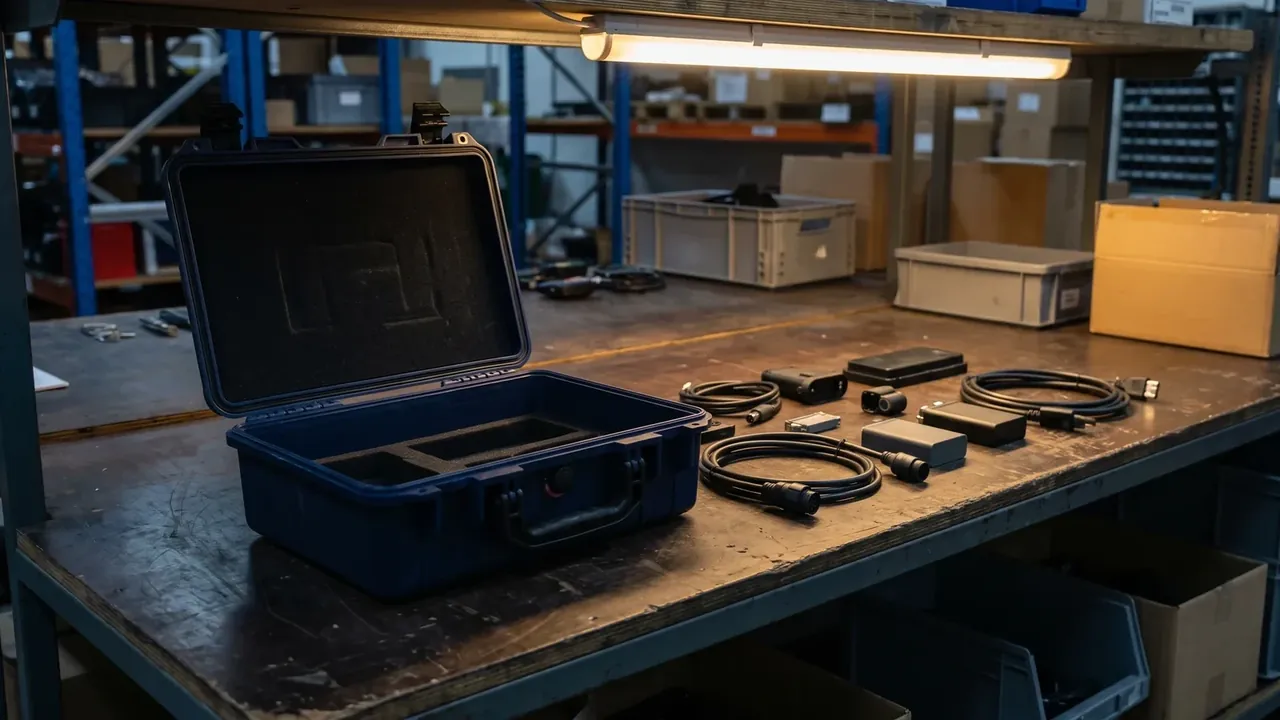
Cooling comes from direction, not area. Two 120 x 8 mm louvres low on each side, with 0.3 mm stainless mesh inside, set up bottom-in, top-out convection while open area stays at 1.2 percent.
Cables leave through 30 mm rubber grommets, one per grommet, ringed by a 2 mm reinforcement so the lip does not crack.
5. Numbering and Locks in Rental Circulation
A hired electric tool box belongs to nobody on site, so the number must read at 3 m: 25 mm stencil on the front at 4:1 contrast, plus a QR label.
Locks follow liability. Batch hire takes a one-time seal tied to the dispatch note; per-unit hire takes a three-digit combination reset between tenants. Both need a 6 mm shackle hole clear of the latch path.
| Hire mode | Marking | Lock | Trips |
|---|---|---|---|
| Batch, short term | Stencil, batch | Seal | 20 |
| Unit, long term | Stencil, QR | Combination | 60 |
| Project allocation | Stencil, staff ID | Padlock | 40 |
Put the trip count in the contract. After 8000 cycles the latch tongue returns slowly, which at six openings a day is three and a half years.
Conclusion
Five scenes reduce the electric tool box to four numbers: a 75 mm wheel, 33 percent compression, a 30 mm cable exit and four stacking layers. Hand carry reads centre of gravity, towing reads wheel mounts, open sites read drainage. Match the numbers to the scene and the configuration stops being rewritten, which is where an electric tool box specification starts.
This article discusses only the container (case body) side of specifications and design intent, and does not cover any handling, loading or use of the contents.
Related Reading
- How a tool box is built
- Rolling tool case configurations
- How waterproof hard cases seal
- Vehicle tool case selection
Related Products
- 8 Series — Gun Cases; Military Equipment Cases; Camera Equipment Cases; Drone Cases; Watch Cases; Knife Cases; First Aid Cases; Electronics Equipment Cases
- WL8-2812 PP Gun Case — model WL8-2812
- All protective cases and toolboxes: 7 series, 158 models