

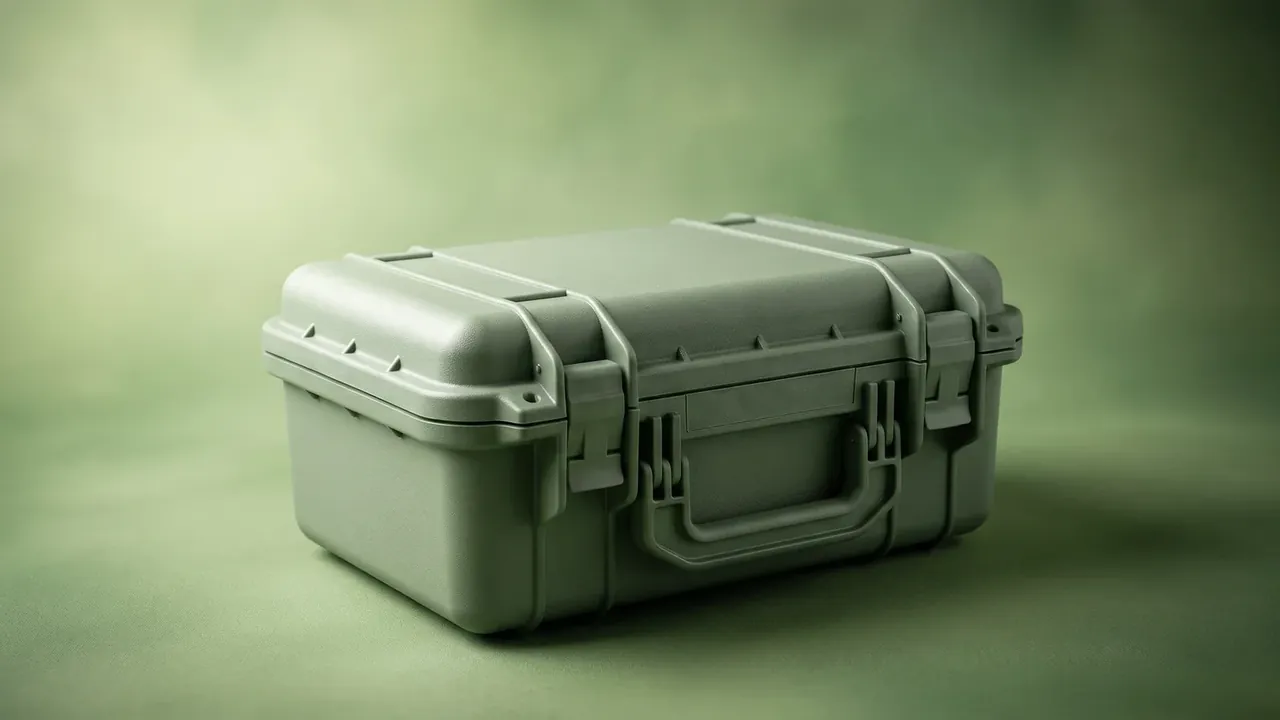
Quick answer: An engineering plastic box is specified from the inside out: cavity first, then a 2.2 mm wall with lid ribs, then hinge and catch life, foam density and order volume. Get one wrong and the lid will not seat or the pockets will not line up.
Table of contents
- How an Engineering Plastic Box Differs from a Case
- Cavity and Compartment Layout: Content First, Outline Second
- Hinges and Catches: Life Numbers for Small Parts
- Lid Stiffness and Stacking: Controlling Thin-Wall Deflection
- Foam Density, Colorant and Minimum Order
- FAQ
1. How an Engineering Plastic Box Differs from a Case
The order reverses against a case: a case starts with resin, an engineering plastic box with the cavity, because the contents are fixed before the drawing opens.
Five criteria follow: cavity, wall and lid ribs, hinge and catch, foam, colorant and minimum order. The sharpest split is wall: 3.2 mm on a case against 2.2 mm on a box, the saving spent on portability and repaid in ribs.
| Criterion | Box | Case | Failure when wrong |
|---|---|---|---|
| Cavity first | Layout drives outline | Outline drives layout | Pockets misaligned |
| Main wall | 2.2 mm | 3.2 mm | Lid sags, sides flex |
| Hinge | Living PP hinge | Steel pin hinge | Stiff or cracked hinge |
| Liner | Cut foam pockets | Solid foam pad | Contents stick |
| Minimum order | 500 units | 300 units | Tool cost unabsorbed |
2. Cavity and Compartment Layout: Content First, Outline Second
An engineering plastic box cavity is derived from the contents: a 280 mm torque wrench, a 150 mm caliper and ten hex keys fill 290 × 220 mm with clearance, so the cavity becomes 300 × 230 mm and the outline 340 × 270 mm.
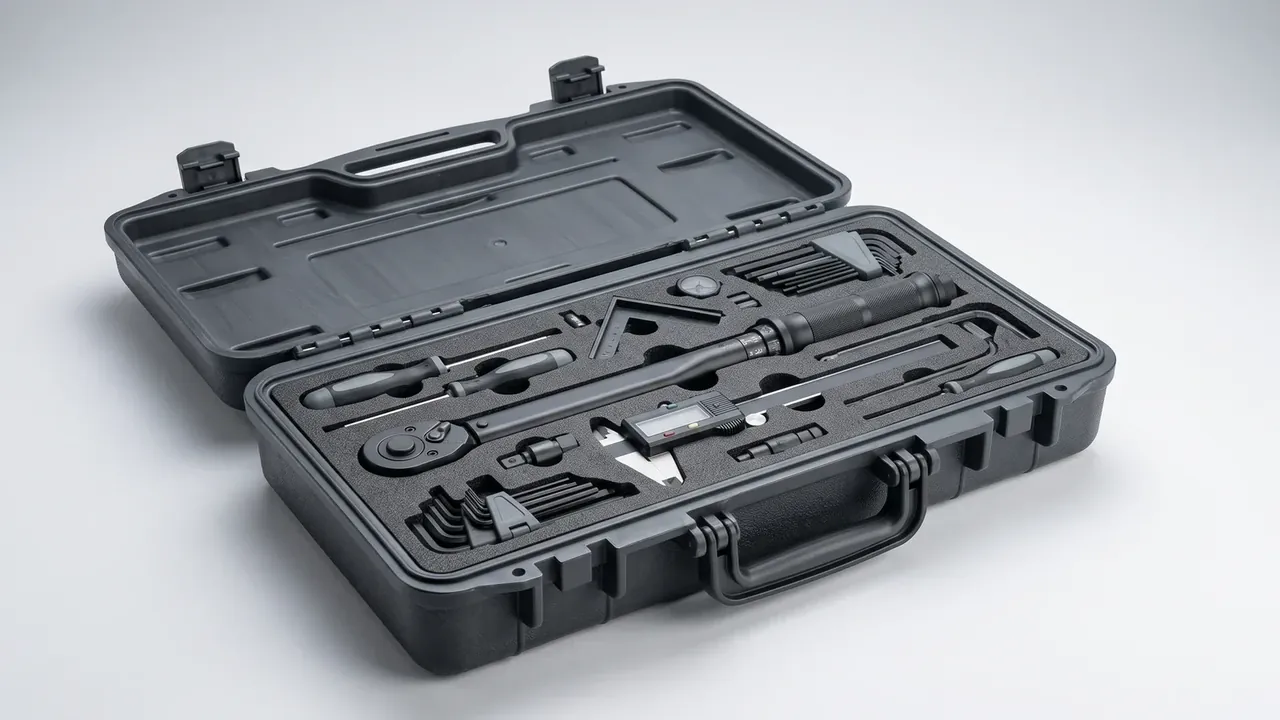
Height follows the tallest item: a 45 mm wrench head plus 8 mm of foam above and below gives a 78 mm cavity and a 95 mm outline. Moulded compartments suit fixed layouts above 2000 units a month at 3 mm walls and 1° draft; cut foam changes in days.
3. Hinges and Catches: Life Numbers for Small Parts
A living PP hinge folds on a thin web: 10000 cycles at 0.35 N·m, cheap and assembly-free, but it whitens and cracks below −10 °C.
A 3 mm stainless pin hinge reaches 30000 cycles, and 60 N catches hold an engineering plastic box lid through a 1 m drop.
| Type | Life | Force or torque | Use |
|---|---|---|---|
| Living PP hinge | 10000 cycles | 0.35 N·m | Ambient, low cycle |
| Steel pin hinge | 30000 cycles | 0.4 N·m | High cycle, cold |
| Two side catches | 8000 cycles | 60 N | Carrying by hand |
4. Lid Stiffness and Stacking: Controlling Thin-Wall Deflection
The lid is where an engineering plastic box fails first. A flat 2.2 mm panel deflects 3.8 mm at the centre under 20 kg; a 45 mm grid of 3 mm ribs pulls that to 1.5 mm on the inside face.
Stacked eight high at 3 kg, the bottom unit carries 24 kg through four corner pads, and a 1.0 m six-face drop calls for 0.3 mm of extra corner wall.
5. Foam Density, Colorant and Minimum Order
EVA at 45 kg/m³ sheds no crumbs and suits metal tools, PU at 30 kg/m³ conforms to odd shapes, EPE at 25 kg/m³ is cheapest but furs up; keep 6 mm between pockets.
Colorant sits at 1.5%: light shades need that much to kill the yellow cast, and excess leaves flow marks on a thin wall. A 380 t press with two cavities cycles in 42 s; a 120000 CNY tool costs 240 CNY per unit at 500 against 24 CNY at 5000, so share a frame below that.
| Liner | Density | Process | Suited engineering plastic box |
|---|---|---|---|
| EVA | 45 kg/m³ | Die cutting, lamination | Metal tools, gauges |
| PU | 30 kg/m³ | Direct foaming | Odd shapes, instruments |
| EPE | 25 kg/m³ | Hot wire, splicing | Light parts, one-way transit |
| XPE | 33 kg/m³ | Die cutting | Frequently handled fittings |
Conclusion
Cavity first, then wall and ribs, then hinge, catch, foam and order volume. Get the cavity wrong and nothing fits; skip the ribs and the lid sags; pick the wrong hinge and it cracks in a cold store. Work the five criteria in order and an engineering plastic box holds both feel and cost.
This article discusses only the container (case body) side of specifications and design intent, and does not cover any handling, loading or use of the contents.
Related Reading
- Selecting a small plastic case
- Material comparison for portable plastic tool boxes
- Specifying foam inserts
- Protective case size ranges explained
Related Products
- 8 Series — Gun Cases; Military Equipment Cases; Camera Equipment Cases; Drone Cases; Watch Cases; Knife Cases; First Aid Cases; Electronics Equipment Cases
- WL8-2812 PP Gun Case — model WL8-2812
- All protective cases and toolboxes: 7 series, 158 models