


Digital multimeters, clamp meters, oscilloscopes, signal generators and spectrum analyzers are the most frequently used measuring instruments in electrical, electronic and field-maintenance work. These devices typically contain precision analog front ends, liquid-crystal displays, rotary switches and fragile test-lead interfaces. The conclusion is clear: without a purpose-built protective box, the drops, compression, moisture, dust and electrostatic exposure encountered during transport and on-site use will directly cause measurement drift and even total failure. A dedicated meter box is the first line of defense for both measurement credibility and instrument service life.
On the job site, instruments are often packed together with tools and consumables, and the frequently opened connectors and probes are the most vulnerable parts. A well-structured protective box not only secures the instrument body but also separates probes, leads, fuses, test clips and data cables so that every call-out can be quickly retrieved and returned. This article systematically reviews the meter-box family across structure, material, standards, selection and customization, helping procurement and engineering teams build a practical configuration checklist.
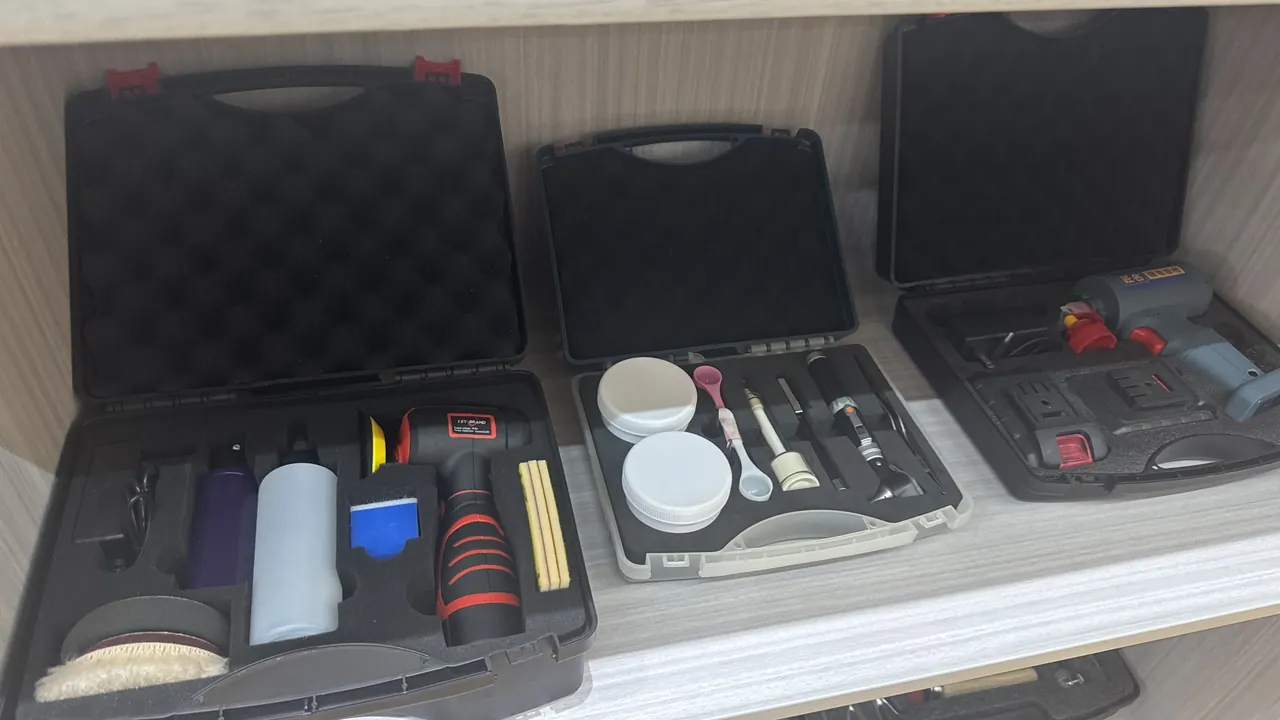
Table of Contents
- Why electrical instruments need dedicated boxes
- Structure and liner design of the multimeter box
- Carrying and access for the clamp-meter box
- Shock protection and connector care for the oscilloscope box
- Temperature and humidity control in the signal-generator box
- EMC shielding considerations for the spectrum-analyzer box
- Protection ratings and referenced standards
- Material and liner comparison
- Selection parameters and capacity reference
- Custom liner and OEM/ODM options
- Field-use and maintenance rules
- Transport, storage and volume supply
- Common misuses of meter boxes and how to correct them
- Acceptance and standardization checklist for volume procurement
Why electrical instruments need dedicated boxes
The failure of precision measuring instruments is rarely sudden; it is usually the accumulated result of long-term micro-damage. Continuous low-frequency vibration during transit loosens rotary switches, repeatedly bent test leads break their cores, and humid environments fog the LCD polarizer and cause PCB leakage. A dedicated protective box isolates external stress from the instrument through a three-layer mechanism: a rigid shell resists compression, a flexible liner absorbs energy, and a sealed gasket blocks moisture.
For B2B procurement, the box carries hidden value: uniformly issued meter boxes reduce the chance of losing accessories on site, cut re-test labor caused by damaged instruments, and simplify asset inventory and transfer. Within the supporting system of the electrician toolkit, the meter box and the tool case form paired "gauge-tool" management.
Rule of thumb: under normal indoor storage, a meter box with an EVA liner can reduce the peak acceleration transmitted to the instrument body by roughly 60%–80%, depending on liner density and wall thickness.
Structure and liner design of the multimeter box
The multimeter box usually adopts an upper-and-lower divided structure: the upper layer fixes the main unit, the lower layer stores leads, test cables, thermocouples and spare fuses. The liner is typically high-density EVA cut by CNC to match the host contour 1:1, so the instrument has "zero displacement" inside the box. The inside of the lid often has a mesh pocket or elastic bands to secure the manual and calibration card.
Selection should focus on three dimensional parameters: the host length × width × height, the maximum probe length, and whether a second meter must be stored side by side. For bench multimeters of four-and-a-half digits or higher accuracy, the liner should leave a cushioning margin to avoid shell deformation that would affect sealing.
The table below lists storage references for common multimeter hosts:
| Instrument type | Typical size (mm) | Suggested liner density | Adapted box type |
|---|---|---|---|
| --- | --- | --- | --- |
| Handheld 3.5-digit meter | 180×90×50 | 30–38 kg/m³ | Small meter box |
| 4.5-digit field meter | 210×100×60 | 38–45 kg/m³ | Medium meter box |
| Clamp + multimeter combo | 240×120×70 | 45–55 kg/m³ | Large meter box |
| Bench 5.5-digit meter | 300×260×100 | 45–55 kg/m³ | Reinforced case |
Carrying and access for the clamp-meter box
The core requirement of the clamp-meter box is "grab on open, go on close." The clamp meter has an irregular shape, and the jaw and pivot are weak points under load, so the liner needs a thickened guard at the jaw. Field electricians often work one-handed, so the box should be light and equipped with a shoulder strap or hanging clip that can attach to a ladder or belt.
In coordinated work with the power-grid inspection case, the clamp-meter box is often transported alongside clamp ammeters and insulation resistance testers. In that situation, modular boxes with the same color scheme and same latches are recommended for quick on-site identification and stacking.
Access rules:
- After opening, confirm the liner pocket is free of foreign objects.
- Slide the host along the locating slot until you hear a fitting click.
- Insert the leads into the dedicated EVA slots, never on top of the screen.
- Before closing, verify the fuse box and test clips are all returned.
Shock protection and connector care for the oscilloscope box
Handheld and bench oscilloscopes are more sensitive to shock, especially the probe BNC interface and the LCD. The oscilloscope box needs an independent buffer cavity at the screen position and separated slots on the side for probes, ground springs and USB cables. For models above 100 MHz bandwidth, transport vibration may cause time-base calibration drift, so the liner should form "floating" support at the four corners.
If the oscilloscope must form a portable lab with a logic analyzer and signal source, the modular drawer-style insert used in the communication test case is a good reference: each layer fixes one class of instrument, and the whole is then loaded into a larger case.
Temperature and humidity control in the signal-generator box
The signal-generator box shifts attention from "drop resistance" to "environmental stability." The temperature drift of high-frequency sources directly affects output accuracy, so the box can include a humidity indicator card or a small desiccant chamber to maintain relative dryness in wet seasons. For models with strict frequency-reference requirements, a combination of closed-cell EVA and a sealing gasket is recommended to keep the micro-environment stable during short transport.
In the field scenarios of the energy detection box, the signal generator is often paired with an oscilloscope and spectrum analyzer for power-ripple analysis. When multiple instruments share one transport case, each must have an independent compartment to avoid metal probes scratching one another.
EMC shielding considerations for the spectrum-analyzer box
Beyond physical protection, the spectrum-analyzer box involves EMC considerations. Although shielding is mainly provided by the instrument's metal housing, if the transport case uses metal latches and hinges, a continuous conductive path can form at the case seams, providing auxiliary attenuation against strong external electromagnetic interference. For teams operating near strong RF environments such as base stations or radar sites, conductive foam tape can be added to the lid.
Tip: a spectrum analyzer is high-value equipment. Before transport, remove all external antennas and adapters and fix them separately in small liner cells to prevent threaded interfaces from loosening under vibration.
Protection ratings and referenced standards
The protection capability of a meter box must be quantifiable and citable; procurement documents should specify the following standards:
- IEC 60529 / GB/T 4208: defines the IP rating; meter boxes commonly range from IP54 (dust-proof and splash-proof) to IP67 (short-time immersion).
- MIL-STD-810H: US military environmental engineering, covering drop, random vibration and humidity-heat cycling, commonly used to justify transport-case reliability.
- ISTA 3A/3E: transport packaging testing, used to verify protection under long-haul logistics.
- UL 94: plastic flammability rating; the meter-box shell is recommended to reach HB or above V-2.
- IK rating (IEC 62262): enclosure mechanical-impact resistance; IK07–IK08 suits field carrying.
The table below compares recommended ratings for different usage scenarios:
| Usage scenario | Recommended IP | Recommended IK | Reference standard |
|---|---|---|---|
| --- | --- | --- | --- |
| Indoor lab transfer | IP20 | IK05 | GB/T 4208 |
| Outdoor distribution O&M | IP54 | IK07 | IEC 60529 |
| Field / vehicular transport | IP67 | IK08 | MIL-STD-810H |
| Humid port operation | IP67 | IK08 | ISTA 3E |
Material and liner comparison
Meter-box shells commonly use engineering plastics: PP (polypropylene, impact-resistant and low cost), ABS (good rigidity and smooth surface) and PC (high strength and wide temperature tolerance). The three are often blended to balance performance. The multimeter box and clamp-meter box mostly use PP+ABS blends to control weight while ensuring rigidity; the oscilloscope box and spectrum-analyzer box, being higher value, tend toward thickened PC-alloy walls.
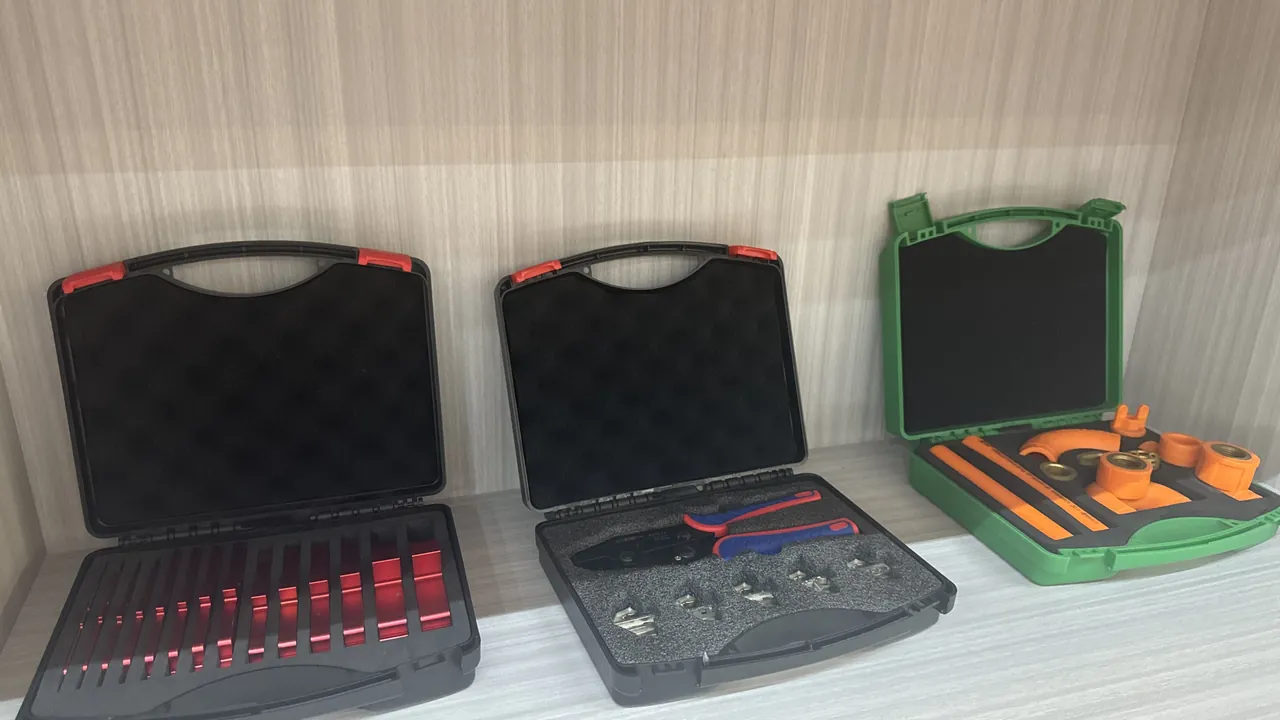
For liners, EVA is soft, resilient and highly cut-precise, making it the mainstream for meter boxes; PE foam is more pressure-resistant but less resilient; polyurethane (PU) is used for high-end customization. JUNZHJIA, at its Zhongshan plant, offers CNC-cut liners based on the host 3D model, deliverable together with OEM/ODM cases to ensure hole-position consistency.
When the meter itself contains sensitive semiconductors or is used near ESD-controlled stations, the liner and shell should consider static control as well. Although most field meters are not as fragile as bare boards, a conductive or dissipative inner tray can prevent static buildup during dry-weather handling and protect attached data modules. The principles are similar to those in the anti-static component box, adapted here to a rugged outdoor shell. In practice this means avoiding pure insulating foams in arctic-dry conditions and choosing liners with a controlled surface resistance when the instrument interfaces with a logged data card or wireless adapter.
Selection parameters and capacity reference
Selection should follow the formula "host size + accessory volume + margin." As a rule, the effective liner clearance should be 8–12 mm larger than the host outline on each axis to avoid tight fitting that hampers access; the total accessory-compartment volume can be reserved at 1.2–1.5 times the host volume.
| Instrument combination | Host size (mm) | Accessory factor | Suggested clearance (mm) |
|---|---|---|---|
| --- | --- | --- | --- |
| Meter + leads | 210×100×60 | 1.3 | 230×120×80 |
| Clamp meter + probe | 240×120×70 | 1.4 | 265×145×95 |
| Scope + probe set | 300×180×90 | 1.5 | 330×210×120 |
| Source + spectrum analyzer | 360×300×130 | 1.4 | 390×330×160 |
Custom liner and OEM/ODM options
When standard box types cannot fit irregular instruments or instrument sets, customization is the best solution. JUNZHJIA supports 1:1 liners made from customer-provided host drawings or physical scans, and can silk-screen company logos, asset numbers and operation diagrams on the inside of the lid. For brand owners, full-chain OEM/ODM from tooling, injection molding, liner to packaging is available, with corresponding documentation (IP test report, drop-test record, material flame-proof certificate).
In the production-line support of the electronics box series, the meter box is often combined with component transit boxes into a "test-station kit" with unified appearance and latches to raise field professionalism.
Field-use and maintenance rules
- Before each use, check whether the sealing gasket embeds sand grains that could cause leakage marks.
- Wipe the liner surface with a slightly damp lint-free cloth; never soak in organic solvents.
- If condensation appears inside, open the lid to dry and replace the desiccant before storing the instrument.
- Add a small amount of silicone grease to latches and hinges quarterly to keep them smooth.
- For long-term storage, separate the host from the battery to prevent leakage corrosion of the liner.
Transport, storage and volume supply
For volume procurement, it is recommended to issue boxes by "color for trade, number for asset": for example, blue for electrical teams and orange for communication teams. Transport uses the stacking scheme validated by the ISTA 3 series, with single-layer load experience value not exceeding 70% of the case nominal. Storage should keep relative humidity at 40%–60% to avoid long-term EVA dampness.
JUNZHJIA provides wholesale, agency and OEM/ODM to global B2B customers, with consistent quality control and documentation per batch, facilitating the standardized management of large maintenance teams.
Common misuses of meter boxes and how to correct them
Many organizations fall into typical misuses of meter boxes; correcting them early significantly extends instrument life. The first is "host-heavy, accessory-light": only the multimeter body is fixed while leads, test clips and fuses rattle loose inside, colliding with the screen in transit and causing scratches or broken cores. The correction is a "host + accessory" integrated liner where every easy-to-lose part has a fixed cell, so opening the lid immediately shows any missing piece. In the supporting of the electrician toolkit, this integrated thinking also applies to clamp meters and thermometers.
The second is "seal without checking the gasket": an IP67 box with sand-embedded or aged-cracked gasket is as good as no protection. The correction is brushing the gasket before every dispatch and replacing it periodically; rinse and dry promptly after salt-fog exposure to keep the EPDM elastic. The third is "mixing metal tools": placing screwdrivers and wrenches in the same cavity as instruments lets metal parts press the LCD or loosen knobs under bumps, corrected by keeping instruments in the instrument box and tools in the toolbox, following the division of the hardware toolbox series.
The fourth is "battery left long-term in the box": instrument batteries left long leak and corrode the liner and main board. The correction is removing batteries for long storage and inspecting periodically. The fifth is "liner too tight or too loose": the former makes access hard, the latter fails fixation; both should be confirmed by trial-fitting the same-spec host at acceptance. JUNZHJIA, at its Zhongshan plant, offers custom liners that separate host and battery cavities to avoid mixing and leakage at the source, delivered together with OEM/ODM cases to ensure hole-position consistency.
A frequent field mistake is treating the meter box as a permanent storage for everything. Technicians sometimes drop calipers, spare fuses and even mobile phones into the same box, which not only scratches the instrument but also defeats the purpose of zoned protection. The electronics box series and precision instrument case show how dedicated boxes keep sensitive items apart; the same logic applies here one box, one instrument family.
Rule of thumb: a meter box used and maintained per spec can cut instrument return rates by about half versus casual storage, with better measurement stability within the calibration interval.
A closely related issue is the "one box fits all" habit. A site may buy a single box size for every instrument, then force a four-and-a-half-digit bench meter and a pocket clamp meter into the same cavity. The result is either a loose instrument that shifts under vibration or a tight instrument that is hard to remove. The better practice is to size the box to the instrument family, as detailed in the electrician toolkit and clamp-meter cases, and to keep sensitive electronics in the electronics box series rather than mixing them with analog meters. The precision instrument case further shows how high-accuracy devices deserve suspended liners that the general meter box may not provide.
Acceptance and standardization checklist for volume procurement
Volume procurement of meter boxes should not just look at unit price but also "consistency" and "traceability." A verification checklist is recommended: first, document check per-batch IP test, drop test, flame (UL 94) and material certificates; second, appearance consistency color, latch model and silk-screen must match the sealed sample; third, liner density trial-fit with the same-spec host to confirm no tight fit or looseness; fourth, seal sampling water or pressure test at 3%–5% ratio to verify the gasket; fifth, asset coding each box gets a unique number for inventory and cross-team transfer.
For cross-region maintenance teams, standardization matters even more. A rule of "trade color + asset number" can be built: electrical teams blue, communication teams orange, metering teams gray, so the field tells at a glance. JUNZHJIA supports OEM/ODM standardized supply with consistent per-batch quality and documents, easing the inclusion of the electronics box series and precision instrument case into one management system. If batch deviation appears, the technical agreement should set return, traceability and re-inspection clauses to avoid problems like non-common latches or uneven stacking across batches.
| Check item | Method | Pass criterion |
|---|---|---|
| --- | --- | --- |
| Documents | Review test reports | IP / drop / flame / material complete |
| Appearance | Compare to sealed sample | Color, latch, silk-screen consistent |
| Liner | Host trial-fit | No tight fit, no looseness |
| Seal | Sampling pressure test | No leakage |
| Coding | Scan verification | Unique and traceable |
Beyond the checklist, buyers should also align the meter box with the wider tool and instrument ecosystem. For example, the hardware toolbox series defines how hand and power tools are stored, and the meter box should sit beside it rather than inside it. Field teams that carry communication testers alongside meters will find the communication test case useful for the RF side of the job, while the IT carry case covers any laptop or tablet used for logging readings. A coherent plan prevents the common failure where every subsystem is protected in isolation but the whole kit still arrives disorganized.
Another practical point is spare-parts management. Latches, gaskets and liners wear; a volume order should include a small percentage of spares or an agreed replenishment channel so that a single failed gasket does not take a whole box out of service. JUNZHJIA, manufacturing at the Zhongshan plant, can bundle spare gaskets and liners with an OEM/ODM order and document them in the same batch file, which simplifies later maintenance for large fleets. Finally, train the end users: a perfectly specified box still fails if technicians prop it open with a screwdriver or store batteries inside for months. A short usage card silk-screened on the lid, referencing the checklist above, closes the loop between procurement and daily practice.
Extended buyer's guide: matching the box to the instrument
Choosing a meter box is less about buying a container and more about matching protection to how the instrument fails. A useful way to think is by failure mode. Drop-related failure calls for thicker walls and suspended liners; moisture-related failure calls for IP67 and desiccant; EMC-related failure calls for metal latches and conductive gaskets; electrostatic failure calls for controlled-resistance liners. Most buyers over-spec one axis and ignore the others, then wonder why the box was expensive yet the instrument still failed. The electrician toolkit and clamp-meter cases and electronics box series show how the same matching logic applies when meters travel with other gear.
A second practical step is to size the box to the instrument family, not the single biggest item. A box sized for the bench meter will leave the handheld clamp meter rattling; a box sized for the clamp meter will crush the bench unit's screen. The compromise is a two-cavity insert: one cavity for the large host, one for the small accessories, each with its own buffer. This is exactly the approach in the precision instrument case, where high-accuracy devices get dedicated suspended cavities rather than sharing space.
| Failure mode | Box feature to prioritize | Common mistake |
|---|---|---|
| --- | --- | --- |
| Drop / shock | Thick wall, suspended liner | Only buying "rugged" shell |
| Moisture | IP67, desiccant, EPDM | Ignoring gasket maintenance |
| EMC | Metal latch, conductive gasket | Assuming shell shields |
| ESD | Controlled-resistance liner | Mixing with bare boards |
Cost of ownership is the third consideration. A cheap box with a soft gasket may need gasket replacement yearly; a well-specified box with EPDM may last the instrument's life. Over a five-year horizon the dearer box is usually cheaper, especially when you include the cost of one ruined instrument. The IT carry case and communication test case make the same point for electronic payloads that ride along with meters. Finally, document the choice: a one-page spec sheet per box type, kept with the asset record, prevents the next purchase from drifting back to ad-hoc buying.
In real-world deployments, selecting Meter Boxes: Multimeter, Clamp-Meter, Oscilloscope & Spectrum Analyzer should never reduce to picking a box by its outer dimensions. These units face combined hazards of dust, moisture, vibration and temperature swing, so dust/water protection, shock resistance and foam retention must be specified together to avoid costly rework after delivery.
From a supply-chain perspective, categories like meter boxes multimeter clamp oscilloscope spectrum analyzer protective case are better served by batch customization than scattered purchases. A volume program locks case color, silkscreen identity, custom-cut foam and seal slots, keeping equipment consistent across sites and cutting the cost of non-interchangeable spares.
Standards give the acceptance its backbone. Meter Boxes: Multimeter, Clamp-Meter, Oscilloscope & Spectrum Analyzer should map to GB/T 4208 (IEC 60529) for the IP code, MIL-STD-810H for drop and vibration methods, and the ISTA transit series; where flammability matters, add the UL94 rating. Put the standard numbers in the contract so vendors cannot substitute claims for test reports.
On materials, modified PP, ABS and PC each trade off differently. PP brings toughness and low-temperature resistance for large cases; ABS is rigid but brittle when cold; PC excels in impact and clear windows. For meter boxes multimeter clamp oscilloscope spectrum analyzer protective case, a one-piece shell with neoprene or EPDM foam gasket tends to age more predictably under salt spray and UV.
Foam is what turns a generic case into a purpose-built one. CNC-cut EVA, layered foam and adjustable dividers let the device sit with zero clearance, so it cannot shift under shock or drop. For Meter Boxes: Multimeter, Clamp-Meter, Oscilloscope & Spectrum Analyzer, custom foam also shortens field setup and re-stow time, and the investment is usually far below a single instrument repair.
Maintenance is routinely overlooked. After each use, wipe standing water and salt from the lid, and on coastal sites rinse the gasket with fresh water then air-dry; periodically check latches and hinges for looseness and the gasket for cracks or loss of spring. Stocking latches and gaskets at about 3% of case count contains sudden failures.
Test documentation is the lever for traceability. Ask the supplier to ship material statements, IP summaries, drop and vibration records, and batch numbers for gasket, latch and hinge. For meter boxes multimeter clamp oscilloscope spectrum analyzer protective case, also keep a seal-status template for handover and audit, closing the loop from order to operation.
The procurement spec should name five hard metrics: target IP grade, the matching shock standard, flammability grade, foam form and the identification/seal position. Make sample-case acceptance a contract milestone, lock process and materials on the sample, then inspect volume lots to the same standard with per-batch files to keep lot-to-lot variance in check.
On site, traceable seal status often matters more than the case itself. Build a one-case-one-record habit listing the device inventory, calibration validity and seal state, checked before every use. This supports availability and gives closed-loop evidence for audits and accountability, especially at scale.
JUNZHJIA typically offers OEM/ODM and device-shaped foam tooling for Meter Boxes: Multimeter, Clamp-Meter, Oscilloscope & Spectrum Analyzer, and can deliver per-batch test-file packages covering material flammability, sealing and drop, so buyers can call them up during supplier review and annual re-inspection.
Temperature swing is often underestimated. If Meter Boxes: Multimeter, Clamp-Meter, Oscilloscope & Spectrum Analyzer is used in freezing or hot environments, confirm the material brittle-point and heat-deflection temperatures to avoid cold cracking or heat softening. For meter boxes multimeter clamp oscilloscope spectrum analyzer protective case, an insulated wall or phase-change buffer can keep the interior steadier during short transits.
FAQ
Q: Must a multimeter box reach IP67? A: Not necessarily. IP67 suits harsh scenarios such as field, vehicular and humid environments, but IP54 is sufficient for indoor labs or dry distribution rooms. Pursuing a high rating blindly raises cost and weight. First clarify the usage environment: if the meter only circulates inside a workshop, a light IP20–IP54 box is more economical; if it must enter rainy construction sites or ports with vehicles, choose IP67 with an EPDM sealing gasket. During procurement, require the supplier to provide a third-party IP test report rather than relying on marketing labels, so acceptance has a basis.
Q: Is EVA or PE foam better for a clamp-meter box liner? A: In most cases, choose EVA. EVA has adjustable density, good resilience and smooth hole walls after CNC cutting, fitting the irregular shape of a clamp meter and holding form after repeated opening. PE foam is more pressure-resistant and cheaper but less resilient; after long compression it does not easily recover, suiting one-time transport rather than daily high-frequency access. If the clamp meter is heavy (such as an industrial 600 A model), a local PE backing plate can be added on top of EVA for support. The key is that the liner should "wrap" the jaw and pivot, not merely support the bottom.
Q: Can an oscilloscope box transport probes together? A: Yes, but they must be zoned. The probe BNC interface is the most vulnerable part of the oscilloscope system and should be fixed in a separate compartment from the host, with the probe cable coiled in a dedicated channel rather than stuffed randomly, to avoid core breakage from too-small bend radius. Add a 3–5 mm buffer sheet on the screen side to prevent accessories above from pressing the LCD. For bandwidth models above 1 GHz, add four-corner floating support to reduce time-base drift from transport vibration.
Q: Why put desiccant in a signal-generator box? A: The frequency reference of a signal generator is sensitive to temperature and humidity; a humid-heat environment causes short-term drift in output frequency and amplitude, and may even condense a water film on the PCB causing leakage. Indicator desiccant or a humidity card in the box maintains a relatively dry micro-environment during short transport and overnight field stays. Note that desiccant must be replaced periodically and should not directly contact metal joints to prevent reverse seepage after absorption. For calibration-grade sources with extreme accuracy, choose a closed-cell EVA plus sealing-gasket combination.
Q: Does a spectrum-analyzer box need extra electromagnetic shielding? A: The instrument's own metal housing already provides the main shielding, and the transport case usually does not need full shielding. But in strong RF environments (such as atop base stations or near radar sites), conductive foam tape on the lid seam and metal latches can form a continuous conductive path for auxiliary attenuation of external interference. More important is physical protection: remove all external antennas and adapters and fix them separately to prevent threaded interfaces from loosening under vibration. For high-value spectrum analyzers, take asset photos and a functional self-check record before transport.
Q: What is the typical lead time for a custom liner? A: Standard modification (cutting EVA based on an existing box type) is usually short; if a brand-new mold or PC-alloy thick-wall case is needed, it involves mold design and trial molding, extending the cycle. JUNZHJIA, at its Zhongshan plant, offers CNC liners based on 3D models or physical scans, deliverable together with OEM/ODM cases to reduce multi-supplier coordination. Brand owners are advised to provide host dimension drawings, accessory lists and desired markings at order time for one-time sample confirmation.
Q: Can a meter box be mixed with other tools? A: Long-term mixing is not recommended. Metal tools such as screwdrivers and wrenches are hard; colliding with instruments during transport easily scratches screens or deforms knobs. If the site must share a case, use a drawer-style insert or hard partition to fully isolate the "gauge cavity" from the "tool cavity," and ensure an independent buffer layer above the instrument. A safer practice is instruments in the instrument box and tools in the tool case, following the division between the hardware toolbox series and this meter-box article.
Q: How to ensure consistent quality across batches in volume purchase? A: The core is "documentation + sampling." Require the supplier to provide IP testing, drop testing, flame rating (UL 94) and material certificates per batch, and agree on a sampling ratio in the contract (such as 3%–5% per batch). Box color, latch model and liner density should also be fixed in the technical agreement to avoid deviation between batches. For standardized maintenance teams, establish asset-number and color-label rules so every meter box is traceable.
Q: How to clean a meter box without affecting sealing? A: Wipe the shell with neutral cleaner and a slightly damp soft cloth; always brush sand from the sealing gasket with a soft brush to prevent leakage marks. Wipe the EVA liner with a lint-free cloth; never soak or contact banana oil, acetone and other organic solvents, or the foamed structure will dissolve. Maintain latches and hinges with a little silicone grease. If the box has contacted oil, dry thoroughly before storing the instrument to avoid oil vapor corroding the LCD polarizer.
Conclusion and Further Reading
The value of an electrical instrument lies in "measuring accurately," and the premise of accurate measurement is "protecting well." From the multimeter box and clamp-meter box to the oscilloscope, signal-generator and spectrum-analyzer boxes, each type corresponds to a different dominant stress drop resistance, moisture proofing, EMC or thermal stability. Establishing a standardized, customizable meter-box system is the practical way to turn "measurement credibility" from a slogan into field reality.
Related Reading