

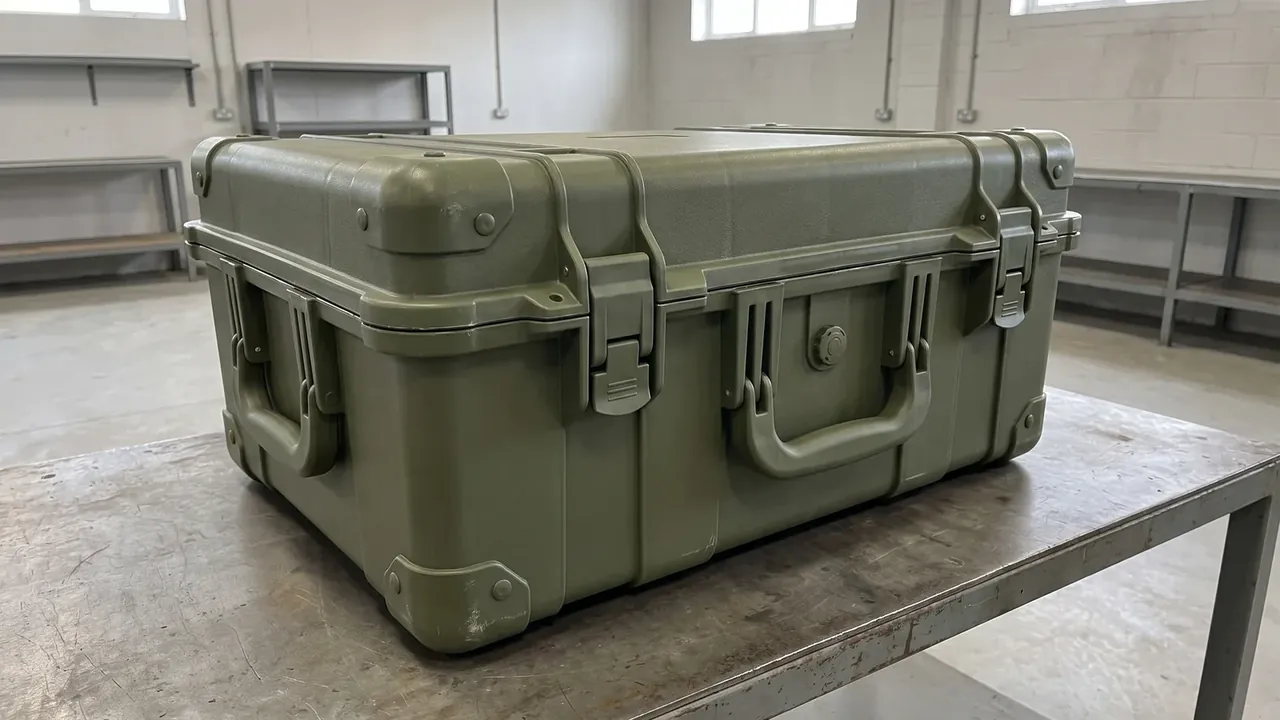
Quick answer: Military case procurement is judged on paper as much as on the shell: method numbers, a marking rule and four handover sheets.
Table of contents
- Military Case Procurement: Which Values the Clauses Fix
- Numbering and Marking for Traceability
- The Four Handover Documents
- Sampling Rules and Acceptance Criteria
- Returns, Rejections and Corrective Action
- FAQ
1. Military Case Procurement: Which Values the Clauses Fix
A tender rarely says what the shell must achieve: it cites a standard and a method number and leaves the translation to the buyer. In military case procurement that translation has four outputs: heat resistance, corner impact, seam water tightness and hardware retention.
The usual envelope is +55 °C for 3 h, −40 °C for 3 h, 26 drops from 1.2 m and 100 mm/h of rain for 30 min; the case side then needs one grade of margin on each.
Heat is a compound question. A PP body rated to a 105 °C deflection temperature and a brittle point below −45 °C covers both ends, while PA66 with 30 percent glass loses under 15 percent of its latch force at −40 °C. Better compound adds about 8 percent to the piece price, less than a failed test and a new tool.
Impact is geometry. A double wall corner at 4.5 mm instead of 3 mm deforms first and absorbs the energy, holding diagonal distortion under 2 mm after the drop sequence.
Packaging levels come from MIL-STD-2073: level A wants a barrier seal plus external support, level B ordinary protection, level C the minimum wrap. One level wrong moves structure and cost by 20 to 35 percent at 2026 quotation ranges.
2. Numbering and Marking for Traceability
In military case procurement numbering is settled at drawing stage or not at all. A workable rule uses 14 characters in four blocks: two year digits, two week digits, a four-character model code and a six-digit serial. Because the batch code matches the delivery note, one lookup reaches the mould cycle and shift.
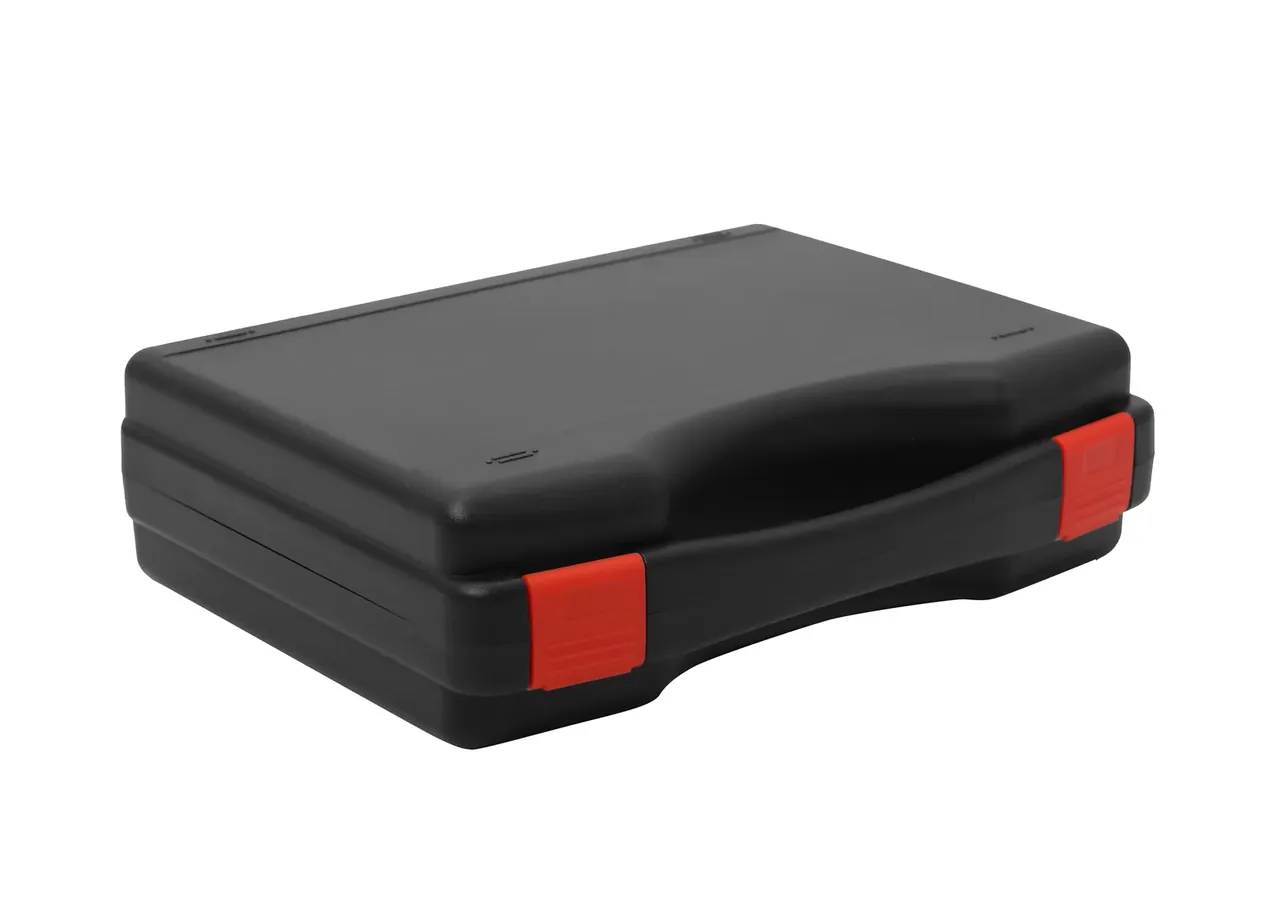
Only two marking methods belong on a drawing. Laser marking runs 0.15 to 0.25 mm deep without touching the inside wall; stamping runs 0.3 to 0.5 mm, resists abrasion but leaves a raised witness mark that thin walls must avoid.
Character geometry is overlooked more than depth: a 5 mm character with a 0.8 mm stroke still reads after 480 h of salt spray, while a deep thin mark blurs within two seasons.
Put the number on the lower right of the front face, 20 mm from the edge and clear of latch loads; one centred on the lid wears away first in a stack. Duplicated serials cost most: two identical numbers in a 500-piece lot mean re-marking every case.
3. The Four Handover Documents
Four sheets travel with the goods: the delivery note for quantity and external condition, the acceptance sheet for measured values, the issue slip for destination, the certificate for batch and standard. All four quote the same code; any mismatch against the shell freezes the lot.
| Document | Mandatory fields | Signed by | Retention |
|---|---|---|---|
| Delivery note | Batch code, quantity, arrival date, visual result | Driver, storekeeper | 3 years |
| Acceptance sheet | Sample size, defect count, verdict | Inspector, buyer | 5 years |
| Issue slip | Asset number, receiving unit, issue date | Holder, storekeeper | 5 years |
| Certificate | Model, batch, standard, date of manufacture | Quality stamp | With the case |
A certificate is not a sticker off a roll: model, batch code, method numbers, date and inspector code, at no less than 90 mm by 60 mm, fixed inside the lid away from transit wear.
Paper and ledger have to reconcile. The batch code is the primary key and asset numbers hang off the issue slips; where field names differ, the marking on the shell wins as the only anchor that survives a migration. A sheet signed the next morning is worth little, its time no longer matching arrival.
4. Sampling Rules and Acceptance Criteria
Sampling follows GB/T 2828.1 at general level II. A lot of 501 to 1,200 draws 80 pieces, a lot of 1,201 to 3,200 draws 125; critical defects are zero, major at AQL 1.0 and minor at 2.5.
| Item | Instrument | Limit |
|---|---|---|
| Outer dimensions | Tape, three readings per axis | ±3 mm |
| Latch opening force | Push-pull gauge | 60 to 90 N |
| Seal compression | Feeler gauge and caliper | 22 to 28 percent |
| Marking depth | Depth micrometer | 0.15 mm minimum |
| Empty weight | Platform scale | ±3 percent of nominal |
Sequence saves hours: appearance and marking first, then dimensions, then seal and latch. Failure in the first two rejects the lot and skips the rest, cutting about 40 percent of a day of inspection.
Re-sampling must be written before it is needed: one doubled sample, then the lot goes back, with freight and re-test cost on the party at fault. That clause is often omitted and often quoted later.
5. Returns, Rejections and Corrective Action
The largest share of returns in military case procurement is marking that disagrees with paperwork: a missing batch code, a skipped serial, a superseded standard. Those three account for over half of all returns, and none is a shell defect.
Structure and sealing come second. A seal compressed below 22 percent lets water through after 30 min of rain, and a latch opening below 60 N releases in transit. Neither is cured by a replacement part; both mean a tool change.
Corrective action has to close the loop. The supplier returns a cause analysis, an action list and a batch trace within 7 working days, and the buyer tightens one grade on the next lot, dropping AQL 1.0 to 0.65, until two consecutive lots pass. Filed beside the acceptance sheet, it lets the next tender compare suppliers on evidence rather than memory.
Conclusion
Military case procurement ends up as three documents rather than one product: a clause-to-value table, a marking rule and a set of handover sheets. The table decides wall thickness and compound; the rule decides whether a fault traces back to one mould cycle and shift; the sheets decide what evidence exists. Fix all three in the contract, and acceptance day shrinks to measuring dimensions and counting defects.
This article discusses only the container (case body) side of specifications and design intent, and does not cover any handling, loading or use of the contents.
Related Reading
- Reading the military standard clauses for protective cases
- Stacking and storage loads for ammunition boxes
- Quotes and lead times when buying military air transport cases
Related Products
- 8 Series — Gun Cases; Military Equipment Cases; Camera Equipment Cases; Drone Cases; Watch Cases; Knife Cases; First Aid Cases; Electronics Equipment Cases
- WL8-2812 PP Gun Case — model WL8-2812
- All protective cases and toolboxes: 7 series, 158 models