

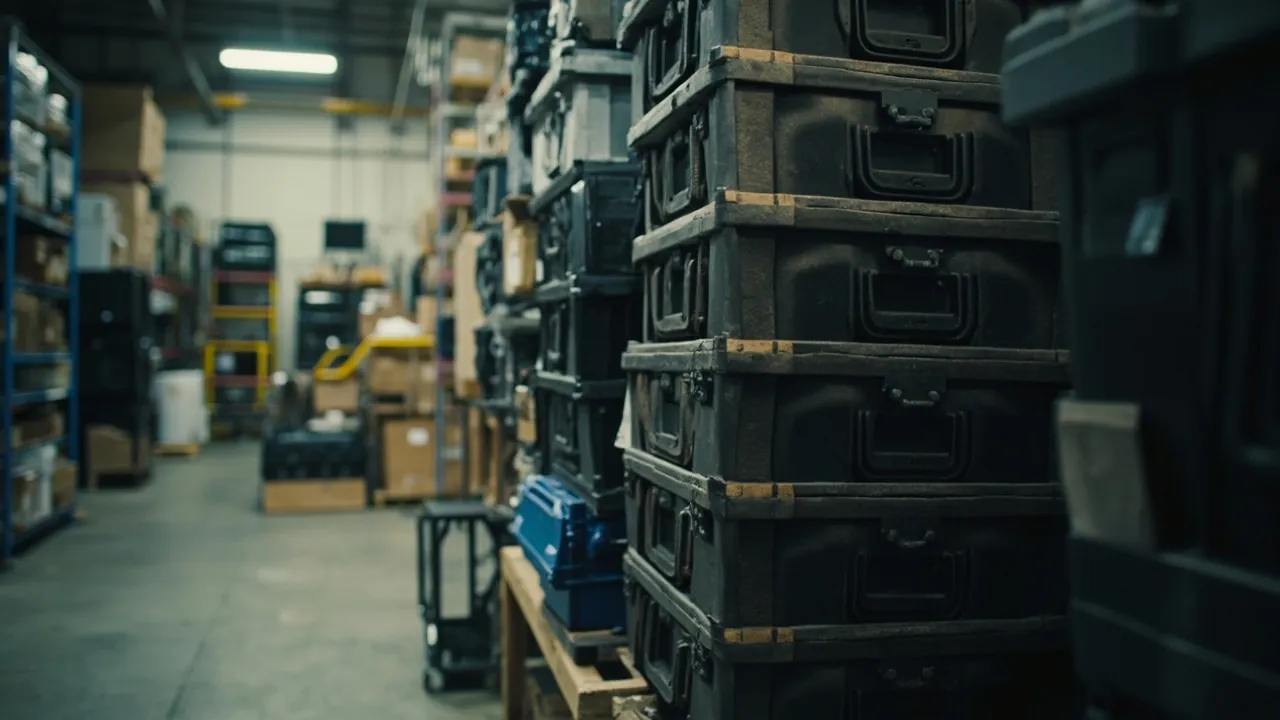
Short answer: yes, military ammo boxes can be stacked, but "how many layers" is not a fixed property of the box. It is a function of four variables: the box's long-term allowable compressive load, the gross weight per box, the storage duration, and the ambient temperature. Under room-temperature, fully loaded, short-term conditions, a well-designed engineering-plastic military-specification storage case typically stacks safely to 3-5 layers. Extend the stacking period to several months, or raise the warehouse temperature above 40 degrees Celsius, and the safe number of layers often drops to 2-3. The reason is that plastics are viscoelastic: unlike steel, a plastic case does not simply hold or collapse, it deforms slowly and permanently under sustained load. This is creep, and it accelerates with temperature and time. Treating a plastic case as a rigid steel body is the single most common stacking misjudgement in warehouses. This article sets out the three mechanical criteria for stacking, a reproducible layer-calculation formula, a lookup table by content weight, a five-step floor procedure, and eight failure patterns with their causes.
The real difficulty with stacking is that it sits at the intersection of four functions: procurement (case strength specification), warehousing (layer count and floor conditions), logistics (palletisation and transport loads), and safety (toppling and falling risk). Most suppliers give only a qualitative "stackable" claim, with no layer curve and no test conditions. The result is that the same case is stacked to very different heights in different warehouses, and when damage occurs there is no agreed basis for deciding who is responsible. This article separates stacking into three independent criteria, compression, stability and creep, and maps them to the test methods and documentation used in military packaging systems, so that a buyer can write stacking requirements into an enquiry and a technical agreement instead of arguing after a failure.
Table of Contents
- Short Answer: Layer Count Depends on Four Variables
- Clearing Up Terms: Stacking, Stacking Load and Palletisation
- Criterion One: Where Compressive Strength Comes From
- Criterion Two: Stacking Stability and the Toppling Boundary
- Criterion Three: Creep, the Deepest Difference Between Plastic and Steel
- How to Calculate Layer Count: A Reproducible Formula
- Military and Transport Packaging Stacking Standards
- Rules for Distributing Content Weight
- The Hidden Influence of Temperature and Time
- Five-Step On-Site Stacking Procedure
- Warehouse Floor and Pallet Requirements
- Stacking Layer Lookup Table
- Common Errors and Failure Patterns
- Customisation and OEM: Designing the Case Backwards from the Stacking Duty
- FAQ
- Conclusion and Related Reading
Short Answer: Layer Count Depends on Four Variables
Many people assume the stack height is a fixed specification printed on the case. That is a misunderstanding. The layer count is really a question of whether the accumulated static load carried by the bottom case exceeds its long-term allowable load, and that allowable load changes with content weight, storage duration and temperature. Of the four variables, compressive strength is set by structure and material and is relatively fixed; content weight is set by loading; stacking duration and temperature are set by the warehouse environment and are variable.
A responsible supplier therefore should not give a bare conclusion such as "stacks to five layers", but rather a conditional statement, for example: "at 23 degrees Celsius, fully loaded at 20 kg, stacked for 30 days, four layers with no permanent deformation". The buyer's job is to substitute the actual warehouse conditions, the maximum temperature, the longest storage period and the gross weight per box, then apply a safety margin. A layer commitment without conditions has almost no engineering meaning.
The core stacking safety inequality: the accumulated static load on the bottom case must not exceed the case's long-term allowable compressive load multiplied by the safety factor.
When the two sides are close, nothing may be visible in the short term, but after several months the bottom case develops irreversible bulging, rim distortion or seal failure. That is the classic signature of a stacking failure.
Clearing Up Terms: Stacking, Stacking Load and Palletisation
Three terms are often used interchangeably in daily conversation but must be separated in engineering judgement, because they correspond to completely different load models.
- Stacking: the general act of placing cases on top of one another. It is a description of a state, with no layer count or time condition attached.
- Stacking load: the state in which a case carries a sustained static load. This is a mechanical concept, concerned with long-term load and deformation, and corresponds to static stacking tests such as GB/T 4857.3 and ISO 2234.
- Palletisation: placing cases onto a pallet for handling as a unit. The focus is unit-load stability, stretch-wrap restraint and forklift operations, and the load model includes the stiffness and deflection of the pallet itself.
The relationship is: stacking is the action, stacking load is the resulting static load, and palletisation is how it is moved mechanically. Confusing them leads either to answering "can it be stacked" when the question was "how many layers", or to running only a compression test and omitting a static stacking test, which misses the time dimension.
In military packaging there is also the design term "stackable structure", meaning that the lid and base have interlocking steps or recesses so that cases align and share lateral forces. This is a different matter from mere load-bearing capacity: the former addresses stability, the latter addresses compressive strength, and they must be assessed separately. For the load-bearing structure itself, see how high-strength case structures are designed.
Criterion One: Where Compressive Strength Comes From
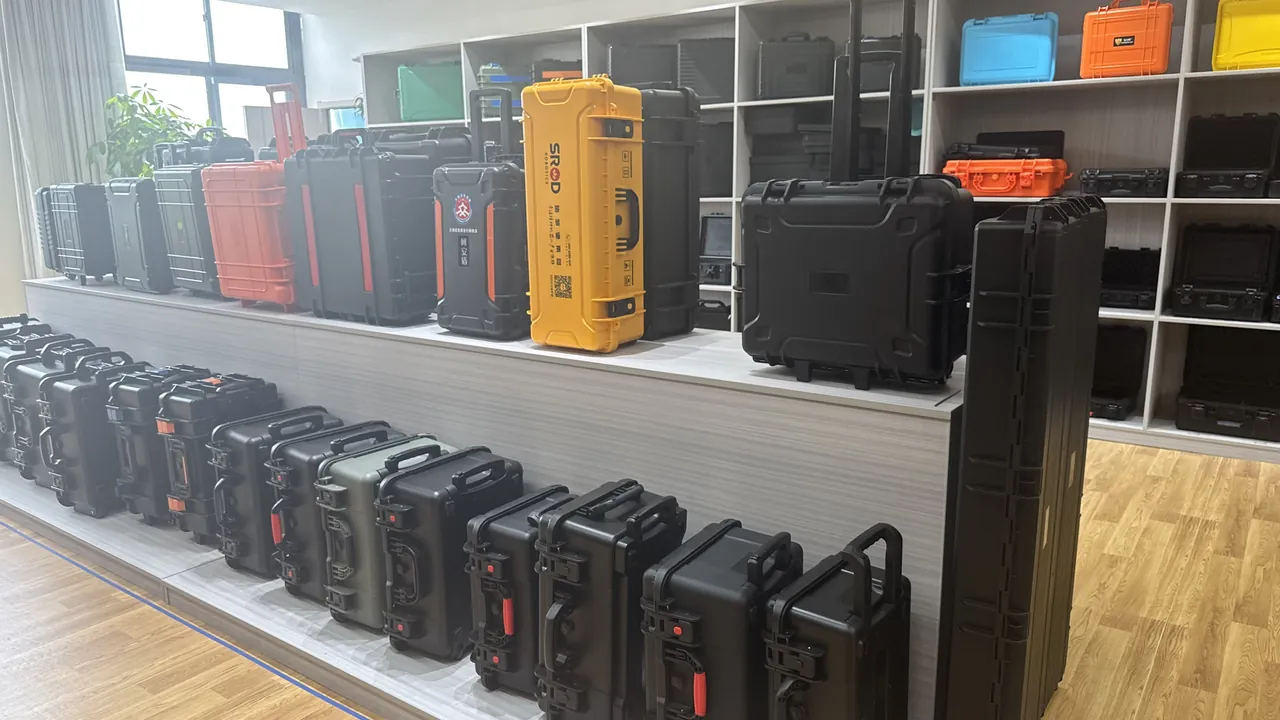
Compressive strength is not simply a matter of thicker walls. It is determined by cross-section geometry, reinforcement rib layout, material modulus and manufacturing process. Understanding this is what allows a buyer to judge the real gap between products of the same outer dimensions.
First, the second moment of area. In bending and compression, the further material sits from the neutral axis, the greater its contribution. A thin-walled case with deep reinforcement ribs can have a far higher second moment of area than a thick-walled but flat case. This is why many military-specification cases show clear longitudinal and transverse ribs: they are not decoration but a way of placing material where it is most effective. See the design role of reinforcement ribs.
Second, material modulus. At the same dimensions and structure, polypropylene (PP), ABS and polycarbonate (PC) differ in rigidity, low-temperature impact resistance, surface hardness, dimensional stability and toughness. Material choice directly affects long-term deformation, and the comparison is covered in PP, ABS and PC case materials compared.
Third, amplification of geometric defects. The case rim is the weakest part of a thin-walled case, because the opening interrupts the cross-section. Without a folded edge or reinforcing ring, the rim deforms preferentially inward or outward under load, which then causes seal failure. Rim cross-section design often matters more to stacking performance than wall thickness.
Fourth, residual stress from manufacturing. Residual stress in injection-moulded parts, and the quality of welds or joints, become initiation points under load. For the same structure, a well-controlled process and a poorly controlled one can differ by a full performance grade in long-term stacking.
Combining these four points: short-term compressive strength can be measured, but what actually governs stacking safety is long-term compressive strength, that is, the allowable load after creep and temperature reduction. This is why the figure on a compression test report cannot be used directly as the allowable stacking load.
Criterion Two: Stacking Stability and the Toppling Boundary
Compressive strength answers "will it be crushed", stability answers "will it fall over". In warehouses the latter is often the more frequent accident, because a collapse is a chain reaction, whereas compression failure usually gives slow deformation as a warning.
Centre-of-gravity height is the core of stability. The higher the centre of gravity of the whole stack, the worse the resistance to toppling. In practice, heavy boxes belong at the bottom and light ones on top. This is not merely habit but has a mechanical basis: lowering the centre of gravity markedly improves resistance to lateral forces such as collisions, earthquakes and forklift contact.
The ratio of base area to height. For a given case type, a larger ratio of stack height to base width approaches a slender column and is more prone to instability. As a rule of thumb, keep the overall height-to-width ratio, stack height divided by the shorter base side, within 3. Above 4, even if compressive strength is sufficient, reduce the layers or switch to racking.
The role of interlocking and cross-bonding. If the case design has interlocking steps, adjacent layers engage laterally and reduce independent sliding. Without interlocks, a cross-bonded pattern, rotating every other layer by 90 degrees, raises friction restraint, provided the case dimensions allow it.
Restraint by stretch wrap and strapping. After palletisation, wrapping the whole stack and adding top compression greatly improves resistance to lateral forces. This is a low-cost, high-value stability measure, but note that stretch wrap provides lateral restraint and cannot substitute for vertical compressive capacity, so layers must not be added merely because the stack is wrapped.
Floor flatness and pallets. An uneven floor distributes load unevenly, so some support points carry far more than average and fail first. The overall design logic is discussed in stacking structure design points.
Criterion Three: Creep, the Deepest Difference Between Plastic and Steel
If the first two criteria are rigid-body thinking, creep is the time dimension that plastic packaging must address on its own. Steel ammo cans can carry heavy long-term stacking loads partly because steel barely creeps at room temperature, whereas engineering plastics creep even at ambient temperature, only more slowly.
Creep shows up as deformation that grows with time. Apply a constant load to a plastic case and the initial deformation is elastic and recovers when the load is removed; but if the load continues, deformation keeps increasing slowly, and that added part is not recoverable. For stacking, this means the deformation measured today does not represent the deformation three months from now.
Temperature is the accelerator. Raising temperature speeds up molecular relaxation and therefore creep. As a rule of thumb, every 10-15 degrees Celsius may multiply the creep rate several times. This is why the same batch behaves very differently in an air-conditioned warehouse and in a metal-sheet warehouse that can exceed 45 degrees Celsius in summer. If the environment cannot be temperature-controlled, the safe layer count must be taken from the maximum-temperature condition.
Long-term allowable load is usually far below short-term compressive strength. In industry practice, the long-term stacking allowable load is often taken as 30-50 percent of short-term compressive strength, depending on material, temperature and the intended period. Long-term storage over three or five years should take the conservative end. The gap between long-term and short-term is much smaller for steel, as discussed in why military steel ammo cans suit long-term storage.
Sealing is also affected by creep. If the case rim deforms irreversibly under long-term load, the compression of the seal changes and water resistance falls with it. For long-term stacking, therefore, it is not enough to ask "will it be crushed"; the question "does the seal still work" must also be answered. See are waterproof ammo boxes really waterproof.
How to Calculate Layer Count: A Reproducible Formula
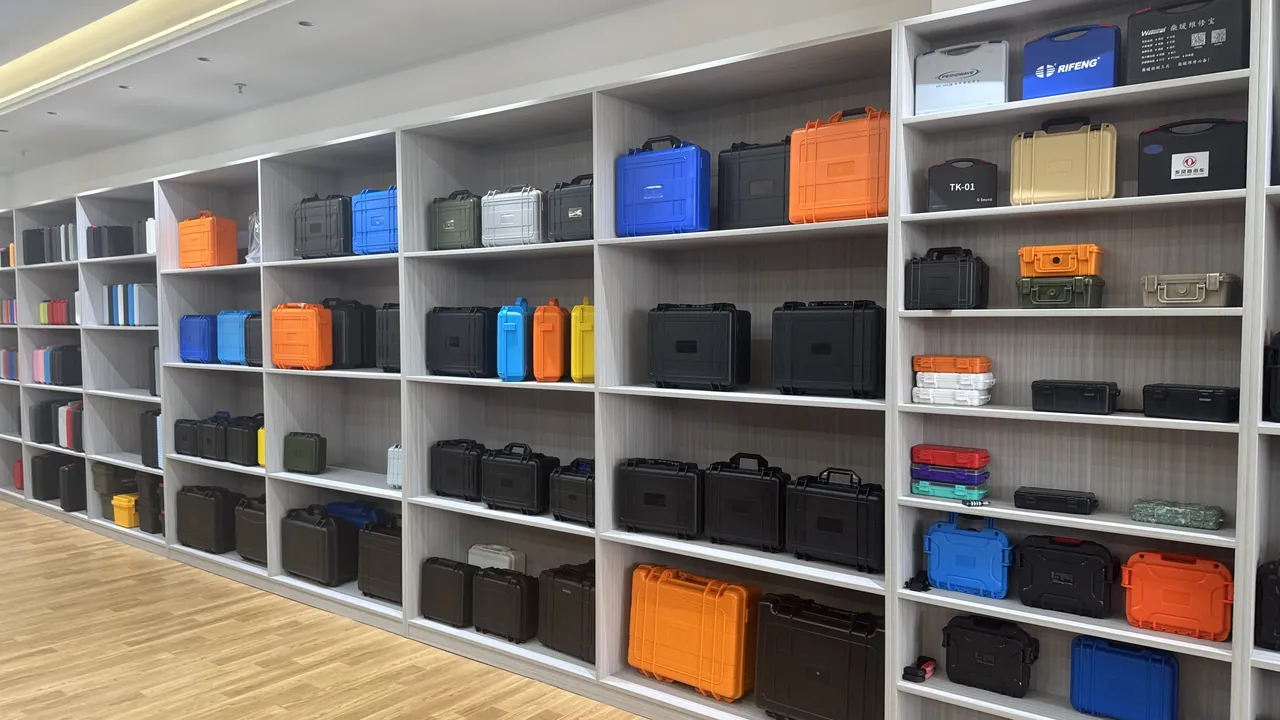
To turn the three criteria into an operational estimate, a clear formula is needed. The following simplified model is common in engineering practice for rectangular cases, uniformly distributed loads and static storage.
Maximum layers N equals (long-term allowable load x safety factor) divided by (gross weight per box x g), minus 1, taking the integer part.
Where:
- Long-term allowable load: the case's long-term allowable compressive load in kilonewtons, obtained by multiplying short-term compressive strength by a long-term reduction factor. In practice, run a static stacking test (GB/T 4857.3 or ISO 2234) or apply a 30-50 percent reduction to the short-term strength.
- Safety factor: for static warehouse loading, 1.5-2.0 is typical; transport stacking conditions require more.
- Gross weight per box: including contents, in kilograms.
- g: gravitational acceleration, about 9.8 metres per second squared.
- Minus 1: the bottom case does not carry load above the top of the stack, so the number of upper layers is N and the total number of layers is N plus 1.
Example. Suppose a static stacking test at 23 degrees Celsius over 30 days gives a long-term allowable load of 4.0 kilonewtons, the safety factor is 1.6, and gross weight per box is 25 kg. The allowable upper load is 4.0 x 1.6, about 6.4 kilonewtons, or roughly 653 kg; divided by 25 kg gives 26.1, that is, up to 26 layers. That seems large because the long-term allowable load is idealised. In reality a case often only has a short-term compressive strength, which must be reduced first. If the short-term strength is 12 kilonewtons and the reduction factor is 35 percent, the long-term allowable load is about 4.2 kilonewtons and the result is similar.
Two boundary conditions apply. First, the formula assumes the load is evenly distributed around the rim; if contents are offset, local pressure is much higher than average and N should be reduced. Second, the formula does not couple temperature and time; if the maximum warehouse temperature is a significant fraction of the material's heat-deflection temperature, reduce the long-term allowable load further. The formula gives an upper reference, not a final value.
Military and Transport Packaging Stacking Standards
Stacking cannot rely on estimation alone; test reports are the basis for procurement and acceptance. In military and transport packaging systems the directly relevant standards fall into a few groups.
| Standard | Title (abbreviated) | Loading method | Primary use |
|---|---|---|---|
| --- | --- | --- | --- |
| GB/T 4857.3 | Transport packages, static stacking test | Constant static load | Long-term warehouse stacking |
| GB/T 4857.4 | Transport packages, compression test | Constant-rate platen | Short-term compressive strength |
| ISO 2234 | Complete, filled transport packages, stacking tests | Static or compression | International transport and storage |
| ASTM D642 | Compressive strength of shipping containers | Compression | Baseline strength value |
| ASTM D4169 | Performance testing of shipping containers and systems | Combined programme | Full-chain transport validation |
| ISTA 3A | Packaged products for parcel delivery | Combined programme | Parcel and small-package shipping |
The key distinction is between measuring strength and measuring stacking. A compression test such as GB/T 4857.4 measures the maximum load a case carries under continuous compression and produces a strength number; a static stacking test such as GB/T 4857.3 measures deformation after long-term loading at a specified load and produces a durability conclusion. If a buyer receives only a compressive strength report, the follow-up question should be whether a static stacking test was done, and under what temperature, duration and pass criteria.
Military packaging systems usually do not have a standalone stacking standard; stacking is treated as part of environmental suitability testing alongside vibration, shock, drop and temperature-humidity cycling. A military-specification case's stacking capability therefore appears in a complete environmental test report rather than in a single figure. For the full set of certifications, see what certifications an ammunition transport box needs.
Rules for Distributing Content Weight
The load in stacking comes from content weight, so how contents are distributed directly determines stacking performance. The following rules are practical.
- Heavy items centred, light items to the sides. Place the densest parts at the bottom centre so that load passes through the base to the centre of the case below, avoiding concentration at the rim.
- Avoid bridging and unsupported spans. If contents span a base cavity supported only at two points, the base bends locally and forms a depression over time. Fill the base with a lining.
- Fill voids to eliminate movement. Gaps between contents and walls allow shifting, producing dynamic shock with peaks far above the static load. Foam or dividers are the basic remedy; options are covered in types of case internal foam.
- Set a gross weight ceiling. The comfortable range for repeated single-person handling is 20-25 kg, extendable to about 30 kg for short, occasional lifts. The ceiling affects not only handling safety but also the number of layers, since gross weight is the denominator of the formula.
- Equal weight within a layer, decreasing upward. Keep each layer of similar weight to avoid point loading, and place heavier boxes lower to reduce the overall centre of gravity.
One commonly overlooked point: linings consume volume and change weight distribution. Thick foam improves protection per box but raises gross weight and thus reduces the layer count. For long-term storage, lining thickness and layer count should be optimised together rather than each taking its maximum. See factors in custom case foam.
The Hidden Influence of Temperature and Time
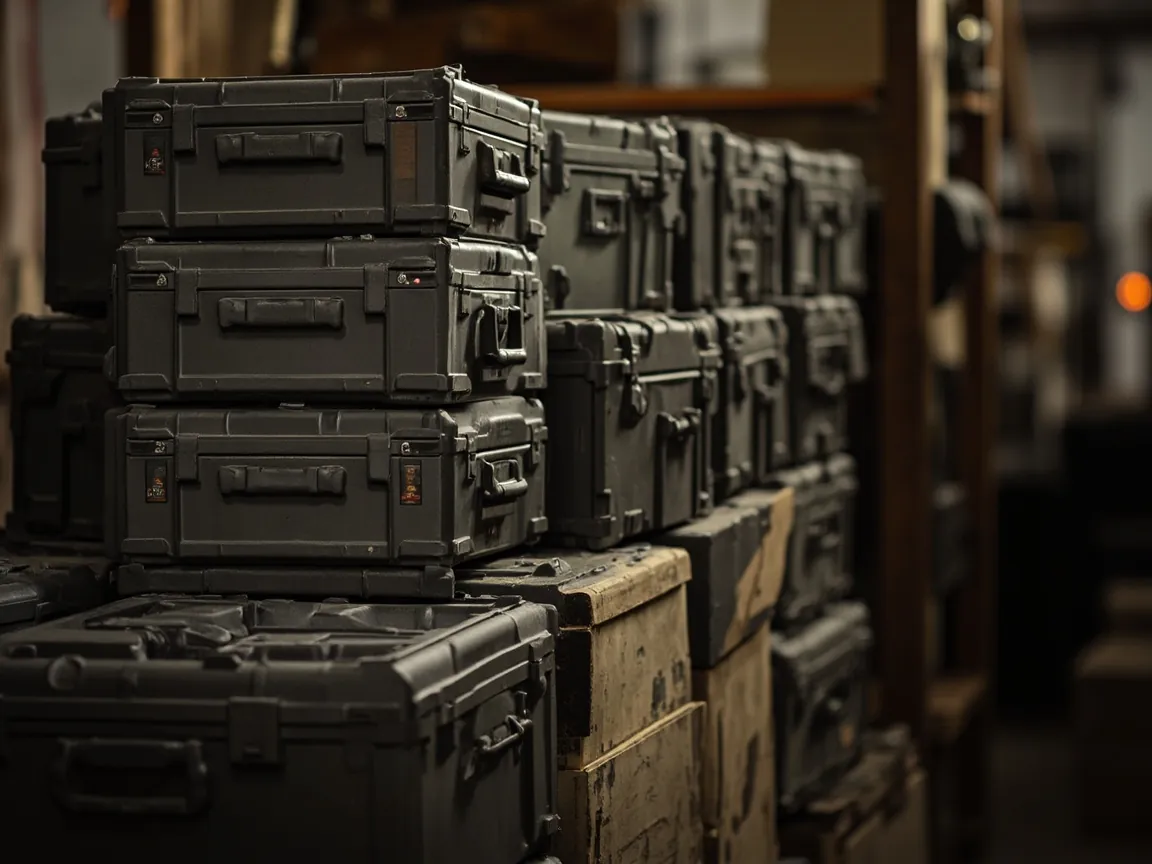
In post-incident reviews, temperature and time are almost always the two underestimated factors. They do not change the load, but they change the case's ability to carry it, which makes them classic hidden variables.
Temperature acts in two ways. On one hand, higher temperature accelerates creep and lowers the long-term allowable load; on the other, as temperature approaches the material's heat-deflection temperature, rigidity falls markedly and the rim deforms more easily. The top layer in an uncooled warehouse can reach surface temperatures well above ambient, making top layers the most creep-affected.
Time changes the pass criteria. A case that performs well in a seven-day test may show unacceptable deformation after twelve months of storage. Long-term storage projects should therefore ask the supplier for longer static stacking data, or apply a more conservative reduction factor directly.
Temperature and humidity combine. A hot, humid environment accelerates creep and also affects seal ageing and metal corrosion. For long-term storage, seal material selection and replacement cycles must be considered; see how to choose case seal materials.
Practical advice. If the warehouse cannot be temperature-controlled, design to the local summer maximum plus 5 degrees Celsius. If the stacking period exceeds six months, raise the safety factor from 1.5-2.0 to 2.0-2.5 and reduce the layer count. Better to stack two layers fewer than to discover a failed bottom seal months later.
Five-Step On-Site Stacking Procedure
Turning the criteria into practice requires an executable, checkable procedure. The five steps below can be written directly into a warehouse standard operating procedure.
- Step one: confirm the duty. Record gross weight per box, whether contents are offset, the maximum warehouse temperature and the intended storage period. All four are required.
- Step two: determine the layer count. Use the formula or the lookup table, and obtain static stacking test data for the corresponding conditions from the supplier as support.
- Step three: check the floor and pallet. The floor should be level, firm and free of hollows; the pallet intact and not broken; the case should sit flush with or slightly inside the pallet edge.
- Step four: stack by the rules. Heavy at the bottom, light on top, centred and aligned, cross-bonded or interlocked, equal weight per layer; after each layer, visually check for obvious tilt or bulging.
- Step five: restrain and label. Wrap the stack, add strapping where needed, and mark the maximum layer count, gross weight per box and stacking date prominently so that periodic review is possible.
The value of this procedure is that it makes both responsibility and criteria explicit: if deformation occurs, it is possible to establish quickly whether the duty exceeded the design, the procedure was violated, or the product was defective, instead of trading blame.
Warehouse Floor and Pallet Requirements
The floor and pallet are the starting point of the load chain and the most easily overlooked link in accidents.
Floor flatness. A local rise causes the case above it to carry far more than average and fail first; a hollow leaves insufficient support and promotes tilting. Warehouse floors should be controlled for flatness to the relevant building standard, and obvious unevenness checked visually before stacking.
Floor load capacity. The whole stack weight ultimately reaches the floor slab, so the allowable floor load must exceed the total stack weight divided by the footprint. This matters especially for dense, heavy stacks.
Pallet quality. The pallet is the transition structure between case and floor. Wooden pallet moisture content, breaking load and deflection all affect stacking; plastic and steel pallets are stiffer but their dynamic and static load ratings must be confirmed. Excessive pallet deflection bends the case bottom and adds local stress.
Moisture isolation. Cases placed directly on a damp floor take up moisture at the base. An isolating layer between pallet and floor with ventilation underneath is recommended.
Zoning and aisles. High stacks should be kept away from busy aisles and forklift operating zones to reduce collision and toppling risk; different stack heights and categories should be zoned to avoid uneven loading from mixed storage.
Stacking Layer Lookup Table
The table below gives practical ranges for different conditions, for quick judgement and enquiry communication. All values are typical or empirical; actual projects should rely on case drawings, material data and test reports.
| Gross weight per box | Short-term compressive grade | Room temp, short term (up to 30 days) | Room temp, long term (6-12 months) | Hot long term (40 C plus, 6 months plus) |
|---|---|---|---|---|
| --- | --- | --- | --- | --- |
| Up to 10 kg | High (15 kN plus) | 6-8 layers | 4-6 layers | 3-4 layers |
| Up to 10 kg | Medium (8-15 kN) | 4-6 layers | 3-4 layers | 2-3 layers |
| 10-20 kg | High (15 kN plus) | 5-7 layers | 3-5 layers | 2-3 layers |
| 10-20 kg | Medium (8-15 kN) | 3-5 layers | 2-4 layers | 2 layers |
| 20-30 kg | High (15 kN plus) | 4-5 layers | 3-4 layers | 2 layers |
| 20-30 kg | Medium (8-15 kN) | 3-4 layers | 2-3 layers | 3 layers not advised |
| Over 30 kg | Any grade | 2-3 layers | 2 layers | 2 layers with pallet restraint |
"High" and "medium" refer to relative short-term compressive grades; confirm with the supplier's test report. Use the table by locating the gross weight and storage period, then check that the overall height-to-width ratio stays within 3; if it is larger, reduce by one layer.
Common Errors and Failure Patterns
The eight errors below are the most frequent causes of stacking failures, with consequences and corrections listed for direct use in staff training.
| Common error | Immediate consequence | Correction |
|---|---|---|
| --- | --- | --- |
| Using short-term strength as allowable stacking load | Irreversible bottom deformation after months | Run a static stacking test or apply 30-50 percent reduction |
| Ignoring warehouse temperature | Faster creep, rim collapse in hot warehouses | Design to maximum temperature; cool if possible |
| Heavy boxes on top | Higher centre of gravity, easier toppling | Heavy at the bottom, light on top |
| Excessive height-to-width ratio | Slender-column instability, chain collapse | Keep ratio within 3 or use racking |
| Contents unfilled and unfixed | Dynamic shock in transit, base depressions | Fill with foam or dividers to stop movement |
| Uneven floor or broken pallet | Local overload, tilting collapse | Inspect floor and pallets before stacking |
| No layer marking or review | Over-stacking goes unnoticed, problems accumulate | Mark the limit and review periodically |
| No seal assessment for long-term stacking | Rim distortion, loss of water resistance | Assess seal compression for long-term duty |
Most failures are not caused by insufficient product strength but by a mismatch between duty and criteria. Putting service conditions and strength figures on the same table is the most effective way to avoid misjudgement.
Customisation and OEM: Designing the Case Backwards from the Stacking Duty
When a standard case cannot meet a particular stacking duty, custom design is the reasonable path. The correct logic is not "choose a case and then see whether it stacks", but "define the stacking duty and design the case backwards from it".
Step one: quantify the duty. Specify layer count, gross weight per box, storage period, maximum temperature and whether palletised. These five form the design input.
Step two: derive the long-term allowable load. Work backwards from the layer formula to the required long-term allowable load, then apply the safety factor to obtain a target short-term compressive strength.
Step three: structural design. Achieve the target through a reinforcing rim, rib layout, wall-thickness distribution and material selection. Evaluate PC or PC/ABS blends where toughness is needed, or modified PP where rigidity is needed.
Step four: test validation. Run a static stacking test to GB/T 4857.3 or ISO 2234, full-chain transport validation to ASTM D4169 or ISTA where required, and protection rating validation to IEC 60529 or GB/T 4208-2017.
Step five: documentation. Deliver test reports, material certificates and a service-conditions statement that states clearly how many layers are permitted under which duty.
JUNZHJIA, manufactured by KeXin New Materials (Guangdong) Co., Ltd., produces protective cases, tool boxes, military-specification storage cases and waterproof junction boxes, and can design case structure and material solutions backwards from a stacking duty, with custom linings, seals and test documentation, serving wholesale, distribution, OEM/ODM and global supply. For how such cases differ from ordinary storage boxes, see military ammo box versus ordinary storage box.
FAQ
Q: How many layers can a military ammo box actually be stacked to? Is there a universal figure? A: There is no universal figure, because the layer count depends on four variables: the case's long-term allowable load, gross weight per box, storage duration and temperature. For an engineering-plastic military-specification case at 23 degrees Celsius, gross weight 10-20 kg and a storage period up to 30 days, the typical safe number is 4-6 layers. Extend the period to 6-12 months and it usually falls to 3-4 layers; raise the maximum warehouse temperature above 40 degrees Celsius and it falls further to 2-3 layers. Steel cases, with negligible creep at room temperature, generally permit more layers under the same conditions. Buyers should require conditional layer data, for example "23 degrees Celsius, 15 kg per box, 30 days, four layers with no permanent deformation", rather than accepting an unconditional "stacks to five layers". Applying actual conditions and a safety margin is the reliable approach.
Q: Why does a case that is very strong in the short term still collapse after months of stacking? A: This is creep, not insufficient strength. Engineering plastics deform slowly and permanently under constant load, faster at higher temperature. Short-term compression tests usually finish within hours to tens of hours and measure instantaneous capacity; real storage lasts months, a difference of more than a hundred times in duration, so the creep deformation is naturally significant. Short-term compressive strength is a baseline only and cannot be used directly as the long-term allowable load. The common engineering approach is to reduce short-term strength by 30-50 percent as the long-term allowable load, taking the conservative end for long-term storage, and to verify with a static stacking test such as GB/T 4857.3 or ISO 2234. If the warehouse cannot be temperature-controlled, the reduction should be more conservative. Also check whether the rim has deformed and whether the seal has failed, because creep usually shows at the rim first.
Q: What is the essential difference between plastic and steel cases in stacking? A: The essential difference is the time dimension. Steel creeps extremely slowly at room temperature and can be treated as non-creeping, so a steel case's long-term allowable load is close to its short-term compressive strength. Engineering plastics creep at ambient temperature, and the long-term allowable load is usually only 30-50 percent of short-term strength. This leads to three practical differences. First, a steel case's layer commitment is insensitive to time, whereas a plastic case's must state the storage period. Second, plastic cases are more temperature-sensitive, so the layer count for hot storage should be reduced, while steel is less affected. Third, over long-term compression a plastic case rim may deform and affect sealing, so seal reliability must be assessed, while steel is mainly a matter of corrosion. Selection should not compare who is sturdier in the abstract but combine storage period and temperature.
Q: Does palletisation increase the number of layers that can be stacked? A: Palletisation mainly improves stability and handling efficiency and does not directly raise the pure compressive layer count, though it helps indirectly. Stretch wrap and strapping provide lateral restraint, preventing sliding and collapse; this is a stability benefit. They do not change the vertical static load on the bottom case, so layers must not be added merely because the stack is wrapped. The indirect benefits come from two sources: the pallet distributes load more evenly, reducing local overload from an uneven floor, and standardised unit loads make it easier to move from high stacks to racking, which replaces stacking with shelving and fundamentally reduces vertical load. A common mistake is to mistake the stability effect of stretch wrap for load-bearing capacity and over-stack. Lateral restraint answers "will it fall", vertical capacity answers "will it be crushed", and the two are assessed separately.
Q: How can I quickly judge on site whether a stack is safe? A: Four visual and simple measurement checks will do. First, check that the stack is vertical, using a plumb line or visual alignment; obvious tilt indicates uneven loading or an uneven floor. Second, check the bottom rim; outward bulging, inward denting or a lid that will not close indicates the vertical static load is at or beyond the allowable value. Third, measure the height-to-width ratio, which should not exceed 3; above that, reduce layers or switch to racking. Fourth, check the marking and records to confirm the stack is within the layer limit and the stacking date is within the intended period. For long-term storage, review monthly, focusing on the bottom and top layers: the bottom for deformation, the top for temperature-driven creep. If irreversible deformation appears, unload and re-stack immediately, and record the duty data to recalculate the layer count.
Q: Does a heavier content mean fewer layers? A: Yes, and it is the most direct relationship. In the formula, gross weight per box is in the denominator: the heavier the box, the greater the load from each upper layer and the fewer the layers. Two effects compound this. First, heavy loads usually need thicker walls or stronger structure, which increases case self-weight and raises gross weight further. Second, offset heavy contents can produce local pressure far above average, requiring another discount on the layer count. The practical approach is to keep gross weight per box within the comfortable 20-25 kg handling range, which aids both manual handling and stacking; for boxes over 30 kg, switch to pallet-plus-racking and move from stacking to shelving, avoiding sustained vertical load and creep failure.
Q: Should long-term storage stacks leave extra margin? A: Yes, and more conservatively than usual. Three reasons apply. First, creep accumulates over long-term stacking; as a rule, the allowable load for long-term storage should be about 30 percent of short-term compressive strength, or lower, with the safety factor raised to 2.0-2.5 and the layer count reduced accordingly. Second, long-term storage involves seasonal temperature and humidity swings, and summer heat accelerates creep, so the layer count should be based on the annual maximum temperature. Third, sustained compression affects rim sealing, so if contents are humidity-sensitive, assess the long-term change in seal compression and reduce layers if necessary. A practical approach is to reduce one further layer below the lookup table for long-term storage and place a humidity indicator card inside the case for periodic checks.
Q: When customising a case, what stacking requirements should go into the enquiry? A: At least six items, since omitting any one can shift the design. First, the target layer count and overall stack height limit. Second, gross weight per box and whether contents are offset. Third, storage period (short or long term) and maximum warehouse temperature. Fourth, whether palletised, plus pallet size and forklift handling. Fifth, whether it is also used in transport, which adds transport stacking load and requires a larger safety factor. Sixth, the required tests and documents, such as a static stacking test report to GB/T 4857.3 or ISO 2234, transport validation to ASTM D4169 or ISTA, and protection rating reports to IEC 60529 or GB/T 4208-2017. JUNZHJIA can design structure and plan tests from these six items and provide conditional layer recommendations.
Q: Can the numbers in the lookup table be used directly? A: They are a quick reference only, not a design or acceptance basis. The table is compiled from typical conditions and makes several simplifying assumptions: uniform load distribution, a level floor, a conventional medium-to-high strength structure, and single values for each condition. In practice any deviation changes the result. Offset contents raise local pressure and reduce the safe layer count; an uneven floor causes local overload; a warehouse temperature above the assumption accelerates creep. The correct use is to locate a reasonable range with the table, obtain test data for the corresponding conditions from the supplier, then check with the formula using actual conditions. Projects involving long-term storage, high-value contents or clear safety responsibility should rely on test reports.
Conclusion and Related Reading
Returning to the title question: military ammo boxes can be stacked, but the safe layer count is jointly determined by the case's long-term allowable compressive load, gross weight per box, storage duration and temperature, and there is no universal number. A plastic case's long-term allowable load is usually only 30-50 percent of its short-term compressive strength, and it falls as temperature rises and time lengthens; steel cases are far less time-sensitive. Assess the three criteria, compression, stability and creep, separately, locate the range with the formula or the lookup table, and back it with a static stacking test report, and stacking safety moves from experience to a verifiable conclusion.
Three practical recommendations: first, quantify the duty before setting the layer count, writing gross weight per box, storage period, maximum temperature and palletisation into the design input. Second, obtain conditional stacking data and test reports from the supplier, and do not accept unconditional layer commitments. Third, allow margin for long-term storage and review periodically, focusing on bottom deformation and top-layer temperature.
JUNZHJIA, manufactured by KeXin New Materials (Guangdong) Co., Ltd., produces protective cases, tool boxes, military-specification storage cases and waterproof junction boxes, serving wholesale, distribution, OEM/ODM and global supply, and can design case structure and material solutions backwards from a stacking duty with supporting test documentation.
Related Reading