

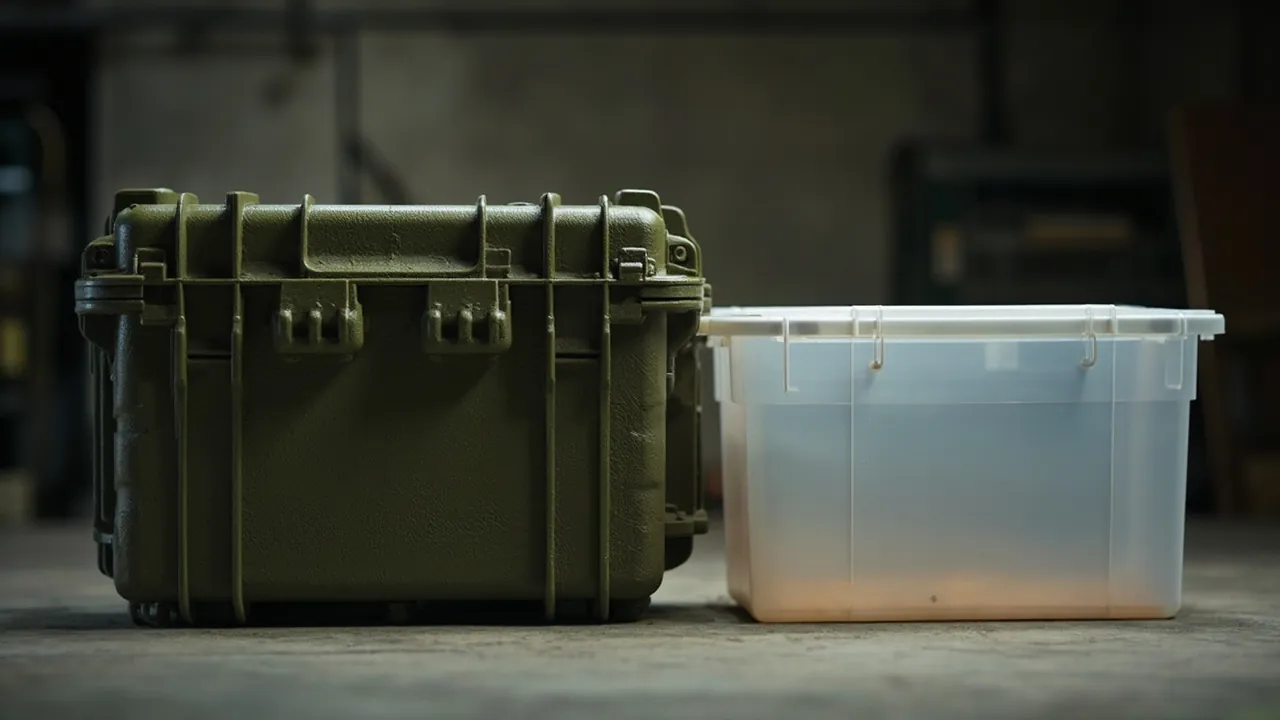
Short answer: the difference between a military-specification case and a general-purpose storage box is not "sturdier versus cheaper". It is a difference between four entirely different design briefs. A general storage box is designed to "hold things at minimum cost, indoors, with someone watching, at manageable weight". A military-specification case is designed to "keep the contents intact while unattended, stacked in the open, transferred repeatedly, exposed to wide temperature and humidity swings, and possibly briefly submerged". Those two briefs produce four hard differences: the material moves from thin-wall recycled polymer to high-density polyethylene or a formed steel body; sealing moves from "close the lid" to a compression seal seated in a machined groove; structure moves from a flat panel with ribs to a rigid frame with reinforcement grids and torsional resistance; and verification moves from "it closes" to traceable testing against frameworks such as MIL-STD-810H, IEC 60529 and ASTM D4169. For a B2B buyer, classifying a case does not require reading the marketing copy — it requires four inspections: wall thickness, seal architecture, latch type, and test documentation.
This article is written for engineers and procurement professionals. It takes the two categories apart across material, structure, sealing, latches, interior foam, stacking, transport compliance and cost structure; it sets out criteria you can paste directly into a technical agreement; and it quantifies the gaps in two comparison tables. All figures are stated as typical or empirical values. Final acceptance should always be based on the supplier's drawings and test reports.
Table of Contents
- Start with the conclusion: four hard differences drive the price gap
- Defining terms first: military-spec cases are industrial packaging
- Material comparison: from recycled PP to HDPE, steel and aluminium
- Wall thickness and stiffness: reinforcement ribs and torsional load
- Sealing systems: flat gaskets versus grooved compression seals
- Ingress protection: where IP54, IP65 and IP67 actually apply
- Latches, hinges and padlock points: life under repeated cycling
- Interiors: from open-cell sponge to CNC pre-cut foam
- Stacking and transport compliance: ASTM D4169 and the ISTA series
- Environmental reliability: MIL-STD-810H and ISO 9227 salt spray
- Capacity definitions: internal volume versus usable volume
- Cost structure: where the money actually goes
- Selection table and procurement recommendations
- FAQ
- Closing remarks and related reading
Start with the conclusion: four hard differences drive the price gap
Place the two categories side by side and the first things you notice are weight and feel. But the four items that decide service life and price are these.
- Different material systems. General storage boxes are typically thin-wall polypropylene (PP) or blended regrind, optimised for stiffness at low cost. Military-specification cases typically use high-density polyethylene (HDPE) or a modified copolymer PP, and some models are cold-rolled steel sheet, stamped and welded or formed as a single body, optimised for low-temperature impact resistance and ageing resistance.
- Different sealing principles. A general box often relies on a flat foam strip or a simple lip pressed face-to-face. A military-specification case machines a continuous groove into the lid rim and seats an O-ring or a profiled extruded gasket in it — a controlled-compression seal whose compression ratio is set by groove depth and latch travel together.
- Different structural stiffness. Military-specification cases carry grid reinforcement on the inner walls, thickened or capped corners, and hinges built around a through-going metal pin. That combination keeps the rim flat under stacking and torsional load — and rim flatness is what keeps the seal working year after year.
- Different verification depth. Ordinary boxes usually get a visual and load check. Military-specification supply can normally provide ingress protection test reports, drop and vibration testing, salt spray and thermal cycling, mapped to IEC 60529, GB/T 4208, MIL-STD-810H, ASTM D4169 and ISTA.
Stacked together, these differences produce a product that is heavier and more expensive per unit at the same volume, but often cheaper over its life — because it pushes down the two most expensive costs in any logistics chain: damaged contents and premature replacement. For a product-level introduction to the category, start with military ammo case versus storage box.
Defining terms first: military-spec cases are industrial packaging
In B2B procurement language, a "military ammo box" or "ammo can" refers to a class of rigid container engineered to military specification for the storage and transfer of equipment and supplies. Its core functions are four: resist compression while stacked, exclude moisture and dust, allow efficient handling, and support long-term warehousing. Its specification system comes from packaging engineering, not from any use behaviour, which is why every metric used to evaluate it is a measurable physical quantity:
- External dimensions and stacking footprint: whether they match standard pallet modules such as 1200 mm × 1000 mm and 1200 mm × 800 mm;
- Internal volume: expressed in litres or cubic decimetres, which sets load density;
- Tare weight and gross weight: which set manual handling limits and lifting requirements;
- Ingress protection: the two digits of the IP code;
- Stacking strength: the long-term static load the bottom case carries;
- Seal service life: measured in closure cycles or years.
Treating "50 cal box" or "ammo can" as a capacity class name is therefore both correct and professional. It works exactly like "20-foot container" or "IBC tote" — a designation for a packaging format. What genuinely matters in a purchase negotiation is cavity dimensions, wall thickness, seal type and stacking height, not the words in the product name.
One further point deserves emphasis: the divider system and interior lining are the second variable that decides load density and protection. The same shell fitted with open-cell sponge, CNC pre-cut foam or rigid divider boards can differ by more than thirty percent in usable volume and in handling efficiency. That is covered in the interior section below.
Material comparison: from recycled PP to HDPE, steel and aluminium
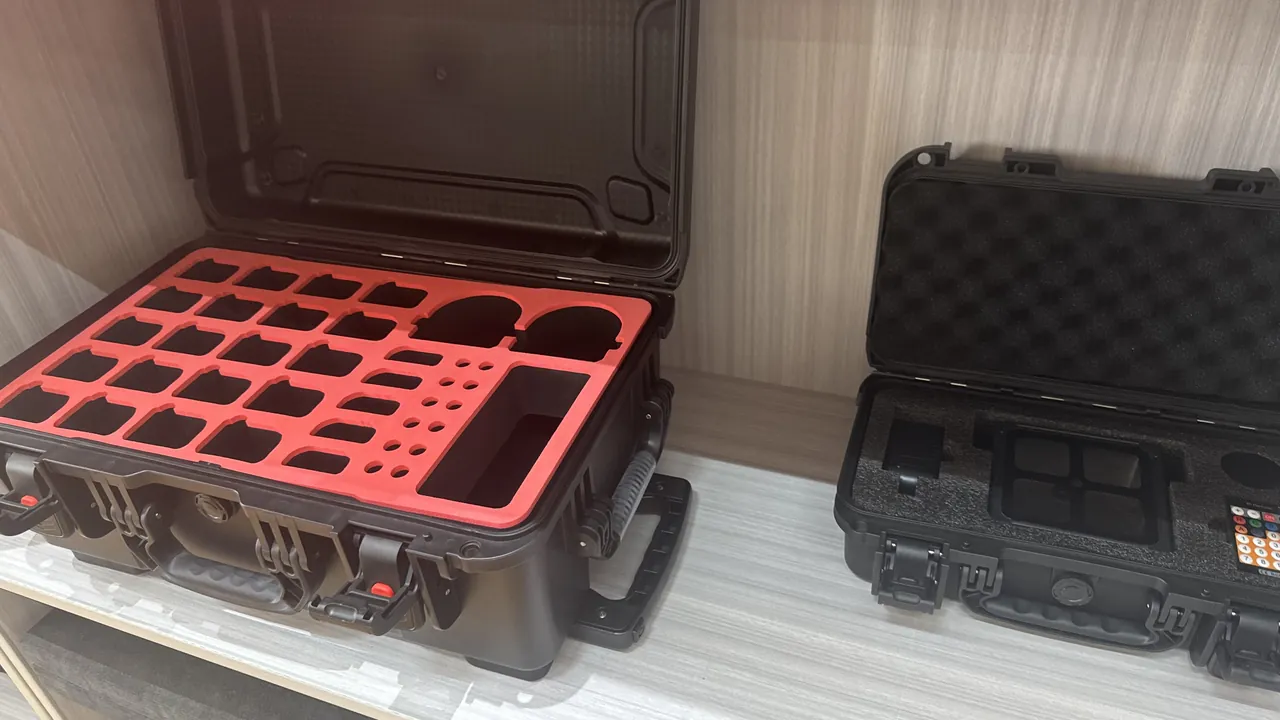
Material is the largest single source of price difference, and the easiest one to hide behind a similar-looking surface finish.
Polypropylene (PP) and copolymer PP. The workhorse of general storage boxes. Homopolymer PP is stiff and cheap but noticeably brittle at low temperature. Copolymer PP improves low-temperature impact by introducing ethylene segments and is the common upgrade for industrial-grade boxes. Typical service range is around -10 °C to +60 °C, and long-term UV exposure requires UV stabilisers, otherwise the surface chalks and the colour migrates. For the logic behind plastic selection, see protective case plastic materials.
High-density polyethylene (HDPE). The most common polymer for military-specification cases. HDPE's low-temperature impact resistance is clearly better than PP, retaining toughness at -30 °C to -40 °C, and its chemical resistance and moisture vapour transmission resistance are also superior. The trade-offs are lower stiffness, low surface hardness and easy scratching, so stiffness must be recovered through reinforcement ribs. Typical production routes are rotational moulding as a single piece, or large-tonnage injection moulding.
Cold-rolled and stainless steel. The traditional route for steel ammo-can style products. Cold-rolled sheet of roughly 1.0 mm to 1.5 mm is stamped, folded, welded or lock-seamed, then phosphated and painted, or galvanised. Steel bodies offer high absolute strength, weld-level sealing reliability and excellent stacking performance. The penalties are weight and the need for a corrosion protection system. Stainless variants (commonly 304/316 families) are clearly better in coastal and high-humidity environments at a corresponding cost. For the corrosion mechanism on the metal route, see why military steel ammo cans suit long-term storage.
Aluminium. Mainly 5052 and 6061 sheet, folded and riveted, with gasket strip and extruded frame corners. Aluminium cases are light, non-magnetic and visually refined, and are common for instrument and equipment transport. They resist local impact less well than steel, and dissimilar-metal contact points need isolation to prevent galvanic corrosion.
Engineering polymers and composites. Glass-fibre reinforced PA, PC/ABS alloys, and glass-reinforced plastic (FRP) sandwich structures. These appear where "high stiffness plus low weight" is the trade being made; cost is higher and applications tend to be specialised equipment cases.
| Material | Low-temp toughness | Stiffness | Moisture barrier | Corrosion | Typical weight | Relative cost |
|---|---|---|---|---|---|---|
| --- | --- | --- | --- | --- | --- | --- |
| Homopolymer PP | Fair | Higher | Medium | Good | Low | Lowest |
| Copolymer PP | Good | Higher | Medium | Good | Low | Low |
| HDPE | Excellent | Low (needs ribs) | Excellent | Excellent | Medium | Medium |
| Cold-rolled steel | Excellent | Excellent | Excellent (no seams) | Needs coating | High | Medium-high |
| 304/316 stainless | Excellent | Excellent | Excellent | Excellent | Highest | High |
| 5052/6061 aluminium | Good | Medium-high | Excellent | Good (needs isolation) | Low | High |
The selection logic is simple: fix the low-temperature limit and the moisture requirement first, then decide whether corrosion is acceptable, and only then look at weight and budget. Coastal, high-humidity and long-term storage duties favour HDPE or stainless. Where light weight matters for manual handling, HDPE and aluminium lead. Where maximum stacking strength is the governing requirement, a steel structure remains the safest answer.
Wall thickness and stiffness: reinforcement ribs and torsional load
This is where the two categories differ most despite looking similar on a specification sheet.
Wall thickness is only the entry-level number; what actually determines stiffness is the second moment of area. A 3 mm flat side wall can be less resistant to bending than a 1.5 mm wall carrying 20 mm tall longitudinal ribs. Common practice on military-specification cases includes:
- Grid reinforcement: a lattice of ribs on the inner wall — typical rib height 3 mm to 8 mm, spacing 40 mm to 80 mm — which divides a large panel into short-span cells and greatly improves resistance to bulging;
- Thickened or rolled rim: the rim deforms first, so thickening it or adding a circumferential rib is what keeps the sealing face flat after the lid is closed;
- Filleted corners and corner caps: these avoid stress concentration and remove the initiation points for cracks during drops;
- Reinforced hinge bosses: hinges concentrate torsional load, so they normally need local thickening or a metal insert.
Torsion is the hidden killer in transport. When a case sits on an uneven truck bed, is lifted on one side by a forklift, or is squeezed by other cargo, the body twists. An ordinary box loses rim alignment diagonally and the gasket lifts locally. A military-specification case uses closed-loop rib grids and through-going metal hinge pins to keep torsional deflection inside the tolerance the seal can absorb.
There is a useful field test for stiffness. Close and latch an empty case, then have two people grip opposite corners and slowly apply a twisting load, watching the rim gap. If the rim visibly opens or a latch pops on its own, torsional stiffness is inadequate for long-term stacking and transfer duty. Structural detail is covered in high-strength case structure and case reinforcement ribs.
Sealing systems: flat gaskets versus grooved compression seals
This is the most fundamental difference between the two categories, and the hardest one to retrofit.
Flat sealing (the usual approach on general storage boxes). A ring of self-adhesive foam is applied to the rim, or the two lips simply meet face-to-face, and the latch presses the two plastic faces together. Three problems follow. First, compression is uncontrolled: once the latch closes, pressure distribution is highly uneven, highest at corners and lowest at the mid-span of straight runs. Second, the foam itself absorbs water and loses resilience once damp. Third, the lip is a flat plane with no groove, so a seal displaces as soon as it sees any lateral force.
Grooved compression sealing (the military-specification approach). A U-shaped or rectangular gasket groove is machined into the rim and an O-ring or profiled extruded gasket is seated in it. The working principle is this: the groove constrains lateral movement of the seal, and latch travel provides a defined longitudinal compression. Compression ratio is typically designed into the 20 % to 30 % band, which puts the rubber in its best elastic range — enough contact stress to seal, without permanent set from over-compression.
Elastomer choice matters just as much. Nitrile (NBR) offers good oil resistance at moderate cost. EPDM offers the best weather, water and ozone resistance and is the mainstream choice for outdoor cases. Silicone (VMQ) has the widest temperature range, roughly -50 °C to +200 °C, but poor oil resistance and modest tear strength. Fluoroelastomer (FKM) offers the best chemical and temperature resistance at high cost. Groove dimensions, seal hardness (commonly 50–70 Shore A) and compression set must be designed as a set; you cannot substitute one element alone. Material comparisons are in case seal materials and outdoor case seal ring design.
| Item | Flat seal (general box) | Grooved compression seal (military spec) |
|---|---|---|
| --- | --- | --- |
| Sealing face | Flat contact plus adhesive foam | Continuous groove plus O-ring/profiled strip |
| Compression control | Uncontrolled, depends on latch stiffness | Set by groove depth and latch travel |
| Lateral displacement | Poor | Good (groove retains the seal) |
| Corner sealing | Prone to lifting and gaps | One-piece moulded or fully vulcanised corner |
| Replaceability | Usually one-time | Seal can be replaced on its own |
| Maintenance | Little needed, but failure means scrapping | Periodic inspection, spare parts available |
| Typical protection | Around IPX4 to IPX5 | Around IP65 to IP67 |
Ingress protection: where IP54, IP65 and IP67 actually apply
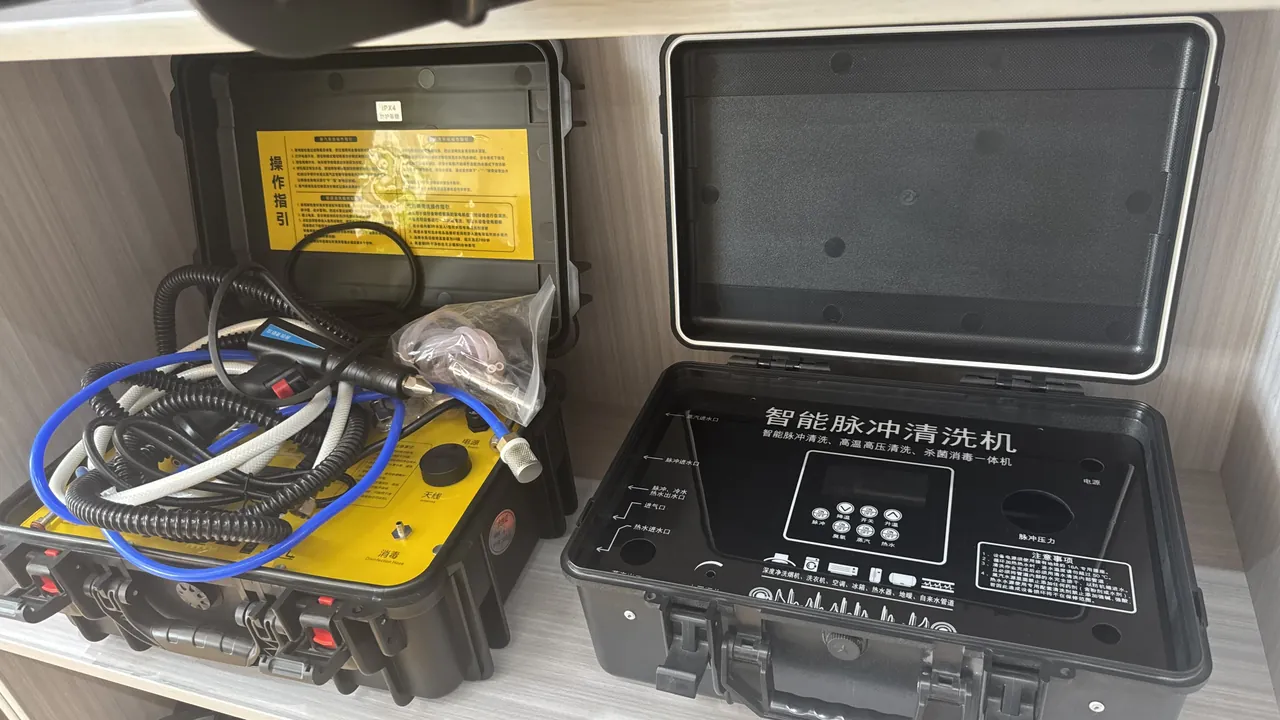
Ingress protection follows IEC 60529, mirrored in China by GB/T 4208-2017, and is written as IP followed by two characteristic digits.
- First digit (0–6): protection against solid foreign objects and dust. Level 5 is "dust-protected" — limited ingress permitted provided operation is unaffected. Level 6 is "dust-tight" — no dust ingress inside the enclosure.
- Second digit (0–9): protection against water. Level 4 is splashing water, 5 is water jets, 6 is powerful water jets, 7 is temporary immersion (commonly 1 m for 30 minutes), 8 is continuous immersion with conditions agreed between supplier and buyer.
The critical point: the step from 5 to 6 is a change in the acceptance criterion, not a tightening of a tolerance. Equally important is that water levels are not a simple progression. A sample that passes IPX7 will not necessarily pass the IPX5 jet test, because the two assess different failure modes — static head pressure versus dynamic jet impact. Technical agreements should therefore spell out each digit, for example "IP6X + IPX5 + IPX7", and state explicitly that substitution with X is not acceptable.
General storage boxes usually sit around the IPX4 level, and a substantial share have never been tested at all. Military-specification cases are commonly designed to IP65 through IP67, where the governing property for immersion is the recoverability of the seal system — an O-ring arrangement returns to its compressed geometry after many closures, whereas a flat foam strip does not. Full explanations are in what is IP67 rating and IP67 immersion test; design essentials are in outdoor case waterproof design.
Latches, hinges and padlock points: life under repeated cycling
The latch is what compresses the seal, and a failed latch is a failed seal. The difference usually shows up a year into service.
General storage boxes mostly use one-piece plastic catches that close by elastic deformation of the polymer itself. They are cheap and need no assembly, but plastic catches undergo stress relaxation: hold them closed for months and closing force declines month by month, while low temperature makes them brittle and prone to snapping.
Military-specification cases commonly use one of three types:
- Cam-action metal draw latch: stamped from stainless or galvanised steel with a cam profile that creates an over-centre self-locking action; closing force is stable and adjustable.
- Lever-action compression latch: long travel, so it can deliver higher compression, suitable for thick-section seals.
- One-piece moulded plastic catch with a metal pin: a compromise between light weight and service life, common on HDPE cases.
Service life is normally assessed on two numbers: closure cycles and the closing-force decay curve. An industry rule of thumb is that a competent cam-action metal latch tolerates several thousand closures with limited force decay, whereas a plastic catch of comparable size may show cracking after a few hundred cycles in cold conditions. Ask suppliers to state the initial closing force and the proportion retained after a defined number of cycles.
Hinges differ just as clearly. General boxes often use a thin moulded hinge that loosens and lets the lid drift after repeated use. Military-specification cases use a through-going metal pin with a wear bushing or thickened boss, so the lid holds position when fully open and can be loaded with one hand.
Padlock points and locks are standard on military-specification cases: a through-hole is formed in the latch so a standard padlock can be fitted, or an internal locking cylinder added. The engineering requirement here is that fitting a lock must not reduce seal compression. Some designs raise latch travel to accommodate a lock and end up under-compressing the gasket — a common design error. Latch selection detail is in case latch selection.
Interiors: from open-cell sponge to CNC pre-cut foam
The shell decides whether the case survives the environment. The interior decides whether the contents survive each other.
- Open-cell polyurethane sponge: lowest cost, inserted as a block and then hollowed out. Open-cell structure absorbs water and oil, ages and sheds, loses support over time, and cushioning is limited by density, commonly 15–30 kg/m³.
- Closed-cell EVA / PE foam: does not absorb water, recovers well, and can be pre-cut. EVA commonly runs 30–80 kg/m³ and can be laminated in layers to create a graded cushion, softer outside and firmer inside. PE foams such as XPE/IXPE offer better stiffness and compression resistance.
- Pre-cut foam: CNC-cut to the outline of the contents, forming a close-fitting recess. "Grid plus pluck-out blocks" suits high-mix low-volume work; CNC precision cutting suits repeat delivery of a fixed item.
- Rigid dividers and trays: wood, engineering polymer or metal boards for load-bearing separation; sliding trays suit tool and hand-tool applications.
- VCI linings: in steel cases storing metal parts long term, VCI vapour-phase film or paper maintains a corrosion-inhibiting atmosphere in the sealed space.
The governing parameter is the cushion curve: item weight and expected drop height together determine the foam thickness and density combination. As a rule, heavier and more shock-sensitive items need thicker foam, and — within a sensible range — lower density, to extend the deceleration distance. A full comparison of divider options is in case divider versus foam and case internal foam types; the design variables for bespoke interiors are in case custom foam factors.
Stacking and transport compliance: ASTM D4169 and the ISTA series
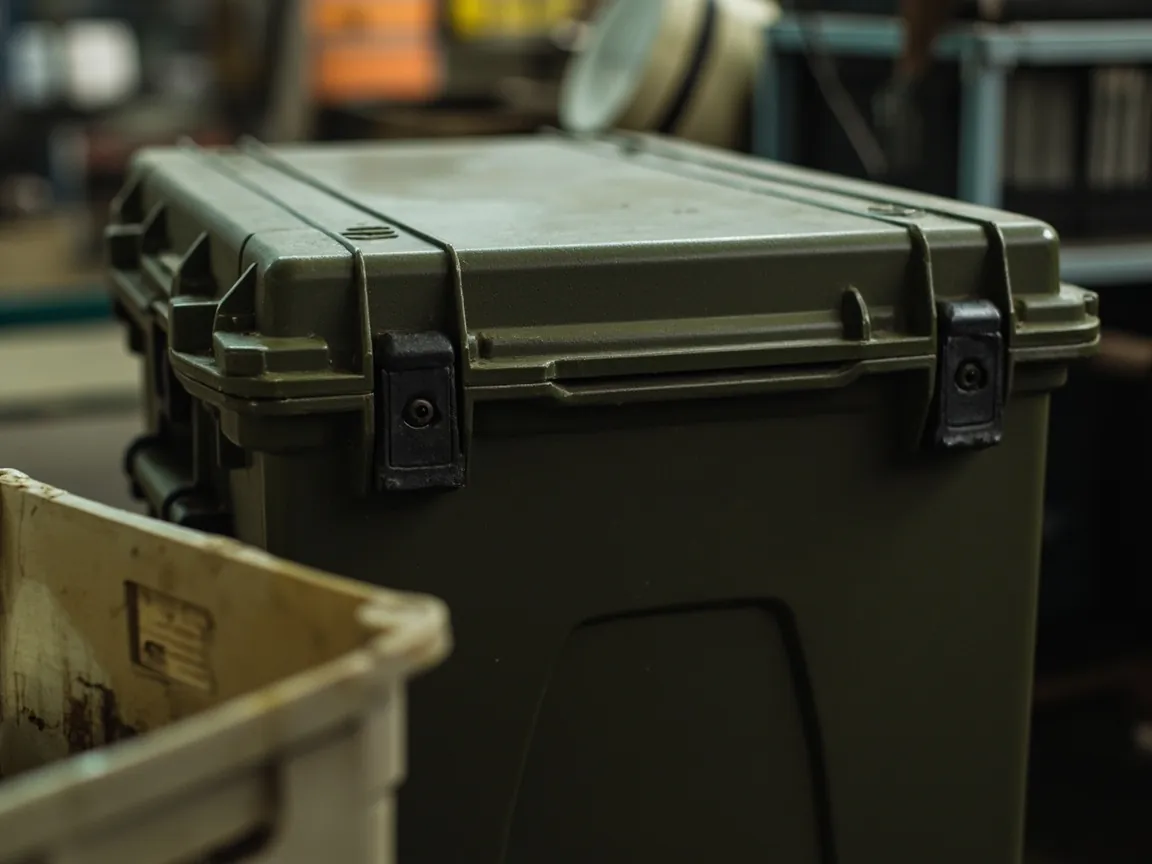
"Stackable" on a general storage box usually means the shapes nest. On a military-specification case it means verified stacking strength.
Stacking strength is stated as: the load the bottom case can carry for a defined storage period — commonly graded at 1, 3 or 5 years — without deformation that impairs function. Design must account for creep, because plastics deform slowly under sustained load, and surviving a short-term squeeze does not mean standing up for years. A practical approach is to estimate long-term stacking strength at 30 % to 50 % of short-term compressive strength, with a further reduction for creep-prone materials such as HDPE.
Transport compliance is usually demonstrated against:
- ASTM D4169, *Standard Practice for Performance Testing of Shipping Containers and Systems*, which organises test sequences — drop, vibration, stacking, concentrated impact — within a Distribution Cycle and Assurance Level framework. It is the most widely cited general transport performance reference;
- The ISTA series (for example ISTA 1 Series non-simulation integrity tests, 2 Series partial simulation, 3 Series general simulation), selected by transport mode and well suited to e-commerce and LTL flows;
- ISO 4180, general rules for compiling performance test schedules for complete, filled transport packages;
- The GB/T 4857 series, the Chinese counterpart covering stacking, vibration, impact and drop test methods.
One easily missed detail: military-specification cases are often dimensioned to pallet modules — for example a footprint that lets an exact whole number of cases sit on a 1200 mm × 1000 mm pallet — which materially improves container and warehouse utilisation. Structural aspects are covered in case stacking structure.
Environmental reliability: MIL-STD-810H and ISO 9227 salt spray
What makes military-specification cases usable in extreme environments is a whole environmental test framework, of which MIL-STD-810H, *Environmental Engineering Considerations and Laboratory Tests*, is the most frequently cited. Relevant methods for cases include:
- Method 501/502, high and low temperature: verifying dimensional stability and toughness at temperature extremes;
- Method 503, thermal shock: verifying stresses between dissimilar materials, such as metal inserts in a polymer body, caused by differing expansion coefficients;
- Method 507, humidity: verifying performance retention under prolonged high humidity;
- Method 514, vibration: verifying structural integrity and latch retention under transport vibration;
- Method 516, shock: verifying that sealing survives drop and impact.
For salt spray, ISO 9227, *Corrosion tests in artificial atmospheres — Salt spray tests*, and ASTM B117 are the usual references for neutral salt spray (NSS), with GB/T 10125 as the Chinese counterpart. Coated steel cases are typically judged on "no red rust after a specified number of hours", with the duration agreed between the parties and commonly graded by environment: inland, coastal or marine.
For UV ageing, ASTM G154 (fluorescent UV) and the ISO 4892 series evaluate colour and mechanical change in polymer cases after prolonged outdoor exposure. UL94 addresses flammability and should be added wherever electricity, rail, marine, mining or lithium batteries are involved.
The value of these standards is that they turn "durable" into something comparable and acceptable. Write the standard number, the method number and the acceptance condition into the technical agreement rather than the phrase "sufficiently durable".
Capacity definitions: internal volume versus usable volume
Capacity is the first selection parameter and the one most often misunderstood.
Three concepts must be kept apart:
- External dimensions, which govern stacking and transport footprint;
- Internal volume, the theoretical load space, expressed in litres;
- Usable volume, the real load space after subtracting lining thickness, rib protrusions and handle recesses.
Wall thickness and reinforcement ribs on a rotational-moulded HDPE or steel case erode usable volume significantly. As an empirical guide, with 20 mm pre-cut foam lining, usable volume is roughly 70 % to 80 % of theoretical internal volume; at 40 mm foam thickness it may fall to 55 % to 65 %. The correct procurement approach is therefore to supply the three-dimensional outline of the packed item, the quantity, and any handling clearance, and let the supplier calculate the required case size — not to fix the case first and then try to fit the contents.
Load density also depends on how the interior is divided. For regularly shaped items:
| Loading method | Space utilisation (typical) | Handling convenience | Suitable for |
|---|---|---|---|
| --- | --- | --- | --- |
| Loose bulk stowage | 70 %–85 % | Poor | Low-value, impact-tolerant items |
| Single block of hollowed sponge | 45 %–60 % | Medium | One sensitive device |
| Pre-cut fitted foam | 55 %–70 % | Good | Repeat delivery of a fixed model |
| Rigid divider grid | 60 %–75 % | Very good | Mixed tools and equipment |
| Bespoke thermoformed tray | 65 %–80 % | Very good | High-value irregular items |
For cases designated by a calibre-style class name, the conversion method and a practical measurement approach are set out in 50 cal ammo box capacity.
Cost structure: where the money actually goes
Understanding cost structure is what lets you judge whether a quotation is reasonable.
- Material and shot weight: the largest single element. At equal volume, an HDPE body uses substantially more material than a thin-wall PP body, and steel adds stamping and welding labour on top of material cost.
- Tooling and process: injection moulding carries high one-time tooling cost but low unit cost; rotational moulding carries lower tooling cost but longer cycle time and a higher labour share.
- Seal system: groove machining in the tool, gasket material and vulcanisation, and assembly labour together push unit cost up by a step — and this is the main source of the performance gap.
- Metal parts: hinge pins, cam latches, padlock points and corner caps; quantity and machining precision feed straight into cost.
- Interior: the spread from a plain sponge block to CNC-cut EVA can be several times over.
- Testing and documentation: third-party ingress protection, drop, vibration and salt spray testing cost real money. Being able to supply complete reports — rather than verbal assurances — is the dividing line between two classes of supplier.
For B2B buyers, the comparison that matters is total cost of ownership: unit price, plus replacement frequency, plus content damage rate, plus internal packing labour. A cheap case that is replaced frequently usually costs more across a three to five year horizon.
Selection table and procurement recommendations
The analysis above, condensed into a decision table.
| Decision item | General storage box | Military-specification case | Procurement guidance |
|---|---|---|---|
| --- | --- | --- | --- |
| Service environment | Indoor, sheltered | Open air, vehicle-mounted, damp, dusty | Anything outdoors should be assessed against military spec |
| Material | Thin-wall PP / regrind | HDPE / steel / aluminium | Rule out homopolymer PP for cold duty |
| Sealing | Flat foam or hard contact | Groove plus O-ring | Require seal material and hardness in writing |
| Ingress protection | Often untested / around IPX4 | IP65–IP67 | Specify each digit; do not accept X |
| Latch | Plastic catch | Metal cam latch | Ask for closing-force decay data |
| Stacking | Shapes nest | Verified stacking strength | State layer count and storage period |
| Interior | None or plain sponge | Pre-cut foam / tray | Provide item dimensions and weight |
| Transport validation | Usually none | ASTM D4169 / ISTA | Require reports at first article |
| Total cost of ownership | Low short term, high long term | High initial, low over life | Model across a 3–5 year horizon |
Three recommendations you can act on immediately.
- Write requirements as acceptance clauses. For example: "IP6X + IPX5 + IPX7; EPDM seal, 60 ± 5 Shore A; stainless cam-action latch retaining at least 80 % of initial closing force after 5,000 cycles." State the test method alongside the value.
- Send the first article for third-party re-testing. Commission ingress protection testing to IEC 60529 / GB/T 4208-2017, transport testing to GB/T 4857 or ASTM D4169, and salt spray to ISO 9227. Confirm that the model and photographs in the report match the delivered goods.
- Ask for spares and drawings at the same time. Seals, latches and hinges are consumables. Confirming that they can be ordered separately, with replacement instructions, extends the life of the whole case. JUNZHJIA supports wholesale, distribution and OEM/ODM programmes with configuration options, test documentation and spare parts, and matches seal and lining specifications to the duty cycle.
FAQ
Q: What is the single most important difference between a military-specification case and a general storage box? A: If you can keep only one criterion, keep the sealing system. Material, wall thickness and latches can all be upgraded by paying more, but sealing is decided by design: a flat-seal structure has no groove, so no amount of upgraded foam can deliver the compression control and lateral restraint of a grooved seal. The value of a groove is that it bounds the seal's deformation within a controlled range — the groove fixes lateral position while latch travel fixes longitudinal compression ratio, typically designed into the 20 % to 30 % band — so the sealing face recovers even after the case has been twisted or knocked in transit. Sealing also determines whether the ingress protection level can be sustained over years, and that level determines whether contents survive damp and dusty conditions. In negotiation, ask three questions in order: is the rim groove-sealed or flat-sealed, what is the seal material and hardness, and can you provide reports. Those three filter out most under-specified product.
Q: How do I choose between a steel case and an HDPE case? A: Judge on two axes: environment and weight. Choose steel when you need very high stacking strength for long-term multi-layer warehouse storage, weld-level sealing reliability, resistance to puncture and crushing, or a sound basis for flame retardancy and static dissipation design. Steel's weaknesses are weight and corrosion, so it must be paired with phosphating and coating, galvanising or a stainless system, and maintenance intervals shortened in coastal or high-humidity sites. Choose HDPE when cases are handled manually and often, when low-temperature impact toughness matters (HDPE retains toughness at -30 °C to -40 °C), when chemical resistance is required, or when colour and marking flexibility are valuable. HDPE's weaknesses are rib-dependent stiffness, scratch-prone surfaces and noticeable creep under long-term high stacking. A common compromise combines the strengths: an HDPE shell with metal hinges and latches, or a steel frame clad in polymer — both are well established in industrial packaging.
Q: Should I specify IP65 or IP67? A: The difference is the physical form of the water. IPX5 assesses water jets — a 6.3 mm nozzle at a defined distance and flow rate from all directions — and therefore tests seal reliability under dynamic water impact. IPX7 assesses temporary immersion, commonly 1 m for 30 minutes, and therefore tests seal reliability under static head pressure. The failure modes differ, which is why the standard states that the two are not a simple progression. Ask two questions: is the site subject to wash-down and driving rain, or to standing water that could submerge the case? The first points to IPX5, the second to IPX7. If both are possible — a vehicle-mounted case that is both rained on and may ford water — require IP6X + IPX5 + IPX7 together. Note that a higher immersion level does not automatically mean a better jet level; each must be tested. See what is IP67 rating.
Q: How should I interpret the "capacity" of a military ammo box? A: In industrial packaging language, capacity means the internal volume of the case, expressed in litres or cubic decimetres, used to calculate load density and piece count. When a product is named after a class designation, such as a 50 cal specification box, that denotes an established external and internal dimensional system; the purchasing conversation should focus on cavity length, width and height, usable volume and lining thickness, not the words in the name. The calculation is straightforward: cavity length × width × height in millimetres ÷ 1,000,000 = litres. Then estimate real load space as theoretical volume × lining reduction factor, an empirical 0.7 to 0.8 with 20 mm pre-cut foam. Divide by the actual volume of the packed item to get piece count. Regularly shaped items can reach 70 % to 85 % space utilisation; irregular items need a trial layout. A physical or cardboard mock-up is always worth the time. The full method is in 50 cal ammo box capacity.
Q: Can an ordinary storage box be modified to reach military-specification protection? A: In most cases it is neither worthwhile nor reliable. Four upgrades would be needed simultaneously. First, machine a continuous seal groove into the rim — general boxes usually have a flat or stepped rim with no material allowance, so an added strip can only ever be a flat contact with no compression control. Second, replace the plastic catch with a metal latch capable of delivering stable clamping force to the sealing face — which means redesigning the latch seat and its reinforcement. Third, add wall reinforcement ribs — impossible after moulding, so an external metal frame is the only route, and weight and cost then exceed buying correctly in the first place. Fourth, re-validate the new protection level with jet and immersion testing. The four together usually cost more than a compliant case. For semi-outdoor, lightly dusty duty, limited modification is reasonable: replace the gasket with closed-cell EPDM, fit corner caps, swap open-cell sponge for closed-cell foam and add desiccant. For immersion, long-term storage or sensitive equipment transport, buy to the required rating directly.
Q: How can I verify that a supplier's claimed ingress protection is genuine? A: Verify in three tiers. Tier one is visual and tactile inspection, suitable for every delivery: check that the gasket is continuous with no breaks or flash and that it rebounds quickly when pressed; close the lid without latching and check gap uniformity around the rim with a feeler gauge or paper strip; latch each catch and confirm consistent force and a definite detent; check that hinges, handles, pressure valves and nameplates all have independent sealing. Tier two is a simple spray screening test, suitable for first articles and periodic sampling: spray from about 2 m to 3 m in all directions, at least one minute per face, concentrating on latches, hinges, handle roots and corners, with dry tissue and a humidity indicator card inside the case, then open immediately and inspect. Tier three is third-party re-testing to the standard, for first articles, major projects and disputes, optionally adding IK impact, salt spray and flammability. In every tier, verify that the model and photographs in the report match the actual product and treat "tested on a similar model" as a red flag.
Q: Should the interior use open-cell sponge or closed-cell foam? A: Two conditions decide it: whether moisture will be present, and whether cushioning must hold up over years. Open-cell polyurethane sponge is cheap and easy to work and suits dry indoor use, short-term circulation and general loading where shapes change; but its open structure absorbs water and oil, ages and sheds, loses support over time, and becomes a contamination source in dusty damp conditions. Closed-cell EVA or PE foam does not absorb water, recovers predictably and can be CNC pre-cut, making it the right choice for outdoor, damp, long-term storage and sensitive items. Thickness and density follow the cushion curve: heavier items and higher expected drop heights need thicker foam. Laminating layers is a standard technique — a low-density outer layer to absorb large deflection and a medium or high-density inner layer to provide support. Where steel or precision metal parts are involved, add VCI vapour-phase corrosion protection alongside the foam. JUNZHJIA can supply pre-cut foam and thermoformed trays built to customer drawings, with matching cushioning recommendations.
Q: Will long-term stacking deform the cases? A: Yes, and the dominant failure is not crushing but sagging: the material creeps under sustained load, the walls bulge slowly, the rim loses flatness and the seal eventually fails. The engineering response has three parts. First, define the storage period — commonly graded at 1, 3 or 5 years — and estimate long-term stacking strength at 30 % to 50 % of short-term compressive strength, reduced further for creep-prone materials such as HDPE. Second, improve the structure: thicken the rim roll, run vertical ribs along the load path, and match the footprint to pallet modules so load transfers directly into reinforced zones. Third, control the conditions: avoid high stacks in hot warehouses, since temperature markedly accelerates creep, and avoid one-sided overhang stacking that induces torsion. At incoming inspection, a simple 72-hour fully loaded stacking test works well — after unloading, measure the change in rim diagonals; a significant and irreversible deviation indicates the stacking design is inadequate. Structural detail is in case stacking structure.
Q: What clauses should a technical agreement contain for a bulk B2B order? A: Eight blocks are worth covering. One, material: base polymer family (for example HDPE or copolymer PP), whether regrind is allowed and at what maximum proportion, colour and colour-difference requirements, UV stabiliser requirements. Two, structure: wall thickness, rib pattern, rim design, hinge and latch type, padlock point position. Three, sealing: groove form, gasket material (NBR/EPDM/VMQ/FKM), hardness, compression set limits, replaceability. Four, ingress protection: each digit spelled out, for example IP6X + IPX5 + IPX7, with substitution by X explicitly excluded. Five, mechanical performance: stacking strength and storage period, drop height, initial closing force and decay allowance. Six, environment: service temperature range, salt spray standard and duration, UV ageing requirements, flammability class if applicable. Seven, interior: foam material, density, thickness, cutting method and tolerances. Eight, documentation and spares: type-test reports, material certificates, spare parts list and lead times, packaging and marking requirements. With these eight in the agreement, later acceptance has a basis.
Closing remarks and related reading
Back to the question in the title: the difference between a military-specification case and an ordinary storage box is the difference between verified protection and apparent capacity. Every design element of the former traces back to a standard and a test — material that survives cold and ageing, structure that survives torsion and stacking, sealing that survives jets and immersion, latches that survive thousands of cycles, interiors that cushion for years. The latter is optimised to complete storage at controlled cost, which is entirely adequate in a controlled environment, and whose weak points appear together the moment the case moves outdoors, into a vehicle, into humidity, into dust, or into a multi-year warehouse.
Three practical recommendations. First, define the duty before the case — establish the low-temperature limit, dust concentration, the physical form of water (splash, jet, immersion), stacking layers and storage period, then choose material, sealing and structure accordingly. Second, convert requirements into acceptance clauses — standard number, method number, acceptance condition and documentation requirement; omitting any one turns into a dispute later. Third, decide on total cost of ownership rather than unit price — factor in replacement frequency, content damage rate and internal packing labour; many "expensive" cases turn out to be the cheaper option.
JUNZHJIA, manufactured by KeXin New Materials (Guangdong) Co., Ltd., covers protective cases, tool cases, military-specification storage boxes and waterproof junction boxes, serving wholesale, distribution, OEM/ODM and global supply. The company configures material systems, sealing solutions, latch types and bespoke interiors to the customer's duty cycle, and supplies the corresponding test documentation and spare parts.
Related reading