

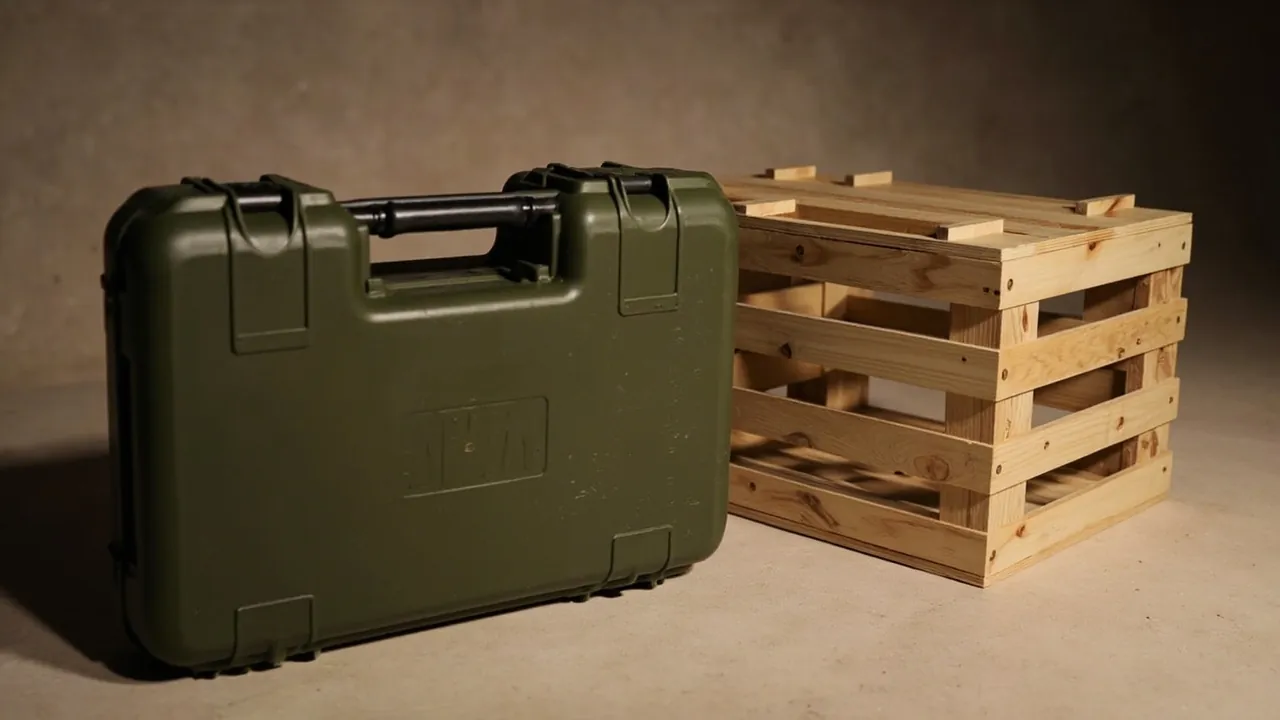
In one sentence: the essential difference between a military style sealed protective case (often referred to as an ammo case style box) and an ordinary storage box is not that the former merely looks thicker. It shows up in four verifiable engineering dimensions: the shell material system (modified PP, ABS or other engineering plastics, or metal alloy, rather than a general purpose polyethylene injection molding), the sealing structure (a full perimeter elastomer gasket combined with multi point mechanical compression, capable of IP67 performance, rather than a simple lid overlap), the structural design (wall thickness, reinforcement ribs, radiused corners, metal inserts and stacking locators, rather than a thin glossy wall), and verifiable protection evidence (environmental suitability verification carried out with reference to MIL-STD-810H, rather than no test basis at all). An ordinary storage box is designed to gather things together in a home or a warehouse. Its typical duty cycle is indoor, static, lightly loaded and only occasionally moved, so it can be built as a thin wall molding with a simple snap latch and no gasket at the lowest possible cost. A military style sealed case is designed to keep its contents intact and identifiable after shock, vibration, rain, dust, salt fog and stacking loads encountered in vehicles, vessels, field work and air freight. Both look like a lidded rectangular box; they belong to two entirely different product categories.
Compliance note: this article discusses only the box product technology itself, covering material, sealing structure, latch format, stacking, identification management and other general engineering questions. It does not address the manufacture, modification or use of any regulated item, and it does not constitute compliance or transport advice. Any purchase and any use must strictly follow the laws and regulations of the country or region concerned, the applicable industry codes, and the requirements of the carrier.
Table of Contents
- The Short Answer: Differences at a Glance
- Shell Material Comparison: Engineering Plastics vs General Purpose Plastics
- Sealing Structure Comparison: Gaskets, Compression Force and IP Ratings
- Structural Strength Comparison: Wall Thickness, Ribs, Corners, Hinges and Stacking
- Identification Management and Latch Format: Two Underestimated Differences
- Selection by Scenario: Which Type Fits Which Job
- Common Mistakes and an Incoming Inspection Checklist
- Frequently Asked Questions (FAQ)
- Conclusion
- Further Reading
The Short Answer: Differences at a Glance
If you only have thirty seconds, this table is enough. It places both box types against the same set of dimensions. Every description refers to the engineering characteristics of the box product itself, not to any contents.
| Dimension | Military Style Sealed Protective Case | Ordinary Storage Box | Practical Effect |
|---|---|---|---|
| --- | --- | --- | --- |
| Shell material | Modified PP, ABS, PC or alloy; engineering plastic systems | General purpose PP, PE or HDPE thin wall molding | Clear gap in low temperature brittleness, impact resistance and creep resistance |
| Wall thickness | Comparatively thick and evenly distributed, thickened at critical areas | Thin wall, often lightweighted to save material | Crush and drop resistance differ by an order of magnitude |
| Sealing | Full perimeter elastomer gasket, groove, multi point compression | Usually no gasket; lid simply overlaps | Whether rain, splash, dust and brief immersion are stopped |
| Latching | Multiple mechanical latches, padlock eye or lock ready | Single or double plastic snap | Whether compression is even and whether it pops open in transit |
| Structure | Ribs, radiused corners, metal inserts, stacking locators | Plain or lightly ribbed, no stacking design | Whether it deforms over time and whether it can be stacked |
| Handling | Recessed handles, anti slip feet, optional wheels | Simple finger grip or protruding handle | Safety and fatigue during loaded handling |
| Verified protection | Environmental suitability verification with reference to MIL-STD-810H; IP67 capability | Usually no standard based verification | Whether parameters can be checked and verified |
| Identification | Label area, card holder, printable logo zone | Generally absent | Multi case management and asset inventory efficiency |
| Cost structure | Higher tooling and material cost, long service life | Low unit price, consumable | Different total cost of ownership |
One point deserves emphasis. The phrase military style describes a product form and a verification method, not a qualification. Any claim that presents military style as a military certification or a defence grade approval is not a verifiable compliance statement. The accurate capability statement for the JUNZHJIA protective case line from kexinMaterials is this: it has IP67 capability and can undergo environmental suitability verification with reference to MIL-STD-810H. That is a statement about test basis, not a certification claim.
Shell Material Comparison: Engineering Plastics vs General Purpose Plastics
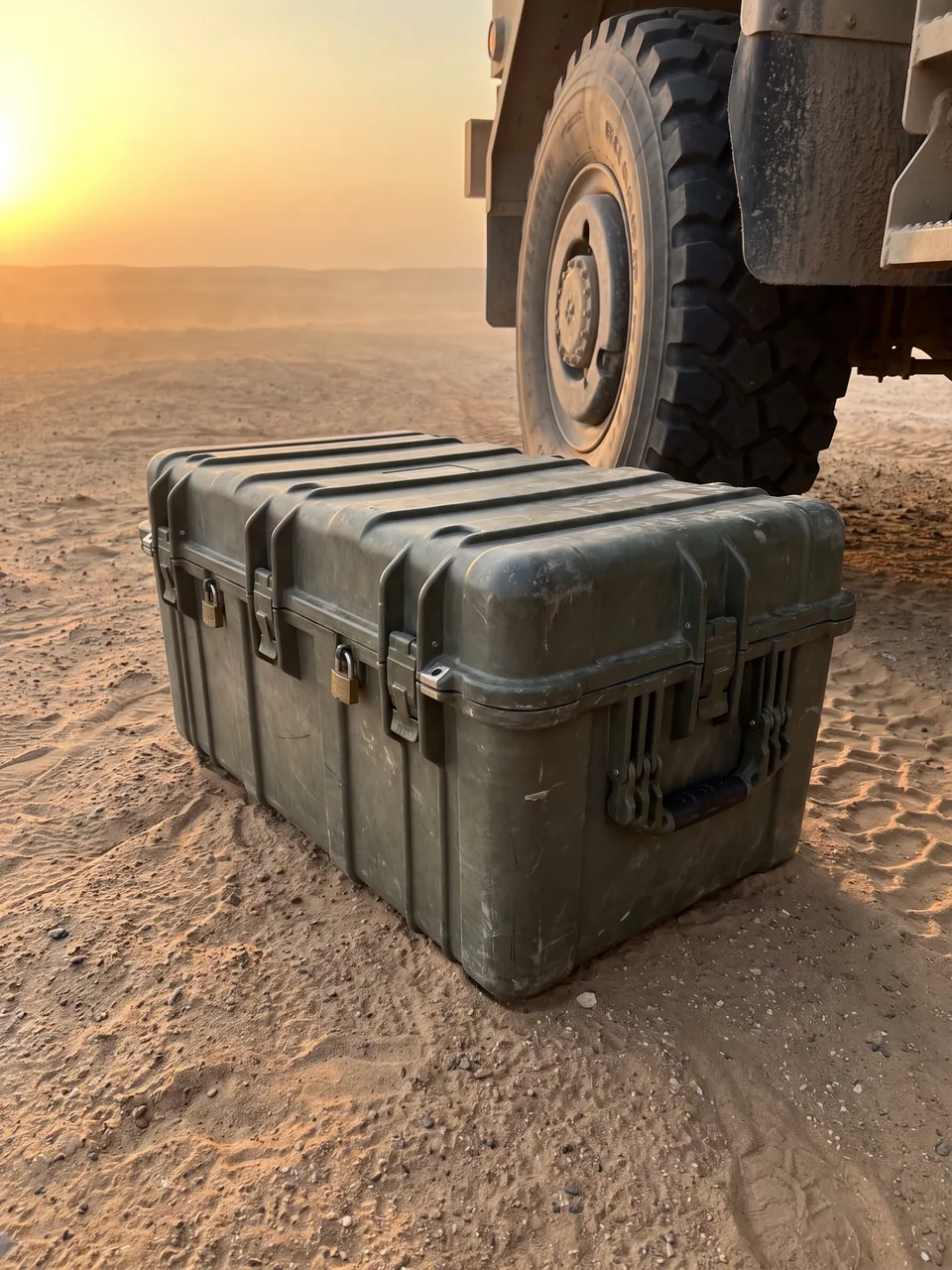
Material is where every performance difference begins. Rather than memorizing grade names, focus on four properties that directly determine service life: impact toughness, low temperature brittleness, creep resistance (whether it slowly deforms under long term load) and environmental stress crack resistance.
Materials commonly used for military style sealed cases
Modified PP (polypropylene). PP has a low density, among the lightest of the common plastics, so a case of a given volume weighs less. That matters whenever the case is carried by hand, loaded into vehicles or shipped by air. Its molecular structure gives good toughness and fatigue resistance, so cracks do not readily propagate after repeated opening and repeated impact. It resists acids, alkalis and most chemicals and absorbs almost no water, so dimensions stay stable in humid environments. With modification (toughening, filling, UV stabilisation) PP retains toughness at low temperature and avoids the brittle behaviour that makes ordinary plastics crack when dropped in the cold. The trade offs are lower rigidity than ABS and a more modest surface hardness and gloss, which have to be compensated by ribs and structural design.
ABS (acrylonitrile butadiene styrene). ABS offers rigidity, high surface hardness, dimensional stability and a good surface finish, and it takes clean edges and fine detail well. Silkscreen printing, hot stamping and laser marking all behave predictably on it. Its impact performance at room temperature is good, but low temperature toughness is inferior to modified PP, and outdoor UV exposure requires a UV stabilized formulation or a protective coating. It is therefore common on cases where appearance, dimensional precision and marking quality matter, while very cold or heavy drop environments tend to favour PP systems.
PC (polycarbonate) and its alloys. PC is known for impact strength and transparency, suiting inspection windows, transparent lids and areas of extreme impact demand. It costs more and is more sensitive to stress cracking under the combined action of certain chemicals and internal stress, so it is usually applied locally or on high end models.
Metal (aluminium alloy, steel). Metal shells offer very high crush and puncture resistance, high temperature tolerance, and the ability to weld or rivet accessories. The downsides are weight, high thermal conductivity (contents follow ambient temperature quickly), permanent denting, corrosion protection requirements in salt fog, and higher material and processing cost. Modern protective cases are dominated by engineering plastics, with metal reserved for special temperature or crush requirements.
Materials commonly used for ordinary storage boxes
Ordinary storage boxes are typically injection moulded in one shot from general purpose PP, PE or HDPE. The base material is not inherently bad; HDPE has respectable toughness and chemical resistance. The difference lies in three things: thin walls, no modified formulation, and no structural design to work with it. Thin wall parts bulge outward at the side when loaded, the lid opening sags and deforms, and any sealing surface that exists loses its fit. General purpose resin loses impact strength noticeably at low temperature, and without UV stabilisation it chalks and embrittles after a few months outdoors.
Three practical criteria for material selection
- Check the lower service temperature. If the case will be handled and shipped below freezing, prefer a modified PP system with good low temperature toughness, and ask the supplier to state the verification basis for the low temperature condition.
- Check whether appearance and marking matter. For large area silkscreen, hot stamping or fine surface detail, ABS systems deliver more consistent surface quality.
- Check the weight budget and shipping mode. Where air freight is charged by weight or where people carry cases long distances, the light weight of PP systems converts directly into lower freight cost and less physical strain.
KeXin New Materials (Guangdong) Co., Ltd. was founded in 2014 and is located in Zhongshan, Guangdong, with a factory of about 18000 square meters, more than 80 machines and more than 100 employees. Its range covers plastic tool boxes, safety protective cases, sealed cases and waterproof moisture proof cases in more than 150 specifications. ABS and PP boxes pass RoHS testing and meet REACH and California Prop 65 requirements, the company is certified to ISO9001, and it holds more than 20 utility model and design patents.
Sealing Structure Comparison: Gaskets, Compression Force and IP Ratings
If you could only choose one dimension to separate the two categories, it would be sealing. Water and dust protection is not achieved by putting the lid on; it is achieved by a complete mechanical system.
The essence of sealing: compressing an elastomer to a specified deflection
A full perimeter sealing system consists of three parts: a groove in the lid, an elastomer gasket seated in that groove (an O ring or a profiled section), and a ring of latches that pull the lid down onto the body. The working sequence is this. When the latches close they apply mechanical force that draws the lid down as a whole; the gasket is compressed against the flat face of the body opening and deforms, filling the microscopic irregularities of the two mating faces (injection moulded surfaces are uneven at micro scale) and cutting off any continuous path for water and dust.
Three engineering points are regularly overlooked:
- Compression must be even. With only one latch on each of two sides, the middle section of the gasket is under compressed, producing a leak path that is tight at the ends and loose in the middle. Latch count therefore scales with the perimeter of the opening: about two on a small case, four on a medium case, six or more on a large one, spaced as evenly as possible.
- Compression must remain stable over time. Plastics creep, meaning they deform slowly under sustained load. If a latch is screwed directly into a thin wall, the wall sinks over a few months, compression force decays and sealing fails. The better approach reinforces the latch seat area with ribs and moulds in metal nuts or studs so that the latch screws engage metal and can be removed and refitted repeatedly without stripping.
- The gasket must retain resilience. The gasket is a consumable. Long term compression produces compression set, and ageing makes it hard, cracked and inelastic. That is exactly why having IP67 capability and still being IP67 three years later are two different statements; the second depends on maintenance.
How to read an IP rating
IP codes follow IEC 60529 and GB/T 4208 and consist of two digits: the first for solid particle protection including dust, the second for liquid ingress.
| Rating | Dust meaning | Water meaning | Typical application |
|---|---|---|---|
| --- | --- | --- | --- |
| IP54 | Dust protected (limited ingress, no functional effect) | Splash resistant | Indoor, sheltered semi outdoor |
| IP65 | Dust tight | Low pressure water jets | Rain, wash down, not immersion |
| IP66 | Dust tight | Powerful water jets | Sea spray, high pressure washing |
| IP67 | Dust tight | Temporary immersion under standard test conditions | Accidental immersion, wading, boats, deck cargo |
| Not declared | Not applicable | Not applicable | Ordinary storage boxes usually carry no IP rating |
Two points matter here. First, an IP rating is a test result on a new product under standard test conditions, not a permanent guarantee. Second, the levels are not a simple ladder of better and better; each corresponds to a different failure risk. Most ordinary storage boxes carry no IP rating at all, and that absence is itself informative: it means the structure has no testable sealing face in the first place, not merely that IP67 has not been measured.
Pressure equalization valve: a necessary companion to sealing
The better the seal, the more important one issue becomes: pressure differential. When internal and external pressure differ, the lid can be held shut and become hard to open (returning from high altitude to low), or the case can bulge outward in a low pressure environment, damaging the gasket and hinges over time. A pressure equalization valve, also called a vent or breather valve, uses a micro porous membrane that passes gas while blocking liquid water and dust, equalizing pressure automatically without compromising the sealing rating. Whenever air freight, high altitude road transport or large day to night temperature swings are involved, the valve should be standard equipment rather than an option.
Structural Strength Comparison: Wall Thickness, Ribs, Corners, Hinges and Stacking
Material sets the ceiling; structure determines what is actually delivered. Two PP mouldings, one structurally designed and one not, can differ several fold in crush and drop performance.
Thicker is not automatically stronger
Increasing wall thickness does raise stiffness, but at the cost of added weight, longer cycle time and a greater risk of sink marks and internal voids in thick sections. The more effective approach is a thin wall plus ribs. Network or radial ribs on the side walls and lid raise bending stiffness through geometry rather than through material volume. This explains why military style cases are always covered in ribs and recesses: that is structure, not decoration.
The check is straightforward. Press both hands against the long side wall and watch the deflection. A good case barely deforms under moderate load; a thin plain wall case visibly caves in and the opening distorts, which directly destroys sealing.
Radiused corners: stress concentration and drop paths
A sharp corner is a stress concentrator. When a case drops, impact energy travels through the shell and collects at geometric discontinuities, and corners are the most common starting point for cracks. A generous radius spreads the energy along an arc and also prevents the case from scratching vehicle interiors, other equipment and people during handling. Look at the eight corners of a case: military style cases usually have large radius corners with extra material at the corner, while ordinary storage boxes tend to have small radii or near square corners with uniformly thin walls.
Hinges: they decide whether the lid lands correctly every time
Sealing presupposes that the lid lands on the sealing groove accurately on every close. Once a hinge becomes loose the lid shifts, part of the gasket is not compressed, and protection drops immediately. Transport cases generally use one of two approaches: a recessed hinge that does not protrude and therefore survives conveyors and stacking, or a hinge integrally moulded from high strength engineering plastic with a metal pin, combining corrosion resistance and strength. Open and close the case several times and feel for play and lateral shift. More detail is available in Why Does a Protective Case Need a High Strength Hinge?.
Stacking locators and anti slip feet
Military style cases usually have mating ribs and recesses on the lid top and the base, so that stacked cases interlock and do not slide when a vehicle is moving. Anti slip feet on the base reduce wear on the contact surface and improve stability on smooth floors. Ordinary storage boxes are usually flat on top and bottom, and stacking more than two high creates a real risk of the stack toppling. See Why Does a Protective Case Need a Stacking Structure? for more on stacking design.
Structural acceptance checks
| Check | Method | Pass criteria |
|---|---|---|
| --- | --- | --- |
| Side wall rigidity | Press both hands on the long side wall | No visible deflection, springs back immediately |
| Lid opening flatness | Sight and finger check along the seam after closing | Even seam, no local gap |
| Latch compression | Close each latch, listen and feel | Crisp engagement, clear self locking feel |
| Hinge play | Open and close ten times, then rock the lid | No visible lateral shift |
| Stack stability | Stack empty cases, push the top one gently | No sliding, locators engaged |
| Corner condition | Visual inspection of all eight corners | Radiused transition, no sink marks or flash |
For a complete set of quality judgement criteria, see How to Judge a High Quality Protective Case from Its Structural Details.
Identification Management and Latch Format: Two Underestimated Differences
In real multi case operations and regulated transport, identification and latching often affect daily efficiency and risk control more than shell hardness does.
Identification management
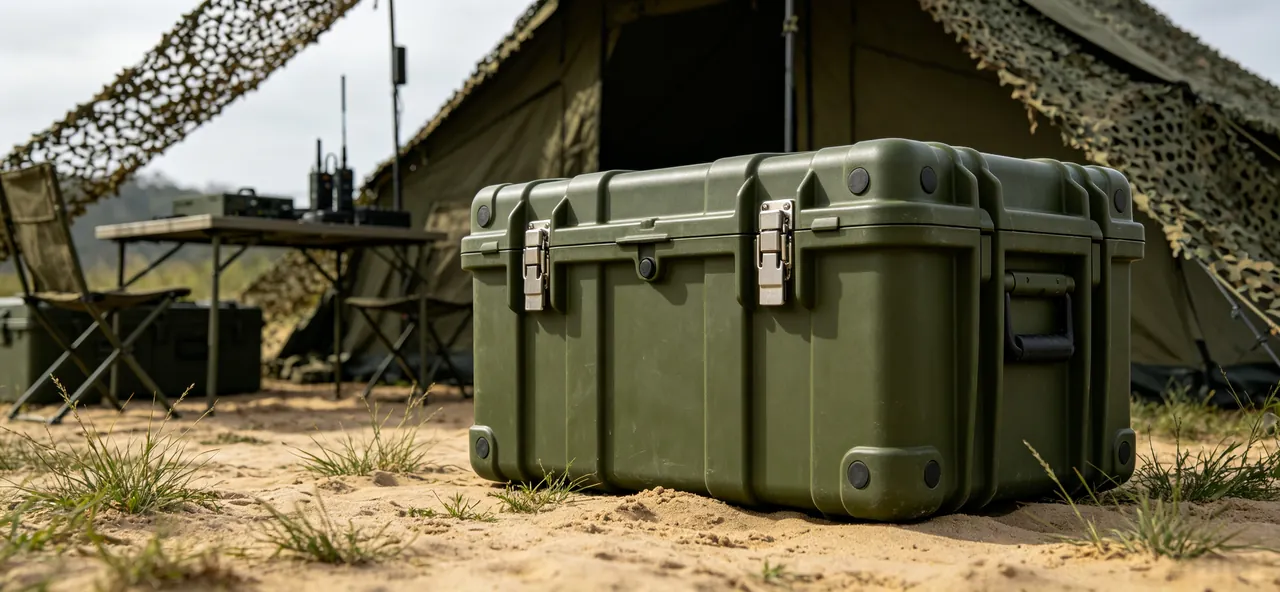
Military style cases usually provide a flat identification area on the lid or end face for labels, card holders or direct printing, recording case number, contents list, responsible person, inspection date and precautions. This delivers three practical benefits: inventory efficiency, because counting no longer requires opening every case; traceability, because case and contents are tied together; and flow management, because the label area can carry a barcode or QR code linked to a warehouse system.
Silkscreen and logo work depend on adhesion and weatherability. PP is a difficult substrate and direct printing tends to peel, so surface treatment such as flame or plasma treatment, or a dedicated ink system, is normally required. ABS takes printing far more readily. That is why stable logo printing capability counts as a supplier capability item.
Latch formats
Two distinct requirements need to be separated: preventing accidental opening in transit and preventing unauthorized opening. The first is delivered by the self locking structure of the latch and by recessed design; the second by padlock eyes, prepared holes or integrated locks. Common latch types include:
- Cam latches. A cam provides high compression force and a definite feel; the most common type on protective cases.
- Pull latches. Recessable into the body with low protrusion, well suited to checked baggage and frequent stacking.
- Push button latches. Openable with one hand for fast access, but the anti accidental opening feature needs attention.
- Double action latches. Require two movements to open, giving strong resistance to accidental opening, suitable for transport.
Details on latch selection are covered in How to Choose a Protective Case Latch. Note that a latch provides physical protection at the box level; any safety management requirement relating to the contents must follow the laws and regulations of the country or region and the carrier requirements.
Selection by Scenario: Which Type Fits Which Job
| Scenario | Main stresses | Recommended type | Key configuration |
|---|---|---|---|
| --- | --- | --- | --- |
| Indoor warehouse, home storage | Static, light load, occasional moving | Ordinary storage box | Choose size as needed, watch stack height |
| Workshop station turnover | Frequent access, oil, knocks | Sealed protective case, entry level | Chemical resistant material, easy clean surface |
| Long distance road transport | Vibration, jolting, hard braking | Sealed protective case | Inner tray fixing, stacking locators, recessed latches |
| Field work, survey | Rain, dust, drops, temperature swings | Sealed protective case | IP67 capability, pressure equalization valve, ribbed shell |
| Sea freight and ports | Salt fog, humidity, stacking crush | Sealed protective case | Corrosion resistant hardware, suitable gasket material, desiccant space |
| Air freight | Pressure change, cold hold, rough handling | Sealed protective case | Pressure equalization valve, recessed latches, crush resistant shell |
| Long term storage | Moisture, insects, oxidation | Sealed protective case | Gasket care, desiccant, identification card |
A four step selection routine works well:
- List the contents. Measure length, width, height and weight item by item, using maximum dimensions including protrusions.
- Calculate internal volume. Sum the individual volumes and multiply by a margin factor of 1.4 to 1.8; the lower bound suits a tight layout, the upper bound thick cushioning plus finger clearance.
- Set the protection level. Use the table above to decide whether IP67 capability, a pressure equalization valve and a particular material are needed.
- Decide the insert and management approach. Whether contents need fixing, separation and moisture protection, and whether label areas and locks are required.
Common Mistakes and an Incoming Inspection Checklist
Five frequent mistakes
- Mistake one: equating thick with strong. A thick wall without ribs deforms just as readily, and weighs more. Judge strength by structural design, not wall thickness alone.
- Mistake two: assuming a lid means waterproof. Waterproofing requires a full perimeter seal plus even compression; a lid overlap blocks dust, not water.
- Mistake three: looking at the IP rating and ignoring maintenance. The gasket is a consumable, and once it ages the rating exists only on paper. Clean it regularly, check resilience and replace when needed. The effects of gasket ageing are explained in What Happens When a Protective Case Gasket Ages?.
- Mistake four: neglecting stacking and restraint. Impact from cases sliding in a vehicle happens far more often than drops.
- Mistake five: treating military style as a qualification. It is a description of form, not a certification. The verifiable statement is environmental suitability verification with reference to MIL-STD-810H.
Incoming inspection checklist
- Visually check for sink marks, flash, colour variation and weld lines.
- After closing, check along the seam that the gasket is compressed evenly with no loose section.
- Test each latch individually for crisp engagement and self locking feel, consistent across the batch.
- Open and close the hinges repeatedly to confirm there is no play and no lid shift.
- Press the side walls and large faces to confirm no obvious deformation.
- Check that anti slip feet, stacking locators, handles and hardware are complete and free of corrosion.
- Verify that identification areas, label positions and custom logos match the specification.
- Record case numbers and inspection results and open a maintenance log.
Frequently Asked Questions (FAQ)
Question: What is the core difference between a military style sealed protective case and an ordinary storage box? Answer: The core difference lies in sealing structure and verification basis. An ordinary storage box is usually a thin wall moulding with a lid overlap, no gasket and no declared IP rating, designed for indoor static storage. A military style sealed case uses an engineering plastic shell, a full perimeter elastomer gasket compressed by multiple latches, ribs and stacking locators, and can undergo environmental suitability verification with reference to MIL-STD-810H, with IP67 capability. The former solves tidying up; the latter solves integrity under transport and environmental stress.
Question: How should a military standard claim be read? Answer: Separate test basis from certification claim. The correct statement is that the protective case line undergoes environmental suitability verification with reference to MIL-STD-810H, meaning the method referenced for environmental testing. Presenting it as passing a military certification or holding a defence grade qualification is not verifiable, and buyers should treat such wording carefully, asking the supplier to state the test items, test conditions and the scope of any report.
Question: PP or ABS for a sealed protective case shell? Answer: It depends on service temperature and appearance requirements. Modified PP offers toughness, low density, no low temperature embrittlement and good chemical resistance, suiting field work, cold climates, heavy loads and weight sensitive applications. ABS offers rigidity, high surface hardness, dimensional stability and good printing and appearance, suiting cases where looks and marking matter. Where low temperature drop resistance and fine marking are both required, consider a zoned design or an alloy system. A detailed comparison is given in PP, ABS and PC Cases: What Is the Difference?.
Question: Does an IP67 marking mean the case can stay under water indefinitely? Answer: No. The second digit seven means the case withstands temporary immersion under standard test conditions, a result obtained on a new product at a specified depth and duration. It is not a guarantee of prolonged submersion or underwater use. Real protection life depends on gasket compression set and ageing, on whether latch compression force has decayed, and on whether an impact has distorted the opening. After wading or boat use, rinse salt off with fresh water and dry the case before storage.
Question: Why is a pressure equalization valve necessary on a sealed case? Answer: Because a fully rigid sealed case develops a pressure differential whenever internal and external pressure differ. Cargo hold pressure drops during climb, high altitude road transport and large day to night temperature swings all create a differential, showing up as a lid that is sucked shut and hard to open, or a case that bulges outward, damaging the gasket, hinges and latches over time. The valve uses a micro porous membrane that passes air while blocking water and dust, equalizing pressure without sacrificing the sealing rating. Whenever air freight, high altitude or wide temperature swings are involved, it should be standard.
Question: How often should a gasket be replaced? Answer: There is no fixed interval; judge by condition. A visual and tactile check every quarter, or before every important shipment, is a reasonable routine. Look for cracks, nicks, permanent flattening with no spring back, tackiness or chalking, and check that latch compression is consistent. Replace on any of these findings. For routine care, wipe with clean water or a neutral cleaner, avoid strong solvents and sharp tools, and avoid storing the case under sustained heavy load.
Question: Can an ordinary storage box be upgraded with added foam to replace a protective case? Answer: No. Added foam only addresses internal cushioning and restraint; it does not address shell rigidity, full perimeter sealing, latch compression or stacking structure, which are properties of the box itself. The opening of an ordinary storage box deforms as soon as it is loaded, so even an added seal strip cannot produce stable compression. If the duty is genuinely indoor, static and light, an ordinary storage box is entirely adequate. Once transport, rain, dust or stacking is involved, choose a case whose structure itself carries the required capability. See Outdoor Protective Case vs Ordinary Storage Box: What Is the Difference? for a related comparison.
Conclusion
Reduced to a purchasing decision, the difference can be summed up in four checks. First, look at the material system: a modified PP or ABS engineering plastic shell working together with structural design is not in the same performance class as a general purpose thin wall moulding. Second, look at the sealing system: a full perimeter elastomer gasket with even multi point compression is the sufficient condition for water and dust protection, a lid overlap blocks dust but not water, and an IP rating is a result obtained on a new product under standard conditions whose long term validity depends on gasket care and latch compression. Third, look at structural detail: ribs, radiused corners, recessed hinges, metal inserts, stacking locators and anti slip feet determine what the case actually looks like after two years of use. Fourth, look at verifiability: a supplier who can say that the line undergoes environmental suitability verification with reference to MIL-STD-810H and has IP67 capability, and can state the scope of the supporting report, carries a completely different risk profile from one who offers only adjectives. Beyond that, identification management and latch format are routinely underestimated: a prepared label area, support for barcode and logo printing, and latches with anti accidental opening and padlock provision directly determine inventory efficiency and control in multi case operations.
KeXin New Materials (Guangdong) Co., Ltd. was founded in 2014 and is located in Zhongshan, Guangdong, with a factory of about 18000 square meters, more than 80 machines and more than 100 employees, and a product range covering more than 150 specifications. Its protective case line is marketed under the JUNZHJIA brand within the global kexinMaterials brand. The line has IP67 capability and can undergo environmental suitability verification with reference to MIL-STD-810H. The company is certified to ISO9001, meets REACH, California Prop 65 and RoHS requirements, holds more than 20 utility model and design patents, and provides one stop OEM and ODM customization from product design and tooling to injection moulding, logo printing and insert manufacturing. For bulk enquiries, specification sheets or customization cooperation, please use the contact page or enquiry form on this site.
Further Reading
- Outdoor Protective Case vs Ordinary Storage Box: What Is the Difference?
- PP, ABS and PC Cases: What Is the Difference?
- What Materials Are Commonly Used for Protective Case Gaskets?
- What Happens When a Protective Case Gasket Ages?
- What Does IP67 Mean for a Protective Case and Where Does It Apply?
- How to Choose a Protective Case Latch
- Why Does a Protective Case Need a High Strength Hinge?
- Why Does a Protective Case Need a Stacking Structure?
- How to Judge a High Quality Protective Case from Its Structural Details