

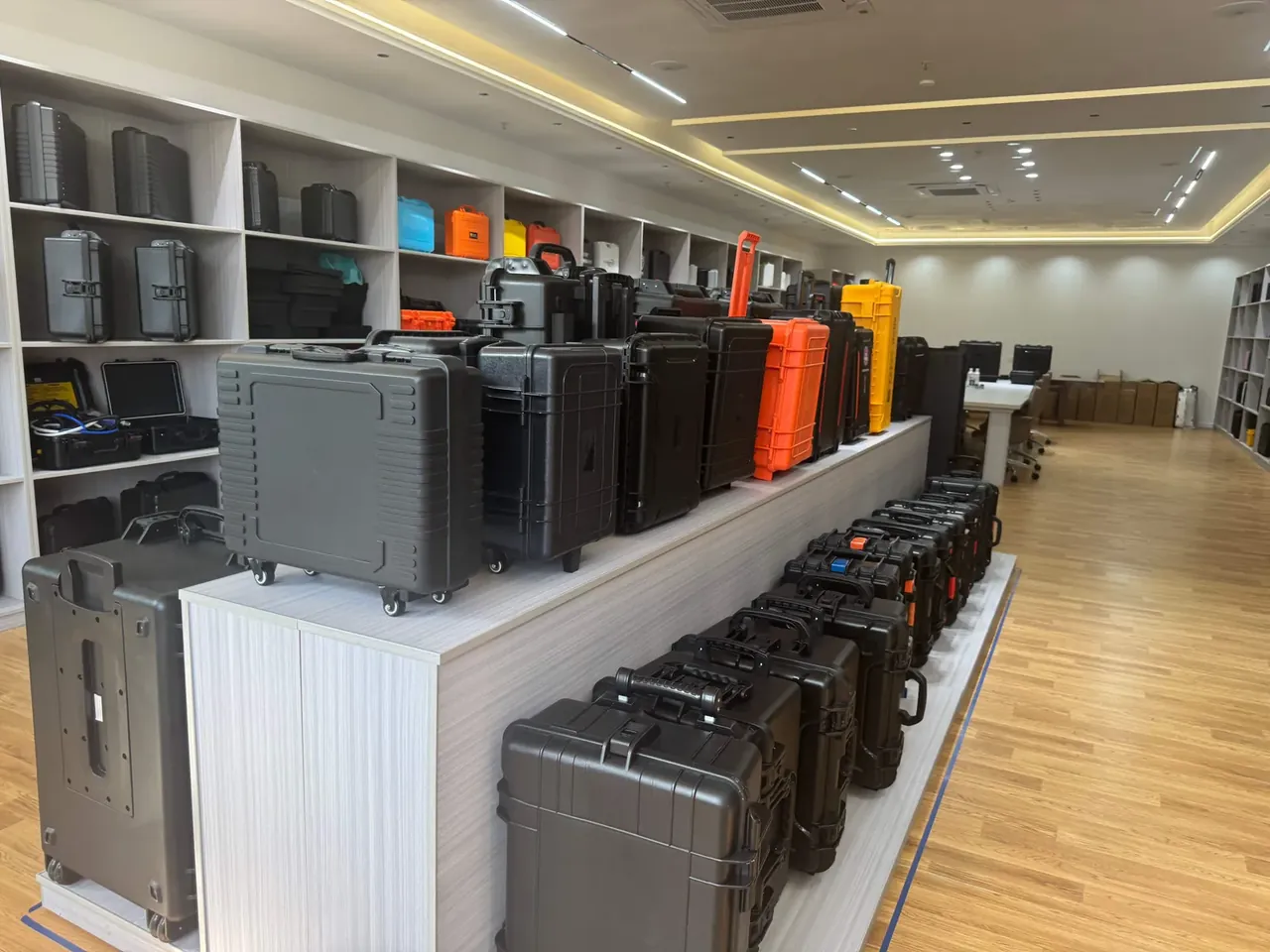
Quick answer: A Military Firearm Storage Box works in four settings: depot storage, vehicle transit, range rotation and issue handover. Configuration follows three readings: openings per day, hours in transit, and how load arrives.
Table of contents
- Four Application Families
- Depot Storage and Shelf Planning
- Vehicle Transit and Temperature Margin
- Range Rotation and Reset
- Issue Handover Units and Labels
- FAQ
1. Four Application Families
The settings divide into depot storage, vehicle transit, range rotation and issue handover. Read three numbers off the setting: openings per day, hours in transit, and how the load arrives. Openings per day size the latches; transit hours decide whether sealing is needed; the load path sets wall thickness and ribs.
The same Military Firearm Storage Box becomes a different product in each setting. Depot units want identical outer dimensions so a shelf row lines up. Vehicle units want stiff corners so straps can be tensioned. Range units want a lid that stays open. Issue units want clear sub-units.
| Setting | Openings per day | Transit time | Load path | Configuration focus |
|---|---|---|---|---|
| Depot storage | 1 to 2 | none | shelf stacking | uniform size, locating step |
| Vehicle transit | 3 to 4 | 6 hours | four-point lashing | lashing points, damping foam |
| Range rotation | 8 to 12 | 2 hours | floor standing | wide lid angle, fast pockets |
| Issue handover | 1 to 3 | 1 hour | pallet stacking | sub-units, label field |
Read it backwards: load path, latch grade, labels.
2. Depot Storage and Shelf Planning
In a depot, a Military Firearm Storage Box answers where one unit sits and how many fit on a shelf. A 450 mm shelf pitch takes six 1200 mm class units per level, five levels make a 30 unit block, and the bottom level sits 150 mm off the floor so ground moisture never reaches the base. Aisles run 1200 mm clear, plus 300 mm at the main run for a trolley.
Uniform outer height pays for itself in a Military Firearm Storage Box block. Hold the spread within 10 mm and the pitch can follow the tallest unit plus 40 mm; mixed heights force the pitch up and the waste repeats.
3. Vehicle Transit and Temperature Margin
Transit is a lashing problem first. Four points, anchored 80 mm above the base, strap breaking strength 2.5 kN, and no visible movement once tensioned. A single anchor lets a Military Firearm Storage Box rotate about that point under braking, while four corners keep it square.
Cabin temperature is the second variable. A closed van reaches 55 Celsius in summer, so foam softening below 60 Celsius sags its pockets after six hours on the road. Check the pressure valve at that temperature, or differential pressure pushes the gasket out.
| Fixing method | Carrier | Key figures | Watch point |
|---|---|---|---|
| Four-point lashing | box van, shelter | 2.5 kN strap, 80 mm above base | never strap over the lid |
| Pallet stacking | flatbed, air pallet | 4 units per pallet, 3 tiers max | stretch film against slip |
| Carrying by hand | foot move, shuttle | 12 kg loaded ceiling | handle load centred |
4. Range Rotation and Reset
Range work is high frequency. Eight to twelve openings a day means lid angle matters: at 105 degrees the lid rests open and one hand can load, while below 95 degrees it falls back and costs a hand.
Reset speed decides throughput. Foam comes out for counting and must drop back without hunting, so pockets run in sequence and numbers print on the pocket wall rather than the case floor. Numbering on the floor forces the operator to lift the insert.
A floor-standing body needs a wear layer that survives 200 drags over gravel without fuzzing.
5. Issue Handover Units and Labels
Issue handover runs on Military Firearm Storage Box pallets. Four units to a pallet sized to the vehicle width, twelve units per forklift trip. The label field is 40 by 20 mm on the upper right of the lid face, matched one to one with the case number, so a scan never needs the case turned over.
Counting is time-boxed: 15 seconds per unit, about a minute for a four unit pallet. Signing by pallet removes double counting while the numbers stay consecutive; one gap sends the check back to unit by unit. Status shares the same field: serviceable, awaiting inspection and sealed in three colours, so a Military Firearm Storage Box block reads at a glance.
Conclusion
Four settings cover most use: depot, vehicle, range and issue, and the differences come down to openings per day, hours in transit and load path. Shelving serves the depot, anchors and temperature margin serve transit, lid angle serves the range, pallets and labels serve handover. Configured this way, a Military Firearm Storage Box earns its keep in daily rotation.
This article discusses only the container (case body) side of specifications and design intent, and does not cover any handling, loading or use of the contents.
Related Reading
- military-firearm-storage-case-comparison
- military-firearm-storage-case-procurement
- Configuring a firearm storage case for transit
- military-firearm-storage-case-standards
Related Products
- 8 Series — Gun Cases; Military Equipment Cases; Camera Equipment Cases; Drone Cases; Watch Cases; Knife Cases; First Aid Cases; Electronics Equipment Cases
- WL8-2812 PP Gun Case — model WL8-2812
- All protective cases and toolboxes: 7 series, 158 models