

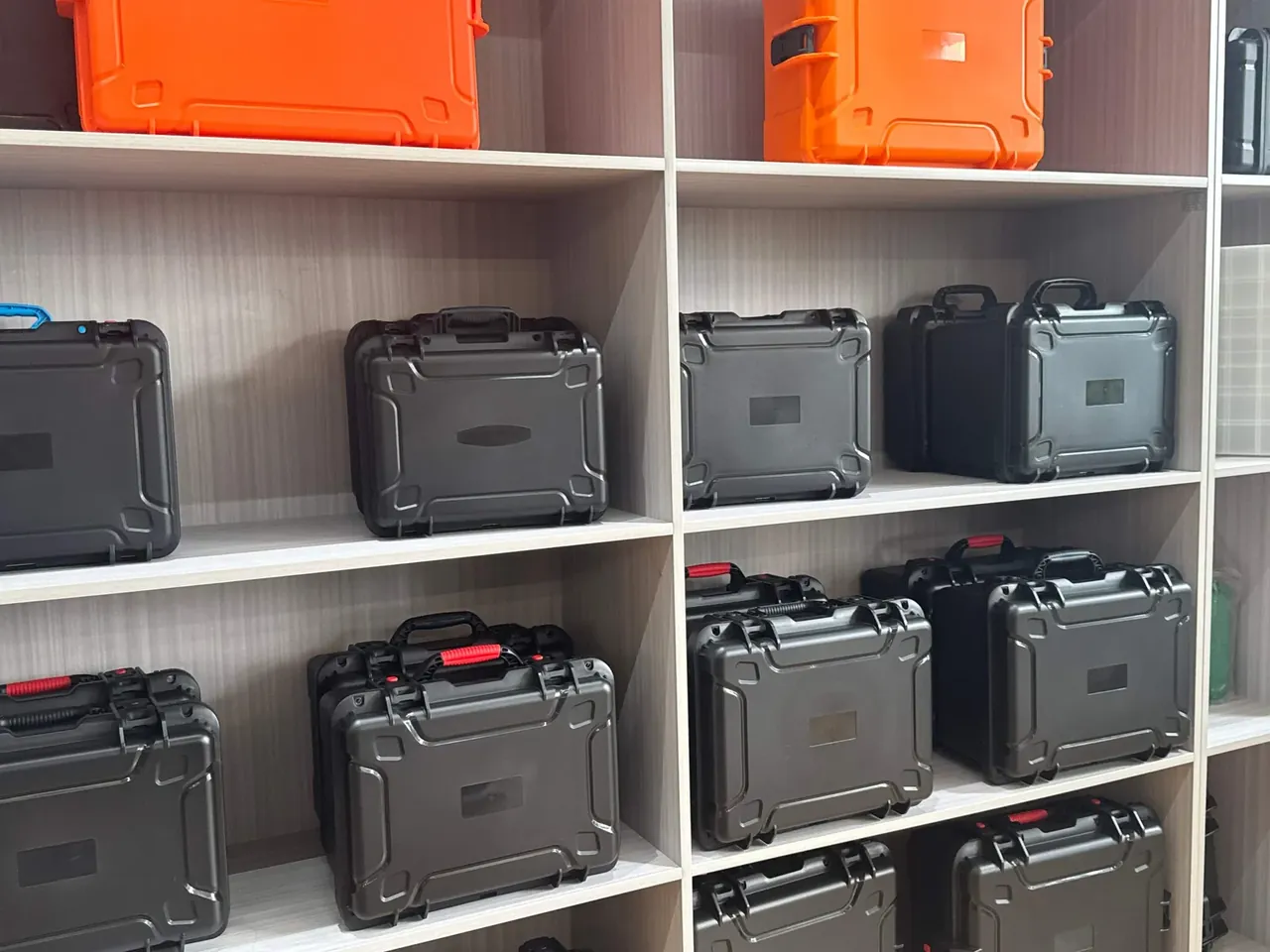
Quick answer: Set a military firearm storage case beside a steel cabinet, an aluminium flight case and a plywood crate and four gaps appear: wall against weight, sealing by structure versus gasket, hardware replaceable singly, and replacements in five years. The first three set the price; the fourth sets the cost.
Table of contents
- Where a Military Firearm Storage Case Sits Among Four Options
- Wall Thickness, Shell Material and Weight
- Sealing and Drop Performance
- Service Life, Repair and Whole-Life Cost
- When an Alternative Is the Better Buy
- FAQ
1. Where a Military Firearm Storage Case Sits Among Four Options
Separate the intended use before comparing numbers. A steel cabinet is a fixture, never moved. An aluminium flight case is light-duty, built around weight. A plywood crate is a consumable for a single trip. A military firearm storage case is movable storage: it stacks, seals and opens again and again.
| Option | Wall | Empty weight | Rated cycles |
|---|---|---|---|
| Military firearm storage case | 4.5 mm | 9.2 kg | 3000 |
| Steel cabinet | 1.2 mm | 26 kg | not moved |
| Aluminium flight case | 1.5 mm | 5.4 kg | 800 |
| Plywood crate | 9 mm | 7.1 kg | single trip |
The cycle column explains most of the price gap. The case costs more per unit than a crate, yet across 3000 openings its cost per opening is the lowest of the four.
2. Wall Thickness, Shell Material and Weight
Rotomoulded polyethylene at 4.5 mm forms one continuous shell with no weld, which is how it holds rigidity at 9.2 kg. Steel goes another way: 1.2 mm cold-rolled sheet, rigid by geometry at 26 kg.
Aluminium is lightest at 5.4 kg, and the price is 60 rivets: one knock loosens a hole and the slack spreads.
3. Sealing and Drop Performance
Sealing is about structure pressing the gasket to the right compression, not soft rubber. A moulded channel and lid rib meet at roughly 30%, and a permanent set of 25% marks the replacement point.
Drop testing separates them fastest. After a 1.2 m drop on six faces, a rotomoulded shell springs back while 1.2 mm steel keeps a dent of about 8 mm, and a dent on the door seam puts the bolt out of line.
| Item | Storage case | Steel cabinet | Flight case |
|---|---|---|---|
| Sealing failure | gasket ageing | frame distortion | lost flatness |
| After 1.2 m drop | recovers | 8 mm dent | corners deform |
| Hardware repair | single parts | door removal | rivets not serviceable |
| Stacking levels | 5 | not stackable | 2 |
Stacking depth is often a selling point, yet five levels only work with continuous ribs in the base; without them the shell bellies out.
4. Service Life, Repair and Whole-Life Cost
Repairability separates them most. Latches and hinges on a military firearm storage case are single parts: one screwdriver at 2.5 N·m swaps a pair in 15 minutes, while a cabinet needs its door plate off.
Over five years the purchase price is only the first line: a crate is replaced twice and a cabinet needs two touch-ups. Whole-life cost lands near 0.6 times that of the crate, against a purchase price 3.4 times higher.
| Cost item | Storage case | Steel cabinet | Plywood crate |
|---|---|---|---|
| Purchase index | 3.4 | 2.8 | 1.0 |
| Replacements in 5 years | 0 | 0 | 2 |
| Cost per opening index | 1.0 | not applicable | 5.2 |
The table is easy to misread as expensive equals better. At low volume the opposite holds: below 200 openings the case costs more, because reuse is what spreads its advantage.
5. When an Alternative Is the Better Buy
For a fixed room and a tight budget, a steel cabinet is the simplest answer: rigid by geometry, no sealing design, no gasket to age, at the cost of never being movable.
For air freight, an aluminium flight case wins, since 5.4 kg converts into freight charges. For a single trip plywood is cheapest, a job a military firearm storage case does not fit.
| Condition | Better option | Reason |
|---|---|---|
| Fixed room, no movement | steel cabinet | rigid, no sealing |
| Air freight | flight case | 5.4 kg, lower freight |
| Single trip | plywood crate | cheap, no return |
| Repeated handling | storage case | sealed, serviceable |
Conclusion
The four differ in premise, not quality: the cabinet assumes it never moves, the flight case a light load, the crate one trip, and the military firearm storage case repeated handling and sealing. Put the cycle count into the comparison and the choice becomes arithmetic, the only fair judge of a military firearm storage case.
This article discusses only the container (case body) side of specifications and design intent, and does not cover any handling, loading or use of the contents.
Related Reading
- How to set selection criteria for a military firearm case
- Rotomoulded versus injection moulded case bodies
- Where aluminium flight cases stop being suitable
- Specifications and load ratings for steel weapon cabinets
Related Products
- 8 Series — Gun Cases; Military Equipment Cases; Camera Equipment Cases; Drone Cases; Watch Cases; Knife Cases; First Aid Cases; Electronics Equipment Cases
- WL8-2812 PP Gun Case — model WL8-2812
- All protective cases and toolboxes: 7 series, 158 models